
The belief that a PhD can be “repurposed” into clinical authority is one of the most dangerous myths in modern healthcare careers.
If you have a PhD and you’re thinking, “I’ll just pivot into clinical work,” you’re already standing near several trapdoors. Some lead to wasted years. Some to legal problems. A few to serious patient safety issues.
I’m not here to talk you out of working closer to patients. I’m here to keep you from making the expensive, reputation-killing mistakes I’ve watched other PhDs make.
Let’s walk through the big ones.
1. Confusing “Clinical Setting” With “Clinical Practice”
The first and most fundamental mistake: thinking that working in a clinic is the same as doing clinical work.
You can absolutely use your PhD in:
- Clinical research units
- Outcomes or health services research
- Quality improvement teams
- Hospital-based data science / informatics
- Clinical trials offices
But that does not mean you’re doing what MDs/DOs/NPs/PAs do.
Clinical practice = direct responsibility for diagnosis, treatment, prescribing, and medical decision-making for patients. That requires licensure and specific training. Your PhD, no matter how impressive, does not substitute.
The misstep looks like this:
- A PhD neuroscientist takes a job in a memory disorders clinic as a “cognitive researcher”
- The clinic starts introducing her to patients as “Dr. Jones from our memory clinic team”
- Patients assume “doctor” = physician
- She starts “recommending” supplements or explaining imaging results “informally”
- One day, a patient acts on that advice instead of the neurologist’s plan
That’s how you drift from “research in a clinical environment” into “unlicensed clinical practice.” It starts with small, casual boundary crossings.
What to do instead:
- Be crystal clear about your role from day one
- Use specific language with patients: “I’m Dr. Smith, but I’m a PhD researcher, not a medical doctor. I focus on the research side, not on your medical care.”
- Push back when marketing or leadership blurs the lines in flyers, websites, or introductions
- Document your role in your job description: research, education, maybe protocol design — not independent patient care
If the job pitch sounds like: “You’ll basically function like a clinician but with your PhD background” — that’s a giant red flag.
2. Underestimating Licensure, Scope, and Legal Risk
The fastest way to ruin your career pivot is to wander into activities that look like medical practice without a license.
Do not assume:
- “Supervised by a physician” = you can act as a quasi-clinician
- “Multidisciplinary team” = shared scope
- “Institutional support” = legal protection
I’ve seen this play out in clinical trials units and private “integrative medicine” clinics:
- PhD gives individualized supplement or medication suggestions
- Reviews and comments on lab results for a specific patient
- “Adjusts” protocol for a participant because “the evidence supports it”
Each of these can cross into the legal definition of medical practice, depending on jurisdiction.
| Activity | Usually Safe for PhDs? | Risk Level |
|---|---|---|
| Explaining study procedures | Yes | Low |
| Teaching general disease concepts | Yes | Low |
| Interpreting *individual* labs | No | High |
| Suggesting meds/supplements | No | Very High |
| Adjusting treatment plans | No | Extreme |
How to stay out of trouble:
- Learn your state/country’s definition of “practicing medicine” or “practicing psychology”
- Get written clarification from compliance / legal about your scope
- Never document in the clinical chart as if you’re making medical decisions
- Avoid phrases like “I recommend you…” when speaking to patients about their care
If you want legal authority to treat, diagnose, and prescribe? Stop looking for shortcuts. That’s an MD/DO/NP/PA/clinical psych training question, not a job-description problem.
3. Overvaluing Your PhD and Undervaluing Clinical Apprenticeship
Another painful mistake: assuming that because you can design RCTs and interpret complex statistics, you’re halfway to being a clinician.
You’re not.
A strong PhD gives you:
- Deep understanding of methodology and evidence
- Rigor in thinking and skepticism about low-quality data
- Advanced analytical and communication skills
What it does not give you:
- Pattern recognition built from thousands of patient encounters
- Real-time triage judgment when someone is crashing in front of you
- Procedural skills and muscle memory
- Experience handling uncertainty when no RCT exists
Clinical expertise isn’t just “applied science.” It’s apprenticeship, repetition, and feedback under pressure. You can’t think your way into it alone.
Typical overreach behaviors to avoid:
- Arguing with clinicians on rounding decisions based solely on trial data, ignoring patient context
- Positioning yourself as the “evidence guru” who corrects everyone without understanding real-world constraints
- Suggesting clinical pathways that are logistically or ethically impossible outside the trial bubble
You’ll gain far more respect (and responsibility) by saying:
- “Here’s what high-quality evidence suggests.”
- “Here’s the limitation — we don’t know in patients like this.”
- “You see these patients all day — how would that actually work?”
The mistake is not having strong opinions. The mistake is assuming your PhD expertise trumps clinical judgment built over thousands of hours of direct care.
4. Pursuing the Wrong Additional Credentials (Or None at All)
If you truly want a clinical pivot — meaning you want to see patients as a licensed provider — you cannot avoid formal clinical training.
Too many PhDs burn years on half-steps that never get them what they really want:
- A random “clinical certificate” with no licensure path
- Short online programs in “functional medicine” or “health coaching” marketed as “clinician-level”
- Vaguely described “doctor of integrative health” degrees from unaccredited schools
You end up with more letters after your name, the same legal limitations, and more confusion about what you’re actually allowed to do.
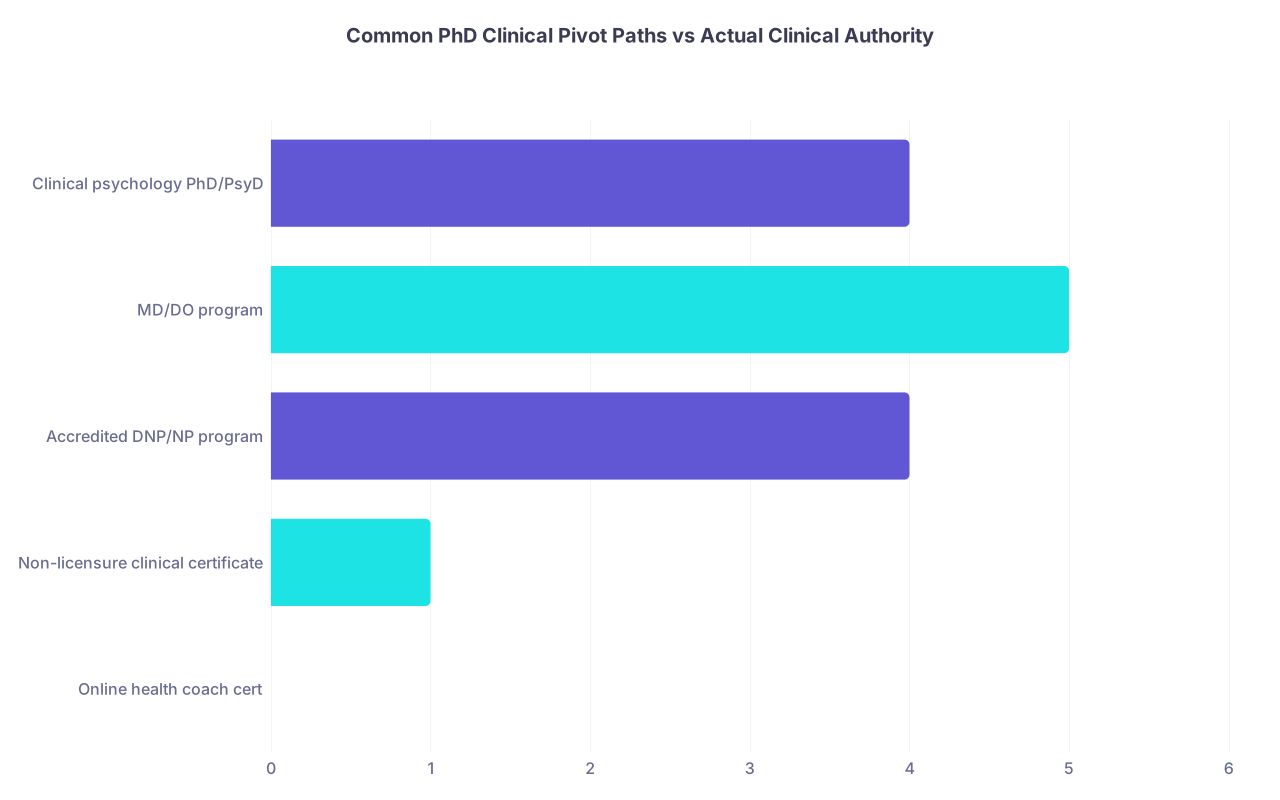
| Category | Value |
|---|---|
| Online health coach cert | 0 |
| Non-licensure clinical certificate | 1 |
| Accredited DNP/NP program | 4 |
| MD/DO program | 5 |
| Clinical psychology PhD/PsyD | 4 |
(Scale: 0 = essentially no independent clinical authority, 5 = full clinical authority within scope.)
Don’t make these two specific mistakes:
Treating accreditation as a footnote.
If the program doesn’t lead to a recognized license (NP, PA, MD/DO, psychologist, etc.), it’s usually a dead end for real clinical practice.Ignoring prerequisites and competitiveness.
You can’t “slide into” an MD or NP program just because you have a PhD. You still need required coursework, clinical exposure, and competitive scores.
If your goal is:
- Full-spectrum medical care → MD or DO
- Focused mental health clinical work → Clinical psychology PhD/PsyD with licensure, or LCSW, or psychiatric NP
- Primary care-style work with nursing model → NP (DNP/MSN)
- Collaborative medicine within a defined scope → PA
Anything else may keep you near patients, but not as a clinician.
5. Misreading How Clinical Culture Sees You
Another subtle but damaging error: assuming your PhD automatically grants status in clinical spaces.
Clinical culture is hierarchy-heavy and experience-aware. I’ve watched brilliant PhDs walk into a ward and:
- Correct a resident mid-presentation based on a paper they skimmed this morning
- Question an attending’s decision in front of the whole team without context
- Use acronyms and jargon from their research world that mean something totally different in the hospital
They’re not bad people. They just don’t realize they’re trampling on unwritten rules.
If you want real influence near patient care, avoid these cultural missteps:
Acting like your time is more valuable.
“I don’t have time to sit on rounds; I’ll just ‘consult’ when you need me” sends a strong signal. Not the one you want.Talking down to nurses or allied health staff.
Massive mistake. They see more of the patient than most physicians do. They’ll also be the first to notice if you’re outside your lane.Treating clinical documentation as trivial.
Clinical notes and orders are their own craft and legal record, not an afterthought. Your ability to write a flawless manuscript does not translate automatically.
The PhDs who integrate well:
- Show up consistently to clinical meetings and rounds
- Ask genuine questions about workflow before proposing changes
- Offer to teach and listen in equal measure
Your research track record can open doors. Your humility will determine whether you stay in the room.
6. Ignoring Burnout, Identity, and Timeline Reality
Let me be blunt: a serious pivot into true clinical practice as a PhD is a multi-year project that can wreck your finances and family life if you do it impulsively.
Common self-sabotaging patterns:
Using clinical dreams to escape academic misery.
“My PI is toxic and grants are miserable; I’ll become a clinician instead.” So you trade one brutal system for another, without thinking carefully about fit.Pretending you can “just” add an MD or NP on top.
You’re already mid-career. You have commitments. Medical training will not politely work around them.Underestimating emotional load.
You might love pathophysiology. That doesn’t mean you’re ready for telling families their child died, every third night on call.
Before any big move, you owe yourself a hard look at:
- Timeline: How many years of training are you realistically willing to do?
- Debt: How much new debt are you prepared to take on?
- Lifestyle: Are you okay with nights, weekends, and holidays on call?
- Identity: Will you be satisfied doing less research and more routine clinical work? Many aren’t.
A useful reality check is to map your path explicitly.
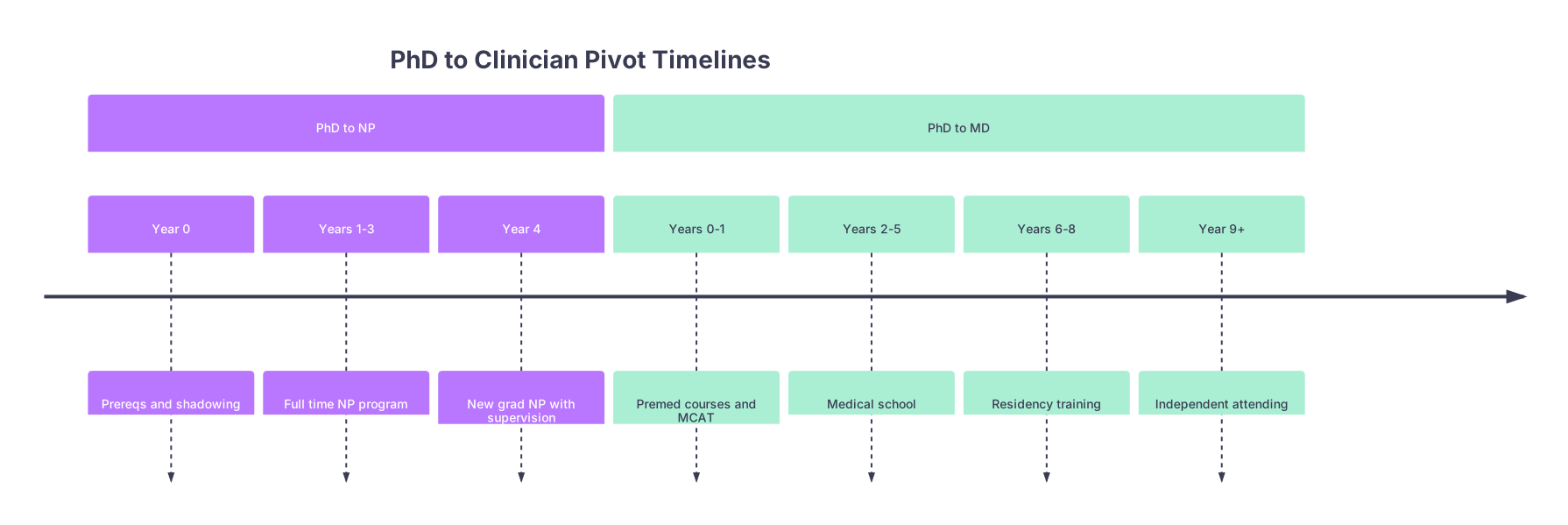
| Period | Event |
|---|---|
| PhD to NP - Year 0 | Prereqs and shadowing |
| PhD to NP - Years 1-3 | Full time NP program |
| PhD to NP - Year 4 | New grad NP with supervision |
| PhD to MD - Years 0-1 | Premed courses and MCAT |
| PhD to MD - Years 2-5 | Medical school |
| PhD to MD - Years 6-8 | Residency training |
| PhD to MD - Year 9+ | Independent attending |
If your stomach drops reading that, good. Better now than after you’ve quit your job and started organic chemistry again.
7. Failing to Clarify the “Clinical Adjacent” Sweet Spot
Not everyone needs or wants full clinical licensure. The mistake is binary thinking: “Either I become an MD, or my PhD is wasted if I care about patients.”
That’s nonsense. There’s a powerful middle lane: clinical-adjacent roles where your PhD is a genuine asset and your risk of scope creep is manageable — if you’re clear.
Examples:
- Clinical trials leadership: PI or co-PI on investigator-initiated or industry-sponsored trials
- Health outcomes / implementation scientist embedded in service lines
- Clinical informatics / data science roles designing tools clinicians actually use
- Patient-centered outcomes research working directly with patient advisory boards
- Quality improvement leadership partnering with clinical chiefs
The mistake here is vagueness. If you just say, “I want a more patient-facing role,” you’ll end up:
- Overpromising in interviews
- Underperforming expectations
- Constantly feeling like you’re “not allowed” to do what you were hired for
Instead, define very clearly:
- What you will do with patients (e.g., consent, education, survey administration, observational interviewing)
- What you won’t do (no individualized treatment advice, no independent interpretation of tests, no chart orders)
- How you’ll add value (stats, trial design, outcomes analysis, evidence synthesis, patient education materials)
Write this down. Use it when you negotiate your job description. Update it as you grow.
8. Neglecting Communication and Title Clarity With Patients
Even if you stay carefully inside the legal lines, you can still mislead patients without meaning to. That’s another big mistake.
If you’re “Dr. X” and you’re sitting in an exam room wearing a white coat, patients will assume you’re a physician unless you explicitly say otherwise.
I’ve had patients tell me:
- “I saw two doctors from your team, the one who didn’t prescribe anything and the one who changed my meds.”
The first was a PhD researcher. The second an MD. The patient had no idea there was a difference.
That’s not fair to the patient or to you.
Concrete steps to avoid this:
- Wear a badge that clearly says: “Research Scientist – PhD” or “Clinical Psychologist” if appropriately licensed
- Start every patient interaction with a clear intro:
“I’m Dr. Lee, but I’m a PhD researcher. I don’t prescribe medications or make treatment decisions — I focus on the research and education side.” - Correct staff when they introduce you incorrectly:
“Just to clarify, I’m not a medical doctor; I’m a PhD psychologist focusing on research.”
Do not let “everyone here just calls you Dr. X, it’s easier” slide. That “easier” now becomes “confusing” and potentially “actionable” later.
9. Building Your Pivot Without Real Clinical Exposure
Last big misstep: trying to design your entire pivot in your head, from your office or lab, without actually spending extended time in clinical environments.
Reading case reports is not the same as:
- Standing in an ICU at 3 a.m.
- Watching a resident manage 15 new admissions on a weekend
- Sitting with a family after a bad prognosis meeting
I’ve seen PhDs spend a year on MCAT prep before ever shadowing an outpatient clinic. That’s backwards.
Before you sign up for anything major:
- Shadow in several settings: inpatient, outpatient, emergency, mental health, primary care
- Talk to people 10+ years out of training, not just residents or students in the honeymoon or burnout phases
- Ask clinicians: “What do you wish you had known before starting?”
- Ask yourself honestly: “Do I want their actual day, or the idea of their day?”
That experiential reality testing will either:
- Confirm your direction and energize you; or
- Convince you to pivot to a different, saner role where your PhD still shines
Either outcome saves you from the worst mistake of all: building your future on a fantasy.
FAQ (Exactly 4 Questions)
1. Can I use my PhD to waive parts of MD/DO or NP training?
No. Medical and advanced practice nursing curricula are tightly regulated. Programs might value your research background (especially for MD/PhD-style tracks or academic careers), but they do not cut out clinical rotations or core training because you already hold a PhD. At best, you might test out of some basic science content or be allowed research electives. You will not skip the painful, hands-on parts.
2. Is it legal to call myself “doctor” in a clinic if I’m not a physician?
It depends heavily on your jurisdiction, and in some U.S. states it’s becoming increasingly restricted. Even where it’s legal in principle for non-physician doctorates to use “doctor,” you can still get into trouble if patients are misled. The safe approach: always pair “doctor” with your degree type and role (“I’m Dr. Patel, a PhD research psychologist, not a medical doctor”) and check your institution’s policies and state law. When in doubt, err on the side of over-clarifying.
3. If I stay in research, how close can I safely get to patient care?
Very close — as long as you’re disciplined about scope. You can consent patients to studies, conduct structured interviews, collect research data, administer surveys, explain study purposes, and provide general disease education written by the clinical team. What you must avoid is individualized diagnosis, interpreting tests for a specific patient, suggesting treatment changes, or documenting medical plans. Always get explicit scope guidance from your institution.
4. How do I know if I should pursue full clinical training or stay clinical-adjacent?
Ask yourself three blunt questions:
- Am I willing to commit 3–9+ years of structured training and potential debt?
- Do I want the responsibility — and emotional burden — of direct medical decision-making for individual patients?
- If all research disappeared from my job and most of my day was patient care, would I still be satisfied?
If you hesitate on any of those, you’re probably better off designing a high-impact, clinical-adjacent career that uses your PhD fully without forcing you into a role you’ll regret.
Key Takeaways
- Your PhD is powerful, but it’s not a shortcut to clinical practice or licensure.
- The biggest dangers are scope creep, title confusion, and pursuing the wrong extra credentials.
- If you want true clinical work, plan for real training; if you don’t, design a clear, clinical-adjacent role and guard your boundaries ruthlessly.