

No, you are not “lucky” just to get an offer. The data says the opposite: most U.S. physicians are in shortage positions, and employers are competing for you—whether they act like it or not.
Let me be blunt. The “you should just be grateful” line you hear from administrators, older attendings, and sometimes even co-residents is not wisdom. It’s a control tactic. It keeps you from negotiating. It keeps you from walking away from bad deals. And it’s quietly costing physicians hundreds of thousands of dollars and a lot of sanity.
You’re not powerless. You’re just systematically taught to feel powerless.
Let’s dismantle that.
The Myth of “You’re Lucky to Have Any Offer”
The story you’ve been fed:
- Jobs are scarce.
- Everyone is replaceable.
- New grads “don’t have leverage.”
- Negotiating is ungrateful and risky.
This story is convenient—for employers.
Here’s what the data actually shows.
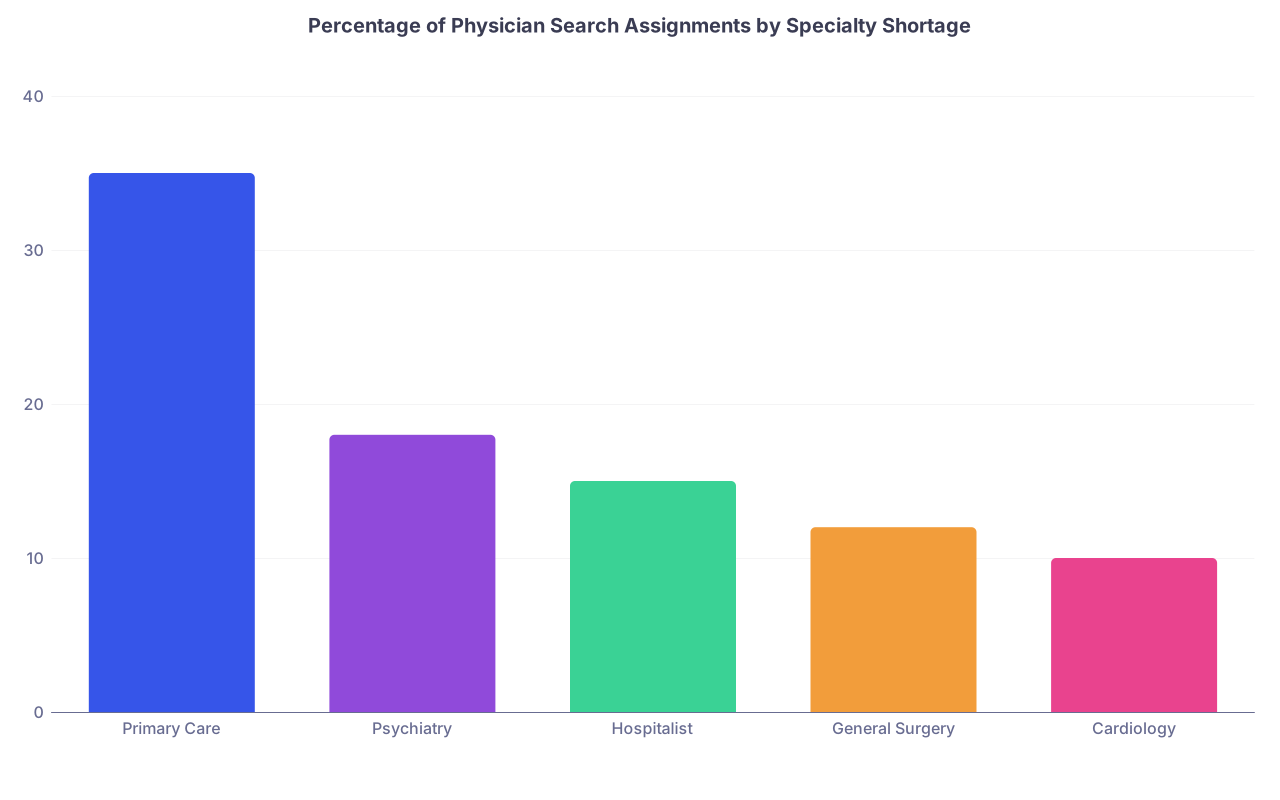
| Category | Value |
|---|---|
| Primary Care | 35 |
| Psychiatry | 18 |
| Hospitalist | 15 |
| General Surgery | 12 |
| Cardiology | 10 |
That bar chart looks abstract, so let’s translate.
Multiple annual reports from major physician recruiting firms (Merritt Hawkins, AMN, etc.) have shown for years:
- Primary care, hospitalists, psychiatry, and many core specialties are aggressively recruited.
- 90%+ of their search engagements are employer-initiated, not physician-initiated. That means hospitals and groups hire them to find you, not the other way around.
- Many searches last months to over a year because they cannot find enough candidates willing to take the terms.
You’re not a lottery winner who happened into an offer. You’re the product in a market with constrained supply and strong demand.
But healthcare employers are not stupid. They know one thing that absolutely works in their favor: physicians are deeply conditioned to:
- Avoid conflict
- Overestimate risk to their career
- Underestimate their own value
- Feel indebted to institutions
That conditioning—built across premed, medical school, residency, and fellowship—is why the “I’m just lucky they want me” myth lands so well. It hits all the old wiring.
What the Power Dynamics Actually Look Like
Let’s strip this to basics.
Power in a negotiation is not vibes. It comes from specific, measurable things:
- How many reasonable alternatives you have (and how fast).
- How costly it is for them if you walk away.
- How replaceable you are in that local market.
- Who is more time-pressured.
- Who has better information.
You’re told employers hold all of those. They don’t.
1. Alternatives: You Probably Have More Than You Think
Here’s the quiet part employers won’t tell you: their alternatives are often worse than yours.
Your alternatives:
- Take another offer (maybe in a slightly different location or setting).
- Do locums for 6–12 months while you shop around.
- Stay where you are short-term (moonlighting, PRN, telehealth, etc.) while you search.
- Pivot geography or practice type.
Their alternatives:
- Re-open a 6–12 month search.
- Pay locums at a premium.
- Lose revenue and patient volume (which hurts them with systems, payors, and regulators).
- Risk burnout and departure of existing staff covering your vacancy.
I’ve seen a rural hospital swallow $400k+ in locums costs in a year because they couldn’t land a full-time FM doc. But that same hospital told a candidate, “We can’t possibly move on the signing bonus; we have lots of interested applicants.” Sure.
2. Vacancy Pain: How Badly They Need You
Hospitals and large groups often downplay how painful a vacancy is, but you can piece it together.
Red flags they’re hurting:
- Recruiters contacting you repeatedly with “updated” offers.
- They’re flexible on start date, schedule, or call coverage if you hint at concerns.
- They want you to sign quickly “before the position fills.”
- They bring in multiple admins to your visit—COO, CMO, service line director—because that vacancy is visible on their dashboards.
If they’re flying you in, putting you up, feeding you, and parading leadership through the interview? That’s investment. They’re not doing that for fun. They’re doing it because unfilled FTEs hurt.
3. Replaceability: Most Specialties Are Not Plug-and-Play
Physician supply is not like hiring nurses or MAs (and even those markets are tight). You’re licensure-dependent, credentialing-dependent, onboarding-dependent, and often specialty- or personality-dependent for that community.
And geography matters. In a big coastal city with desirable lifestyle and a loaded specialty (like derm or ophtho), yes, your leverage is lower. In most of the rest of the country? It’s the opposite.
Look at what employers are actually doing:
- Offering six-figure signing bonuses in many regions.
- Loan repayment, relocation, residency stipends.
- Tolerating months of locums at eye-watering rates just to keep doors open.
Nobody spends that kind of money for a “commodity” that’s easy to replace.

The Psychological Trap: Why Doctors Hand Away Leverage
If this were just about market stats, physicians would negotiate like tech engineers. But you don’t. Here’s why.
You Were Socialized to Be Grateful, Not Powerful
From day one:
- Grateful to be admitted.
- Grateful to match.
- Grateful for “the opportunity to learn,” even when it’s exploitative.
- Grateful to be allowed into an attending job.
Gratitude is nice in life. It is poison in negotiations when it blinds you to value.
Employers know this. I’ve heard admin literally coach recruiters with lines like:
- “Remind them we’re taking a chance on a new grad.”
- “Emphasize how competitive this area is.”
- “Make sure they understand how much we’ve invested in this position.”
This is positioning. It’s designed to shift the emotional frame from “my value on the market” to “their generosity toward me.”
Fear of Being “Difficult”
The next trap: you’re terrified of getting labeled as “high maintenance,” “entitled,” or “not a team player.” The profession bakes this fear in early.
So you:
- Don’t ask for clarification on restrictive covenants.
- Don’t push on RVU thresholds that don’t even match MGMA medians.
- Don’t question call expectations that would destroy your life.
And then you tell yourself, “I’m just lucky to have something.”
What’s actually happening is this: you’re preemptively surrendering to avoid imagined reputational damage. Meanwhile, the hospital negotiates hard with payors, vendors, and everyone else. No one calls them ungrateful.
What the Data Shows: Negotiating Works (And Is Normal)
There’s this fantasy that if you negotiate, they’ll yank the offer and blacklist you. That fear is wildly out of proportion to reality.
Here’s what actually happens when physicians negotiate, based on survey data and countless real contracts I’ve seen:
Most offers have slack. Salary bands, bonus pools, relocation, CME, signing bonus, schedule, and call are often negotiable.
Contracts change. Not always on money, but very often on:
- Non-compete radius or duration
- Call requirements
- RVU thresholds
- Termination notice
- Tail coverage
Pulling an offer is rare. It happens. But usually:
- When a physician is wildly unrealistic and disrespectful.
- When the employer was never that serious or has a backup already lined up.
- Or the employer shows you their true colors—a blessing in disguise.
Let me show you the difference a modest negotiation can make.
| Item | Original Offer | Negotiated | 5-Year Difference |
|---|---|---|---|
| Base Salary | $250,000 | $270,000 | +$100,000 |
| Signing Bonus | $20,000 | $40,000 | +$20,000 |
| CME/Business Expense | $3,000/year | $5,000 | +$10,000 |
| Tail Coverage | Physician pays | Employer | +$40,000–$80,000 |
| Total | — | — | ~$170k–210k |
That’s with very normal, not aggressive, adjustments. Not “give me $500k or I walk.” Just a new grad asking, “Can we get closer to market medians, and can you cover tail?”
Over a full career—if you stack early negotiations plus later raises and retention offers—you’re talking seven-figure differences. From not acting like you’re lucky to be in the room.
Tactics That Actually Shift Power Back to You
You don’t fix the power imbalance by just “being confident.” You fix it by changing the structure of the situation.
1. Get Multiple Irons in the Fire—Early
Nothing increases leverage like being able to say, truthfully:
“I’m considering two other opportunities and expect offers in the next 2–3 weeks.”
You do not have to be coy about this. Employers do it constantly: “We’re interviewing several candidates.” Same game.
That means:
- Start exploring jobs months before you think you “need” to.
- Respond to recruiters selectively but keep a few discussions alive.
- Do not stop looking because you think one offer will work out.
2. Separate Gratitude From Business
You can be polite and firm. For example:
“Thank you for the offer and for the visit—everyone was welcoming, and I really enjoyed meeting the team. I’d like to review a few key contract terms so we can see if this is the right long-term fit.”
Two truths can exist:
- You’re appreciative of the opportunity.
- You’re not signing a document that underpays you or boxes you in.
3. Use Their Pain Points—Respectfully
If they’ve:
- Been recruiting for a year,
- Are using locums,
- Or clearly have growth ambitions they keep talking about,
you can leverage that. Not by threatening. By aligning.
Example:
“I understand you’ve been looking to expand this service line and that coverage has been challenging. If we can get to X on base and Y on call structure, I can commit to a long-term presence here and help you grow this program.”
You’re not begging for generosity. You’re tying your ask directly to their goals.
4. Lawyer Up (The Right Way)
No, your buddy who’s a divorce attorney cannot “just glance” at your contract. Physician employment agreements are their own ecosystem: RVUs, non-competes, tail coverage, Stark/AKS issues, partnership tracks.
A real physician contract attorney does three big things for you:
- Spots ugly clauses you’re underestimating (especially non-compete and termination language).
- Translates vague or misleading compensation models into real numbers.
- Gives you scripts and structure for the counteroffer.
You’re not “making it adversarial” by getting counsel. You’re informing yourself. The hospital already has lawyers. You’re just closing the information gap.

| Step | Description |
|---|---|
| Step 1 | Receive Offer |
| Step 2 | Attorney Review |
| Step 3 | Clarify Priorities |
| Step 4 | Prepare Counter Terms |
| Step 5 | Discuss With Recruiter |
| Step 6 | Sign Contract |
| Step 7 | Negotiate Again or Walk |
| Step 8 | Continue Search |
| Step 9 | Revised Offer Acceptable |
5. Be Willing to Walk—At Least Once in Your Life
The nuclear fuel of negotiation power is this: a credible willingness to say “no.”
You don’t have to be reckless. But you should experience, at least once, that:
- You can decline an offer.
- The world does not end.
- Another offer appears.
- Your career does not implode.
Once your nervous system learns this, you stop clinging to bad deals out of fear. You start evaluating jobs on their actual merits instead of, “Well, at least someone wants me.”
Common Manipulation Lines—and How to Translate Them
Let’s decode a few greatest hits you’ll hear.
“We’re offering you the standard contract we give everyone.” → Translation: “We really hope you do not ask us to change this.”
Response: “I understand you have a standard form. There are a few terms I’d need adjusted for this to be workable for me long-term. Are you open to revisions?”
“This is a very competitive market; we have other candidates interested.” → Translation: “We want you to feel rushed and replaceable.”
Response: “I’m glad the position is attracting interest. Given the importance of this decision on both sides, I’ll still need time to review with my attorney and compare with my other opportunities.”
“We don’t usually negotiate with new graduates.” → Translation: “Sometimes they still negotiate and we still change the offer, but we hope you will not.”
Response: “I understand. Even as a new grad, I bring significant training and I want to be sure this is sustainable for both of us. Let’s walk through compensation, call, and the non-compete to see where there’s room.”
“You’re lucky; many people would love to be in your position.” → Translation: “We’re trying to replace your market-based thinking with guilt and scarcity.”
Response: “I am grateful to have options. That’s exactly why I need to make sure this contract reflects a fair market arrangement and supports a stable, long-term relationship.”
Quick Reality Check: Who Actually Depends on Whom?
Just ask yourself:
- If this job vanished tomorrow, could I find another job within 3–12 months that pays my bills?
- If I vanished tomorrow, how long would it take this hospital to fill the vacancy with someone equally qualified?
In many specialties and locations, the answers are:
- You: months.
- Them: a year or more—or never, realistically.
That’s not “you’re lucky to have anything.” That’s shared dependence with a heavy tilt in your favor. The only way you lose that advantage is by pretending you don’t have it.
FAQ (Exactly 3 Questions)
1. Can negotiating really cause an offer to be withdrawn?
Yes, it can—but it’s uncommon. When it happens, it usually reveals one of three things: the employer was never that serious about you, their budget/terms were rigid from the start, or your ask was way outside reality and badly delivered. Normal, respectful negotiation—especially focused on a few key items like salary band, call, and non-compete—almost never leads to a pulled offer. And if a place rescinds an offer just because you asked questions? They’ve done you a favor by showing you how they handle conflict.
2. What if I’m in a hyper-competitive specialty or dream city—do I still have leverage?
You have less leverage, not zero. In crowded markets (ortho in Manhattan, derm in LA), there really may be multiple qualified candidates. That just means you need to be strategic: get more than one offer if possible, consider slightly less “sexy” neighborhoods nearby, and prioritize the few contract terms that matter most. You may not move salary much, but you can often improve non-compete terms, call burden, schedule, or partnership track. And you can always choose a different geography where you are not just “another CV in the pile.”
3. How do I know if what I’m being offered is actually fair?
You do not guess. You compare. Use MGMA or similar benchmarks (often available through your attorney or specialty society), talk to recent grads in similar roles, and have a physician contract lawyer translate RVU or productivity models into realistic expected income. “Standard” does not automatically mean “fair.” You’re signing something that will control your income, freedom to move, and malpractice risk for years. Spending a few hundred to a couple thousand dollars to verify fairness is not a luxury; it is basic self-preservation.
Key points: You’re not lucky to “just get an offer”; in many markets, they’re lucky to have you. Power in physician contract negotiations comes from facts—supply, demand, vacancy cost—not from how grateful you feel. And the physicians who stop acting like supplicants and start acting like professionals at a bargaining table do not get punished; over a career, they get paid.


