

You’re sitting in a cramped back office of a community practice. The waiting room looks half empty. The office manager just mentioned “cash flow has been tight this year.” The senior partner is selling hard: “We really need another doctor; you’ll have so much volume once we get over this hump.”
You like the location. You like the patients. You even like the people.
But your gut is whispering: this place might be in trouble.
You’re about to sign your first attending contract. If this practice goes sideways—loses a key payer contract, the main partner gets sick, they sell to a private equity group, or they just quietly fall apart—your student loans and your life plans do not care. You still need income, malpractice coverage, and a clean record.
This is where risk protection clauses matter. A lot.
Let me walk you through what to demand, what to watch, and how to protect yourself when you knowingly (or half-knowingly) join a struggling practice.
Step 1: Admit the Practice Is High-Risk—and Act Like It
If any of these are true, you are not joining a stable, low-risk group:
- They’ve recently lost multiple physicians.
- They’re openly talking about “keeping the doors open.”
- They’re behind on paying vendors or staff.
- They’re offering you a surprisingly high salary for the market… with vague details on how they’ll sustain it.
- Billing is outsourced to “a guy we’ve always used” with no actual reporting shown to you.
In this situation, you do not negotiate like you’re joining Mayo. You negotiate like you’re lending money to a shaky business—because in a way, you are. Your time and your license are capital.
So your strategy shifts from “maximize comp and sign quickly” to “I’ll join, but only if you take on your fair share of the risk.”
That means:
- You protect your downside (if they implode, you’re not wrecked).
- You limit your lock-in (shorter term, easier exit).
- You do not get stuck with their mistakes (malpractice, billing, clawbacks).
Step 2: Non-Negotiable Protection Clauses to Demand
These are the core “if this place goes south, I’m not ruined” clauses.
1. Tail Coverage Protection – Full, Written, and Clear
Struggling practices cut corners. Tail coverage is one of the first corners.
You want explicit language that:
- The employer pays for malpractice tail coverage if:
- The practice closes, dissolves, sells, or loses its malpractice carrier.
- You’re terminated without cause.
- You leave for “good reason” (more on that later).
You do NOT want some hand-wavy, “We’ve always covered tail; don’t worry.”
You want something like:
“In the event of termination by Employer without cause, termination by Physician for Good Reason, or dissolution, sale, or bankruptcy of the Practice, Employer shall be solely responsible for procuring and paying the full cost of malpractice tail coverage covering Physician for all acts or omissions during the term of employment.”
Then, confirm:
- Claims-made vs occurrence policy.
- Limits (e.g., $1M/$3M; match current policy).
- That tail covers the entire employment period.
If they resist this when you already see signs of struggle, that’s a red flag so big you could see it from space.
2. Short Initial Term and Reasonable Notice
You don’t want to be locked into a 3-year contract with a sinking ship.
Push for:
- One-year initial term, auto-renewing annually.
- 60–90 days’ mutual without-cause termination notice.
That means either side can end it with 2–3 months’ notice for any reason, no excuses.
If they push for 180 days or 12 months notice for you but reserve a shorter notice for them, that’s nonsense. Fix it.
A fair clause looks like:
“Either party may terminate this Agreement without cause upon ninety (90) days’ prior written notice.”
Shorter term + reasonable notice = you’re not chained to a burning building.
3. Clear “For Cause” vs “Without Cause” Termination
Struggling practices sometimes fire physicians and try to label it “for cause” to avoid paying tail or bonuses.
You want:
- A tight, specific list of “for cause” reasons.
- A cure period for anything non-egregious (billing errors, documentation issues, minor metric issues).
Good language:
“For cause shall be limited to: (i) loss, suspension, or restriction of Physician’s license, DEA registration, or hospital privileges; (ii) conviction of a felony; (iii) documented, material breach of this Agreement not cured within thirty (30) days of written notice…”
If they try to include vague language like “conduct detrimental to the practice” without definition, you push back or narrow it.
Why this matters: Tail coverage, bonuses, and sometimes relocation payback often hinge on whether termination was “for cause” or not.
Step 3: Financial Safety Nets When Cash Is Tight
If you’re walking into a practice that admits it’s financially strained, you should assume:
- Payroll might be late at some point.
- Collections might be messy.
- Their optimistic projections are… optimistic.
Build protection around that.
4. Salary Floor with Transparent Bonus Structure
Do not sign onto a purely RVU-based or collections-based system at a shaky practice “once you ramp up” unless you like gambling.
Demand:
- Guaranteed base salary for at least 1–2 years.
- A clear, written bonus formula.
And if comp is tied to collections, protect against their billing incompetence:
“Compensation based on collections shall be calculated using collections attributable to Physician’s personally performed services, independent of any delays or failures of employer billing, provided Physician documents services appropriately.”
Bluntly: You shouldn’t be punished because their biller is terrible.
5. Payment Timing and Late Payment Remedies
Include language that:
- Salary is paid on a specific schedule (e.g., twice monthly).
- Bonus timelines are defined (e.g., quarterly, with payment within 30 days after quarter end).
- There’s a mechanism if they do not pay.
Example:
“If Employer fails to pay any undisputed compensation due to Physician within fifteen (15) days of the scheduled pay date, Physician may provide written notice. If such failure continues for fifteen (15) days after notice, Physician may terminate this Agreement for Good Reason.”
Then link “Good Reason” to tail coverage and any clawback waivers.
This is one of the strongest protections you can have in a struggling practice: if they stop paying, you can walk, and they still have to pay tail.
Step 4: Protect Yourself if They Sell, Merge, or Collapse
Struggling practices often end up in one of three situations:
- Sold to a hospital or corporate group.
- Merge into a larger practice.
- Quietly disintegrate.
You are planning for all three.
6. Change-of-Control Protection
You want a clause that addresses what happens if the practice changes ownership.
Key pieces:
- You have to approve assignment of your contract to the buyer, or:
- You have an automatic right to leave without penalty if there’s a sale and:
- Your comp structure is reduced.
- Your location/workload materially changes.
- They push new restrictive covenants.
Sample:
“In the event of a sale, merger, or other change of control of the Practice that results in a material reduction in Physician’s compensation, a material change in practice location, or increased call or clinical obligations, Physician may terminate this Agreement for Good Reason upon thirty (30) days’ written notice, and such termination shall be treated as termination by Employer without cause for all purposes, including tail coverage and any reimbursement obligations.”
You’d be shocked how often a struggling practice gets bought and the new owner tries to stick you with worse terms and the old tail.
7. Bankruptcy / Dissolution Language
You don’t want to be calling the malpractice carrier yourself when the practice dissolves and finding out nobody bought tail.
Add something like:
“In the event of dissolution, insolvency, or bankruptcy of Employer, Employer (or its successors or assigns) shall remain solely responsible for procuring and paying malpractice tail coverage for Physician. Employer shall provide Physician with proof of such coverage within thirty (30) days of policy binding.”
Is this enforceable if they’re broke? Maybe not perfectly. But having it in writing strengthens your position with any successor entity or bankruptcy process and signals you know what you’re doing.
Step 5: Non-Compete and “I Need to Stay in Town” Reality
You join a local primary care or specialty group in the exact area you want to live. If they go under, you’re not looking to move states; you just need to work somewhere else.
A harsh non-compete in a struggling practice is insane risk.
Your goals:
- No non-compete. Or:
- Very short, very narrow non-compete.
| Type | Risk Level | Comment |
|---|---|---|
| No non-compete | Low | Ideal |
| 5–10 miles, 1 year | Moderate | Sometimes tolerable |
| 20+ miles, 2+ years | High | Avoid in weak practices |
| Multi-county/region | Extreme | Walk away |
If they insist on a non-compete, at least tie it to who terminates whom:
- No non-compete if:
- They terminate you without cause.
- You leave for “Good Reason.”
- The practice closes or sells and you don’t accept the new terms.
Something like:
“The restrictive covenant shall not apply in the event Employer terminates this Agreement without cause, Physician terminates for Good Reason, or Employer ceases operations in the geographic area.”
A struggling group that might fold should not also be able to block you from earning a living in that same town.
Step 6: “Good Reason” – Your Legal Escape Hatch
I’ve mentioned “Good Reason” several times. If it’s not in your draft, add it.
This is your way out that still triggers all the benefits of a “without cause” termination (tail, no penalties, bonus payouts, etc.)
You want Good Reason to include:
- Material reduction in compensation.
- Chronic late or incomplete payment.
- Significant change in practice location.
- Major increase in call/clinical load without compensation.
- Loss of major payer contracts that crush your income.
- Any sale/merger that worsens your key terms.
Example:
“Good Reason shall mean: (i) a reduction of more than 10% in Physician’s base compensation or a material adverse change in bonus methodology; (ii) Employer’s failure to pay any undisputed amounts due within thirty (30) days after written notice; (iii) relocation of Physician’s primary practice site by more than fifteen (15) miles; (iv) a material increase in call duties or clinical hours without corresponding compensation; or (v) any sale, merger, or change in control that results in any of the foregoing. Physician shall provide Employer written notice and a thirty (30) day opportunity to cure, after which Physician may terminate for Good Reason if uncured.”
Then you tie Good Reason to all the protections: tail, non-compete waiver, no clawbacks.
This is how you avoid being trapped in a collapsing practice while still getting treated like you were terminated without cause.
Step 7: Do Not Be the Collections Garbage Can
Struggling practices are often sloppy with billing. Missing modifiers, undercoding, late filing, denials ignored. Then they suddenly “discover” the shortfall and start pressuring physicians.
You want three things:
- You aren’t personally liable for generalized billing errors.
- You don’t have to pay back compensation because their bad billing gets audited.
- If compensation is tied to collections, it’s tied to your work, not the entire practice chaos.
Good clause ideas:
“Physician shall not be personally liable for billing or coding errors made by Employer’s billing staff, provided Physician documents services in good faith and in accordance with applicable standards.”
And:
“Any recoupment or clawback from payers due to Employer’s billing practices shall not result in retroactive reduction of compensation already paid to Physician, absent documented fraud or intentional misconduct by Physician.”
You’re not their compliance officer. Protect your income from their dysfunction.
Step 8: Watch These Red-Flag Phrases in Drafts
Certain contract language is especially dangerous in a struggling group:
- “As determined by Employer in its sole discretion” – used everywhere. Narrow it or define standards where it affects pay, schedule, or termination.
- “Material changes may be implemented from time to time” – with no limit. Not acceptable.
- “Subject to availability of funds” – for your salary? Absolutely not.
- “Physician responsible for costs associated with malpractice coverage upon any termination” – this is where they try to stick you with tail.
Every time you see these, ask: Could they weaponize this if they’re desperate for cash or control?
If yes, fix it or walk.
Step 9: Get a Real Health-Care Contract Lawyer (Not Your Uncle the Divorce Attorney)
Struggling practices love verbal reassurances:
- “We would never make you pay tail.”
- “We’d never enforce the non-compete.”
- “If things get rough, we’ll work something out.”
If it’s not in the contract, you should assume it does not exist.
You want a lawyer who:
- Reviews physician contracts weekly, not once a year.
- Understands RVUs, Stark, and typical regional comp.
- Has actually seen practices fail and knows where people get burned.
It’s a few hundred or a couple thousand dollars well spent to avoid a five-figure tail bill, relocation under duress, or months of unpaid work.
Step 10: Sanity-Check – When You Just Should Not Sign
Even with all the protections in the world, sometimes the answer is: walk.
Big warning signs:
- They absolutely refuse to cover tail in any scenario.
- Non-compete is massive and non-negotiable.
- They won’t give you basic financial transparency (payer mix, approximate collections per FTE, whether payroll has ever been missed).
- They dodge specific questions about prior physician departures.
- Your gut is screaming that they’re disorganized and panicky.
Use this mental rule: If they want you to shoulder most of the financial and professional risk, they’re not looking for a colleague. They’re looking for a shield.
You’re a new attending, not a bailout package.
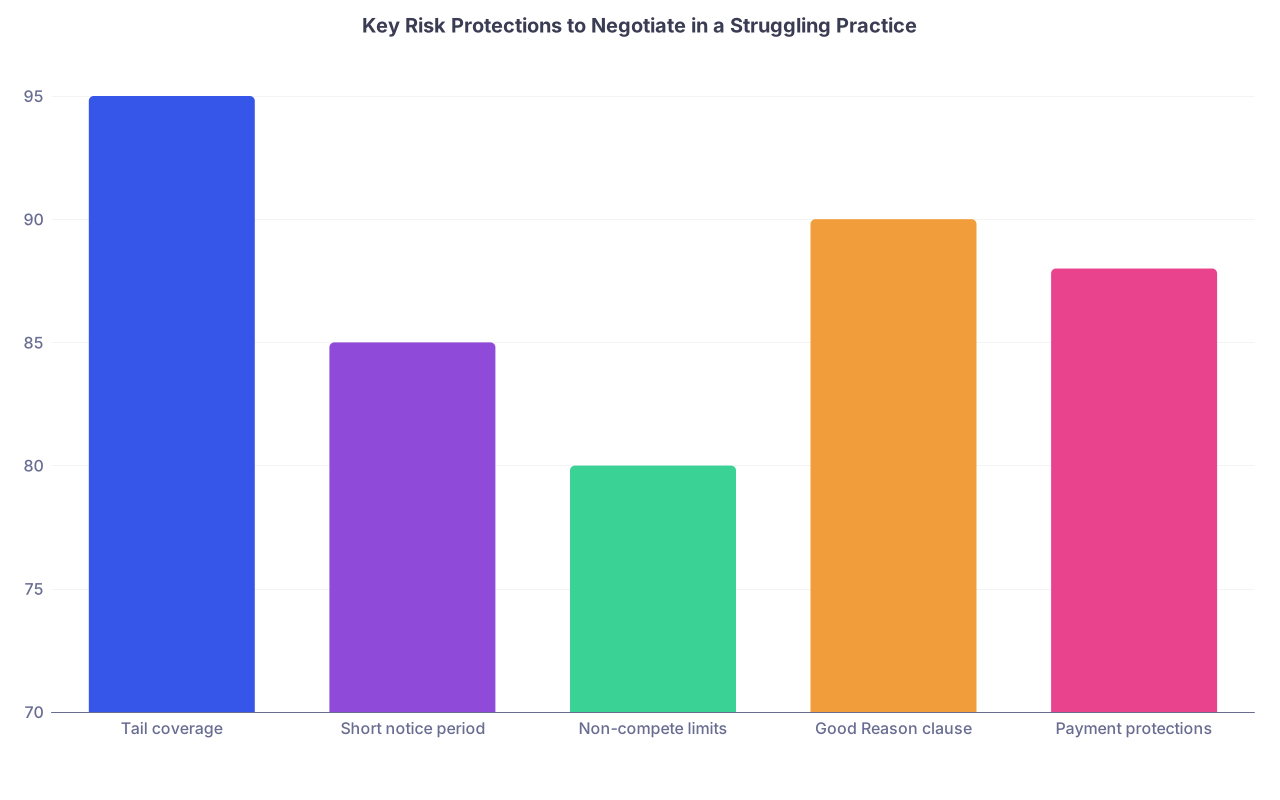
| Category | Value |
|---|---|
| Tail coverage | 95 |
| Short notice period | 85 |
| Non-compete limits | 80 |
| Good Reason clause | 90 |
| Payment protections | 88 |
Quick Example: How This Plays Out in Real Life
Scenario I’ve seen more than once:
- New outpatient IM doc joins a 3-physician group.
- Practice is borderline: they’ve lost a hospitalist contract, collections are down.
- Contract has:
- 2-year term.
- 180-day notice.
- Doc pays tail unless fired without cause.
- Big non-compete (25 miles, 2 years).
- No Good Reason clause.
Year 1: Things are ok. Year 2: Main partner gets sick, practice volume drops, billing company changes. Payments to the doc are late and inconsistent.
Doc wants out. But:
- If they resign, they owe a $45k tail.
- If they stay, they’re making less than a hospitalist job across town.
- They can’t work within 25 miles for 2 years if they leave.
That’s how you get stuck in a dying group resentfully working extra, praying they don’t fully collapse before you’ve saved enough to cover tail and move.
Now imagine the same scenario with:
- 90-day notice for both sides.
- Employer-paid tail if the practice dissolves or fails to pay on time.
- Non-compete waived if doc leaves for Good Reason or if they’re not paid.
- Clear Good Reason clause tied to late payments.
Completely different outcome. Doc leaves, joins a hospital-owned clinic 10 miles away, doesn’t pay tail, keeps their income stable.
Same external situation. Different contract. Different life.

| Step | Description |
|---|---|
| Step 1 | Receive Contract |
| Step 2 | Negotiate normal terms |
| Step 3 | Add risk protection clauses |
| Step 4 | Push for employer-paid tail |
| Step 5 | Demand limits or walk |
| Step 6 | Add detailed Good Reason |
| Step 7 | Do not sign |
| Step 8 | Proceed with caution |
| Step 9 | Practice seems unstable |
| Step 10 | Tail covered in bad outcomes |
| Step 11 | Non-compete narrow or waived on collapse |
| Step 12 | Good Reason clause included |
| Step 13 | Still major red flags |
FAQ (Exactly 5 Questions)
1. How can I tell if a practice is actually “struggling” or just being modest about finances?
Look for behavior, not just words. Signs of real struggle: frequent staff turnover, delayed vendor payments, reluctance to share any financial basics (like approximate annual collections or payer mix), stories about “that one bad year” that seem to repeat, or a pattern of physicians leaving after 1–2 years. Also, if they offer way above-market comp with no clear explanation of where the money comes from, that’s not generosity—that’s usually desperation.
2. Is it ever worth accepting a big non-compete if everything else looks good?
In a rock-solid, well-known system hospital or large stable group, a modest non-compete can be tolerable. In a practice that might not exist in 2–3 years, a broad non-compete is poison. If the group is clearly shaky, I’d call a large non-compete (>10–15 miles, or >1 year, or multi-location restrictions) a deal-breaker unless they carve out explicit exceptions for practice closure, sale with worse terms, or nonpayment.
3. What if they refuse to agree to employer-paid tail in any scenario?
That tells you one of three things: they do not understand the risk, they do not have the cash cushion, or they fully intend to push that cost onto you. All three are bad. At minimum, push for employer-paid tail in specific scenarios: practice dissolution, your termination without cause, or your termination for Good Reason tied to their nonpayment. If they refuse even that, I’d strongly advise walking away, especially in a high-risk environment.
4. Do I really need a lawyer if I already know these clauses to ask for?
Yes. Knowing what you want and actually getting it are different worlds. A good physician contract lawyer knows how to word clauses so they actually work, how far local employers typically bend, and what landmines you’re missing. I’ve seen smart residents negotiate hard on tail coverage and then miss a cross-reference clause that effectively undid it. Spend the money. It’s an attending-level problem; treat it like one.
5. If the practice truly cannot budge on key protections, is there any safe way to still join?
Only if you treat it like a short, calculated gamble and structure your life accordingly. That means: no big fixed expenses you can’t escape, aggressive saving, assuming tail might be on you, and having a clear exit plan. But honestly, as a new attending with options, betting your first job and your geographic flexibility on a group that won’t protect you is usually a bad play. There are enough jobs out there that “they refused to protect me in a worst-case scenario” should usually equal “I’m not signing.”
Today, do one concrete thing: pull up your draft contract (or the template they sent) and use the search function for the words “tail,” “non-compete,” “without cause,” and “Good Reason.” If any of those are missing, vague, or tilted entirely toward the practice, mark them. Those are your must-fix items before you even think about signing.


