

What happens when the “fun little side project” you started to feel more fulfilled ends up making you hate medicine, your life, and yourself?
If you are a physician, PA, NP, resident, or med student flirting with side hustles, you are in the highest‑risk group for a mistake I see over and over: using side work to escape burnout and instead accelerating it.
Let me be direct: side hustles can be fantastic. They can also quietly wreck your career, your health, and your relationships if you miss the early warning signs.
This is the line you do not want to cross.
The Core Problem: You Think More Income = More Freedom
It almost always starts with a rational story.
“I just want to pay off my loans faster.”
“If I can replace call income, I’ll cut back my clinical FTE.”
“This consulting gig is just a few hours a week; it will be easy.”
The story feels logical. Especially when:
- Admin keeps cutting support.
- RVU pressure is suffocating.
- You are watching colleagues burned out, divorced, or leaving medicine entirely.
So you decide: I will outsmart the system. I will build my way to freedom.
Here is the trap: You add a second job to escape the first, without fixing the underlying problem that you are already running near redline.
Most physicians are not burned out because they are lazy or unmotivated. The opposite. They continue to say yes long after their capacity is gone. A side hustle slots perfectly into that flaw.
If you do not treat your side hustle like a business with constraints, it will expand into every empty space in your life. Then it starts eating into the non‑empty spaces: sleep, relationships, recovery, clinical focus.
That is how “one extra thing” becomes the final straw.
Objective Red Flags: When the Numbers Say You Are Doing Too Much
If you want to avoid fooling yourself, start with hard numbers, not feelings. Feelings are the last thing to show trouble. By the time you feel destroyed, you have been over the limit for months.
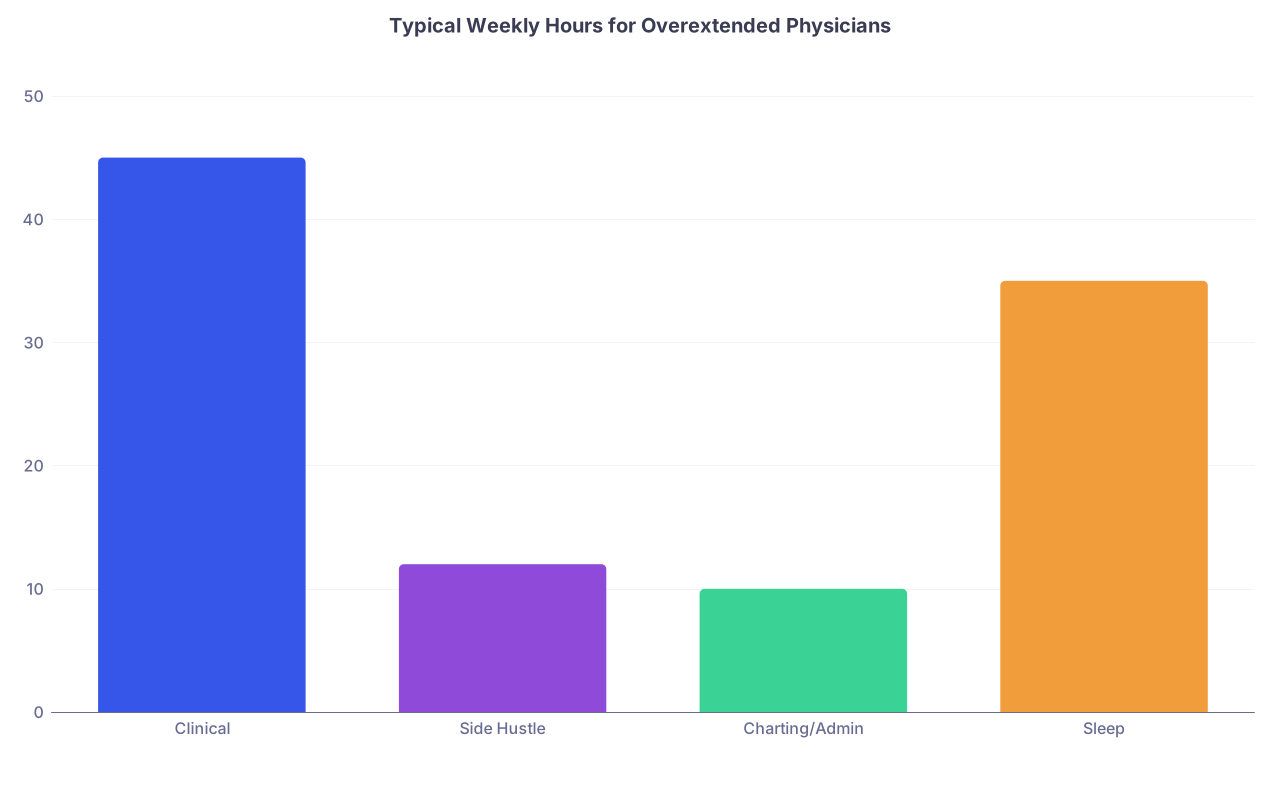
| Category | Value |
|---|---|
| Clinical | 45 |
| Side Hustle | 12 |
| Charting/Admin | 10 |
| Sleep | 35 |
Here are the objective warning signs I see repeatedly in physicians crashing from side‑hustle overload.
1. Your total weekly work time is physically unsustainable
Do some basic math. Be honest, not aspirational.
- Clinical: 36–60 hours (depending on specialty, call, and charting)
- Side hustle(s): 5–20 hours
- Admin/EMR: often another 5–10 off the books
If you are consistently above 55–60 total “brain‑on” work hours per week (clinical + side), you are already in the danger zone. Above 65 for more than a few weeks? You are not “grinding”; you are pre‑burnout.
Look at your calendar and ask bluntly:
“How many hours last week was my brain doing something that required real concentration, responsibility, or emotional labor?”
If that number scares you, good. It should.
2. Sleep is the first thing you “borrow” from
Classic mistake: you do not cut clinical work; you cut sleep.
- Up at 5:00 to write a blog post, record a podcast, or check investment deals.
- Late nights finishing charting because the “real work” for the side business started at 8 p.m.
- “It’s just for a few months” that quietly becomes a year.
If your average sleep is consistently below 6.5 hours, and you are adding side work instead of fixing that, you are not “ambitious.” You are playing chicken with your cognitive function.
3. Your calendar has no white space
Pull up a week on your calendar. Count:
- How many completely free evenings?
- How many half‑days with no clinical, no calls, no meetings, no side hustle tasks?
If the only “unstructured” time left is the commute and the 20 minutes between cases, you are overextended.

Subjective Warning Signs: What Burnout by Side Hustle Feels Like
Numbers convince your rational brain. Symptoms convince the rest of you. If you see yourself in too many of these, you are not “just tired.”
4. You feel dread about both medicine and the side work
Burnout by side hustle has a specific flavor. At first the side gig feels energizing. You feel creative, valued, autonomous.
Then, slowly:
- Clinic days feel like an interruption to your “real work.”
- Side hustle work starts to feel like homework you are always behind on.
- You are never fully present in either space because you are thinking about the other.
If you catch yourself thinking, “I hope clinic is light so I can work on my course / content / startup between patients,” that is not entrepreneurship. That is split attention that can hurt patients and you.
5. You are making more errors or near‑misses
I have had physicians admit this in hushed tones:
“I almost prescribed the wrong dose because I was thinking about a contract negotiation during rounds.”
“I missed a lab result because I was trying to answer business emails between cases.”
Side hustles often demand context switching: emails, content, legal issues, marketing, technical tasks. If those mental threads bleed into clinical time, your risk of error climbs.
You know your baseline. If you are having more:
- Charting mistakes
- Missed messages
- Forgetting small steps or instructions
…that is not “just being busy.” That is your cognitive bandwidth getting chewed up by too many roles.
6. Your empathy is gone or feels fake
One of the clearest burnout indicators: you stop caring. Or you are acting like you care without feeling it.
- Patients become “slots” or “numbers.”
- Every consult feels like an imposition.
- You feel nothing when bad news lands, only “time cost.”
If your side hustle is framed as “my way out of clinical work,” the risk of emotional disengagement is even higher. You start mentally moving yourself out of medicine before you have actually left. That can be devastating for care quality and your professional identity.
Lifestyle Collateral Damage: What You Are Sacrificing Without Admitting It
The easiest lies are the ones you tell yourself about “temporary” sacrifices.
“I’ll miss a few family dinners now so I can be more present later.”
“I just need six months to get this course/business off the ground.”
Six months turns into two years. Meanwhile:
7. Relationships are being downgraded to “maintenance mode”
Watch for these changes:
- You are physically present at home but mentally reviewing KPIs, sales, downloads, or contract terms.
- Your partner stops asking for help because the answer is always “I’m finishing something.”
- You decline social events by default because evenings and weekends are now your “side work time.”
Ask your partner or a close friend one brutal question:
“Have I become less available or more distracted since I started this side thing?”
Listen carefully. If they hesitate, you have your answer.
8. You outsource self‑care… and then stop doing that too
At first, you are “efficient”:
- Grocery delivery
- House cleaner
- Babysitter to cover weekend work blocks
That is fine, even smart. Then you start skipping the actual restoration practices entirely:
- Gym time becomes “optional.”
- Hobbies are abandoned because “I should use this time for the business.”
- Vacations turn into “work retreats” where you bring the laptop “just for a few hours” every day.
Burnout by side hustle often hides behind the illusion of optimization. You feel productive. Until your body gives out.
Financial and Strategic Red Flags: When the Hustle Owns You
Here is a nasty truth: a surprising number of physicians are burning themselves out with side work that does not even move the financial needle.
| Metric | Healthy Range | Burnout Risk Range |
|---|---|---|
| Hours/week on hustle | 3–8 | 10+ consistently |
| Extra income/month | ≥ 2–3x hourly rate | Less than clinical rate |
| Time to decision | 6–12 months | Indefinite 'wait and see' |
| Revenue vs expenses | Clearly positive | Vague or negative |
9. You are making less per hour than your clinical rate
If you are spending five hours a week to make $200/month (after expenses and taxes), you are paying a very high life premium for very little gain.
I see this a lot with:
- Low‑traffic blogs or YouTube channels
- Small consulting gigs with terrible rates
- Underscaled coaching or course offerings
If you are going to take time away from rest, family, or personal health, the side work had better be:
- Strategically important (builds an asset with real future value), or
- Financially meaningful (eventually beats your clinical hourly rate), or
- Genuinely energizing (fuels you rather than draining you)
If it is none of the above, it is a vanity project that is costing you dearly.
10. You have no exit criteria or success metrics
Another mistake: the endless experiment.
“I want to see where this goes.”
“I’ll stop if it doesn’t work.”
“How do I know what ‘working’ is? I’ll just know.”
That is how you stay trapped in a half‑dead side business for years. Not big enough to justify the sacrifice. Not dead enough to bury.
You need pre‑defined conditions like:
- “If this does not make $X/month by month 6, I pause or kill it.”
- “If I need to sleep less than 7 hours to keep this running, I cut back.”
- “If my clinical error rate or complaints increase, I stop and reassess.”
No criteria = no brakes.
Psychological Traps: Why Smart Physicians Ignore Obvious Danger Signs
Physicians are not stupid. Yet they repeatedly walk into burnout by side hustle. Why?
11. Identity: You only know “full throttle”
You were selected and trained to:
- Ignore fatigue
- Override discomfort
- Perform under chronic stress
Side hustles plug into the same circuitry: more is better, suffering is normal, rest is for later.
So you misinterpret early burnout warnings as a sign you are not trying hard enough, instead of what they really are: your nervous system sending distress signals.
12. Sunk cost: “I have already put so much into this”
You spend thousands on coaching, courses, software, branding, or legal work. You announce publicly that you are “building something.” Now it is much harder to step back.
Quitting feels like failure.
Here is the reality: shutting down or pausing an unsustainably structured side hustle is not failure. It is course correction. Every good entrepreneur kills ideas that are not worth the cost. Physicians are weirdly bad at this because medicine never trained you to sunset a project before it breaks you.
13. Social comparison: everyone online looks like they are thriving
Social media is full of doctors bragging about seven‑figure side businesses, real estate empires, and “leaving clinical medicine at 40.”
You see the outcome, not the wreckage:
- The failed ventures they do not mention
- The marriages strained behind the scenes
- The health scares that forced rebalancing
Do not copy the Instagram version of someone else’s life. You do not know their real denominator of hours, risk, and losses.
How to Side Hustle Safely: Guardrails You Actually Need
If you still want a side gig (and I am not saying you should not), you need rules. Hard ones. Not vibes.

| Step | Description |
|---|---|
| Step 1 | Want Side Hustle |
| Step 2 | Reduce clinical or say no |
| Step 3 | Define income and time limits |
| Step 4 | Start small test phase |
| Step 5 | Scale slowly |
| Step 6 | Pause or stop |
| Step 7 | Total work hours over 55? |
| Step 8 | Clear goal and metrics? |
| Step 9 | Protect 7 hr sleep and 1 day off? |
| Step 10 | Energizing and sustainable? |
Here are the guardrails most physicians skip, then wish they had not.
Non‑negotiable #1: One protected day completely off
At least one full day per week with:
- No clinical work
- No side hustle work
- No inbox “quick checks”
If your side business cannot survive you being completely offline one day a week, it is badly designed. You are building a new cage, not freedom.
Non‑negotiable #2: Minimum sleep and maximum weekly work cap
Decide your numbers before ramping up the hustle.
For most physicians:
- Minimum sleep: 7 hours per night averaged over the week
- Maximum active work (clinical + side + admin): 50–55 hours/week
Then be ruthless:
If a new gig pushes you over the limit, something else must shrink. Often that means negotiating down clinical FTE or saying no to another committee, not just stacking everything.
Non‑negotiable #3: Time‑boxed experiments
Treat any new side hustle phase as a controlled experiment:
- Duration: 3–6 months
- Hypothesis: “If I do X hours/week, I expect Y outcome (income, growth, or satisfaction).”
- Review date: already on the calendar, with a trusted person to keep you honest.
At the review you ask:
- Is the income or traction meaningful?
- Am I more or less burned out than when I started?
- What did this cost me in health and relationships?
If the answers are bad, you either radically restructure or stop. Not “give it one more quarter” forever.
Quick Self‑Audit: Are You Already in Trouble?
Run through this list. If you are nodding along to several, you are on the edge or already in burnout by side hustle territory.
- I often work on side hustle tasks when I meant to be resting.
- I feel guilty when I am not being “productive” with free time.
- My partner or kids have commented that I am “always working.”
- I have cut sleep to maintain my current level of commitments.
- I cannot remember my last full day truly offline.
- My mind drifts to business issues during patient care.
- I would be embarrassed to tell a colleague my actual weekly hours.
If more than three of these are true, your risk is high. The solution is not “better time management.” It is subtraction.
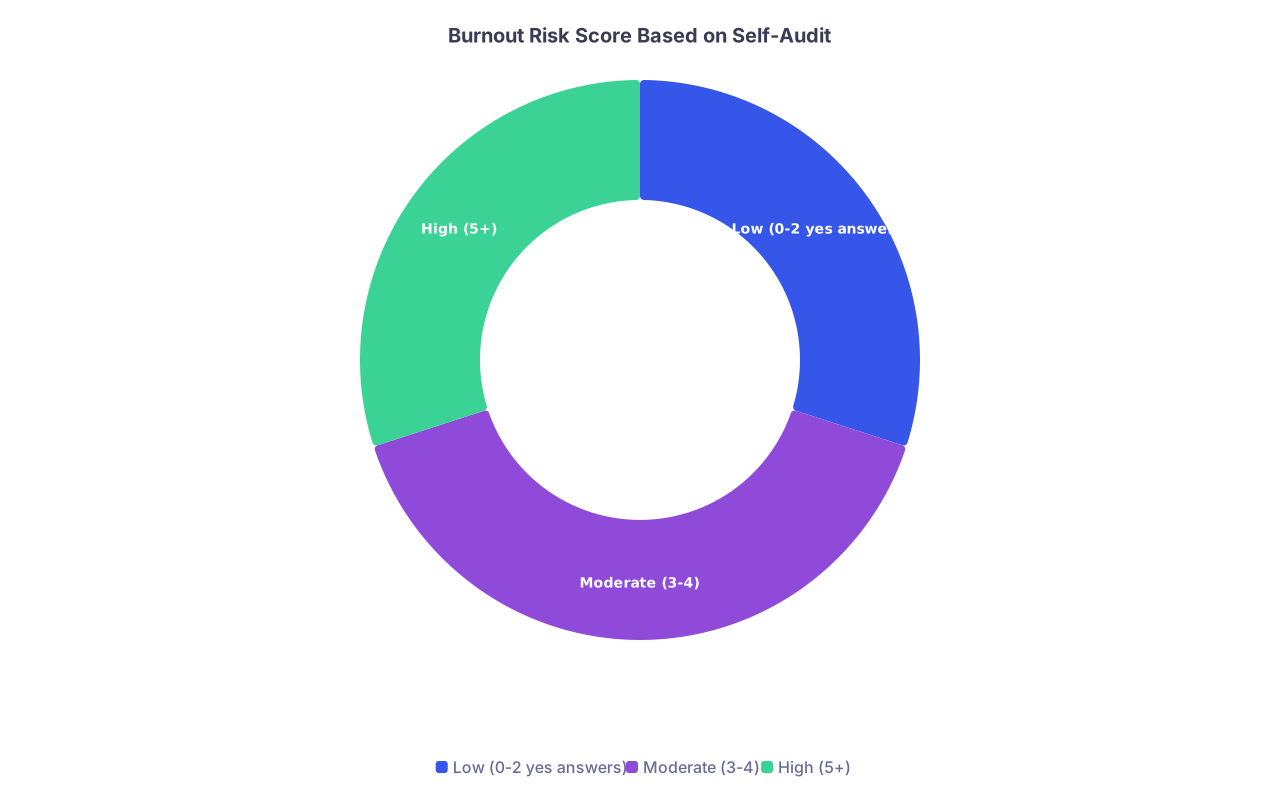
| Category | Value |
|---|---|
| Low (0-2 yes answers) | 30 |
| Moderate (3-4) | 40 |
| High (5+) | 30 |
The Future of Medicine: Side Hustles Are Not Going Away – Your Health Might
Medicine is not magically trending toward lower workloads, higher respect, and more autonomy. Many clinicians will keep looking to side hustles for:
- Financial independence
- Identity beyond “just a doctor”
- Protection against institutional instability
I do not think that is wrong. I think doing it blindly is.
The physicians who will survive this next decade with their sanity intact are not the ones chasing the biggest side income. They are the ones ruthless about constraints:
- Designing work that amplifies, not competes with, their core values.
- Saying “no” early before something metastasizes into a second full‑time job.
- Being willing to kill projects that are profitable but personally toxic.
If your side hustle is turning you into a worse physician, partner, parent, or human, it is not a clever strategy. It is just another form of self‑exploitation dressed up as entrepreneurship.
You do not need to learn this the hard way.


