

The biggest tax mistakes physicians make usually don’t show up on a tax form. They’re buried in the employment contract you already signed.
And yes, I know—that’s exactly what you’re afraid of.
You signed a complicated physician contract, and now your brain is doing that catastrophizing thing:
Did I just nuke my tax situation? Am I locked into some awful setup for years? Did I miss something everyone else knows?
Let me be blunt: you probably didn’t ruin your life. But you might have made things harder or more expensive than they needed to be. And the contract absolutely can shape your taxes in ways no one explained to you.
So let’s walk through this like two people sitting at a kitchen table with your contract and a highlighter, and a big ball of anxiety between us.
First: You Didn’t “Ruin” Everything (But You Might Be Leaving Money on the Table)
Most physician contracts don’t destroy your tax situation. They just silently push you into one of a few buckets: W‑2 employee, 1099 independent contractor, or some hybrid mess where you’re technically one thing but being treated like another.
The worst part is no one tells you what that means for taxes.
You’re probably spiraling about things like:
- “I’m W‑2… does that mean I can’t deduct anything and I’ll be broke?”
- “I’m 1099… did I accidentally sign up to be my own HR department and get audited?”
- “They mentioned ‘partnership track’ and ‘K‑1’… is that code for IRS nightmare?”
- “They’re paying my student loan bonus as a ‘forgivable loan’… am I getting hammered later?”
Here’s the calmer truth:
Your tax situation is like a house. The contract is the foundation. Maybe it’s not the ideal layout. Maybe you would’ve chosen other materials. But you can still rearrange the furniture, fix leaks, and even do some renovations with proper planning.
You’re not trapped. You just need to understand what you actually signed.
The Big Tax Question: Are You W‑2, 1099, or Owner?
This is the first fork in the road. Your contract usually decides this, even if it doesn’t use those exact terms.
Look for clues like:
- “Employee,” “salary,” “benefits,” “withholding taxes” → W‑2
- “Independent contractor,” “no benefits,” “responsible for own taxes” → 1099
- “Partner,” “share of profits,” “K‑1,” “buy‑in” → owner / partner
Here’s why that matters so much.
| Status | Tax Form | Main Tax Impact |
|---|---|---|
| W‑2 Employee | W‑2 | Less flexibility |
| 1099 Contractor | 1099-NEC | More deductions, more responsibility |
| Partner/Owner | K‑1 | Complex but flexible |
If you’re W‑2
This is typical for hospital-employed docs, big systems, academics.
Your anxiety script probably sounds like: “I’m doomed. I can’t deduct anything. I’m just paying full freight.”
Reality:
You lose some deductions that 1099 people get (like writing off CME, mileage, home office, etc.) because unreimbursed employee expenses basically died after 2017. But you gain simplicity. Taxes are withheld. You get benefits. You’re not chasing quarterly estimates.
Big issues to watch for as a W‑2 doc:
- No control over retirement plan design (you’re stuck with what they offer)
- No business expense deductions for work stuff
- Moving / signing bonuses and loan repayments that might be taxed in weird ways
- Noncompetes and clawbacks that can hurt you financially when you leave
You didn’t ruin your taxes as a W‑2—you just didn’t choose the “power user” setting. And honestly, as a new attending that’s not the end of the world.
If you’re 1099 (independent contractor)
This is where your anxiety really spikes, because it feels like “did I just start a business without meaning to?”
You kind of did. But that’s not automatically bad.
You get:
- Deductions: CME, licenses, work laptop, home office, professional fees, mileage, part of your phone/internet, etc.
- Flexibility: You can set up an LLC, maybe an S‑corp later, pick your retirement plan (solo 401(k), SEP, etc.)
- Control: You decide how to structure cash flow, equipment, etc.
You also get:
- No benefits unless you set them up
- No employer paying half of your Social Security/Medicare (you pay self‑employment tax)
- Quarterly estimated taxes (if you ignore these, it gets ugly)
You didn’t ruin your taxes by signing a 1099 contract. You just signed up for a game where you need a decent CPA and some intentional planning. The “ruin” comes from ignoring it and then meeting the IRS at penalty time.
If you’re a partner / owner (K‑1)
Group practices, some private practices, “track to partnership.” Your contract may talk about “profits,” “distributions,” “guaranteed payments,” or a future buy‑in.
This can be tax‑efficient long term but confusing early on. You might be getting:
- A mix of W‑2 wages and K‑1 profit
- Or just K‑1 income treated as self‑employment
- Or some Frankenstein structure that only your CPA truly understands
Key fear here: “I’m going to mess this up and get audited.”
Reality: if you get a good CPA who understands physician partnerships, you’ll be fine. But don’t DIY TurboTax your first year as a partner. That’s how things break.
Sneaky Contract Clauses That Wreck Your Tax Planning (or Make It Messy)
The part you’re probably really worried about: what did I already agree to that’s going to hurt me?
Let’s hit the common landmines.
1. Sign‑on bonuses and repayment clauses
That nice $20k “signing bonus”? It’s usually taxable. As ordinary income. Upfront.
And then they add a repayment clause: if you leave before 1–3 years, you owe it back.
So what happens tax‑wise if you leave and have to repay?
Worst case scenario you’re imagining:
“I pay tax on $20k now, then later repay $20k with after‑tax money, and I get nothing back. I just lit money on fire.”
Not exactly, but it can feel like that.
Sometimes you can deduct the repayment in a later year (subject to weird rules and limits). Sometimes the structure of the contract (loan vs bonus) changes the tax treatment. This is why “forgivable loan” language matters.
You didn’t ruin everything. But you may have:
- Guaranteed tax on a bonus tied to a job you might hate
- Locked yourself into staying purely to avoid repaying after taxes
This is fixable only going forward—by understanding the clawback terms and planning your timeline before you jump ship.
2. Student loan “forgiveness” or “repayment” benefits
Some employers will “help with your loans.” Sounds holy and pure. Tax-wise, it can be dirty.
There are three common setups:
- They pay you extra cash, and you pay your loans yourself → definitely taxable income.
- They pay directly to your lender as part of a signed program → may still be taxable unless it qualifies for a specific exception (like some education assistance programs).
- They set it up as a forgivable loan that’s forgiven each year you stay → that forgiveness is often taxable income each year.
Your fear: “Did I just double‑tax myself on my loans?”
Probably not double. But it may be less generous after tax than you thought.
The real damage is psychological—you think, “I’m getting $30k in loan help,” but after tax it’s more like ~$18k. That doesn’t mean it’s bad. It just means your contract’s “wow factor” isn’t as big as they sold you.
3. Tail coverage and buy‑out / buy‑in terms
Tail malpractice coverage can be brutal. $30k–$80k is not unusual.
Your contract might say:
- Employer pays tail (good for you)
- You pay tail if you leave before X years (ehhh)
- You always pay tail (oof)
Tax‑wise: yes, if you personally pay tail, it’s usually a deductible business expense if you’re 1099 / partner, or a miscellaneous deduction situation that got neutered if you’re W‑2. But the bigger issue is cash flow and timing.
Same thing with buy‑in / buy‑out for partnerships. You might be on the hook for big chunks of money that have tax consequences (depreciation, goodwill, etc.) that you’re not modeling at all.
Again: not ruin. Just complexity you didn’t price correctly in your brain.
The 199A QBI Deduction: The Thing No One Explained in Training
If you’re 1099 or getting K‑1 income, there’s this “Qualified Business Income Deduction” (Section 199A) that can be huge.
And then there’s the bad news. Medicine is considered a “specified service trade or business” (SSTB), and the deduction phases out at certain income levels.
Translation into your fear language:
“I signed this big-money contract. Did I just disqualify myself from a giant tax break and pay tens of thousands more forever?”
Maybe. Sometimes yes. And that’s infuriating.
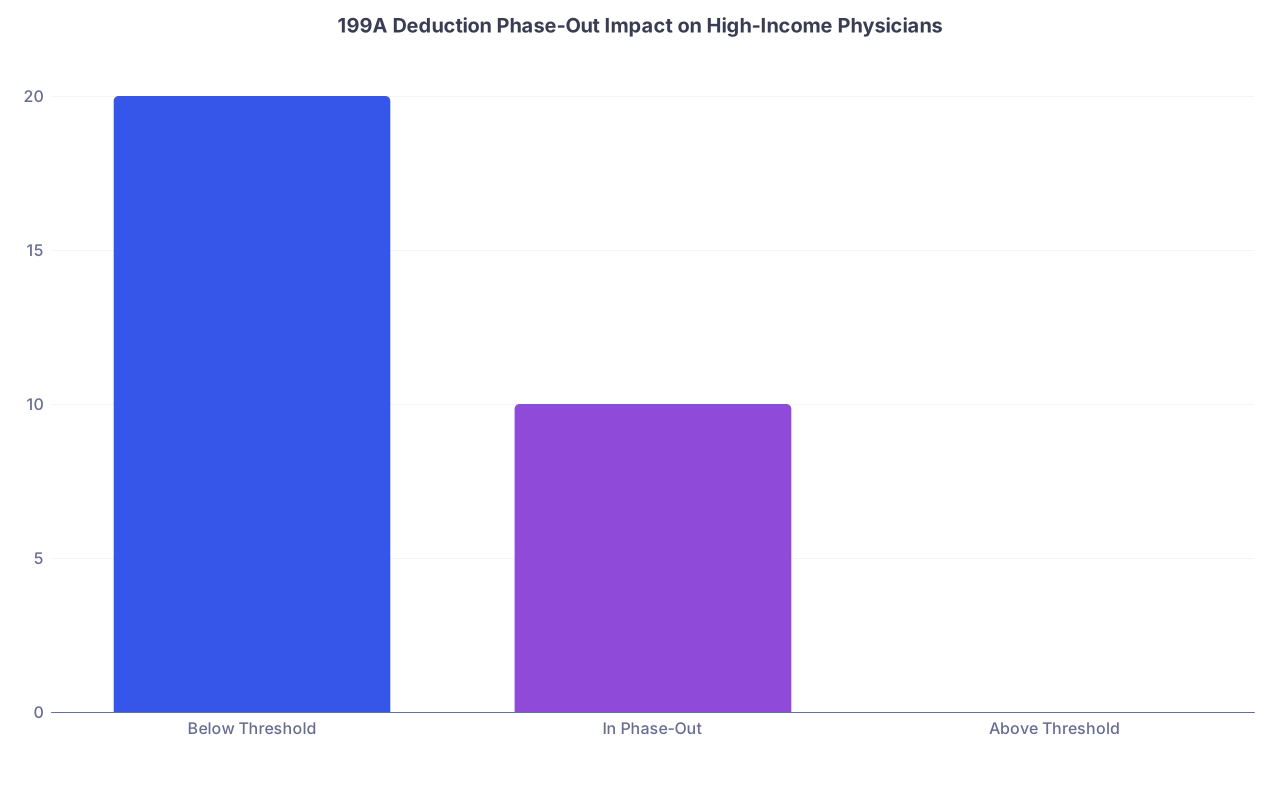
| Category | Value |
|---|---|
| Below Threshold | 20 |
| In Phase-Out | 10 |
| Above Threshold | 0 |
That little chart is the emotional picture: potential 20% deduction at lower income, shrinking to zero as your income climbs.
But here’s where hope sneaks in:
- Filing status matters (married vs single)
- Entity structure can matter
- How income is labeled (W‑2 vs K‑1 vs guaranteed payment) matters
- Retirement contributions and HSAs that lower taxable income can influence it
You didn’t “ruin” this forever with one signature. But the contract does constrain the game board. An actual tax pro can still play some moves.
W‑2 vs 1099: Did I Pick the “Wrong” One for Taxes?
This is the anxiety that hits at 2 a.m. when you talk to another doc:
“They’re 1099 and writing off everything and paying less tax. I’m W‑2 like an idiot.”
Or:
“They’re W‑2 and don’t worry about audits. I’m 1099 and the IRS is going to live in my walls.”
The truth is boringly in-between.
Here’s the real comparison if you zoom out a bit:
| Feature | W‑2 Employee | 1099 Contractor |
|---|---|---|
| Simplicity | High | Low |
| Deductions | Low | High |
| Benefits | Employer provided | You provide |
| Audit risk (if sloppy) | Lower | Higher |
| Control | Low | High |
The “wrong” choice is the one where you don’t match your structure with your reality.
If your contract treats you like an employee (set hours, one site, one boss, no autonomy) but calls you a 1099 just to avoid benefits? That’s not just bad for taxes, it’s risky from a labor law standpoint. I’ve seen locums‑type deals that were basically W‑2 jobs dressed up as 1099.
Can you fix that after you signed? Sometimes, yes—at renewal, or by pushing back if the misclassification is obvious. But for this year, the move is: accept reality, set up proper bookkeeping, and file correctly so your tax return matches your contract.
What You Can Still Do Now Even Though You Already Signed
This is the part your brain needs to hear: you are not stuck just because the ink dried.
Here’s what “damage control” actually looks like.
Step 1: Identify your category and income streams
Grab your contract and literally write in the margin:
- W‑2 only
- 1099 only
- Mix: W‑2 + moonlighting 1099
- Future partner → K‑1 later
Then make a super simple list: salary, bonuses, call pay, RVU bonuses, loan repayment, stipends, anything extra.

| Category | Value |
|---|---|
| Base Salary | 70 |
| Bonuses | 15 |
| Call/Extra Shifts | 10 |
| Other Stipends | 5 |
Just seeing this on paper drops the panic from “everything is a fog” to “okay, I see the machine.”
Step 2: Get a CPA who actually understands physician contracts
Not your cousin who “does taxes on the side.” Not a random chain tax office.
Someone who:
- Knows W‑2 vs 1099 vs K‑1 physician setups
- Has seen hospital employed vs private practice vs locums
- Understands 199A, forgivable loans, loan repayment, tail coverage
Show them the actual contract. Let them say, “Yep, this line right here—that’s what’s driving your tax consequences.”
Step 3: Adjust what you can this year
Even with the contract fixed, you can still change:
- Retirement contributions (maximize 401(k), 403(b), 457, HSA, backdoor Roth where appropriate)
- Estimated tax payments or withholding so you don’t get crushed next April
- Business expense tracking if you’re 1099 (set up a separate account, basic bookkeeping software)
- How much you rely on that “bonus” that might get clawed back
Small moves. Big long-term effect.
Step 4: Plan your next contract from a tax lens
Your current contract is version 1. Painful lesson. Use it.
Next time you negotiate, you’re not just asking “What’s my base?” You’re asking:
- How is this income structured—salary, bonus, K‑1?
- Who pays malpractice and tail?
- How are sign‑on and loan repayment taxed and clawed back?
- Am I W‑2 or 1099 and why?
You become the annoying but smart person who says, “I want the offer letter and draft contract before I accept verbally.”
Quick Reality Check: Worst‑Case vs Actual Risk
Let me speak directly to the nightmare scenarios spinning in your head and contrast them with what actually happens.

“Did I just trigger an audit?”
Not by signing a contract. Audits come from messed-up or suspicious tax returns, not normal employment arrangements. The audit risk comes if your return doesn’t match your reality.
“Am I going to owe tens of thousands unexpectedly?”
You might owe more than you expected if you’re 1099 and no one withheld taxes, or if your bonuses were bigger than you accounted for. But this is a planning issue, not a moral failing. A good CPA can estimate this and help you fix it before penalties snowball.
“Did I lock myself into the wrong structure forever?”
No. Contracts end. Jobs change. Entity structures can be formed or reformed. 199A eligibility can change with life events and planning. You’re not branded for life by your first attending contract.
“Did everyone else know all this and I’m just behind?”
Absolutely not. Most physicians learn this the hard way. In fact, you’re ahead of the crowd simply because you’re asking the question now instead of three years and two IRS letters from now.
A Simple Visual: How Contract Type Ripples Into Taxes

| Step | Description |
|---|---|
| Step 1 | Physician Contract Signed |
| Step 2 | Employer Withholding |
| Step 3 | Self Employment Tax |
| Step 4 | Schedule K-1 |
| Step 5 | Limited Deductions |
| Step 6 | Employer Retirement Plan |
| Step 7 | Business Deductions |
| Step 8 | Quarterly Estimates |
| Step 9 | Complex Allocation |
| Step 10 | Potential QBI Planning |
| Step 11 | Status Type |
That’s really the whole story. You signed a contract, which dropped you into one of those lanes. Now it’s about driving that lane correctly, not jerking the wheel every time you hear a new tax podcast.
FAQs
1. I already signed a 1099 contract but I’ve done nothing about taxes—what do I do this year?
Stop ignoring it. Open a separate business checking account today and run all contract income and business expenses through it. Then find a CPA who works with physicians and tell them, “I’m an independent contractor, I haven’t made estimated payments yet, and I need to clean this up.” They’ll help you calculate catch‑up estimates, set up a system going forward, and figure out whether an LLC or S‑corp makes sense down the line. You’re not the first person to be behind; just don’t wait until March.
2. My sign‑on bonus has a clawback if I leave early—can that be fixed now?
You usually can’t retroactively renegotiate what’s already signed unless your employer is unusually flexible. But you can understand exactly how the repayment is calculated (gross vs net, prorated vs full) and how it’s treated for tax purposes. A tax pro can tell you what the hit looks like if you leave at 12 vs 24 months. That knowledge helps you make a rational exit plan instead of staying forever purely out of fear.
3. I’m W‑2 and feel like I’m missing out on deductions. Should I try to switch to 1099?
Don’t chase 1099 status just for write‑offs if it turns a good job into an unstable one or strips critical benefits. Some W‑2 setups are actually better after you factor in health insurance, retirement match, malpractice coverage, and stability. If you want tax flexibility, a middle ground is adding 1099 moonlighting on the side, which opens up business deductions and potentially a solo 401(k), without blowing up your core W‑2 job.
4. How do I know if my contract is “tax‑friendly” or not?
A contract is tax‑friendly if three things line up: your status (W‑2/1099/partner) matches how you actually work, the income structure doesn’t block you from major benefits (like retirement contributions or potential 199A deduction), and the “extras” (bonuses, loan help, tail, buy‑in) are structured in a way you understand and can plan for. The cleanest test is: give your contract to a CPA who regularly works with physicians and ask, “If this were your contract, what would worry you from a tax and cash‑flow standpoint?” Their face will tell you as much as their words.
Here’s what I want you to do today:
Pull out your contract, grab a pen, and write “W‑2,” “1099,” or “Partner” in big letters at the top. Then underline every place it mentions bonus, loan repayment, malpractice, and partnership. Those circled words? That’s your tax story.
Once that’s marked up, email a CPA who works with physicians and attach the contract. Subject line: “New attending contract—need tax strategy, not just tax filing.”


