
The idea that doing two different preliminary years is a smart or common strategy is mostly a myth. When you look at the data and the incentives of programs, it almost never makes sense—and when it does, it’s usually a last-resort salvage maneuver, not a plan.
If you’re even thinking about a second prelim year, you’re probably in one of a few situations:
- You finished (or are finishing) a prelim and did not match into an advanced program.
- You started a categorical program that fell apart (fired, left, or contract not renewed), and now you’re trying to re-enter.
- Someone—often an older resident or an attending—told you, “You can always just do another prelim year and reapply.”
Let’s go myth by myth, and then talk about the few times a second prelim year is actually rational.
What a Preliminary Year Really Buys You (and What It Doesn’t)
Prelim years are not magical golden tickets. They are transactional.
A preliminary year (IM or surgery) is used for:
- Satisfying PGY-1 requirements for advanced fields (e.g., anesthesia, radiology, derm, neuro, ophtho, rad onc).
- Filling service needs for hospitals at relatively low cost.
- Very occasionally, functioning as a long tryout for a categorical spot (rare, and usually informal).
What it does not reliably do:
- Guarantee you a categorical spot at that institution.
- “Boost” your application year over year just by existing.
- Automatically fix step score problems, red flags, or a weak application.
If anything, after the first prelim year, the bar for “improvement” gets higher, not lower. You can’t just say “I’m more experienced.” Every PD knows that experience without a clear upward trajectory can look like stagnation.
The Common Myths About Doing Two Prelim Years
Let me call out the main myths I hear over and over.
Myth 1: “If I do another prelim year, I’ll be more competitive next cycle.”
Not by default, you won’t.
Program directors are not impressed by repetition. They’re impressed by:
- Strong objective scores (Step 2 CK, shelf exams).
- Strong, specific letters tied to a particular specialty.
- Clear narrative: “This is where I’m going, here’s why, here’s what’s changed.”
If your application in Year 2 looks like your application in Year 1 plus “did more ward months,” that’s not growth. That’s just time passing.
I’ve seen this play out. Applicant does a prelim medicine year, applies to anesthesia, doesn’t match, does another prelim medicine year somewhere else, reapplies with essentially the same Step, same research, same generic IM letters—and is genuinely surprised they get the same result.
From a PD’s perspective, that file reads:
“Had one full year to improve and essentially didn’t.”
The second prelim only helps if your trajectory changes:
- You crush Step 2 CK (or other standardized metrics if applicable).
- You pivot specialties strategically (e.g., from derm → IM with strong IM letters).
- You repair a real red flag (professionalism, performance, gaps) with excellent subsequent evaluations.
If there’s no new story, there’s no new outcome.
Myth 2: “Two prelims show dedication and perseverance.”
Program directors do not reward suffering. They reward fit and predictability.
Staying in a non-advancing role for 2 years can trigger questions:
- Why did no one promote this person to a categorical spot?
- Are there subtle performance, interpersonal, or professionalism concerns?
- Is this person struggling to decide on a long-term path?
You may feel like you’re proving grit. The file may look more like you’re stuck.
There’s also a brutal scheduling reality: many prelim-heavy programs are service mills. You’re grinding Q4 call, nights, high census, and then trying to simultaneously:
- Study or improve scores
- Develop or finish research
- Network in the specialty you actually want
Most people don’t magically do more academic work in a second prelim year. They’re just more exhausted.
Myth 3: “Programs like seeing more clinical experience before bringing you on.”
Some do. Within reason.
One good prelim year with strong letters is usually enough to show:
- You can handle call.
- You are safe.
- You show up and function.
A second prelim year might marginally increase PD comfort if you had major doubts or a later pivot, but the return on investment drops sharply after that.
There’s also the financing/eligibility side nobody tells you clearly: more years of prelim/transition-year status can complicate:
- GME funding (Medicare caps, reimbursement issues).
- Visa issues (for IMGs on J-1/H-1B).
- Your eventual board requirements and program duration.
I’ve heard PDs say explicitly in meetings: “If someone is already 2+ years in and not advancing, they’re a risk for funding and fit.” That’s the quiet part people don’t say during your interview.
When a Second Prelim Year Might Make Sense
“Almost never” is not “never.” There are edge cases where two different prelim years are rational. They share some traits: clear story, real change, and no better alternative.
Let’s slice it into scenarios.
Scenario 1: You pivot specialties late—and genuinely switch lanes
Example: You did a prelim surgery year targeting categorical general surgery. Mid-year, your performance is fine, but it’s clear:
- You hate the OR.
- You love ICU, wards, consults.
- You realistically won’t match categorical surgery at a program you’d accept.
You pivot to internal medicine or anesthesia, but it’s too late in the cycle for full-strength letters, away rotations, and a polished narrative. You apply and either don’t match or match to something that doesn’t fit.
A second prelim (this time in internal medicine or a TY with strong medicine) may make sense if:
- You can secure strong specialty-specific letters in the new field.
- You are using that year to actually build the new specialty profile (research, mentorship, away rotations, professional identity).
- You’re moving from a clearly bad fit to a more suitable specialty.
That’s not “I’ll just do another year and hope.” That’s “I’m rewriting my application to a different audience, and my first prelim isn’t aligned with them.”
Scenario 2: You had real, fixable red flags during the first year
Not soft “I think my PD didn’t like me,” but actual documented problems:
- Unprofessional incidents
- Struggles adjusting to intern responsibilities
- Academic remediation
- Health or personal crises
If in year one, your record is rough, and your PD letter is neutral or weak, you’re in a hole. A second year can help if:
- You are in a healthier environment with actual support.
- You have stabilized whatever was going wrong (mental health, family stress, health issues).
- You come out of year two with glowing evaluations and letters specifically stating: “This resident has shown clear, sustained improvement and is ready for categorical training.”
This is not cosmetic. It’s rehabilitation. And it only works when the second year is significantly better and the people writing your letters will put their name on that transformation.
Scenario 3: You’re an IMG using prelim years as a bridge while improving the rest of your file
This is harsh but real: some IMGs use back-to-back prelim or TY positions while:
- Getting U.S. clinical experience.
- Building research with a specific department.
- Waiting out visa timing or exam retakes.
- Networking their way into a categorical or advanced position.
This can work in narrow bands:
- You’re clearly high functioning clinically.
- You’re tied into a department that actively wants you (e.g., a neurology chair who’s trying to open a slot).
- Your research output or exam improvement during that time is obvious and tangible.
But if all you’re doing is two generic prelim years with no specialty home, you’re not “bridging.” You’re burning time and eligibility.
What the Numbers and Structures Actually Favor
We don’t have a neat randomized trial of “one prelim vs two prelims,” but NRMP and GME data tell a pretty consistent story.
Look at patterns in who actually gets picked up into categorical positions after prelim:
- One strong prelim → often absorbed internally or matched elsewhere, if scores and letters align.
- Multiple prelims → increasingly rare in mainstream programs, more common in low-fill programs or places desperate for service coverage.
Here’s a simplified look at typical outcomes people think happen versus what actually tends to happen:
| Path | Expected Outcome | More Typical Reality |
|---|---|---|
| 1 prelim, reapply once | Easy step up to categorical/advanced | Competitive only if file clearly improved |
| 2 prelims, same specialty | Extra “dedication” rewarded | Raises questions, rarely a strong advantage |
| 1 prelim, pivot specialty | Need extra year automatically | Sometimes, but often can match with one year |
| 2 prelims, IMG bridge | Guaranteed eventual spot somewhere | Highly variable, many never get categorical |
If you want to visualize why doing more and more prelim years is a bad long-term slope, think of the value curve dropping off:
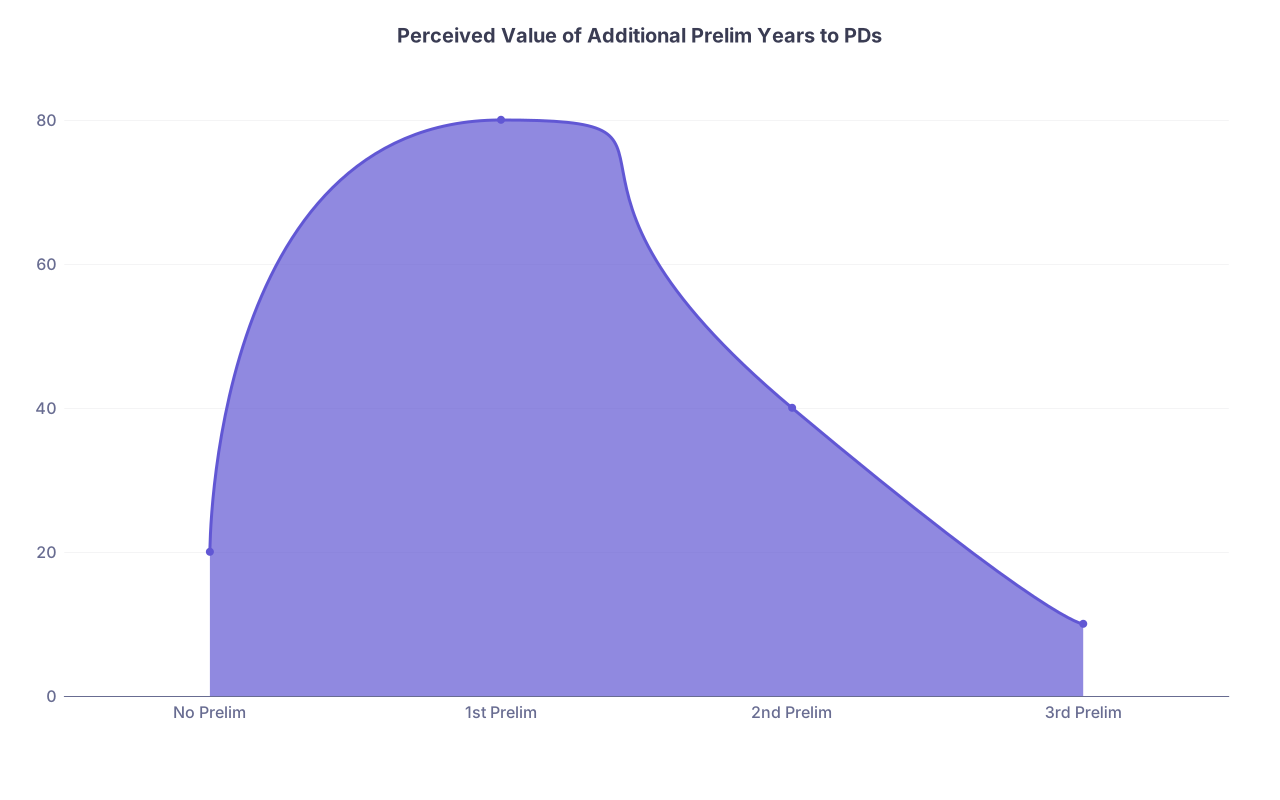
| Category | Value |
|---|---|
| No Prelim | 20 |
| 1st Prelim | 80 |
| 2nd Prelim | 40 |
| 3rd Prelim | 10 |
The first prelim can be a big jump in credibility if you were a risky or borderline applicant. After that, each added year looks less like “extra training” and more like “can’t progress.”
Alternatives That Usually Make More Sense Than a Second Prelim
If you’re staring at a non-match after a prelim year and thinking “just do another one,” stop and ask what problem you’re actually trying to solve.
Some higher-yield options than jumping into a second prelim by default:
Research year in your target specialty
Especially relevant for derm, rad onc, plastics, neurosurgery, competitive fellowships. A year of solid research with the right mentor and letters can do more for your application than another 12 months of night float on a general IM service.Non-traditional clinical roles
Hospitalist extender, clinical instructor, or junior faculty-type roles at some institutions. These can:- Keep you clinically fresh.
- Give you teaching experience.
- Lead to letters from people who supervise residents and work with PDs.
Direct categorical reapplications using the single prelim year
Many applicants underestimate how much they can leverage:- One strong PD letter
- One chair letter in the target field
- Thoughtful geographic strategy Without repeating intern year.
Deliberate specialty pivot
Some people chase the same oversubscribed field for years when they’d be happier and more successful in another. A well-executed pivot (plus one solid prelim) beats two or three years of chasing a door that’s barely open.
Red Flags Where a Second Prelim Year Is a Bad Idea
A second prelim year almost certainly does not make sense if:
You’re doing it because you “don’t know what else to do.”
That’s not strategy. That’s drift.You’re repeating the exact same type of prelim (IM→IM, Surg→Surg) with no substantive changes in your application plan.
PDs will see the redundancy.You’re ignoring major score deficits and hoping “more intern time” compensates.
It won’t. Step 2 CK and core exam performance still dominate.You’re emotionally burned out and think another high-service year will somehow be less painful “once you’re used to it.”
More of the same grind usually means worse burnout, not resilience.
How to Decide Rationally: A Simple Flow
Here’s a rough decision process that actually reflects how PDs think, not how message boards fantasize:

| Step | Description |
|---|---|
| Step 1 | Finished or finishing first prelim |
| Step 2 | Do not do second prelim |
| Step 3 | Reassess goals, consider research or nonclinical year |
| Step 4 | Reapply using one prelim year |
| Step 5 | Second prelim low yield, rethink path |
| Step 6 | Consider targeted second prelim with explicit plan |
| Step 7 | Matched categorical or advanced? |
| Step 8 | Clear specialty target and mentors? |
| Step 9 | Did application meaningfully improve? |
| Step 10 | Second prelim changes story? |
If you can’t honestly answer “yes” to “a second prelim changes my story in a concrete, positive, and provable way,” you’re probably just repeating time.
The Rare Case Where Two Prelim Years Actually Work Out
I have seen second prelims work. But the common pattern in the “success” stories is not “they worked harder.” It’s:
- There was a specific opportunity (e.g., “our department will likely have a categorical PGY-2 spot next year if X retires”).
- There was a champion (an APD, chair, or PD explicitly wanting to bring that person on).
- There was a genuine, measurable improvement in performance, narrative, or alignment with the new specialty.
The person did not just sign up blindly for a random second prelim and hope the universe rewarded their suffering. They treated the second prelim like a bridge with a visible other side, not an endless loop.
The Bottom Line
Doing two different prelim years is not inherently “wrong.” But the romantic idea that it’s some sort of noble grind that programs will inevitably reward is fiction.
Most of the time:
- One well-executed prelim year is sufficient signal.
- Two suggests something in the trajectory is off.
If your second prelim year:
- Fixes a real, documented red flag,
- Aligns you with a new and better-fitting specialty,
- Or is part of a deliberately built relationship with a department ready to invest in you,
then yes, it can make sense.
If it’s just “try again, same as before, but more tired,” you’re not building a career. You’re just running in place in a very expensive, very exhausting year of your life.
Years from now, you won’t judge yourself by how many times you were willing to repeat intern year. You’ll judge yourself by whether you made clear, honest decisions with the data in front of you—and had the courage to change course when repetition stopped being progress.