

The instinct to rank a “better” prelim above a “worse” categorical is how people quietly lose years of their life.
Let me answer the core question first, then we’ll unpack it:
Most of the time, it is NOT smart to rank a preliminary spot higher than a less‑ideal categorical position.
There are real exceptions. But you’d better be crystal clear that you’re in one of them before you gamble.
Quick Definitions: What You’re Actually Choosing Between
If this already feels fuzzy in your head, you’re exactly the audience for this.
Categorical (CAT) spot – You match into the full residency in that specialty at that program (e.g., Internal Medicine categorical, General Surgery categorical, Psych categorical). No need to reapply for that same specialty. You’re “in” for the duration, assuming you perform adequately.
Preliminary (prelim) spot – Typically 1 year (sometimes 2) of mostly the same clinical work as an intern in that field (prelim medicine, prelim surgery, prelim transitional).
But:- You do not have a guaranteed PGY‑2+ spot.
- You must reapply to something: an advanced specialty (like Derm, Rad Onc, Neuro, Anesthesia) or another categorical slot.
| Feature | Prelim Year | Categorical Spot |
|---|---|---|
| Length at entry | 1 year | Full residency |
| Job security | 1 year only | Multi-year |
| Need to reapply | Yes | No (same specialty) |
| Common specialties | Med, Surg, TY | All specialties |
| Risk of being unmatched later | High | Low |
So your real question isn’t “Which is nicer next year?”
It’s: “Do I want a guaranteed full training path that I’m lukewarm on… or a single year I might love, followed by reapplying and possibly getting stuck?”
The Core Rule: Security Usually Beats “Prestige for a Year”
Here’s the blunt framework I use when people ask me this:
If the only reason you want to rank the prelim higher is:
- “It’s a big-name academic place”
- “I’d get stronger training”
- “I’d feel more proud telling people where I matched”
- “It’s in a city I love”
…then you probably should not put that prelim above a solid, less‑flashy categorical.
Because this is the trade‑off:
Categorical:
- You may be at a mid-tier or community program.
- Faculty might be less famous.
- City might be less exciting.
But you are done with the application circus for that specialty. You can build a CV, continuity, relationships, and a sane life.
Prelim:
- You may get a great name on your CV.
- You may have strong letters.
But you’ll spend that entire year: - Rewriting your personal statement
- Sending ERAS again
- Missing interviews because of call
- Stressing that you still might not match into the thing you actually want
If you’re even somewhat risk-averse and you don’t have a strong, realistic Plan B, a bird in the hand (categorical) usually wins.
When It Does Make Sense to Rank a Prelim Higher
There are situations where ranking a prelim over a weaker categorical is reasonable. They’re narrower than most students think.
1. You Have an Advanced Position Already Locked
Example:
You matched into an advanced Anesthesia spot starting PGY‑2, and now you’re ranking prelim programs for your PGY‑1 year.
In that case:
- The prelim vs categorical debate is irrelevant.
- You’re not gambling your training future; you already have the advanced position.
- Rank prelims however you want for quality of life, geography, reputation.
But that’s the “classic” situation, and honestly, not what you’re asking about. You’re asking about someone who doesn’t have a guaranteed PGY‑2+ anywhere.
2. You Are 100% Committed to a Competitive Advanced Specialty
For example:
- You only want Derm, Integrated Plastics, ENT, Rad Onc, or IR
- You didn’t match this year
- You’ve already been told by program directors that with an extra year (research/clinical) you have a real shot
Then:
- A strong prelim at a big academic center that regularly sends people into your target specialty might be strategic.
- You can get research, networking, and letters that actually matter in that field.
Even then, ask yourself:
- Are there realistic PGY‑2+ options for you at that institution?
- Do they historically take their prelims into their categorical/advanced slots?
- Will you have protected time or at least support for interviews?
If those answers are no, you’re just signing up for more misery in a nicer building.
3. You’re Willing to Change Specialties if It Goes Sideways
I’ve seen this work:
A student does a prelim medicine year, doesn’t land into Cardiology pathway/desired advanced specialty, but uses the year to pivot into Psych, FM, PM&R, or even Hospitalist work via a second match cycle.
This is not the usual or cleanest route, but if:
- You’re flexible about specialty
- You can emotionally tolerate another application year
- You’re okay potentially matching somewhere less competitive the second time around
…then ranking a prelim where you’ll be well-trained and well-supported can be rational.
But don’t pretend you’re flexible if you’re not. If the idea of ending up in FM at a random program terrifies you, that’s a sign.
When Ranking the Categorical Higher is the Smart Move
Let’s talk about the more common reality: you’re choosing between:
- A categorical IM or surgery or psych spot at a not‑your‑dream program
- A prelim IM or surgery year at a shiny institution
Here’s when I’d tell you flat-out: put the categorical higher.
Scenario A: You Don’t Have a Clear, Achievable Advanced Plan
If your “plan” is:
- “I’ll just do really well and then I’ll get a spot somewhere better after prelim”
That’s magical thinking.
People overestimate:
- How much PDs care about where you did intern year vs your Step scores, letters, and fit
- How easy it is to get interviews while working 80 hours a week
- How much control they’ll have over rotation scheduling
If you don’t already have:
- Decent board scores for the specialty you want
- Reasonable geographic preferences
- A CV that at least puts you in the conversation
then a prelim doesn’t fix that. It just delays the reckoning.
Scenario B: You Actually Like the Categorical Specialty
You want IM? Psych? Gen surg? OB/Gyn?
If you’d be happy practicing that field in a normal setting, a categorical is gold.
What you’re trading away by turning it down for a prelim:
- Guaranteed training completion
- Predictable path to board eligibility
- A lot of future financial stability and sanity
What you’re chasing with the prelim:
- Maybe a “better” program
- Maybe a more exciting city
- Maybe a more competitive fellowship down the line
You can get fellowships from community and mid-tier programs. People do it every year. Programs love a solid, hardworking resident with good letters more than a fancy hospital logo.
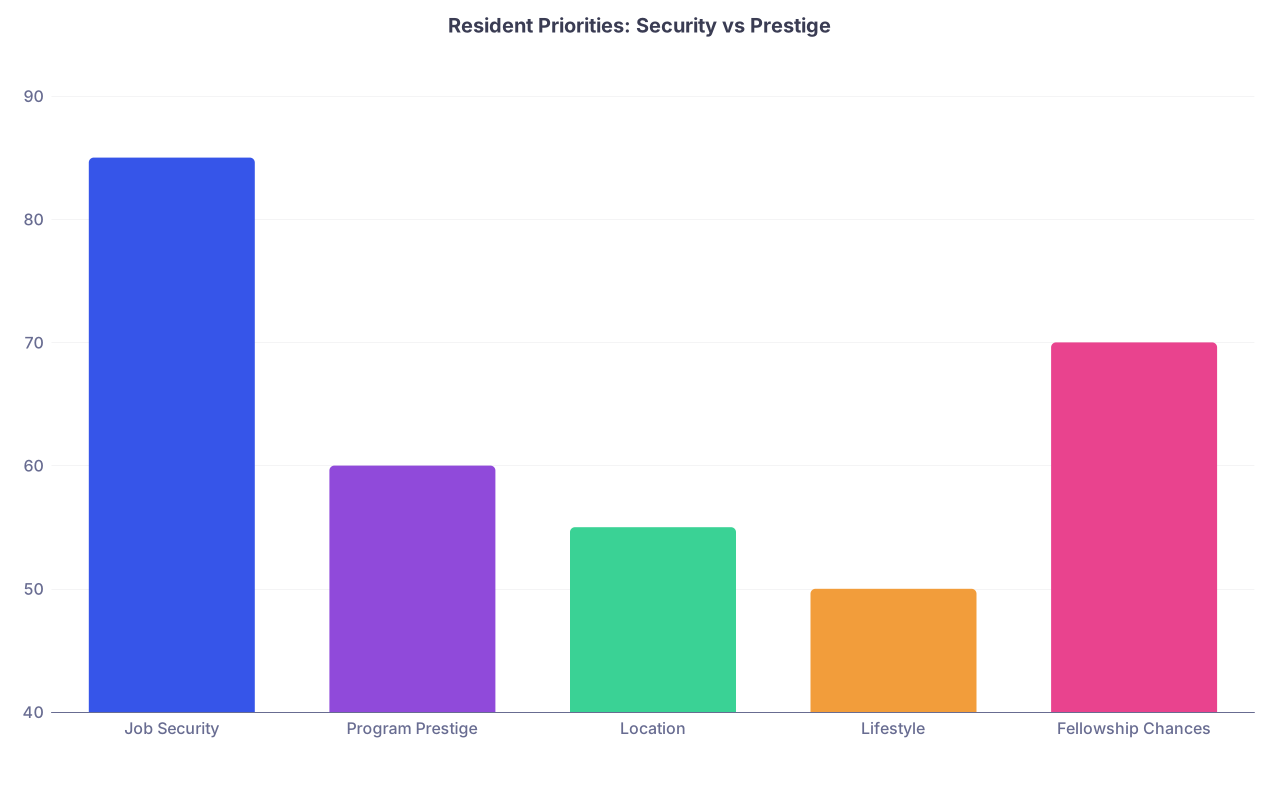
| Category | Value |
|---|---|
| Job Security | 85 |
| Program Prestige | 60 |
| Location | 55 |
| Lifestyle | 50 |
| Fellowship Chances | 70 |
(Think of this as how much weight you should be giving each factor, out of 100. Most people overweight prestige and location.)
Scenario C: You Really, Truly Hate the Idea of Reapplying
Some people can tolerate another ERAS season. Others are barely holding it together now.
If you’re the latter:
- Rank the categorical first.
- Get off the carousel.
- Use your energy to become excellent where you are instead of endlessly re-marketing yourself.
I’ve seen strong students burn out completely during a prelim year because they’re doing two impossible jobs at once: intern + full‑time applicant.
Strategic Way to Build Your Rank List
Here’s a simple decision path that matches how actual program directors think, not Reddit:

| Step | Description |
|---|---|
| Step 1 | Have guaranteed PGY2+ spot? |
| Step 2 | Rank prelims by quality of life |
| Step 3 | Happy long term in categorical specialty? |
| Step 4 | Prioritize categorical spots |
| Step 5 | Realistic shot at target advanced specialty? |
| Step 6 | Choose categorical with best overall fit |
| Step 7 | Compare risk vs upside of prelim |
| Step 8 | Rank strategic prelims higher selectively |
| Step 9 | Rank categorical higher |
| Step 10 | Comfortable reapplying and maybe switching fields? |
Practical steps:
Make two lists
- List A: All categorical spots you’d be okay spending 3–6 years at.
- List B: All prelims you’re considering.
Order List A first based on:
- Overall fit (faculty, vibe, location, support)
- Training quality
- Your happiness outside the hospital
Only then insert prelims above certain categoricals if:
- They clearly advance a realistic advanced/fellowship goal
- You are psychologically and financially able to tolerate another match cycle
If you’re torn between one specific prelim and one specific categorical, do this thought experiment:
Imagine it’s Match Day and your envelope says that prelim. Do you feel relief or immediate anxiety about what comes next year?
Now imagine it says that categorical. Which future makes you breathe easier?
Your gut here is more honest than whatever prestige-scale your brain has built from online forums.
Common Myths That Push People Toward Bad Decisions
Let me kill a few bad ideas I hear every year:
Myth 1: “From a famous prelim, I can go anywhere.”
Reality: You still need numbers, letters, timing, and luck. The name helps, but it doesn’t erase gaps.
Myth 2: “I’ll easily transfer into their categorical program after prelim.”
Reality: Some programs do that. Many don’t. Spots rarely open, and when they do, internal politics rule. Ask them directly about their track record; do not assume.
Myth 3: “I can’t get a good fellowship from a smaller categorical program.”
Reality: People match cards, GI, heme/onc, critical care, etc., from very average IM programs all the time. Strong mentoring and your own performance matter more.
Myth 4: “If I hate my categorical, I’m stuck forever.”
Reality: Switching specialties from within a categorical is hard but absolutely possible. And you’re at least inside the system, with a salary, benefits, and clinical experience.
FAQs
1. If I take a less‑ideal categorical, can I still reapply to a different program or specialty later?
Yes. Residents reapply all the time:
- To switch specialties (e.g., IM → Anesthesia, Surgery → Radiology)
- To move programs for geographic or personal reasons
It’s awkward and logistically messy, but you’re doing it from a position of relative safety: you already have a spot. That’s still easier than reapplying from a one‑year prelim with no guaranteed follow-up.
2. Do program directors look down on people coming from a prelim year?
Not automatically.
What they’ll actually ask themselves is:
- Why did you only do a prelim?
- Did you not match, or was this part of a planned path (e.g., advanced specialty)?
- What did you do with that year—strong letters, research, obvious growth?
A prelim can be neutral or even positive if the story fits your target specialty and you’ve clearly used the year well. But it’s not a free upgrade in their eyes.
3. Are transitional year (TY) prelims better or worse than medicine/surgery prelims?
They’re different tools:
- TY: Often cushier, more elective time, better for advanced fields that don’t care as much about hardcore inpatient training (Rad, Ophtho, Derm, etc.).
- Prelim Medicine/Surgery: Better if you might want to continue in those fields or need strong inpatient experience.
Neither inherently justifies ranking them above a categorical unless they clearly serve a bigger plan.
4. What if my categorical option is truly toxic or has terrible board pass rates?
That’s one of the few times I’d seriously consider a prelim above it. If a program has:
- Repeated, credible reports of abuse or severe dysfunction
- Very low board pass rates
- Horrible ACGME citations or people constantly leaving
…then a strong prelim year while you re-strategize might be safer long-term than committing 3–7 years to a sinking ship. This is not “less‑ideal”; this is “dangerous.” Different category.
5. How much should location factor into prelim vs categorical ranking?
Location matters for your sanity. But letting location trump job security is usually a mistake.
Ask yourself:
- Will being in this city for just one year really change my life trajectory?
- Am I willing to end up in a worse city later because I sacrificed security now?
If location makes a categorical intolerable (e.g., you have a partner, kids, visa limits), that’s different. But choosing a prelim in a cool city purely for vibes, over a stable categorical elsewhere, is rarely smart.
Bottom line?
- A guaranteed categorical spot in a specialty you can live with is usually more valuable than a sexy prelim year with no safety net.
- Rank prelims higher only when they clearly and realistically advance a specific, well‑thought‑out long‑term plan—and you can stomach another match cycle.
- Don’t let prestige or short‑term location excitement trick you into trading years of stability for one shiny line on your CV.


