
The idea that “preliminary residents get less teaching than categorical interns” is lazy hallway wisdom masquerading as fact.
Sometimes it is true. Often it is not. And if you choose programs based on this myth without looking under the hood, you can absolutely sabotage your education for no good reason.
Let me walk you through what actually drives how much teaching you get as a prelim. It is not the word “preliminary” in your contract. It is:
- How the program uses prelims in its staffing model
- The culture of the department you rotate with
- How the formal curriculum is structured (and enforced)
Everything else is noise.
What “Prelim” And “Categorical” Actually Change — And What They Do Not
People talk about prelim vs categorical like they are different species. They are not.
You’re both PGY‑1s. You:
- Admit to the same services
- Write the same notes
- Call the same consults
- Present to the same attendings
- Take the same cross‑cover calls (usually)
The real structural differences are:
Categorical: You’re committed to that specialty in that institution for the full training path. The program “owns” you long term.
Preliminary: You’re there for one year, usually for:
- Anesthesia, radiology, neurology, PM&R, derm, ophtho, rad onc, etc.
- Or as a “transitional” or gap year when reapplying.
Where the myth grows: people assume that because the program doesn’t keep you, they invest less in you. That’s occasionally true. More often, the incentives cut the opposite way.
Programs that rely on prelims to keep their services running need you to function. That forces them to teach you aggressively in the first few months or they eat chaos all year.
Where The Myth Comes From (And Why It’s Outdated)
The “prelims get dumped on and ignored” story mostly comes from three situations I keep seeing:
- Old‑school malignant services where everyone gets dumped on, but prelims have zero reason to tolerate it, so they complain loudly.
- Surgery or medicine programs that over‑matched prelim spots and then used them as buffer labor. (Classic big‑city legacy programs from the 90s and 2000s.)
- Transitional years that marketed themselves as “cush” and then quietly stopped caring about education.
Those stories get repeated at pre‑interview dinners like ghost tales. Nobody brings data. Just phrases like “I heard,” “someone said,” or “my friend’s roommate.”
But here’s the quiet flip side: big, reputable institutions now depend on prelims and transitional interns to keep:
- Night float systems going
- ICU coverage staffed
- Consult services viable
Joint Commission and ACGME do not care if the PGY‑1 is prelim or categorical when they review didactics, supervision, or duty hours. Every PGY‑1 on the roster counts.
So what actually happens on the ground?
Example: Medicine Prelims On Ward Teams
On an academic medicine service, a typical teaching team might be:
- 1 senior (PGY‑2 or PGY‑3)
- 2–3 interns (mix of prelim + categorical)
- Students
If you’re a prelim intern on that team:
- You’re on the same rounding structure
- You go to the same noon conference
- You get pulled to the same morning report
- You staff new admissions to the same attendings
The ACGME doesn’t say: “only categorical interns must have protected didactics.” Programs can’t legally structure “prelim‑only scut blocks” that replace teaching across the year. They can be sloppy, sure, but they can’t formally exempt you.
I’ve seen more than one program try to sideline prelims from clinic or continuity experiences — and then get smacked by internal review or resident feedback because it wrecked team function and morale.
The Real Teaching Differences: By Program Type, Not Contract Type
Stop thinking “prelim vs categorical.” Start thinking: “Which ecosystem am I stepping into, and how do they use their interns?”
Below is the pattern I see repeatedly:
| Program Type | Prelim Teaching vs Categorical |
|---|---|
| Academic IM (big university) | Roughly equal |
| Community IM (service-heavy) | Slightly less, but similar |
| Academic General Surgery | Variable, sometimes worse |
| Community Surgery | Often worse |
| Transitional Year (strong) | Better teaching, more protected |
| Transitional Year (cush name only) | Worse, fragmented |
1. Academic Internal Medicine
Medicine departments at major academic centers (think places like UCSF, BIDMC, Michigan, Emory, etc.) usually plug prelims straight into the same track as categorical interns with:
- Identical ward blocks
- Shared ICU rotations
- Same codes/rapid response exposure
- Shared didactic schedule
Where prelims can feel short‑changed is in:
- Continuity clinic (they might get fewer sessions)
- Longitudinal quality improvement projects
- Mentorship for medicine fellowships (because you’re not staying)
But strictly in terms of day‑to‑day teaching on wards and ICU? It’s essentially the same. If anything, seniors often over‑teach prelims because they know you’re going off to anesthesia, radiology, or derm and want to “send you out right.”
2. Community Internal Medicine
Here the game changes slightly.
Community IM programs that are service‑heavy often run one of two models:
- Everyone is crushed → both prelims and categoricals get minimal teaching because there’s simply no slack.
- Prelims floated to “just service” roles like admitting shifts or night cross‑cover, while categoricals get a bit more protected time in clinic or electives.
Do prelims “get less teaching” here? Sometimes. But the denominator is low: no one is getting the robust academic experience you imagined.
You do not fix that by being categorical instead of prelim. You fix it by not matching into a pseudo‑workhorse program if you actually care about teaching.
The Transitional Year Wildcard: Often More Teaching, Not Less
This is the piece most applicants get completely backwards.
Strong transitional year (TY) programs are often obsessive about:
- Protected didactic time
- Considerable elective time with structured goals
- Simulation, procedure labs, boot camps
- Wellness days that, like it or not, reduce raw service time
Why? Because they’re selling themselves as:
- A safe, well‑structured landing spot for future anesthesiologists, radiologists, dermatologists, ophtho residents, etc.
- A pipeline partner to competitive advanced specialty programs. Those advanced programs do not want their future residents chewed up and spit out by a malignant intern year.
So many TYs at respected community‑academic hybrids or large health systems end up having better teaching and balance than categorical IM at some purely service programs.
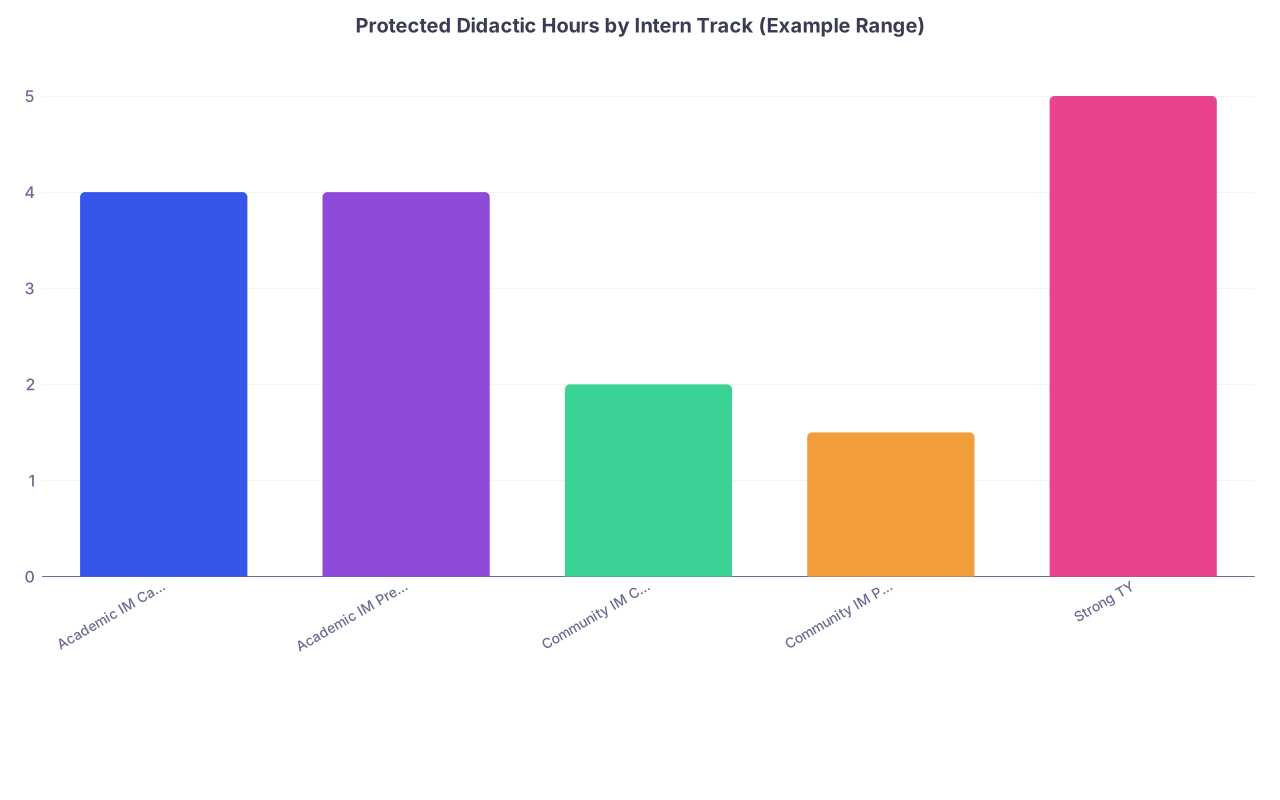
| Category | Value |
|---|---|
| Academic IM Categorical | 4 |
| Academic IM Prelim | 4 |
| Community IM Categorical | 2 |
| Community IM Prelim | 1.5 |
| Strong TY | 5 |
These numbers are illustrative, but the shape is real: strong TYs frequently out‑teach a fair chunk of categorical programs weekly.
Of course, not all TYs are like this. There are “brand name” transitional years coasting on reputation that quietly lean on TYs as fill‑in night float, admissions buffers, or orphan rotation coverage. The brochure says “broad exposure”; reality is “you’re always the extra body.”
Here’s the hinge:
- Good TY: structured, protects your brain, lots of formal teaching.
- Bad TY: fragmented, you bounce between services, nobody feels responsible for you, and teaching becomes opportunistic at best.
Again: prelim vs categorical is the wrong axis. You’re really comparing “programs that designed education” vs “programs that designed staffing and slapped a schedule together.”
Surgery Prelims: Where The Myth Is Most Likely To Be True
I am not going to pretend here. General surgery has some of the biggest gaps between categorical and prelim experiences.
Surgery programs sometimes:
- Assign prelims to more night float or trauma admitting blocks
- Give priority for OR cases and clinics to categoricals
- Exclude prelims from certain skills labs or retreat days
- Subtly (or explicitly) signal: “You’re just here for a year”
This does not mean all surgical prelim spots are garbage. But you cannot assume equality.
A few hard questions you should ask any surgery program if you’re ranking a prelim spot:
- “How many OR days do prelim interns have on average compared to categoricals?”
- “Do prelims attend the same M&M, skills labs, boot camps?”
- “How many past prelims matched into categorical surgery (here or elsewhere) in the last 3–5 years?”
If the answers are vague, defensive, or dismissive, believe the behavior, not the website.
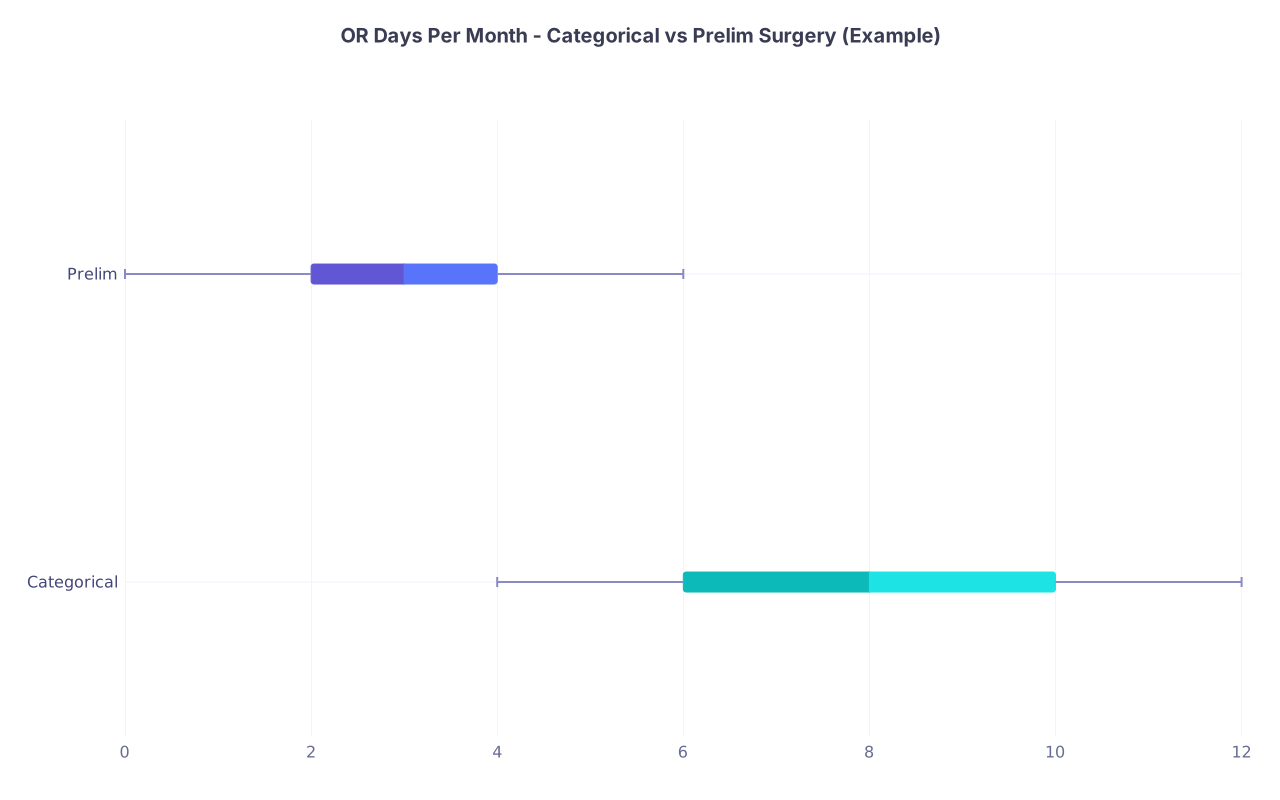
| Category | Min | Q1 | Median | Q3 | Max |
|---|---|---|---|---|---|
| Categorical | 4 | 6 | 8 | 10 | 12 |
| Prelim | 0 | 2 | 3 | 4 | 6 |
In some surgical programs, prelims really do get systematically less meaningful teaching. That’s not a “prelim problem.” It’s a program problem. And it’s usually obvious if you ask the right people.
So How Do You Actually Judge Teaching As A Prospective Prelim?
You are not powerless here. There are concrete things you can do.
1. Stop Asking “Do Prelims Get Good Teaching?”
Everybody on the tour will say “yes.” It’s meaningless.
Instead, ask for specifics that expose structure:
- “How many hours per week of protected conference do interns actually attend?”
- “Are prelims pulled from conference for pages or scut?”
- “Who is the program leadership contact specifically for prelims or TYs?”
- “Do prelims have formal evaluations and mentorship, or just end‑of‑year sign‑out?”
You want to know if there is:
- A defined curriculum
- Accountability for involving prelims
- Someone who is responsible for your experience
2. Look At The Block Schedule — And Who Owns You
Ask to see a sample intern schedule for a prelim or TY. You’re looking for:
- Number of ICU, wards, and night blocks
- How many “orphan” rotations (admitters, float, generic “coverage”)
- How many electives and who supervises them

| Step | Description |
|---|---|
| Step 1 | Prelim IM |
| Step 2 | Wards 4-5 blocks |
| Step 3 | ICU 1-2 blocks |
| Step 4 | Electives 2-3 blocks |
| Step 5 | Float/Night 2-3 blocks |
| Step 6 | Categorical IM |
| Step 7 | Clinic/Continuity 2-3 blocks |
If prelims are disproportionately placed on float and nights while categoricals are blessed with electives/clinic, your exposure to direct teaching will be lower, no question.
But note the reason: schedule design. Not your prelim label.
3. Ask Current Prelims Without Faculty Present
The single most reliable data point: a five‑minute hallway chat with a current prelim.
Good questions:
- “Did you feel like an actual member of the program, or a temp worker?”
- “How often do you sit at a table with attendings to discuss cases in a structured way?”
- “If you had to do it again, would you rank this prelim spot the same?”
Pay attention to tone. Watch for:
- Long pauses before answers
- Phrases like “it’s workable” or “you get through it”
- Obvious over‑selling like “it’s amazing, we learn so much all the time” (often code for the opposite)
What The Data Actually Say: Teaching Is Driven By Culture, Not Contract
Let me summarize what decades of resident experience, accreditation rules, and staffing realities add up to:
- ACGME standards for teaching and supervision apply to all PGY‑1s. Programs do not get a free pass because you’re “just a prelim.”
- Many strong IM and TY programs give prelims nearly identical or better teaching than some categorical tracks at service-heavy places.
- Some surgical and weaker community programs clearly treat prelims as expendable labor, and the teaching gap is obvious once you look.
- The correlation is between “programs that care about education” and “good teaching,” not between “categorical status” and “good teaching.”
So the myth — “preliminary residents get less teaching than categorical interns” — is wildly oversimplified at best, and outright wrong in a large chunk of cases.
The better mental model:
Prelim = one‑year contract.
Teaching quality = function of program culture, schedule, and leadership.
Connect the right pieces.
Years from now, you won’t be bragging about being categorical or prelim; you’ll remember who actually taught you how to take care of sick patients when you were terrified and clueless. Choose your year based on that reality, not on the labels people whisper about in the hallway.