
The idea that “doing a prelim year means you failed” is flat-out wrong.
I know that voice in your head doesn’t care. It’s already screaming: “If I end up prelim I’ll be labeled weak, unwanted, second-class. Programs will judge me forever.”
Let’s drag that into the light and actually look at how programs see preliminary years—transitional year, prelim medicine, prelim surgery—not how your 3 a.m. brain tells the story.
First: What a Preliminary Year Actually Is (Not the Horror Version in Your Head)
A preliminary year is just a 1-year internship. That’s it. Not a scarlet letter. Not a permanent caste system.
Most common flavors:
- Transitional Year (TY)
- Preliminary Internal Medicine
- Preliminary Surgery
- Less common: prelim anesthesiology, prelim radiology, etc. (usually integrated, but there are weird one-off setups)
Core reality:
It’s PGY-1 like everyone else. You’re an intern. You’re getting paid. You have patients. You’re in the system.
Where it gets messy is what your brain does with it.
You’re probably thinking one of these:
- “I only got a prelim because I wasn’t good enough for categorical.”
- “Future programs will see prelim on my CV and assume I was a reject.”
- “A prelim spot is basically ‘we’ll use you for a year and toss you.’”
- “If I don’t have a guaranteed PGY-2, I’m screwed.”
I’ve heard program directors actually talk about prelims in real meetings. That’s not how they see it.
How Programs Actually View a Preliminary Year
Let me be blunt: programs care about three things with prelims:
- Can you safely function as an intern?
- Will you make their lives harder or easier?
- Does this year explain something about your trajectory in a coherent way?
That’s it. The whole “prelim = failure” narrative mostly lives in students’ heads and occasionally in toxic group chats.
Here’s the more honest breakdown.
1. They don’t see it as “you failed” — they see it as “you trained”
Program directors look at previous clinical experience as a positive, not a stain.
They’ll literally say stuff like:
- “Oh, they’ve done a prelim year? Good, they know how to handle nights.”
- “They won’t need hand-holding on day one.”
- “They survived intern year already; they’ll be functional.”
For internal medicine, EM, anesthesia, radiology, PM&R, neurology—lots of fields—having a solid prelim/TY is actually a selling point. Especially if:
- You have strong letters from that year.
- Your evals say you’re reliable and easy to work with.
- You didn’t ignite the hospital.
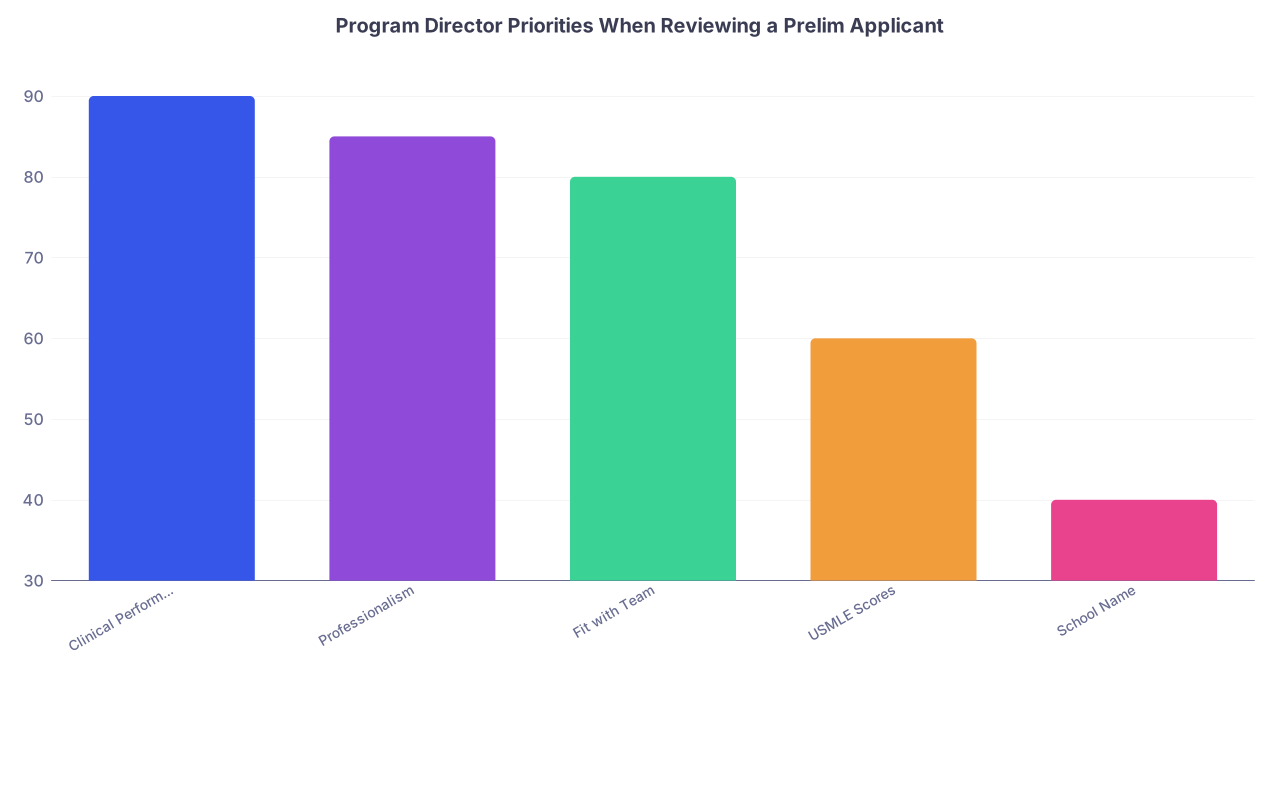
| Category | Value |
|---|---|
| Clinical Performance | 90 |
| Professionalism | 85 |
| Fit with Team | 80 |
| USMLE Scores | 60 |
| School Name | 40 |
Are there some old-school people who see prelim and think “maybe this person struggled”? Sure. But when you add context—why you did the prelim and what you did with it—that usually dissolves.
2. There are different prelim narratives—and programs know the difference
Programs aren’t stupid. They can usually tell which bucket you’re in:
| Scenario | Typical Program Interpretation |
|---|---|
| Needed a prelim before advanced (e.g., radiology, derm) | Standard pathway, expected |
| Aimed for very competitive field, matched prelim only | Took a shot; now regrouping |
| Switched specialties after starting | Figured out better fit, not failure |
| Applied late/with red flags, got prelim as a foothold | Second chance, watch performance |
| International grad using prelim to enter system | Proving self in US training |
Only one of those is even kind of negative—and even then, strong performance can rewrite the story.
You’re terrified they’ll think: “No one wanted this person.”
They’re more likely thinking: “Okay, what happened, and what did they do with the year?”
3. Prelim interns are not “disposable” in the way you fear
Is there a grain of truth that some programs use prelims as service workhorses? Yes. Especially in surgery-heavy hospitals. They need bodies. That’s not a secret.
But that’s not the same as “we don’t care about you” or “you’re invisible in the match.” These programs still need:
- Good board pass rates
- Safe patient care
- Decent reputation with other programs
Tormenting interns and sending broken humans into the system is bad optics. Most PDs get that.
Also, you’d be surprised how often I’ve seen this:
- Prelim IM intern crushes the year → PD advocates for them → they slide into a categorical IM spot there or get strong letters to go elsewhere.
- Prelim surgery intern → realizes they’d rather do anesthesia → surgery PD writes “strong team player, technically solid, great work ethic” → anesthesia program snaps them up.
Again: performance matters way more than the label “prelim.”
When a Prelim Year Actually Helps You
Your brain is telling you: “Prelim = permanent red flag.”
Reality: lots of people quietly use a prelim year to fix or upgrade their trajectory.
Situation A: You swung for a hyper-competitive specialty and missed
Example: You apply to ortho or derm. You get a prelim surgery or prelim medicine spot, but no categorical.
You think: “Match failure. I’m doomed.”
What programs see next cycle if you play it right:
- This person worked hard enough to secure something rather than sit out.
- They didn’t bail—they showed up and did a real job.
- They have updated letters saying, “We’d take them as categorical if we could.”
I’ve seen people go:
- Prelim surgery → anesthesia
- Prelim medicine → neurology
- Prelim TY → radiology
- Prelim medicine → EM, cards-focused IM, hospitalist-track IM
Your prelim year gives you new currency:
- Fresh, US-based, concrete performance.
- An explanation that isn’t just “I bombed Step” but “I matured and proved I can do this.”
Situation B: You needed time to fix a problem
If you’ve got:
- Low Step/COMLEX scores
- Gaps
- Academic probation
- A scary professionalism note in your dean’s letter
Programs are nervous about taking a 3+ year gamble on you as categorical. A 1-year prelim? Less risk.
You can use that year to:
- Prove professionalism isn’t an issue.
- Stack up “this person is dependable” comments.
- Retake Step 2 (if appropriate) and score better.
- Show growth instead of just promises.
For some people, prelim is literally the only realistic way into the US system. Especially for IMGs. That’s not failure. That’s your doorway.
When a Prelim Year Can Hurt You (and How to Stop the Bleeding)
I’m not going to sugarcoat everything. There are ways a prelim year backfires.
Potential landmines:
- Poor evaluations: “Frequently late. Struggled with basic responsibilities.”
- Burning bridges: clashing with senior residents/PD, documented unprofessionalism.
- Failing Step 3 while in prelim and not addressing it.
- Applying lazily for PGY-2+ and assuming “someone will pick me up.”
Programs don’t freak out about the existence of a prelim year. They care what you did with it.
If you’re staring down a possible prelim:
- Decide early: Am I treating this like a 12-month audition or a 12-month pity party?
- Ask explicitly for feedback: “What can I improve to be a strong candidate for [field]?”
- Get 2–3 strong letters from faculty who actually worked with you.
Your worst-case fear is: “I do prelim, then nobody wants me, then I’m floating.”
That worst case becomes more likely if you emotionally check out or act like prelim is beneath you.
How Programs Think About Prelim vs Categorical (In Plain English)
Let’s stop pretending this isn’t partly strategic for them too.
| Aspect | Prelim Spot | Categorical Spot |
|---|---|---|
| Length of commitment | 1 year | 3–7 years |
| Risk tolerance | Higher (more willing to take chances) | Lower (want safer bets) |
| Expectation of board performance | Important but less long-term impact | Very important |
| Willingness to take “non-traditional” | Higher | Lower |
| Chance to convert to categorical | Sometimes | N/A |
This is why a prelim spot often goes to:
- People who are a bit riskier on paper
- Strong people who missed in competitive specialties
- IMGs who need US experience
- People switching fields
And no, that doesn’t translate to “garbage bin.” It translates to “shorter contract, more flexibility.”
The Story You Tell About Your Prelim Year (Programs Listen To This)
One big thing PDs care about: can you tell a coherent story?
Imagine two applicants, same history:
- Didn’t match categorical
- Did a prelim medicine year
- Now reapplying
Applicant 1, anxious and bitter: “I had no choice. I just ended up in this prelim spot. It wasn’t what I wanted. I’m trying again because I still really want [specialty].”
Applicant 2, honest but grounded: “I didn’t match into [specialty] the first cycle. I chose a prelim medicine year because I still wanted strong clinical training and a way to grow. Over this year, I’ve improved my clinical judgment, confirmed that I’m deeply drawn to [specialty X], and now I have clearer goals and stronger skills to bring to your program.”
Who do you think they’ll rank higher?
You’re terrified they’ll interrogate you about “why prelim?”
They mostly want to know:
- Did you learn anything?
- Are you stable and safe now?
- Do you actually want their field and not just “anything categorical”?
The Ugly Social Part: What Your Peers Think vs What Matters
The shame piece? That’s mostly about other students and your own expectations.
Class group chats, Reddit, random attendings with zero stake in your future—these are the people who say stuff like:
- “Prelim is just one step above SOAP.”
- “If you’re good, you never end up prelim.”
- “Why waste a year?”
They don’t decide your rank on any list.
Program directors do. Chairmen do. Core faculty do. And those people think much more in terms of:
- “Are you coachable?”
- “Will you show up?”
- “Do you learn from setbacks or get stuck in them?”
If someone sneers at your prelim year, that’s about their insecurity, not your worth. I’ve seen absolute rock stars come through prelim or TY and end up:
- Chief resident in their eventual categorical program
- Matched into fellowship at big-name places
- In faculty positions mentoring others
Their CV has: Prelim [X] PGY-1. Then? Nobody cares. It’s a line. Not a warning sign.
How to Talk About a Prelim Year in Interviews/Personal Statements
You’re scared they’ll grill you. Let’s disarm that.
Basic framework that works:
Name what happened without drama
“I initially applied to [specialty] and matched into a preliminary medicine position.”State the reason you did the prelim year
“I wanted to continue my training, improve clinically, and reassess my career goals with more experience.”Highlight what you gained
“This year has strengthened my [skills], taught me [lessons], and confirmed my interest in [new or same specialty].”Show you’re not running away from something; you’re moving toward something
“Now I’m seeking a categorical position in [specialty] where I can build on this foundation long-term.”
Short. Calm. Adult. No self-flagellation.
Quick Reality Check With Some Numbers
No, I don’t have a perfect NRMP pie chart just for prelim folks. But we do know:
- Thousands of prelim and TY positions fill every year.
- Many are designed for people who will move on to PGY-2 elsewhere (radiology, anesthesia, derm, ophtho, etc.).
- A non-trivial chunk of people re-match into different specialties successfully after doing a prelim.
You are not some bizarre outlier if you go this route. You’re…normal. Just not on the “straight line” path that everyone pretends is standard.
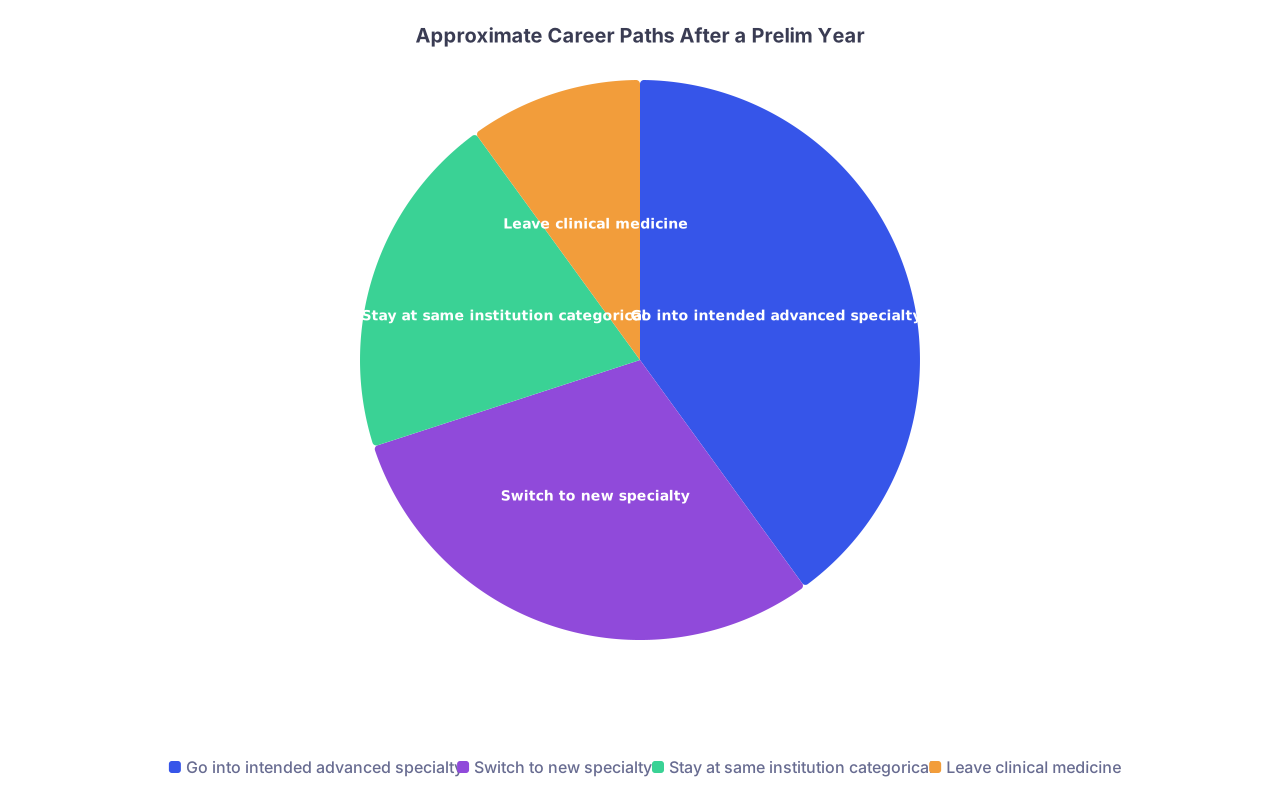
| Category | Value |
|---|---|
| Go into intended advanced specialty | 40 |
| Switch to new specialty | 30 |
| Stay at same institution categorical | 20 |
| Leave clinical medicine | 10 |
Is this exact? No. But you can see the point: a huge majority land somewhere meaningful.
If You’re Sitting There Thinking “But What If I End Up With Only a Prelim Spot?”
Let’s do the ugly “what if” scenario your brain keeps replaying.
Worst-case fantasy:
You match only into a prelim. No advanced spot. No guarantee. You feel humiliated.
Reality-based version:
- You still have a job July 1. You’re not locked out.
- You get to:
- Build a new set of mentors.
- Get fresh letters.
- See what actual doctor work feels like.
- You reapply as someone with US clinical experience, not just test scores and school grades.
Is it more stressful than having a straight-through categorical? Sure.
Is it a dead end? No. Unless you treat it like one and mentally check out.

| Step | Description |
|---|---|
| Step 1 | Match Prelim Only |
| Step 2 | Crush Intern Year |
| Step 3 | Struggle and Withdraw |
| Step 4 | Apply Same Specialty Again |
| Step 5 | Switch Specialty |
| Step 6 | Convert to Categorical at Same Program |
| Step 7 | Reassess Career Options |
You have multiple branches that still lead to you being a practicing physician.
FAQ (5 Questions)
1. Will future programs automatically assume I failed if they see a prelim year on my CV?
No. They’ll assume you took a 1-year position. What they think beyond that depends on the story you tell and your performance there. Strong letters and good evals flip the narrative from “maybe they struggled” to “this person has real-world experience and resilience.”
2. Is a transitional year better than a prelim medicine or prelim surgery year?
Not universally. TY is often cushier and more flexible, which is nice for lifestyle and Step 3. But prelim medicine can be great if you’re headed to cards, pulm, EM, or IM-associated fields. Prelim surgery can help if you might still want surgical or procedural specialties. Programs mostly care: did you do well where you were?
3. Can I switch specialties after a prelim year, or am I locked into what I started?
You can absolutely switch. People do it all the time: prelim surgery to anesthesia, prelim medicine to neurology or EM, TY to radiology, etc. Your prelim year doesn’t chain you to that specialty—if anything, it can help clarify what you actually want and show other fields that you can function clinically.
4. What if my prelim year is at a “no-name” community program—will big-name places ignore me later?
Name matters less than you think. A smaller community program with great letters that say you’re reliable, smart, and pleasant is often more powerful than a big-name place where you’re anonymous. Big-name categorical later is still possible if your performance and narrative are strong.
5. Is it ever better to not match at all than to match into a prelim year?
In almost all cases, a prelim year is better than sitting out. It keeps you clinically active, gives you new mentors and letters, and shows programs you didn’t just give up. The only time I’d hesitate is if the prelim is clearly malignant and you have a strong backup plan (research year with guaranteed support, reapplying with substantial changes). For most people, though, taking the prelim is the smarter, safer move.
Key points to hold onto:
- Programs don’t see “prelim” and stamp “failure” on your file; they look at what you did with that year.
- A prelim year can be a bridge, not a verdict—especially if you show up, work hard, and collect strong letters.
- Your story about the prelim matters more than the fact of it: frame it as growth and evidence, not shame.