The biggest misunderstanding about “big city safety-net training” is that people treat New York, Los Angeles, and Chicago as interchangeable. They are not. The medicine feels different. The system problems feel different. Even the way you suffer on call feels different.
Let me break this down specifically.
What “Safety‑Net” Actually Means On The Ground
People throw around “safety‑net” as if it is a vibe. It is not. It has very specific operational consequences for your day‑to‑day work.
In simple terms: safety‑net hospitals are the places that cannot say no. They absorb the underinsured, undocumented, uninsured, the socially complicated, the medically neglected. In each of these three cities, that role sits on different shoulders.
| City | Main Public System | Example Flagship Hospital | Typical Bed Size |
|---|---|---|---|
| NYC | NYC Health + Hospitals | NYC Health + Hospitals / Bellevue | 800–900 |
| LA | Los Angeles County DHS | LA County + USC Medical Center | 600–700 |
| Chicago | Cook County Health | John H. Stroger Jr. Hospital | 450–500 |
The culture you get in residency springs from:
- Who pays (state, county, city, mix with private academic partners).
- How many competing hospitals share the safety‑net burden.
- Immigration patterns, housing policy, and local politics.
New York, Los Angeles, and Chicago line up very differently on those axes.
New York City: Fragmented Giants And Maximal Volume
New York training at a safety‑net feels like controlled chaos that someone wrapped in six layers of bureaucracy.
The Landscape
NYC Health + Hospitals is the largest public health system in the US: 11 acute‑care hospitals spread across five boroughs, plus Gotham clinics. Overlay that with big academic anchors:
- Bellevue (NYU affiliate)
- Harlem, Kings County, Lincoln, Jacobi, Elmhurst (various affiliations with Columbia, Weill Cornell, Mount Sinai, Einstein, etc.)
Each hospital is its own micro‑culture. You could be in Manhattan doing high‑acuity trauma at Bellevue or in Queens at Elmhurst drowning in complex immigrant medicine.
What almost all share:
- Enormous ED volumes
- High uninsured / Medicaid proportions
- Under‑resourced ancillary support compared to glossy private Manhattan hospitals
Day‑to‑Day Resident Experience
NYC safety‑net work tends to feel like this:
Insane patient churn with extreme social complexity
You will have days where your census is full of:- Undocumented patients with end‑stage disease who have never seen outpatient care
- Homeless patients with dual diagnoses (severe mental illness + substance use)
- Recently arrived immigrants with zero prior records in the system
The mental load is less “what is the diagnosis?” and more “what can I realistically implement before they disappear?”
Language and cultural fragmentation
Spanish is mandatory for survival in many units, but you will also see:- Bengali, Haitian Creole, Mandarin/Cantonese, Arabic, Russian, Urdu, West African languages
The interpreter phone / iPad is your lifeline. Expect 50–70% of patient interactions needing language assistance in some services at places like Elmhurst or Lincoln.
- Bengali, Haitian Creole, Mandarin/Cantonese, Arabic, Russian, Urdu, West African languages
Bureaucracy as a constant antagonist
Outpatient follow‑up at city clinics, charity medication programs, housing placement—everything takes forms, calls, faxes, and time you do not have.
I have seen interns spend 40 minutes trying to arrange a cab voucher to get a patient to a clinic, only to have the clinic cancel because “the charity slot is full until next month.”Rotation structure and call
Call schedules vary by program, but safety‑net services in NYC tend toward:- Heavy ED time (trauma, psych holds, boarding)
- Big inpatient censuses (15–20+ on ward teams is not rare in some programs)
- Frequent cross‑cover on patients with minimal documentation or clear disposition plans
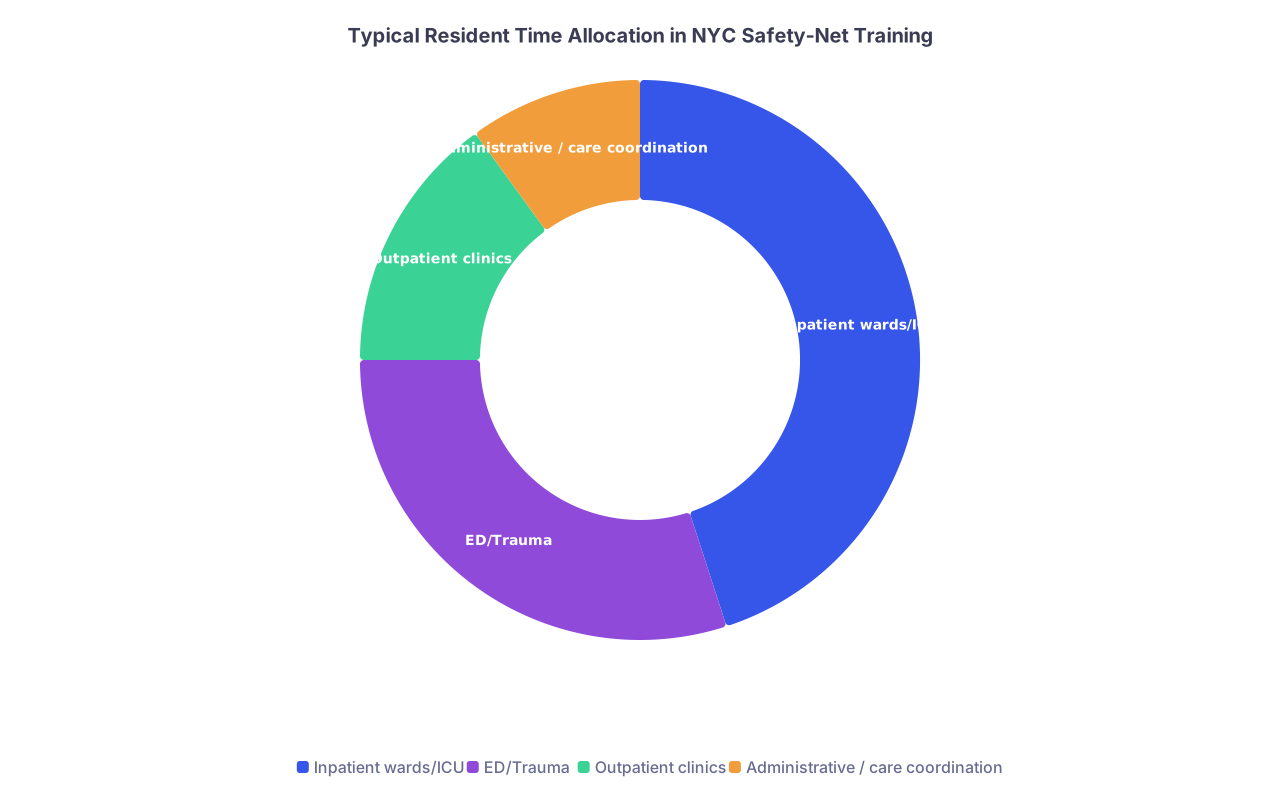
| Category | Value |
|---|---|
| Inpatient wards/ICU | 45 |
| ED/Trauma | 30 |
| Outpatient clinics | 15 |
| Administrative / care coordination | 10 |
NYC training teaches you to move fast in chaos, manage incomplete systems, and live with partial victories. You become comfortable with uncertainty and structural barriers.
Clinical Breadth and Pathology
NYC’s draw is variety:
- World‑level HIV, TB, and opportunistic infections (Bellevue and Harlem have deep HIV histories).
- Very late‑presentation chronic disease: untreated diabetes, hypertensive emergencies, severe CKD in younger patients.
- Injury patterns: more blunt trauma than LA (subway falls, pedestrian accidents), assaults, some gun violence depending on borough.
You also see a lot of advanced mental illness poorly treated in the community, cycling through EDs and inpatient units. Psych consults are constant.
Lifestyle and System Quirks
People romanticize “living in New York” without doing the math.
- Commute reality: Residents often live 40–60 minutes away by subway because housing near the hospital is expensive or nonexistent. Night float + long commute is brutal.
- Cost of living: On a standard resident salary, you are squeezed. Roommates are standard. Children or single‑income households strain hard.
- Fragmented supports: Different safety‑net hospitals have very different wellness resources, EMRs, ancillary staffing. You can rotate at one place and think, “This is manageable,” then cross the East River and feel you joined a different era.
Summary Judgment on NYC Safety‑Net Training
Strengths:
- Sheer volume and variety of pathology
- Deep experience with immigrant medicine and language barriers
- Strong academic linkages with brand‑name universities
Weaknesses:
- System fragmentation and bureaucratic drag
- High cost of living and long commutes
- Variable support services; burnout risk is real
If you thrive in loud, crowded, overcomplicated systems and want maximal diversity of patients and pathology, NYC safety‑net is the purest form of that.
Los Angeles: County‑Heavy, Trauma‑Rich, Immigration at Scale
Los Angeles safety‑net training feels more consolidated and, in some ways, more coherent than New York. But the scale is enormous.
The Landscape
The core of LA’s safety‑net system is Los Angeles County Department of Health Services:
- LA County + USC Medical Center (major academic hub)
- Harbor‑UCLA
- Olive View‑UCLA
- Plus a network of county clinics and public-private partnerships
Then layer in:
- MLK Community Hospital in South LA
- Various Federally Qualified Health Centers (FQHCs)
LA County + USC (LAC+USC) and Harbor‑UCLA are the prototypical county training grounds that applicants think of.
Day‑to‑Day Resident Experience
LA County culture is county medicine writ large: you are the doctor, social worker, and sometimes amateur immigration lawyer.
Massive immigrant and undocumented populations
Spanish dominates, but you also see large communities speaking:- Armenian
- Korean
- Tagalog
- Vietnamese
- Mixtec and other indigenous Mexican languages
County hospitals in LA are ground zero for caring for people who cannot or will not go anywhere else. The “clinic desert” phenomena in some neighborhoods means county clinics are slammed.
Trauma and ED intensity
LA’s car culture and violence patterns translate into a different trauma feel than NYC. More:- MVCs at highway speeds
- Pedal cyclist trauma
- Gunshot wounds in certain catchment areas
- Occupational injuries
LAC+USC trauma resuscitation bays on a weekend night feel like a production line. If you are surgery, EM, or anesthesia, this is where you get reps that are hard to match.
Resource constraints with a more modern shell
Many LA county facilities look newer than their NYC counterparts, but the underlying resource constraints are similar:- Delays in imaging and consults when volumes spike
- Shortages of social work coverage after hours
- Limited post‑acute care options for undocumented or uninsured people
Residents often become adept at “county workarounds”—knowing which clinic director will squeeze in an urgent consult, which charity pharmacy will honor a particular workaround prescription.
Geography and commuting
Unlike New York, you are not on a subway. You are in a car. Many residents drive 30–60 minutes to work, with rush‑hour traffic adding unpredictability. Nights and 24‑hour calls followed by a long drive home are a real fatigue hazard.
Clinical Breadth and Pathology
LA safety‑net pathology skews like this:
- High burden of advanced liver disease (alcohol, viral hepatitis, NAFLD)
- High prevalence of diabetes and obesity‑related complications
- HIV burden, but often better resourced through specific programs compared with older NYC narratives
- TB and parasitic diseases in specific immigrant populations
On the surgical/trauma side, LA’s volume is legendary. You get more penetrating trauma than Chicago in many settings, and more high‑speed blunt trauma than dense‑urban NYC.
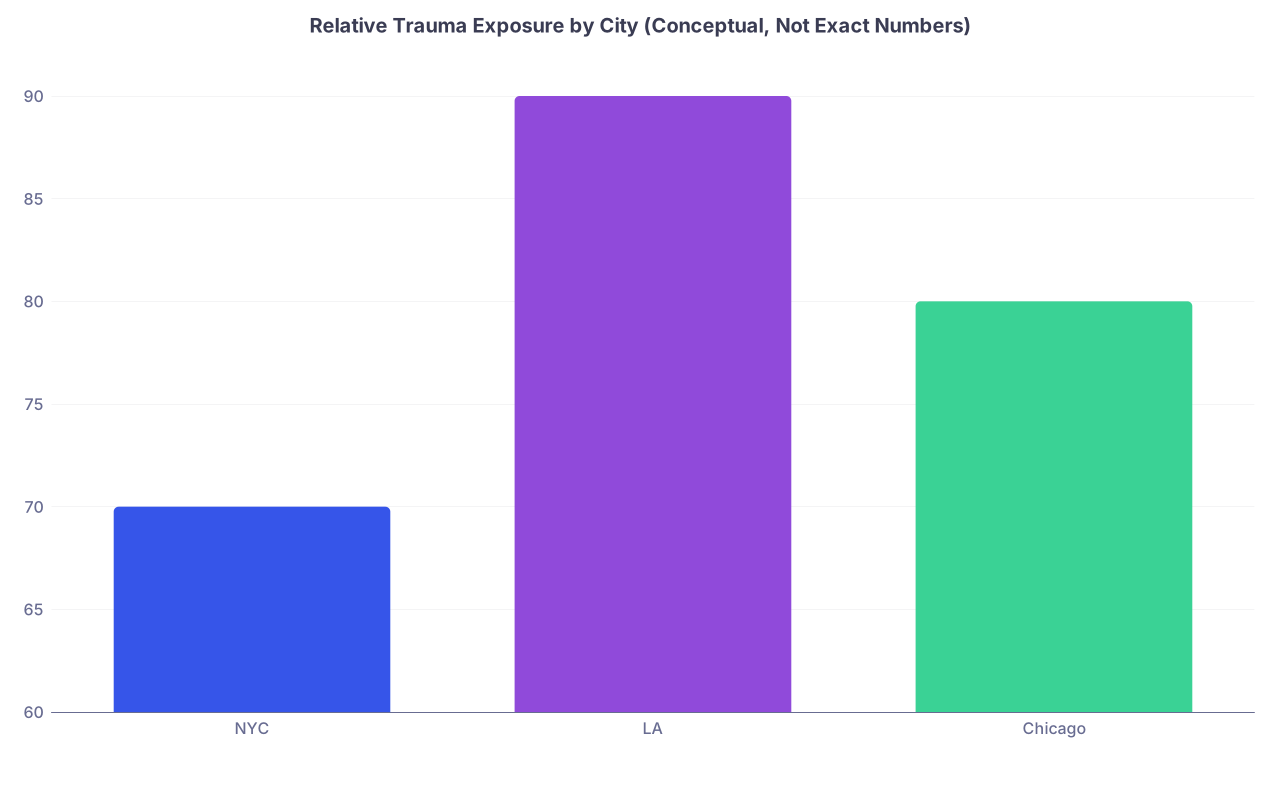
| Category | Value |
|---|---|
| NYC | 70 |
| LA | 90 |
| Chicago | 80 |
(Think of 100 as “maximal trauma exposure among major US training sites.”)
System Culture and Academic Integration
LA county programs tend to have tighter, more stable linkages to single universities:
- LAC+USC with USC
- Harbor‑UCLA with UCLA
- Olive View with UCLA
This creates more cohesive academic cultures compared with NYC’s patchwork affiliations. The downside: fewer distinct “flavors” within one city. The upside: you know what you are getting.
Teaching quality is often strong, with attendings deeply committed to county populations. Many chose to stay in the system despite lower pay because they believe in the mission. That seeps into how they train residents.
Lifestyle and Future‑Facing Issues
Residents often imagine LA as palm trees and off‑day beach trips. Reality:
- You see sunlight mostly through hospital windows.
- Cost of living is high, though depending on where you live, sometimes slightly less punishing than Manhattan or Brooklyn.
- Commute eats more of your life than you think.
Future‑of‑medicine angle in LA county:
- Strong movement toward telehealth and community‑based chronic disease management via county clinics.
- Pilot programs around homelessness medicine and street outreach that residents will intersect with, especially in IM, psych, FM, and EM.
- Decent exposure to carceral health (jail/prison medicine) given county responsibilities.
Summary Judgment on LA Safety‑Net Training
Strengths:
- Extremely strong trauma and acute care exposure
- Deep, sustained experience with undocumented/immigrant populations
- More consolidated county system with clearer academic pairings
Weaknesses:
- Commute fatigue and car dependence
- Resource constraints that can feel arbitrary and political
- Slightly less diversity of training environments within the city compared to NYC
If you want county medicine concentrated into large, high‑impact centers with a heavy dose of trauma and immigration‑focused care, LA is where that model is most coherent.
Chicago: Classic County Medicine With Midwest Grit
Chicago safety‑net training is more compact geographically but just as intense. The vibe is different. Less spectacle, more quiet grind.
The Landscape
The core structures:
- Cook County Health: John H. Stroger Jr. Hospital (the heart of “County” training)
- Northwestern’s link with Erie Family Health Centers and some safety‑net affiliates
- UChicago’s connection with South Side community hospitals (past and present vary)
- Sinai Chicago, Mt. Sinai Hospital on the West Side
- Other community safety‑nets in West and South Side neighborhoods
Stroger Hospital (Cook County) is the archetype: if you say “I trained at County” in Chicago, most people assume Stroger.
Day‑to‑Day Resident Experience
Chicago county work has its own flavor:
Gun violence and trauma
Chicago’s gun violence has been widely covered. For residents, this is not a talking point; it is the pager going off repeatedly.You see:
- Multiple GSWs in a night, often young patients
- Complex social dynamics around retaliation, safety of discharge destinations
- Patterns of recurrent visits among the same neighborhoods and sometimes the same individuals
Trauma exposure at Stroger is very high. EM, surgery, anesthesia, and critical care residents get dense procedural training.
Chronic disease in structurally abandoned neighborhoods
Large swaths of Chicago’s West and South Sides are health‑care deserts. Safety‑net centers become the single reliable entry point. That means:- Very late stages of CHF, COPD, CKD
- Poorly controlled diabetes with advanced complications (osteomyelitis, amputations, blindness)
- Substance use comorbid with chronic pain and mental illness, in a city with uneven access to addiction treatment
Systems that are rough but focused
County hospitals in Chicago often feel older and more austere than big private centers downtown. However, the systems are surprisingly mission‑aligned:- Fewer competing bureaucracies than NYC
- Strong identity around serving the county population
- Longstanding trauma systems coordinated with EMS
Documentation can still be painful. Outpatient access is still a slog. But there is less of the “12 overlapping agencies each owning 10%” feeling.
Weather and its consequences
This is not academic. Chicago winter changes your medicine:- Frostbite, hypothermia in the unhoused
- Poor chronic disease control when people cannot get to clinics in snow/ice
- Volume spikes with extreme cold or heat waves
Residents walk to bus stops in negative wind chills after night shifts. That colors your experience in ways sunny‑coast folks underestimate.
Clinical Breadth and Pathology
Chicago safety‑net pathology leans into:
- Violence‑related trauma (GSWs, stabbings)
- Chronic disease sequelae from fragmented primary care
- Substance use (heroin, fentanyl, alcohol), with regional patterns in each neighborhood
- Infectious disease: HIV, HCV, serious soft tissue infections in IV drug users, TB in specific populations
You get less of the massive multi‑language immigrant mix seen in NYC/LA, but still meaningful immigrant communities (Polish, Mexican, African, South Asian) depending on clinic location.
Academic and Program Culture
A few realities:
- Cook County has a clear identity: high‑acuity county training with a long history of producing strong, resilient clinicians.
- University programs (Northwestern, UChicago, Rush) interact with safety‑net populations through specific rotations and clinic partnerships, but their core inpatient experience is more mixed (private + safety‑net integration rather than pure county).
- Teaching can be excellent, but it is very service‑heavy. Residents sometimes feel like “we are here to run the hospital,” because you are.
Chicago programs also often have tighter resident communities. People know they are in a tough system in tough weather, and that mutual understanding builds cohesion.
Lifestyle and Future‑Facing Issues
Compared to NYC and LA:
- Cost of living: Significantly more reasonable. You can live closer to the hospital without annihilating your budget.
- Commute: Often shorter. Some residents genuinely walk or have 10–20‑minute drives.
- Future of medicine: City and county are experimenting with violence interruption programs, MAT (medication‑assisted treatment) expansion for OUD, and integration with community organizations on the South and West Sides.
Where Chicago lags is the large‑scale digital health and telemedicine innovation culture you see seeping into LA and NYC from their tech/finance sectors. It exists, but it is less in your face during residency.
Summary Judgment on Chicago Safety‑Net Training
Strengths:
- High trauma exposure, especially penetrating trauma
- Deep experience with advanced chronic disease and substance use
- Strong county identity and often tighter resident camaraderie
- More sustainable cost of living and commutes
Weaknesses:
- Fewer language and global‑health‑like experiences compared to NYC/LA
- Brutal winters that exacerbate both patient issues and resident fatigue
- Less density of different safety‑net training environments within one city
If you want serious trauma, classic county medicine, and a city where your salary stretches further, Chicago is usually the more rational—but less glamorous—choice.
Side‑By‑Side: How Training Really Compares
Boil this down to what you will actually feel three years into residency.
| Factor | NYC | LA | Chicago |
|---|---|---|---|
| Main system type | City + public corp (H+H) | County (LA County DHS) | County (Cook County) |
| Trauma emphasis | High, more blunt / assault | Very high, blunt + penetrating | Very high, especially penetrating |
| Immigrant language mix | Extreme, many languages | High, Spanish + Asian languages | Moderate, more localized |
| Bureaucracy feel | Fragmented, multi‑layered | Centralized county, political | Focused county, still heavy |
| Cost of living | Highest | High | More manageable |
| Commute mode | Public transit | Car, long drives | Mix; often shorter |
| Pathology flavor | Immigrant medicine, HIV, TB | Immigration + trauma + metabolic | Violence, chronic disease, OUD |
If I had to give you one‑line caricatures:
- NYC: “Maximum diversity, maximum chaos, minimum space.”
- LA: “Big county machine, sun‑drenched trauma and immigration.”
- Chicago: “Classic county grit, gunshot wounds, real winter, real rent.”
The Future Of Safety‑Net Training In These Cities
You are not just choosing what the next three to five years look like. You are choosing where systems are heading.
Digital Health And Telemedicine
- NYC: Aggressive expansion of NYC H+H telehealth for primary care, psych, and chronic disease. Residents will increasingly manage panels via video/phone, especially for language‑matched care.
- LA: County clinics using telehealth to stretch limited specialist capacity across huge geographic areas. If you do IM, FM, or psych, expect tele‑consults to be routine.
- Chicago: Growing, but less mature. County is investing, but the baseline digital infrastructure started further behind.
If you want to be on the front lines of safety‑net telemedicine models, NYC and LA expose you earlier and more often.
Homelessness And Street Medicine
- LA has probably the most intense homelessness crisis of the three, along with concentrated Skid Row and encampments across the city. County programs interact heavily with:
- Medical respite
- Street medicine teams
- Housing‑first pilots
- NYC’s shelter system and encampment policies create a different pattern—more shelter medicine and ED‑based recurrent care, less open encampment street coverage (though it still exists).
- Chicago sees significant homelessness, but scale and visibility are somewhat less overwhelming than LA’s coastal sprawl; still plenty of ED cycling and shelter medicine.
If homelessness medicine is your niche, LA County is the most intense and programmatically developed arena.
Immigration Policy And Access
Policy shifts hit these systems differently:
- Sanctuary city policies in NYC and LA push hospitals to reassure undocumented patients and provide more robust protections. Residents feel this in decreased fear‑driven AMA discharges, but increased demand.
- Chicago is also a sanctuary city, but the volume of new arrivals, especially from the southern border via bus transports, has strained systems recently; safety‑nets are scrambling to respond.
Expect all three cities to keep absorbing the downstream effects of national immigration battles. LA and NYC will see larger absolute numbers; Chicago is already feeling the pinch with new migrant arrivals.
Workforce And Burnout
Here is the part people gloss over: safety‑net training is emotionally expensive.
- NYC: Burnout often comes from sheer volume + bureaucratic grind + cost‑of‑living stress.
- LA: Burnout often comes from county politics + continuous trauma + long commutes.
- Chicago: Burnout often comes from repeated exposure to violence and generational neglect in the same neighborhoods, with harsh winters as background noise.
There is no city where safety‑net residency is “easy.” What differs is the flavor of hard.
How To Decide If You Are Choosing Between Them
Strip away the hype and ask yourself:
Do you want maximal linguistic and cultural diversity in your patients?
Then NYC wins, LA close second.Do you want the heaviest trauma exposure with strong county culture?
LA or Chicago, with LA leaning more toward blunt/vehicle trauma plus immigration, Chicago leaning more toward gun violence and chronic disease.Do you care about cost of living and realistic commute times?
Chicago is the sanest. LA is tolerable with planning. NYC is rough unless you get lucky with housing.Do you want strong integration with a single academic partner and clearer program identity?
LA and Chicago county systems are more integrated than NYC’s patchwork of affiliations.Is your long‑term plan community safety‑net practice vs academic subspecialty?
Any of the three can get you there.- For pure community/safety‑net primary care, all three are solid; your future job will care more that you can function in chaos than which city that chaos came from.
- For competitive fellowships, NYC and LA’s linkages with big‑name universities can be a political plus, but a strong record from Cook County or similar in Chicago still carries weight.
The Bottom Line
If you have read this far, you are probably serious about doing real safety‑net work, not just using “county” on your CV as aesthetic.
Three closing points:
- NYC, LA, and Chicago are not interchangeable; each city’s safety‑net system shapes a distinct kind of physician. Know which flavor of hard work, trauma, bureaucracy, and city life fits you.
- Volume and acuity are high everywhere. The real differentiators are system structure (fragmented city vs consolidated county), lifestyle (cost and commute), and the dominant patient narratives (immigration, violence, chronic disease).
- Whichever you choose, commit. These hospitals run on residents willing to fight for patients that the rest of the system quietly discards. If that is why you are doing this, you will come out trained, tired, and very, very capable.