It is late August on the Gulf Coast. The heat index has been over 100 for days, the water in the Gulf feels like bathwater, and every inpatient team room TV is quietly tuned to a swirling radar image in the Atlantic. You walk onto your night float shift and the charge nurse says, “Administration just went to HURCON 3. We may start discharges first thing in the morning.”
If you are considering training at a Gulf Coast residency program, this is not a hypothetical. This is your normal.
Let me break down specifically what “hurricane preparedness” and “disaster medicine” actually look like in Gulf Coast programs, how they differ between institutions, and how to evaluate whether a program treats this as a checkbox requirement or a genuine educational strength.
1. The Reality Of Training On The Gulf Coast
Start with geography. When I say Gulf Coast, I am talking about programs in:
- Texas Gulf: Houston, Galveston, Corpus Christi, Brownsville, the Rio Grande Valley
- Louisiana: New Orleans, Baton Rouge, Lake Charles
- Mississippi Gulf: Gulfport, Biloxi
- Alabama: Mobile
- Florida Gulf: Pensacola, Panama City, Tampa, St. Petersburg, Fort Myers, Naples, Sarasota
Every one of these markets has been hit or meaningfully threatened by hurricanes in the last 20–25 years. Some have been ground zero for events that shaped national disaster policy: Katrina (New Orleans), Harvey (Houston), Michael (Panhandle), Ida (LA), Ian (SW Florida), Rita (TX/LA).
That history matters. Because it changes three things about your training:
- How your hospital plans and drills
- How often you actually experience real disaster operations
- The kind of pathologies and systems failures you see
You will learn disaster medicine in Boston or Denver. You will live it on the Gulf.
2. Core Structures: How Gulf Coast Hospitals Plan For Hurricanes
Most large Gulf Coast academic centers and safety-net hospitals have a similar structural backbone for disaster operations. The details vary, but the skeleton is the same.
Incident Command And HURCON Levels
Hospitals run on an Incident Command System (ICS) adapted from FEMA. In practice, here is what you see as a resident:
- A well-defined chain of command: Incident Commander (usually a senior hospital leader), Section Chiefs for Operations, Logistics, Planning, Finance.
- A physical or virtual Emergency Operations Center (EOC). Big screens with weather, census, bed tracking, EMS traffic, sometimes utility status.
- Status levels tied to storm trajectory. Many Gulf systems borrow from military “HURCON” (Hurricane Condition) tiers or their own color-coded levels.
A very simplified version you might actually see:
| Level | Time to Impact (approx) | Operational Focus |
|---|---|---|
| 4 | 72–96 hours | Planning, supply checks, staff alerts |
| 3 | 48–72 hours | Elective case cancellations, early discharges |
| 2 | 24–48 hours | Lockdown planning, shelter-in-place teams set |
| 1 | 0–24 hours | Lockdown, emergency-only care |
As a resident you will hear things like, “We are at Level 3, discharging anything that breathes on its own,” or “Level 2: ride-out teams only after 7 pm.”
You are not just “on call.” You are part of a designated ride-out or recovery team.
Ride-Out vs Recovery Teams
Most Gulf Coast programs use this split:
-
- Stays in the hospital during the storm
- Often 24–72 contiguous hours on site
- Focused on emergent care, inpatients, and whatever walks in until EMS shuts down
Recovery Team:
- Comes in once winds drop, roads open, and EMS restarts
- Handles the surge of delayed care, transfers, and new emergencies
- Often deals more with staff exhaustion and system chaos than direct wind impact
Who ends up on ride-out? Often:
- In-house residents already scheduled for call
- Select volunteers (there are always a few)
- Those without critical family care obligations
I have seen programs where interns are never on ride-out their first month or two, and others where interns are absolutely part of the ride-out structure from day one. This is something you should directly ask about.
3. What Hurricane Preparedness Training Actually Looks Like
Let us separate marketing from reality. Lots of brochures say “robust emergency preparedness.” The question is: what do residents actually do before, during, and after a storm?
Pre-Season: Didactics, Drills, And The “Go Bag”
A serious Gulf Coast program does the following by late May or early June:
Delivers structured didactics on:
- ICS basics
- Hurricane-specific planning
- Evacuation vs shelter-in-place decision making
- Surge capacity and crisis standards of care
- Key regional disasters (Katrina, Harvey, Rita, Michael, Ida, Ian) as case studies
Runs at least one:
- Tabletop exercise: You sit with leadership and walk through a hypothetical storm landfall. The better ones force you to decide: who gets transferred, which units consolidate, when you declare diversion.
- Functional drill: Partial activation of the EOC, often involving nursing, transport, labs, and sometimes EMS.
Sets clear resident expectations:
- Communication tree (who calls whom, when)
- Where you park, sleep, and eat during ride-out
- How to prep your own family (this part is often ignored; good programs address it explicitly)
The best Chiefs will literally tell interns: “Have a hurricane go bag in your trunk. Scrubs, toiletries, some snacks, a phone charger, and any meds. You may not leave when you expect to.”
If you do not hear any of this on interview day or orientation, the program is behind.
Just Before Landfall: Controlled Chaos
In the 24–48 hours before projected landfall, you see a predictable pattern:
- Elective ORs shut down.
- Patients with safe discharges are pushed out aggressively. “Medically stable” gets stretched.
- Chronic dialysis patients are clustered for early runs.
- Ventilator-dependent LTAC patients either get moved or locked-in with contingencies.
- Outpatient clinics convert to telehealth or cancel.
Your work as a resident gets oddly binary:
- You are either working like a maniac to discharge, transfer, or stabilize everything
- Or you are doing long, slow monitoring with constant administrative huddles
You start hearing things like, “All transfers out stop by 18:00,” or “EMS will stop at sustained 45 mph winds.” If you are on ED or ICU, you think about who you can safely send home before that window closes.
4. Disaster Medicine At The Bedside: What You Will Actually See
“Disaster medicine” sounds abstract until you are managing DKA in the dark because the generator just hiccupped, or triaging three chest pains with a single functioning monitor.
Let me break it down clinically.
Pre-Landfall Cases
Before a storm hits, you get:
- Anxiety and panic attacks (“I got chest pain watching the news”)
- Exacerbations of chronic disease because people skipped meds while evacuating
- Trauma from rushed prep: falls from ladders, chainsaw injuries, lacerations
You also see “just in case” visits—patients who do not want to be stuck at home with borderline symptoms. Asthmatics, brittle diabetics, preeclampsia workups.
During The Storm: The Bubble
Large institutions often go into partial diversion during peak winds. What you get then depends heavily on infrastructure.
Storm surge zones and older buildings with vulnerable utilities may see:
- Power flickers despite generators
- Loss of city water pressure → no flushing toilets, compromised sterilization
- Oxygen or suction problems if infrastructure is flooded
Modern hardened hospitals (e.g., high-floor emergency departments, elevated power plants, flood-gate protected campuses) ride through with less drama. You still see:
- Staff fatigue from 24–36 hour stretches
- Supply limitations if deliveries were delayed
- Patchy communications with EMS and city agencies
Clinically, your census drops briefly as the outside world freezes. Then it explodes post-storm.
Post-Landfall Surge
This is where you learn disaster medicine properly.
Days 1–5 post-storm, you will see:
Trauma:
- Chain saw lacerations, crush injuries from cleanup
- Electrocution from downed lines or generator misuse
- MVCs at intersections with nonfunctional lights
Medical:
- COPD/asthma exacerbations from mold, dust, generator exhaust
- Volume overload in dialysis patients with interrupted access
- Infectious diarrhea from compromised water in some communities
- Heat stroke and dehydration in prolonged power outages
Social / Systems:
- Medication loss (“my insulin was in the fridge that flooded”)
- Oxygen-dependent patients whose home concentrators lost power
- Nursing home evacuations gone badly
EDs and inpatient services get slammed with what would have been routine outpatient medicine, now compressed and destabilized. This is where you see triage not as a theoretical concept but as a daily reality.
5. Program-Level Variability: Who Actually Teaches Disaster Medicine Well?
Not all Gulf Coast programs are equal here. Some are world-class in disaster preparedness and research. Others survive each storm by brute force and improvisation and teach almost nothing formally.
Here is how to tell the difference.
Concrete Signals A Program Takes This Seriously
Look for programs that have at least several of the following:
- A formally designated Emergency Management or Disaster Medicine faculty lead
- Ongoing collaboration with:
- Local or state emergency management agencies
- EMS systems
- National Disaster Medical System (NDMS) or DMAT teams
- A history of published research or national presentations on:
- Hurricane impact on healthcare utilization
- Evacuation ethics, triage processes
- Climate and health on the Gulf Coast
- A disaster medicine elective or track (some EM, IM, FM, and surgery programs have this)
- Documented ACGME-required education in systems-based practice that uses real storm events as core teaching material
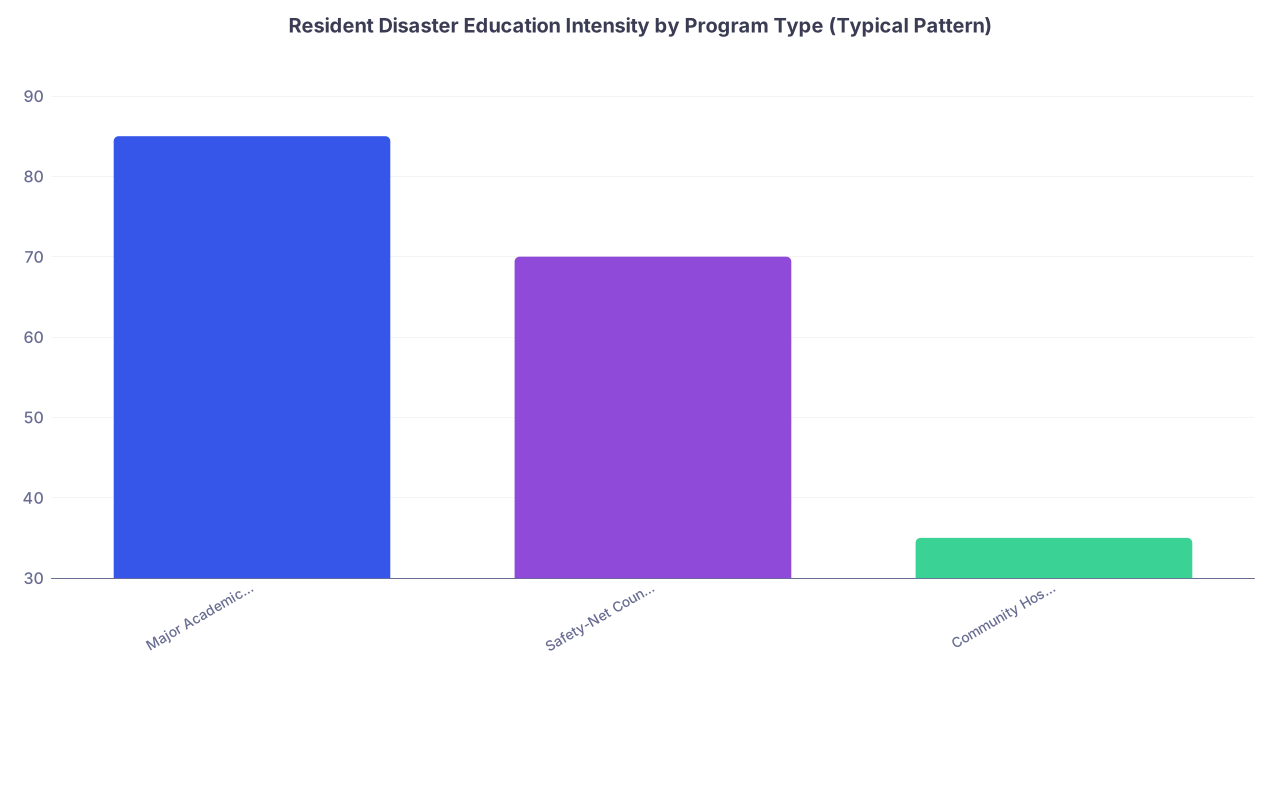
To make this more concrete, here is the pattern you typically see:
| Category | Value |
|---|---|
| Major Academic Center | 85 |
| Safety-Net County Hospital | 70 |
| Community Hospital | 35 |
(Where the “value” is essentially a rough composite score for structured disaster education and involvement. Not a real dataset, but very close to what you will experience.)
Academic centers and county hospitals that were hammered by named storms usually sit at the top. Some community programs, especially newer ones, are still learning by fire.
Red Flags
Be cautious if you hear or see:
- No clear answer to “What is the resident role during hurricanes?”
- “We sort of just play it by ear depending on the storm.” → That is not acceptable on the Gulf.
- No mention of drills, ICS, or ride-out planning in orientation materials.
- Senior residents with blank stares when you ask, “Have you done a hurricane ride-out?”
These programs may keep you physically safe because the larger hospital system is decent. But they are missing a huge educational opportunity and may put you in avoidable chaos.
6. Disaster Medicine As A Career Interest: What Gulf Coast Training Offers
If you are serious about disaster medicine or climate and health, Gulf Coast residency can be a foundation, not just an experience you survive.
Types Of Exposure You Get
You gain:
Repeated real-world “events” (threats and actual landfalls) to observe system operations
Experience with:
- Surge planning and crisis staffing
- Hospital evacuation decisions
- Supply chain fragility in real time
- Interfacing with local and regional emergency operations centers
Rich clinical material for:
- Quality improvement: time-to-disposition during storm surges, ED boarding patterns
- Health services research: impact of hurricanes on chronic disease outcomes
- Population health: inequities in who evacuates, who gets stuck, who dies
Programs And Pathways To Look For
You want to see:
- Emergency Medicine programs with:
- Disaster medicine fellowships or strong elective options
- Faculty who deploy with DMAT/USAR, or have roles in city/county emergency management
- Internal Medicine and Family Medicine programs that:
- Work closely with public health departments
- Have population health tracks tied to climate resilience and disaster recovery
- Surgery programs that:
- Explicitly participate in regional mass casualty drills
- Have faculty involved in trauma system planning or state EMS committees
If you see a resident research day with projects titled “Impact of Hurricane X on dialysis patient morbidity” or “ED utilization before and after storm Y,” you are in the right place.
7. Lifestyle And Personal Risk: The Part Applicants Dance Around
Now the uncomfortable part: how this affects your actual life.
You are not just a trainee. You are also a human who has to live somewhere that has a real disaster season every year.
Personal Logistics And Safety
You need to think ahead about:
Housing:
- Is your apartment in a flood zone?
- Does your building have storm shutters or rated windows?
- Do you understand your local elevation and flood risk?
Evacuation and transportation:
- If you are on ride-out team, where does your family go?
- Can your partner or kids safely evacuate without you?
- How long does it actually take to get inland when half the city is leaving?
Insurance:
- Flood insurance is separate and often not included by default in rentals.
- Car insurance for hail, flood, and wind damage should not be an afterthought.
I have seen interns realize during their first hurricane watch that their spouse and toddler are in a ground-floor apartment in a mandatory evacuation zone, and they (the resident) are required to sleep at the hospital. That is not something you want to figure out at the last minute.
Workload And Burnout Risk
Disaster seasons magnify whatever cultural strengths or weaknesses a program has.
Good programs:
- Protect post-storm recovery time for ride-out residents
- Provide mental health support after major events
- Spread the burden over years so no one class gets crushed repeatedly
- Debrief operationally and emotionally
Bad programs:
- Treat ride-out as “heroic duty” and forget to protect recovery time
- Understaff recovery teams
- Pin ride-out mainly on junior residents
- Brush off moral distress from triage and system failure
You need to ask residents directly: “What happened to your schedules and sanity after the last major storm?”
8. How To Evaluate Gulf Coast Programs Through The Hurricane Lens
All of this is only helpful if you know how to put it into practice on the interview trail.
Questions Worth Asking (Verbatim If You Want)
To program leadership:
- “Can you walk me through how residents were used during the last hurricane threat or landfall?”
- “How do you structure ride-out and recovery teams for housestaff?”
- “Is there formal education on ICS and disaster medicine for residents?”
- “Have there been any system changes based on prior storms that involved resident feedback?”
To residents (away from leadership):
- “Have you personally done a ride-out? What was that like?”
- “Did you feel physically safe in the hospital during the storm?”
- “How were your schedules adjusted afterward?”
- “Does the program treat hurricanes as a nuisance or as a real educational topic?”
You are looking for specific, concrete stories. “Yeah, during Ida we…” is a good sign. “I think we might have had a lecture once about hurricanes” is not.
Matching Your Priorities To Program Profiles
You can roughly group Gulf Coast programs into three categories from a disaster standpoint:
| Type | Disaster Focus | Pros | Cons |
|---|---|---|---|
| Disaster-Centered | High | Strong training, research, leadership roles | More frequent high-intensity duty |
| Disaster-Competent | Moderate | Solid safety, decent teaching | Less depth if you want a career focus |
| Disaster-Minimal | Low | Fewer structured demands | Missed learning, more chaos when events occur |
The “right” category depends on you:
- If you want academic disaster medicine or climate-health work, aim for Disaster-Centered.
- If you want reasonable exposure but not a defining feature, Disaster-Competent is enough.
- Disaster-Minimal on the Gulf Coast is, frankly, a bad sign about institutional maturity.
9. Future Directions: Climate Change And The Evolving Gulf Coast
Climate change is not a theoretical factor here. You will see its fingerprints on your call schedule.
Trends you should expect over the next decade:
- Warmer Gulf waters → stronger, faster-intensifying storms
- Higher baseline sea levels → more catastrophic storm surge potential
- More frequent “near miss” events that still flood communities and destabilize infrastructure
Hospitals are responding with:
- Hardened infrastructure: elevated generators, internal flood walls, sacrificial first floors
- Diversified water and power redundancy
- Regional evacuation networks for high-risk facilities (nursing homes, LTACs)
- Expanded telehealth built into emergency operations plans
From an educational standpoint, this means:
- Disaster medicine will move from “niche interest” to mainstream competency
- ACGME and boards will expect more systems-based practice and disaster knowledge
- Gulf Coast experience will be viewed as highly relevant for national-level roles in emergency management, public health, and hospital administration
One more angle: climate migration. Some Gulf programs are already seeing shifts in patient demographics as people move away from repeated disaster zones and into “safer” coastal or inland areas. That reshapes catchment areas and training exposure in a more subtle, longitudinal way.
10. Practical Takeaways If You Are Actually Considering These Programs
Let me pull this into something usable if you are seriously adding Gulf Coast residencies to your rank list.

| Step | Description |
|---|---|
| Step 1 | Storm Watch Issued |
| Step 2 | Assigned Ride-out or Recovery |
| Step 3 | Prepare Home and Family |
| Step 4 | Report for Briefing |
| Step 5 | Sleep at Hospital |
| Step 6 | Report After All Clear |
| Step 7 | Potential Backup Call |
| Step 8 | Provide Emergency Care |
| Step 9 | Post-Storm Surge Phase |
| Step 10 | Debrief and Schedule Recovery |
| Step 11 | Resident On-Call? |
| Step 12 | Ride-out Team? |
If you are early in the process, pay attention to three things above all:
- Infrastructure and system maturity: Does the hospital look and sound like it has learned from recent storms? Is there hardened physical plant, clear ICS, and specific historical lessons?
- Resident experience: Do current residents tell coherent stories about past storms with a sense of safety, clear roles, and some educational reflection? Or just trauma and chaos?
- Educational integration: Are hurricanes treated as rare interruptions to “normal training,” or as a core part of what it means to practice medicine on the Gulf Coast?
Key Points To Remember
- Gulf Coast residency means training in a region where hurricane preparedness is not theoretical. You will be part of ride-out and/or recovery teams, and that should be structured, taught, and debriefed.
- The best programs treat disaster medicine as a genuine educational domain, with ICS training, drills, defined resident roles, and real research and QI work built around storm events.
- When evaluating programs, push past the brochure: ask for specific examples of how residents were used, protected, and taught during the last major hurricane or near-miss. The answers will tell you almost everything you need to know.