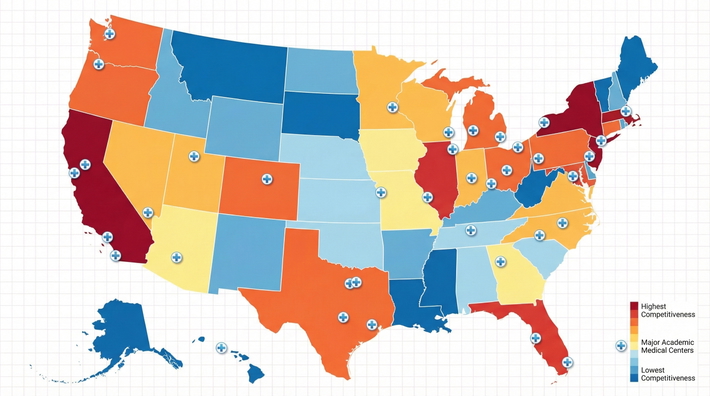
Worried I’ll Be Stuck Practicing Forever Where I Do Residency
What if matching in the “wrong” city means you’re basically stuck there for the rest of your career?
Because that’s the little voice, right? You rank a program in a region you don’t love—but the training is great—and suddenly your brain is like: “If I match here, I’m never leaving. I’ll die in this ZIP code.”
You’re not the only one thinking that. I’ve heard this exact sentence way too many times:
“If I match in [insert city they secretly hate], am I signing a 30-year contract I don’t see?”
Let me be blunt: residency location matters. A lot. But this “forever trapped” fear? It’s exaggerated, and sometimes straight-up wrong. The problem is that nobody in med school actually sits down and explains how much your residency region affects where you can go later… and how much of that is you, not the system.
So let’s pull that apart.
Does Residency Location Actually Lock You In?
Short answer: no, not automatically. But it does pull on you. Harder than people expect.
Programs don’t hand you a legal chain that says, “You must live and practice within 30 miles for eternity.” But there are three real forces that make people feel stuck:
Job pipelines are local.
Hospitals love hiring who they know. Same region, same health systems, same referral networks. You do IM at a big Northeast program? Half your attending jobs will magically “appear” in the Northeast. That’s not a conspiracy. It’s just where the attendings know people and where word-of-mouth travels.Your professional network is heavily regional.
Where do your letters come from? Who picks up the phone for you? Your PD, attendings, fellowship directors—almost all of them have their tightest relationships in their geographic region. So when you say “I want to go across the country,” you’re basically asking, “Can we stretch your connections far beyond where you usually operate?” It’s possible. It’s just less automatic.Life inertia is real.
During residency you get a favorite grocery store, maybe a partner, maybe a kid, maybe a mortgage. Suddenly the “temporary” city becomes home-ish. Even when you swore you’d leave the second you graduated.
But here’s the part no one tells you clearly: plenty of people leave. Every year. Every specialty. From every city.
I’ve seen IM residents in the Midwest match GI in California. I’ve seen EM residents in Florida go home to New England. I’ve seen surgeons trained in NYC open practices two time zones away.
So no—residency is not a life sentence. But if you totally ignore geography now and assume you can easily “fix it later,” you might feel like you’re swimming upstream when that “later” comes.
How Much Does Region Matter By Specialty?
Some specialties glue you to a region more than others. Not equally.
| Specialty | Regional Pull | Easier to Move? |
|---|---|---|
| Family Med | Low-Medium | Yes |
| Internal Med | Medium | Yes |
| EM | Medium-High | Sometimes |
| Ortho | High | Harder |
| Gen Surgery | High | Harder |
| Derm | Very High | Tough |
Rough breakdown, from what I’ve seen and heard over and over:
Primary care (FM, IM without super competitive fellowship, peds)
More flexible. There are jobs everywhere. A solid residency plus state license plus normal references → you can usually move states or regions without drama.Hospital-dependent fields (EM, some hospitalist jobs, anesthesiology)
Still moveable, but health systems and corporate groups sometimes recruit locally and regionally more aggressively. Not impossible to move. Just more work.Super competitive or prestige-obsessed fields (ortho, derm, certain surgical subspecialties, plastics, ENT)
Your residency name and network matter more. Fellowship location matters even more. These fields often have tight local ecosystems—big regional private practices, prestige hospitals, long-standing referral chains. Moving is absolutely possible but can be more politics and networking heavy.
Notice what’s missing?
Nowhere on this chart does it say: “If you train in X region, you’re barred from ever leaving.” Because that’s just not how it works.
What Actually Keeps People Stuck (And It’s Not Just the System)
The brutal part: a lot of “I’m stuck here” comes from choices and fear rather than actual barriers.
Here’s what I’ve seen trap people:
- They never applied broadly to out-of-region fellowships or jobs because “I probably won’t get them anyway.”
- They waited until May PGY-3 to start networking for an out-of-region job, when most prime positions were already whisper-reserved.
- They got comfortable—friends, partner, cheaper cost of living—and then talked themselves into staying because leaving felt scary.
- They didn’t get licensed in another state early enough, and hospitals didn’t want to wade through that delay vs a local candidate already licensed and ready.
- Their PD and mentors only really had strong contacts nearby, and they didn’t proactively reach out themselves to people in the region they wanted.
So yeah—the system tugs you toward your training region. But there’s a lot of self-sabotage mixed in.
If you’re already worried about being stuck, that’s weirdly good. It means you’re more likely to plan around it instead of waking up PGY-3 and panicking.
Region vs. Reputation: The Ugly Tradeoff
Here’s the anxiety-inducing scenario:
You get:
- A really strong program in a city/region you don’t like, far from home.
- A weaker program (less name, maybe less volume or weaker fellowship match) but in your ideal region, maybe near family.
Which one screws your future more?
Here’s my honest, non-diplomatic view:
If you’re going into a hyper competitive specialty or fellowship, a stronger program even in a suboptimal city can genuinely open more doors nationwide. In some fields, the name buys you mobility more than the zip code limits it.
If you’re in a more flexible specialty, and you’re already emotionally fragile about location (no judgment, just reality), being closer to your long-term target region might matter more than some abstract prestige bump.
Because here’s the thing: a “fancy” residency won’t help much if you’re miserable and burnt out and too depressed to do the extra stuff (research, networking, electives) that makes people mobile.
How Fellowship Changes the Equation
Fellowship is like a second chance to reposition yourself geographically.
I’ve watched this pattern over and over:
- Med school in Midwest → Residency in Southeast → Fellowship in West Coast → Job back in Midwest
- Med school in California → Residency in Texas → Fellowship in NYC → Job in California again
Fellowship location often acts as your “final anchor” for networking. A lot of people end up practicing near where they do fellowship, not residency.
So if your specialty route likely involves fellowship (cardiology, GI, heme/onc, critical care, some surgical subs), you have another major chance to reset your region.
Caveat: you still need that fellowship match to go your way. That means while in residency, you:
- Tell program leadership early: “My long-term goal is to end up in X region, ideally via Y fellowship.”
- Push for interviews/electives or conferences in that region.
- Go to conferences and intentionally meet faculty from programs in that area (not just stand by the coffee).
Concrete Ways to Avoid Being “Geographically Trapped”
You’re not helpless here. If your worst-case brain is screaming “I’ll be stuck forever,” this is what you can actually do to make that less likely.
During Interview Season / Ranking
Pay attention to where grads end up.
Not just the hospital list they flash in a pretty PowerPoint. Ask: “What percentage of your grads stay in this region vs move to other states?” If 90% stay local, is that by choice… or because out-of-region placement is weak?Ask about connections to other regions.
“Do your graduates often match fellowships or get jobs in [region you want]?”
Watch their face. If they hesitate or can’t name a few, that’s information.Check alumni maps.
Some programs literally have a map of where grads practice. That’s gold.
During Residency
Do away or elective time in your target region.
Yes, it’s annoying to arrange. Yes, you’re tired. But a 2–4 week elective at a hospital in your dream region can be huge. They meet you. You see them. You’re no longer just a cold email.Go to conferences strategically.
Not just to pad your CV. Before you even get there, look up people from hospitals in your desired region and literally introduce yourself after their sessions. It feels awkward. Do it anyway.Tell your PD what you want. Repeatedly.
Not just once in PGY-1 when they’re half listening. Keep saying: “I’d like to end up in [region]. If any contacts or positions come across your desk, I’m very open to relocating.” They forget. You remind them.Get licensed in your target state early (if possible).
Some states are slow, expensive, or both. But having a license where you want to go makes you instantly more attractive than “great candidate—but we’ll need 4–6 months to onboard them.”
Some Regions Are Easier To Leave Than Others
There’s a pattern. It’s not absolute, but it’s real.

From what I’ve seen:
Training in large coastal academic centers (NYC, Boston, SF, LA) often gives you name recognition that travels well. People all over the country know those hospitals. They’ll take your email.
Training in very insular or rural systems sometimes anchors you more locally, not out of malice, but because their network is primarily regional.
Training in big name Midwestern academic centers (Mayo, UMich, etc.) can actually export people in all directions. But many still stay local because the jobs are good.
If your dream is “one specific city” (like “I must end up back in Seattle or I’ll combust”), then you want at least one of these three:
- Your med school there
- Your residency there
- Or your fellowship there
Two out of three? Even better. None of the three? Not impossible—but more work.
Reality Check: People Change Their Minds About Where They Want To Live
This part messes with people’s heads.
You might be dead certain right now:
“I’ll only be happy if I end up in [East Coast city / West Coast / near family].”
Then you land in a residency location you thought you’d hate.
And suddenly:
- You realize you actually like four seasons.
- Or you fall in love with lower cost of living.
- Or your partner finds their dream job there.
- Or your kid’s school is great and pulling them out feels wrong.
- Or you feel more supported and less burned out than you ever did “back home.”
I’ve watched people swear they’d leave the South the minute residency ended. They’re still there 7 years later. Happy. And vice versa—people thought a “cool city” would solve everything and now can’t wait to escape the traffic and rent.
The point isn’t “you’ll magically love wherever you match.” You might hate it.
The point is: you seriously don’t know yet. Locking yourself into panic about spending 30 years somewhere you haven’t even lived for 3 months is your anxiety trying to time-travel.
What If I Already Know I Matched Somewhere I Don’t Want To Stay?
OK, this is where the anxiety spikes.
You open your email. See the city. Your stomach drops. You’re already fast-forwarding to being 45 and wondering how you never escaped.
Here’s how I’d approach it:
Give yourself a year before making any permanent story.
Intern year is survival mode. Don’t also demand that you figure out your 20-year geography plan while getting wrecked by call. Just collect data: what do you like? what do you hate? where do grads go?Early PGY-2, start mapping your exits.
Decide: Fellowship route vs straight-to-attending route. Identify 3–5 cities or regions you’d actually be happy in (not just one fragile dream city).Build at least one concrete tie in your target region.
An away elective, a mentor there, co-authored research with someone there, a conference connection—something that gives you a specific name and email, not just “I’ll cold apply on Indeed.”Treat your location move like a long-term project, not a last-minute scramble.
That means researching state licensing timelines, compensation norms, job saturation, and starting networking 12–18 months before graduation. Not 3.
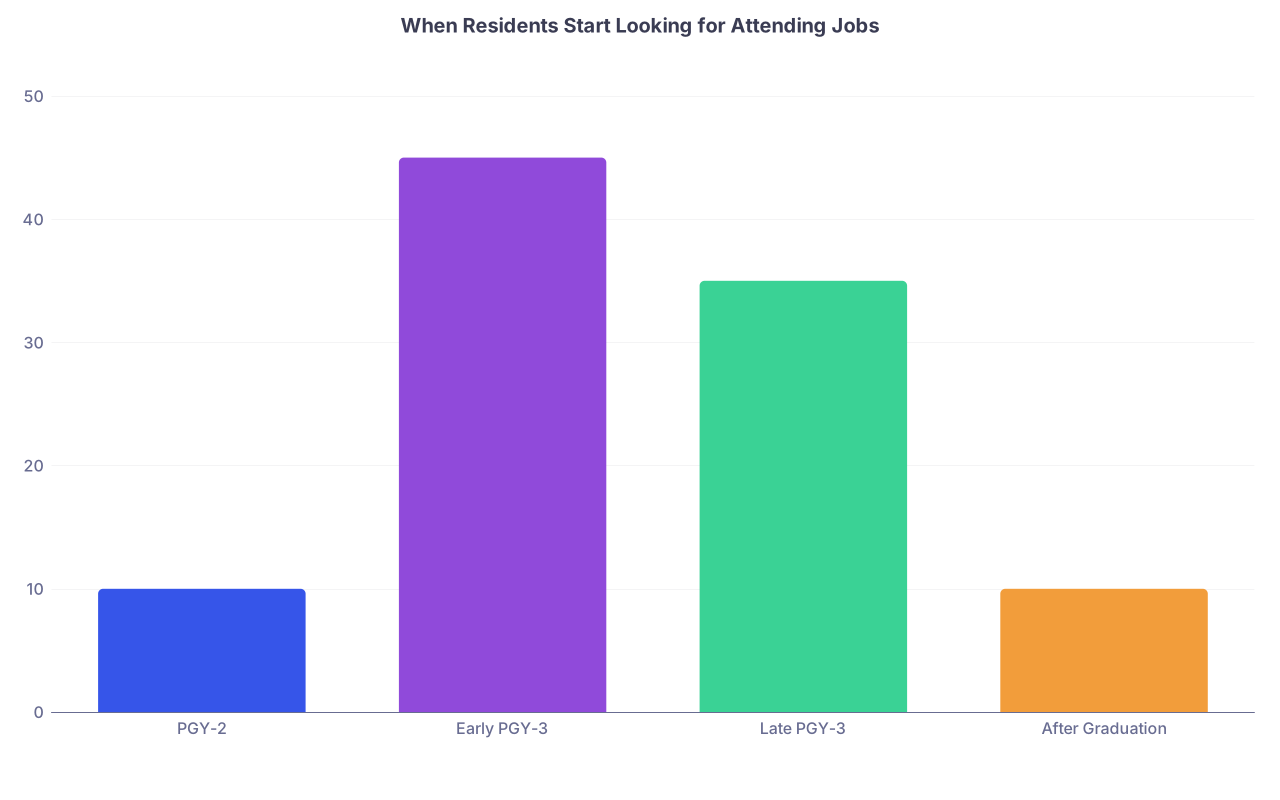
| Category | Value |
|---|---|
| PGY-2 | 10 |
| Early PGY-3 | 45 |
| Late PGY-3 | 35 |
| After Graduation | 10 |
Most people seriously start late PGY-3. If you’re trying to move regions, you want to be in that early PGY-3 group—or even PGY-2 if it’s a saturated market.
The Awful “What If I Regret My Rank List” Loop
You might be reading this before you even match, spiraling about the rank list you already submitted.
“I ranked a program in a region I hate higher than I should have. What if I get stuck there forever?”
Here’s the hard truth: you can’t edit your rank list now.
But you can choose how you interpret the outcome.
If you match in that “dreaded” region:
- You got training that you thought was strong enough to rank highly. That still matters.
- You now know from this whole rant that you have tools and timing windows to reposition yourself later.
- You’ve learned something about your own priorities that will make you much sharper when you choose fellowship and first job.
And if you end up loving it? You get to laugh at your Match Day meltdown in a few years.
Moving After Residency Is Workable. Being Strategic Is Non-Negotiable.
Let me strip this down to the core, for your anxious brain that wants a simple verdict:
- Residency location does influence where you end up. It does not determine it.
- If you care a lot about ending up in a particular region, you need to act like it’s a priority—during interviews, residency, and job/fellowship hunting—not assume it’ll magically sort out.
- You always have more flexibility than your 3 a.m. catastrophizing tells you. But it won’t feel that way unless you build options on purpose.