

The way most people talk about pre‑med publications in residency applications is wrong.
You’ve probably heard some version of: “Any publication is gold. Start research as early as possible. Med schools and residencies love a long PubMed list.” That’s not how selection committees actually think. And if you structure your career around that myth, you waste time chasing cosmetic lines on your CV instead of substance.
Let me be blunt: pre‑med publications are taken seriously only in very specific circumstances—and in most cases, they’re background flavor, not a deciding factor.
Let’s walk through what the data and real committee behavior actually show.
What Programs Really Look At First
Nobody on a residency selection committee starts your file by scrolling to “Undergraduate Research.” They start with the traditional big four:
- USMLE/COMLEX scores (or pass/fail + Step 2 score)
- Medical school name and class rank/clinical performance (MSPE, clerkship grades)
- Specialty‑relevant letters of recommendation
- Evidence you can function on the wards (narratives, sub‑I evals)
Research matters more in some specialties (derm, radiation oncology, plastics, neurosurgery) and less in others (family medicine, psych, peds). But “research” to them mostly means what you did as a medical student, not what you did as a sophomore pipetting in a basic science lab.
Here’s the hierarchy I’ve seen over and over when PDs skim the “Scholarly Activity” section:
- First author clinical or outcomes papers in their field, ideally during med school
- Co‑authored papers in solid journals, during med school
- Conference abstracts/posters in their field
- Basic science research with real continuity and depth
- Everything else (case reports you barely touched, middle‑author bench work from undergrad, random low‑impact stuff)
Notice where pre‑med work sits. Near the bottom—unless it’s unusually substantial.
The Evidence: What the Numbers Actually Say
Let’s put some numbers to this, because vague “they like research” talk doesn’t help you.
The NRMP’s “Charting Outcomes in the Match” and the “Program Director Survey” give you a rough sense of how research productivity correlates with matching. Key point: they do not distinguish between pre‑med vs med school research. It’s all one bucket. But the implicit message from PD comments is clear: recency and relevance matter.
You consistently see:
- Competitive specialties: matched applicants have more “abstracts, presentations, and publications” than unmatched ones.
- Less competitive specialties: research counts, but as a tertiary factor behind exams and clinical performance.
For a sense of scale:
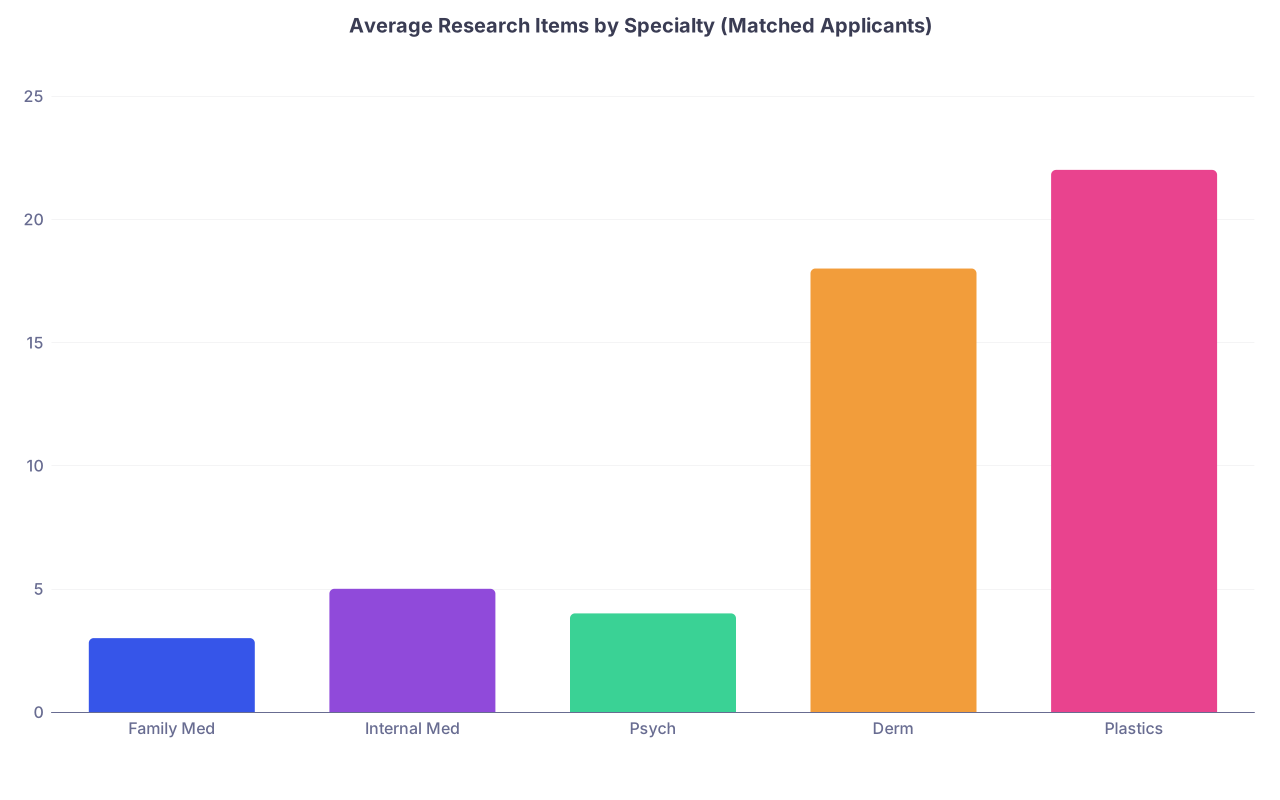
| Category | Value |
|---|---|
| Family Med | 3 |
| Internal Med | 5 |
| Psych | 4 |
| Derm | 18 |
| Plastics | 22 |
Those 18–22 “items” for derm/plastics? That’s everything: posters, local presentations, low‑impact journals, case reports, med school research, pre‑med research. It’s a volume metric, and frankly, a crude one.
So where do pre‑med pubs fit?
They pad that number. But when PDs actually read your CV, they care how you got there:
- Was this one long‑term project with real intellectual ownership?
- Or were you guest author #5 on your PI’s endless stream of minimally different papers?
That difference matters way more than whether it happened before or during medical school.
When Pre‑Med Publications Actually Impress
Pre‑med research is taken seriously when it shows unusual maturity, continuity, or impact. Not when it’s a vanity line.
Here are the cases where your pre‑med work genuinely moves the needle:
1. Sustained, Longitudinal Work That Continues Into Med School
If you spent 3 years in an undergrad lab, stayed on through an MD program in the same institution or same field, and your story is:
“I started as an undergrad in this outcomes group, built skills, took on more responsibility, and now as a med student I’m first author on follow‑up work.”
That looks real. That reads as: you’re not a box‑checker; you’re someone who can stick with complex projects over years.
Programs notice that. Especially academic ones.
2. First‑Author, Real‑Deal Publications
A first‑author paper in a solid journal—even if the field is slightly outside the specialty you’re applying into—shows capability, not just exposure.
If you’re applying to IM and have a first‑author paper in Journal of Hepatology from undergrad work at a liver center? That’s credible. If it’s a random undergraduate journal almost nobody respects? Slight eye‑roll.
Not everything has to be NEJM. But people on selection committees do differentiate between:
- Peer‑reviewed, indexed, decent‑impact journals
vs. - Predatory open‑access journals and undergraduate‑only publications
They may not say that out loud, but I’ve watched people Google journals mid‑meeting. It happens.
3. Direct Relevance to the Specialty (Especially in Small Niches)
Pre‑med cardiology outcomes work when you’re applying IM with a cardiology interest? More interesting than pre‑med fish physiology if you’re going into EM.
The closer your undergrad research is to the clinical questions of the specialty, the more likely faculty will say, “OK, this person actually knows something about our world.”
4. Grant‑Funded, Competitive Programs
If your pre‑med work involved things like:
- National research fellowships (Goldwater, Fulbright, NIH UGSP, etc.)
- Named institutional research scholarships with competitive selection
- Oral presentations at real national meetings with strong acceptance thresholds
That signals you can compete nationally. That sort of pre‑med research does get respect.
When Pre‑Med Publications Are Basically Wallpaper
Now the part no one likes to say out loud: a huge fraction of pre‑med “publications” are functionally decorative. They may have helped you get into med school. They rarely matter for residency.
Examples:
- Middle‑author on a basic science paper where you washed glassware and did some Western blots three summers ago.
- A case report where your entire contribution was “helped with chart review” and “wrote part of the introduction.”
- Posters at tiny undergrad symposia that you still list like they’re national conferences.
- Pre‑print server uploads that never made it into peer‑reviewed journals, but you list like completed publications.
Does this mean you should hide them? No. They round out your narrative. They show early interest. They might give you something to talk about when an interviewer asks, “So how did you get into research?”
But are they a tiebreaker between you and another applicant with similar scores and better, more recent med‑school research? No chance.
How Committees Actually Read Your “Research” Section
Here’s the unglamorous reality of how PDs and faculty review your research during application season.
They don’t have hours to parse every DOI. They:
- Scan the number of items.
- Look for first‑author or second‑author positions.
- Notice recognizable journals or big‑name conferences.
- Glance at dates to see trajectory: early interest only, or active during med school?
- Look for alignment with their specialty or interest area.
Pre‑med entries aren’t cut; they’re just low‑priority. Many reviewers mentally weight them like this:
| Timing of Research Activity | Relative Impact on Residency Decisions |
|---|---|
| Medical school, recent | High |
| Research year during med | Very High (if productive) |
| Gap years pre‑med | Moderate |
| Undergrad during semesters | Low–Moderate |
| High school | Negligible |
That “gap years pre‑med” row is important. If you took 1–2 years as a research assistant or coordinator and actually produced something: those pre‑med publications may matter more than some half‑hearted med‑school case reports.
But the key throughline: timing with depth and ownership is what matters, not the arbitrary “pre‑med vs med school” boundary.
The Biggest Myth: “Any Pub Is Better Than No Pub”
I hear this constantly from pre‑meds and early med students: “I’ll join anything, as long as it gets me a paper.” That’s a great way to burn your time on low‑yield busywork.
Let me rewrite the myth:
- A shallow, forgettable publication does almost nothing for your application beyond inflating your “research items” count.
- Serious, high‑ownership work, even if it produces fewer total “items,” gives you stronger letters, better interview stories, and a more convincing trajectory.
I’ve seen applicants with three very good, coherent projects come across as far stronger than applicants with 20+ case reports and “me too” middle‑author papers where they clearly barely knew the science.
The PD reaction is predictable: “This person chases CV lines.” Not a compliment.
So no, “any pub” is not always better than none. A thin pub list built on fluff can expose that you chased metrics rather than learning how to think.
Pre‑Med vs Med School Research: A Smarter Strategy
If you’re already in med school or beyond, you can’t go back and rewrite your pre‑med life. But you can decide how to present it and how to invest your time next.
Here’s the pragmatic way to think about it:
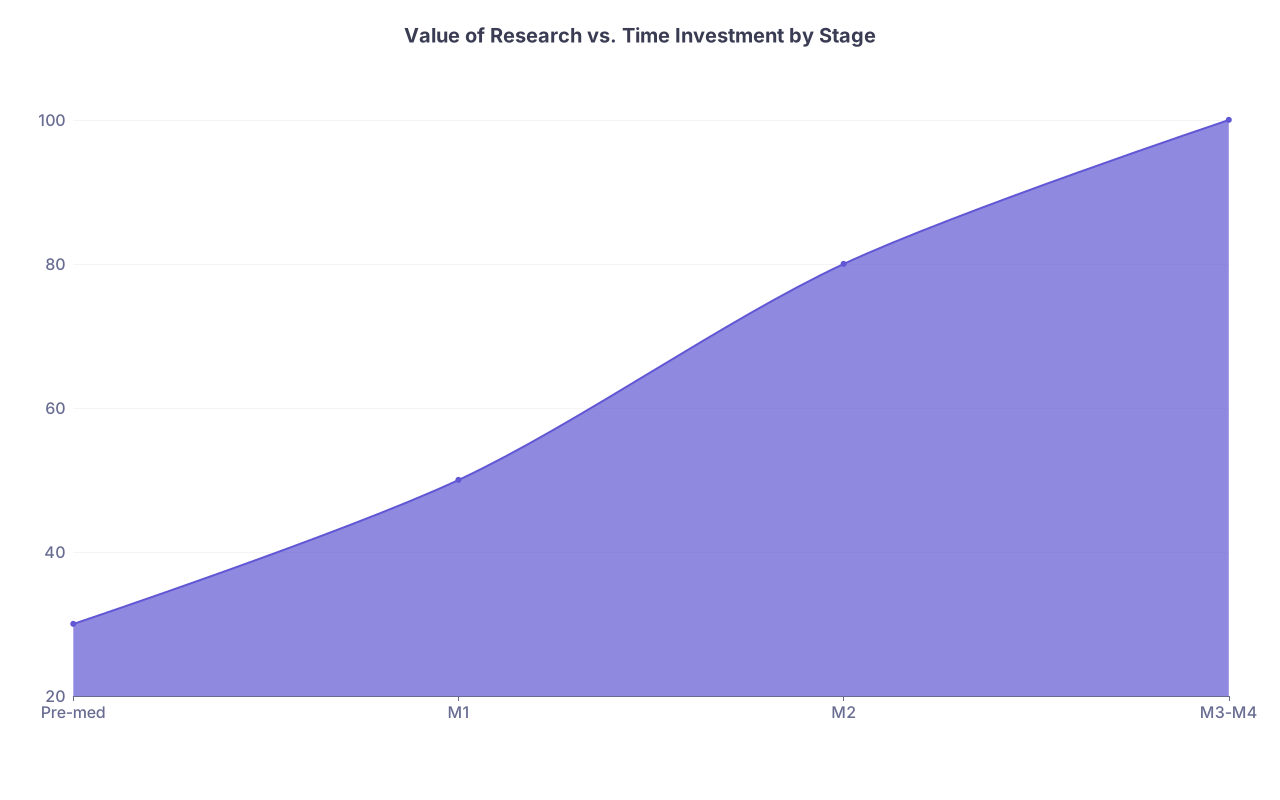
| Category | Value |
|---|---|
| Pre-med | 30 |
| M1 | 50 |
| M2 | 80 |
| M3-M4 | 100 |
The return on research effort goes up as you approach the application, as long as it’s well‑aimed.
So:
- If you already have meaningful pre‑med pubs: great. Use them to support a story of long‑standing interest and skills. But build on them during med school so you do not look like you peaked at 20.
- If your pre‑med work was light: don’t panic. Focus now on 1–2 serious projects in med school, not on retro‑manufacturing impact from minor undergrad efforts.
How To Present Pre‑Med Publications So They Help (Not Hurt)
The content of your research is one part; the framing is another.
Here’s how to make pre‑med pubs work for you:
1. Be Honest About Your Role
Interviewers can tell when you’re overselling. If you were middle‑author on a massive RCT and only did data entry, say that plainly. Then talk about what you learned from being embedded in a serious research operation.
You lose credibility fast if your ERAS description screams “first‑author energy” but your name is 7th on a 15‑author paper.
2. Show Trajectory, Not Stagnation
Map it clearly:
- Undergrad: basic skills, early exposure
- Early med school: small projects, posters, maybe small case series
- Later med school: more ownership, first‑author, specialty‑aligned work
If all your “real” work is pre‑med and your med‑school research activities are anemic, PDs will wonder what happened. Did you lose interest? Burn out? Couldn’t function on a clinical team?
3. Use Pre‑Med Work To Justify Your Specialty Choice
If your undergrad publications align with your chosen specialty, make that explicit:
“I started working with the stroke team as an undergrad, stayed with cerebrovascular research through med school, and that’s what pulled me toward neurology.”
That story makes sense. It feels authentic.
Compare that with this nonsense:
“I did a pre‑med publication in marine ecology, then a random case report in ophthalmology, now I’m applying orthopedic surgery because I shadowed once.” People notice that incoherence.
4. Be Prepared To Talk Methods, Not Headlines
If you list a pre‑med publication, you should be able to explain:
- What the study question was
- What design was used (retrospective cohort, RCT, etc.)
- What your actual task was
- One key limitation and what you’d do differently next time
Selection committee members aren’t impressed by titles. They’re impressed when you clearly understand how the sausage was made.
Special Case: MD/PhD and Heavy Research Tracks
Different rules apply if:
- You’re an MD/PhD, or
- You’re applying to a research track or “physician‑scientist” residency
These programs absolutely care about your full research arc, starting from undergrad. For them, pre‑med work is part of your scientific “CV,” not just your medical one.
But even there, the logic holds:
- A thin cluster of small, scattered undergrad projects → weaker impression
- A coherent, building trajectory of meaningful work → stronger
They’ll look for things like:
- Evidence you can carry a project from idea to publication
- Technical skills (stats, coding, specific lab techniques)
- Letters from real research mentors, not just “hard worker” fluff
Pre‑med publications are taken very seriously here—but only as part of a convincing larger picture.

| Step | Description |
|---|---|
| Step 1 | Undergrad Research |
| Step 2 | Post-bacc/Gap Year Research |
| Step 3 | PhD or Heavy Med School Research |
| Step 4 | Research-focused Residency |
| Step 5 | Faculty or Fellowship |
If you’ve got pre‑med pubs and then go dormant for 6–8 years? That story’s harder to sell.
What To Do If You Have Zero Pre‑Med Publications
Let’s kill this anxiety outright: you are not doomed if you didn’t publish as a pre‑med. A lot of excellent residents and attendings had exactly zero publications until midway through med school.
What matters:
- Do you have anything by the time you apply?
- Does it make sense with your narrative and interests?
- Did you actually understand and contribute to it?
If you start in M1 or M2 and end up with:
- One decent first‑author project
- One or two posters
- A mentor who can write, “This student drove this project from beginning to end”
That beats a scattered pile of pre‑med busywork almost every time.

So… Are Pre‑Med Publications Taken Seriously?
They are taken seriously when they show:
- Depth of involvement
- Clear continuity into med school
- Real intellectual contribution
- Coherent alignment with your specialty story
They’re mostly ignored as a deciding factor when they’re:
- One‑off, shallow, middle‑author vanity lines
- In obscure or low‑credibility journals
- Never followed by any meaningful med‑school research
Use your pre‑med publications as foundation, not as your headline. Program directors are not dazzled by a high school‑to‑med school PubMed trail if it doesn’t translate into competence, judgment, and growth where it actually matters: in clinical medicine.
Key Takeaways
- Pre‑med publications help only when they show depth, continuity, and real contribution; most are background noise, not decision‑makers.
- Recent, med‑school‑level research with ownership and specialty relevance carries far more weight than early, superficial undergraduate work.
- Focus less on gaming “any pub” and more on doing a few serious, well‑owned projects that support a coherent story for your chosen specialty.
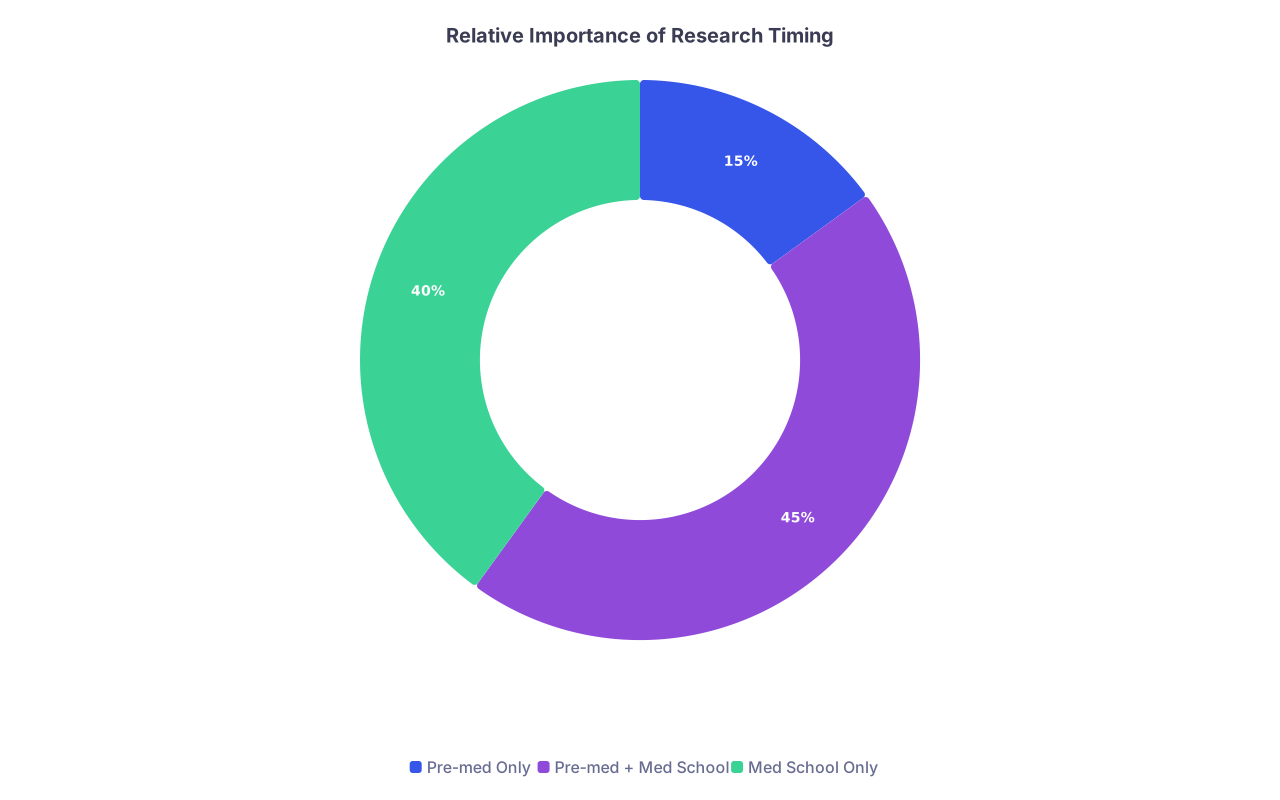
| Category | Value |
|---|---|
| Pre-med Only | 15 |
| Pre-med + Med School | 45 |
| Med School Only | 40 |


