
The worst way to spend a research gap year is to “see what comes up.”
You need a roadmap. With timestamps. Otherwise you burn 12 months, collect three half-finished projects, and enter ERAS with nothing solid to show.
I am going to walk you month by month through a research-focused gap year between medical school and residency. The goal is simple: at Match time you should have:
- 1–2 first-author manuscripts submitted or accepted
- Several co-author papers, abstracts, or posters
- Strong letters from recognizable researchers who actually know you
- A coherent story that makes PDs think, “This person used their year well.”
This is how you get there.
6–9 Months Before Graduation: Decide, Commit, Position
At this point you should be in late MS3 or very early MS4. If you are even considering a research gap year, you are already on the clock.
Step 1: Decide if a research gap year is actually worth it
Bluntly, a research year makes sense if:
- You are aiming for a competitive specialty (derm, ortho, neurosurgery, plastics, integrated vascular/CT, rad onc, ENT)
- You have low or average board scores and need a research “hook”
- You lack specialty-specific output in your chosen field
- You want a serious academic career and need momentum early
If you are going into FM, psych, peds, or IM without subspecialty ambitions and your application is already solid, a gap year is usually overkill.
| Situation | Research Year Value |
|---|---|
| Applying Derm with 0 pubs | High |
| Applying Ortho with 1 poster | High |
| Applying IM, strong scores, 2 pubs | Low |
| Switching late into ENT | Very High |
| Interested in academic career early | Moderate–High |
Make a decision by September–November of MS3. Waiting until February is how you end up scrambling for positions that are already taken.
Step 2: Pick a specialty lane
At this point you should pick a field even if you are not sure about the exact niche.
You cannot do a “general” research year and expect it to impress derm, ortho, and anesthesia all at once. Commit:
- Choose one specialty
- If unsure, pick the one where you can realistically get strong mentorship and output at your institution
Step 3: Start identifying research homes
From around October–December (MS3):
Map your home institution:
- Search your med school/hospital website for:
- “Dermatology research fellow,” “postdoctoral research fellow,” “clinical research coordinator”
- Faculty with high publication volume in your field
- Look up their PubMed profiles. You are looking for:
- Recent publications (last 3–5 years)
- Multi-author clinical papers with med student-friendly roles (chart reviews, retrospective cohorts, case series)
- Search your med school/hospital website for:
Collect targets:
- Make a spreadsheet with:
- Faculty name
- Research focus
- Recent first/last author pubs
- Whether they have current research fellows
- Make a spreadsheet with:
Look externally too:
- Check:
- Major academic programs’ “Research Fellowship” pages
- Specialty societies’ websites (e.g., AAD, AAOS) for gap-year fellowship listings
- Big-name programs known for research years in your field
- Check:
At this point you should have a list of 10–20 potential mentors or programs.
3–6 Months Before Graduation: Secure the Position
Now the window tightens. This is January–March of MS4 for most people, or late MS3 if you are planning ahead. Your job here is to lock in a research home before you graduate.
Step 4: Apply like it’s a real job (because it is)
From January to March:
Prepare a tight 1-page CV focused on:
- Board scores (if decent)
- Any prior research (even posters or QI)
- Specialty interest (clerkships, electives)
- Skills: basic stats, R/SPSS familiarity, REDCap, data cleaning, etc.
Cold-email properly:
- Subject line: “Prospective [Specialty] Research Year (Graduating MS4, Class of 202X)”
- 8–10 line email:
- Who you are
- When you graduate
- Your specialty interest
- Why their work specifically interests you (mention 1–2 of their recent papers)
- What you want: full-time 1-year research position, willing to work hard, aim for publications
- Attach CV and unofficial transcript as PDF
Volume and persistence:
- Email 10–15 people initially
- Follow up at 10–14 days if no reply
- If still silent, another 10–15 programs/PI’s
Plenty of serious research fellowships are filled via exactly this “cold but targeted” approach.
Step 5: Clarify expectations before you say yes
When someone bites and schedules a call, at this point you should be asking very concrete questions:
- How many fellows are currently in the group?
- What are recent fellows’ outcomes (pubs, Match results, specialties)?
- How many active projects could I join on day one?
- Typical workload? (hours/week, evenings, weekends)
- Who actually mentors/writes letters?
- Is there formal funding or is this unpaid / volunteer?
A strong program will brag (rightly) about publications, conference presentations, and Match success. If they hand-wave or dodge, that is a red flag.
0–1 Month Before Gap Year Starts: Set Up Your Infrastructure
You have now matched into a research position and graduated. It is late May–June, and your research year starts July 1 (or earlier).
At this point you should be:
Step 6: Define your personal output goals
Concrete, not vague:
- 2 first-author clinical papers submitted
- 3–5 co-author projects (case reports, chart reviews, multicenter studies)
- 2 conference abstracts / posters
- 1 strong research letter from a recognizable PI
Write these down. Share them with your mentor at the start. Make it explicit: “I want to work to achieve X, Y, Z this year. How do we make that realistic here?”
Step 7: Build your systems before the chaos
The most efficient fellows I have seen start week 0 with systems:
- Reference manager: Zotero, Mendeley, or EndNote ready, with folders by project
- Project tracker:
- Spreadsheet or Notion table with: project name, PI, your role, status, next action, target submission journal
- Standard templates:
- Generic IRB template
- Data collection sheet templates (Excel / REDCap)
- Manuscript skeleton (Intro–Methods–Results–Discussion headings)
This upfront work saves weeks later.
Months 1–3 of Gap Year: Load Projects and Front-Load IRBs
This is July through September. These months make or break your year.
At this point you should focus aggressively on project volume and setup, not perfection.
Step 8: Week 1–2 – Onboarding and project claiming
Your first two weeks:
- Meet with your main PI and senior fellow / coordinator
- Review all active and pending projects
- Ask directly:
- “Which projects need a first author?”
- “Which ones are stalled and need someone to push them?”
- “What can I take full ownership of right now?”
You want:
- 1–2 projects where you are clearly first author
- 3–6 where you are a meaningful co-author (data extraction, analysis, manuscript sections)
Do not agree to 15 things. You will drown and end up finishing none.
Step 9: Week 3–8 – IRB and data infrastructure
From late July through August, your main job is to get studies legally and operationally off the ground:
- Draft or revise IRB protocols for your primary projects
- Build or refine:
- Data dictionaries
- REDCap databases
- Inclusion / exclusion criteria with clear operational definitions
- Get IRBs submitted as early as possible; many will take 4–8 weeks for approval.
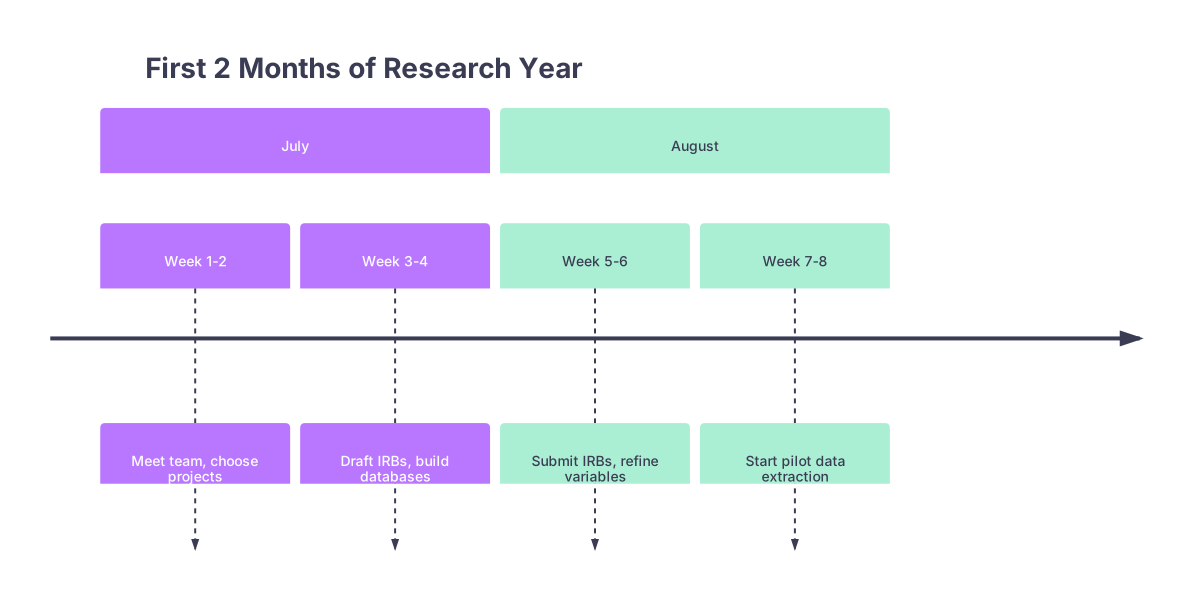
| Period | Event |
|---|---|
| July - Week 1-2 | Meet team, choose projects |
| July - Week 3-4 | Draft IRBs, build databases |
| August - Week 5-6 | Submit IRBs, refine variables |
| August - Week 7-8 | Start pilot data extraction |
If your projects are retrospective chart reviews, you should be piloting data extraction by the end of Month 2 on at least one project, even while IRB is under review (depending on institutional policy for de-identified or QI work—ask your coordinator; do not guess).
Step 10: Set a weekly rhythm
At this point you should adopt a predictable pattern:
- One blocked time for each first-author project every week (deep work, 2–3 hours)
- A recurring check-in with PI/senior fellow (30–60 min/week)
- A standing “admin” block (IRB edits, emails, reference management)
Without this, your time gets eaten by random tasks from everyone else’s priority list.
Months 4–6: Data, Drafts, and ERAS Strategy
You are now in October–December of your research year. Application season is looming if you plan to apply that same cycle, or one year later if this is a pre-application year.
Step 11: Maximize data throughput (Months 4–5)
At this point you should be:
- Actively collecting or cleaning data on at least 2 first-author projects
- Simultaneously handling smaller tasks on 2–4 co-author projects (e.g., drafting parts of the intro, running basic stats)
For clinical projects:
- Set weekly data quotas (e.g., “50 charts/week for Project A, 30/week for Project B”)
- Use standardized variable definitions, double-check 5–10% of entries for accuracy
- Keep an analysis log: which scripts, which variable transformations, version numbers
This is where people either build momentum or stall.
Step 12: Start writing Results and Methods early
Do not wait for data to be “perfect.”
By Month 5 or 6 you should have:
- Methods drafted for at least one major project
- Skeleton Results sections with:
- Tables started (baseline characteristics, outcome tables)
- Figure concepts (Kaplan–Meier curves, flow diagrams, etc.)
You can refine and update as data matures. But starting early means your submission is much faster once you have final numbers.
Months 7–9: Manuscripts Out, Abstracts Submitted, Letters Brewing
You are now at January–March. For many specialties, you will be applying in a few months. At this point you should be ruthless about turning work into products.
Step 13: Target journals and abstract deadlines
- Journal targeting:
- Make a short list for each project:
- 1 “reach” journal
- 1 realistic specialty journal
- 1 backup lower-tier option
- Make a short list for each project:
- Abstracts:
- Identify national specialty conferences: deadlines are often February–April for fall meetings
- Convert early Results into abstracts even if the full manuscript is not finalized
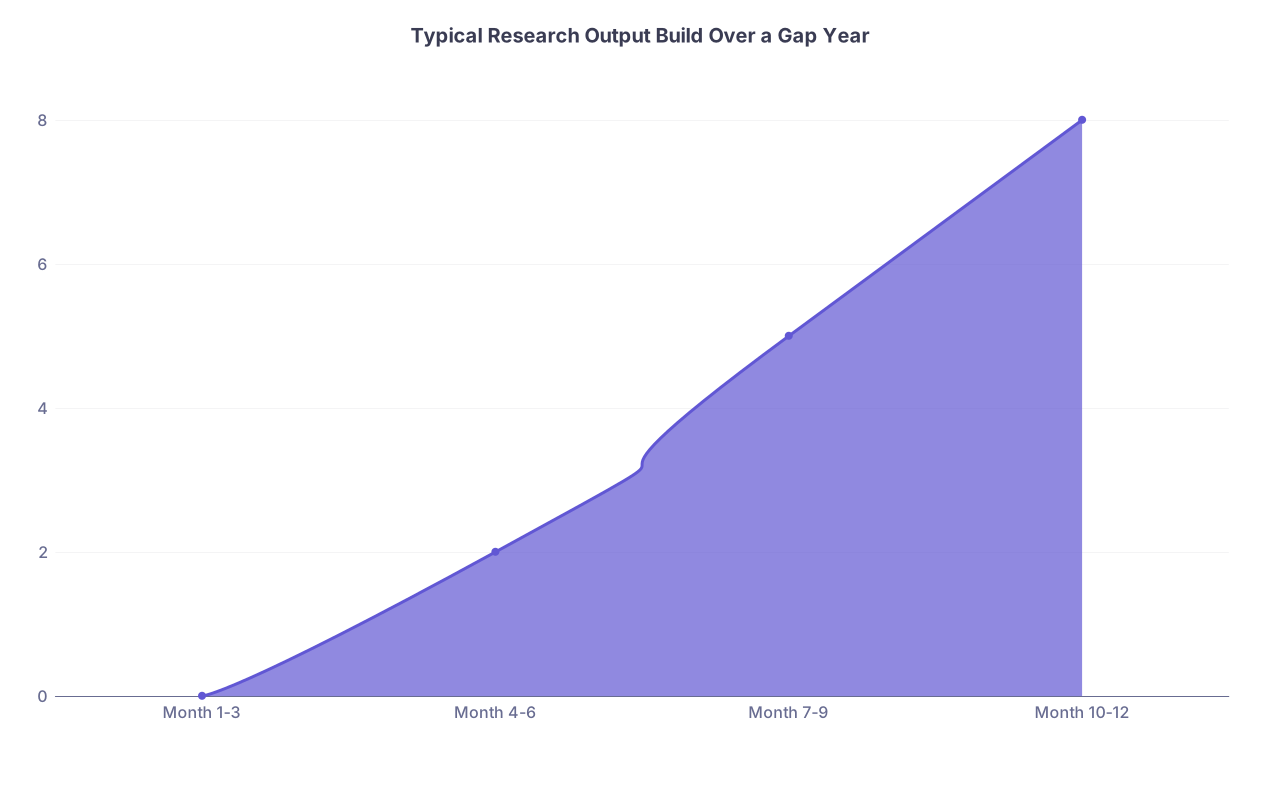
| Category | Value |
|---|---|
| Month 1-3 | 0 |
| Month 4-6 | 2 |
| Month 7-9 | 5 |
| Month 10-12 | 8 |
By end of Month 9, your target:
- 1–2 manuscripts submitted or nearly ready for submission
- 2–4 abstracts submitted to conferences
- Several co-author pieces in late-stage drafting or under review
Step 14: Line up your letters
At this point you should:
- Meet 1:1 with your primary PI and any secondary mentors
- Be explicit:
- “I am applying to [Specialty] this fall. I would be honored to have you as a letter writer. Is that something you would feel comfortable doing strongly based on the work we have done together?”
A polite but honest mentor will tell you if they do not know you well enough yet. If that happens, adjust: increase your visibility, show up prepared, ask for more responsibility.
Months 10–12: ERAS, Interviews, and Closing the Loop
These months are April–June of your research year if you will apply immediately, or later if your timeline is shifted. The big trap here: letting ERAS prep completely derail your research productivity.
Step 15: Integrate ERAS work without killing your output
At this point you should set boundaries:
- Dedicated ERAS time: 2 evenings per week or specific weekend blocks
- No ERAS during your best research hours: mornings or whenever you are sharpest
Your tasks now:
- Update your CV with:
- “Submitted,” “In revision,” “Accepted,” and “In preparation” clearly labeled
- Write your personal statement with a tight narrative:
- Why the research year
- What you actually did (methods, dataset sizes, specific contributions)
- How it shaped your career goals (academic vs clinician-educator etc.)
Programs can smell fluff. “I learned how to critically appraise literature” is weak. “I led a 600-patient retrospective cohort on [condition] including IRB authorship, data cleaning, and first-draft manuscript writing” is strong.
Step 16: Finish projects before you disappear into interviews
If interviews will be heavy in October–January, then by June–August (before ERAS opens) you should:
- Submit all mature manuscripts, even if to backup journals first
- Push co-author teams to finish their pieces; volunteer to write extra sections if that gets your name on one more accepted paper
- Keep a running “Accomplishments” list (submitted/accepted/under review) you can update programs with during the cycle
If Your Gap Year Is After One Failed Match
Different situation, same need for structure. Quick adjustments if you are doing this after not matching:
- Be ready to explain the prior failure without bitterness or excuses
- Use the research year as both:
- A productivity engine (more pubs)
- A narrative of growth: improved focus, evidence of perseverance, concrete skills gained
- At this point you should also:
- Fix any glaring weaknesses (late Step 2 score, no home rotation in desired specialty, poor letters)
- Use your research mentor’s network for away rotations and program introductions
Daily and Weekly Execution: What Your Life Actually Looks Like
Let me be concrete about rhythm. Because vague “work hard” advice is useless.
A typical high-yield week mid-year
At this point (Months 4–9) a strong research fellow’s week looks something like:
Mon AM: Data extraction for Project A (3 hours)
Mon PM: Lab/group meeting, 1–1 with PI (1–2 hours)
Tue AM: Draft Methods for Project B (2 hours)
Tue PM: Help with junior project (case report draft, 2 hours)
Wed AM: Stats/analysis with biostatistician for Project A (2 hours)
Wed PM: Admin (IRB modifications, reference management, 1–2 hours)
Thu AM: Results and tables for Project B (3 hours)
Thu PM: Reading recent field literature + ERAS/board prep (1–2 hours)
Fri AM: Co-author contributions on 1–2 smaller projects (2–3 hours)
Fri PM: Planning for next week, email cleanup (1 hour)
And yes, many fellows put in some weekend time, especially around abstract deadlines.
Common Mistakes by Month (And How to Avoid Them)
You will be tempted to make these errors. Do not.

Early months (1–3)
Mistake: Saying yes to every project to “be helpful.”
Fix: Cap first-author projects at 2; co-author at 4–6 initially.Mistake: Treating IRB/admin as background work.
Fix: Front-load it aggressively into your calendar. No IRB = no data = no paper.
Middle months (4–6)
Mistake: Polishing intros and discussions before any real data exist.
Fix: Start with Methods and Results. Perfect the story later.Mistake: Not tracking tasks and deadlines.
Fix: Weekly review of your project tracker. Hard stop until it is updated.
Late months (7–12)
Mistake: Letting ERAS destroy your daily structure.
Fix: Time-box ERAS prep and keep your research routine intact.Mistake: Failing to close the loop on manuscripts before leaving.
Fix: Aim to have all manuscripts submitted or in final draft before your last month.
Program Directors Care About Trajectory, Not Just Numbers
One last reality check. PDs do not just count your publications. They read your timeline.
They look at:
- What you were doing when you produced those papers
- Whether your research aligns with your specialty choice
- How your mentors describe your work ethic, ownership, and follow-through
- Whether your gap year looks intentional or like damage control
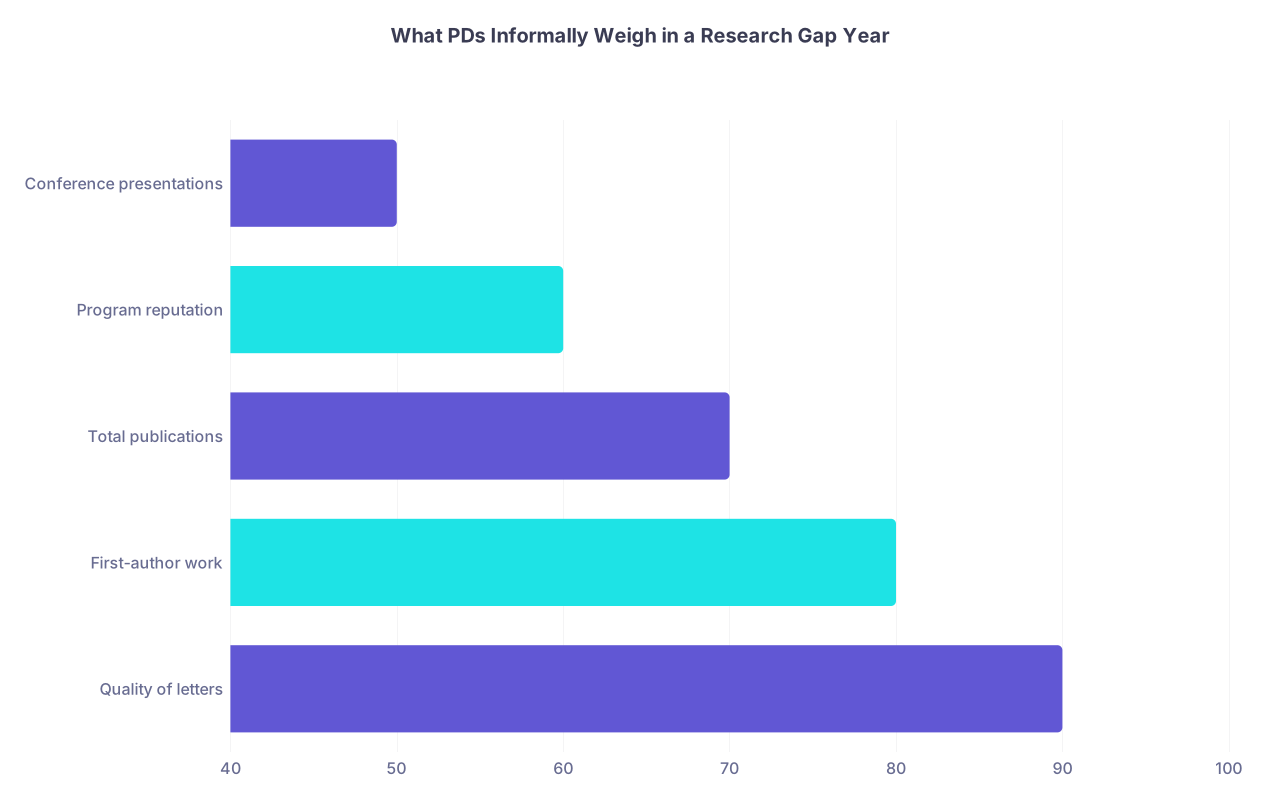
| Category | Value |
|---|---|
| Quality of letters | 90 |
| First-author work | 80 |
| Total publications | 70 |
| Program reputation | 60 |
| Conference presentations | 50 |
A well-structured gap year can flip your trajectory from average to excellent. A sloppy one just delays the inevitable outcome.

Quick Recap: Your Roadmap in Three Sentences
- Decide early, choose a specialty lane, and secure a research home before graduation.
- Front-load IRBs and project setup in the first 3 months, then spend Months 4–9 converting data into manuscripts and abstracts.
- Enter ERAS with concrete output, strong letters from real mentors, and a clean, chronological story that shows you used your research gap year strategically—not accidentally.