
You’re sitting in the library, half‑finished research abstract open on your screen, and you’re thinking, “I would literally rather be on a 28‑hour call than keep doing this.”
Meanwhile, every program website you stalk says the same garbage line: “We value applicants with a strong commitment to scholarly activity.” Your classmates are flexing first‑author pubs, throwing around words like “translational” and “R01” like it’s their love language. You? You just want to see patients, do good clinical work, maybe teach. Not spend your life editing figure legends because Reviewer #2 woke up angry.
And now you’re stuck in this mental spiral:
“If I say I hate research, no one will rank me.”
“If I pretend I love it, they’ll expect me to do research forever.”
“If I don’t have ‘enough’ research, I’m dead.”
Let’s talk about all of that. Honestly.
Do You Actually Have to Pretend You Like Research?
Short answer: No, you don’t have to fake being a budding NIH PI.
Longer, more honest answer: You do need to be smart about how you present yourself, especially depending on:
- Your specialty
- The programs you’re targeting (community vs academic)
- How weak/strong the rest of your application is
There’s a difference between:
- “I hate research and refuse to ever touch a project again,” and
- “Research isn’t my favorite, but I can do it, I understand why it matters, and I’m more drawn to clinical work/education/quality improvement.”
Programs are fine with the second one. They get suspicious about the first—especially at big academic places where everyone’s pretending they love research even when half of them don’t.
You don’t need to pretend research is your passion. But you do need to avoid sounding like:
- You’re anti‑intellectual
- You think evidence‑based medicine magically appears out of thin air
- You’re going to be the resident who rolls their eyes every time someone mentions a journal club article
That’s the line. Don’t cross it.
How Much Research Do Programs Actually Expect?
Let’s cut through the vague stuff and talk in concrete terms.
| Program Type | Realistic Expectation |
|---|---|
| Community IM/FM/Peds | Any research/QI is a bonus, not mandatory |
| Mid-tier Academics | Some experience (case, poster, QI, etc.) |
| Top Academic IM/Neuro | Multiple items; doesn’t all need to be PubMed |
| Surgical (competitive) | Research is often heavily weighted |
| Lifestyle specialties | Often expect research for top programs |
If your stats are solid and you’re aiming for:
- Community internal medicine, family med, peds, psych:
A case report + small QI project can absolutely be enough. - Mid‑tier academic programs:
A couple posters/abstracts and something you can talk about in detail is usually fine. - Super competitive specialties (derm, plastics, ortho, ENT, rad onc, some ophtho):
Yeah, here research is basically a second Step score. Programs use it to filter.
So no, it’s not one size fits all. A PGY‑1 in community family medicine without any publications? Completely normal. A derm applicant with no research? That’s a “probably not matching” situation.
If you’re going into a research‑heavy field and you hate research… that’s a bigger conversation about whether you’re forcing yourself into the wrong specialty just because of prestige or lifestyle.
How Honest Can You Be on Interviews?
This is where everyone panics.
You imagine the nightmare scenario: Program director, dead stare: “So tell me about your passion for research.” You: (internal screaming) “I’d rather do a fourth Q4 call month.”
Here’s how you handle it without lying and without tanking yourself.
1. Reframe it as: “I’m clinically driven, but I respect research.”
You can say things like:
- “My primary interests are clinical care and teaching, but I’ve found that doing research helped me think more critically about the evidence behind what we do.”
- “I wouldn’t call myself a ‘research person,’ but I see research skills as part of being a good clinician—knowing how studies are built helps me interpret the literature my patients’ care depends on.”
Notice what this does:
- You’re not faking some burning love for p‑values
- You’re showing you’re not dismissive of scholarship
- You’re framing research as a means to an end: better patient care
2. Emphasize what you learned, not how much you “loved” it
Instead of: “I loved my time working on this meta‑analysis.” Try:
- “That project forced me to learn how to evaluate biased data.”
- “I realized how many assumptions go into every guideline we follow.”
- “It made me much more critical of small underpowered studies.”
You’re allowed to sound pragmatic rather than starry‑eyed.
3. Do not say these things, even if they’re true
Avoid:
- “I hate research.”
- “I only did research because I knew it was required.”
- “I don’t plan to do any research as a resident.”
- “I’d rather just see patients and never think about papers.”
This stuff is radioactive. People will code that as: rigid, closed‑minded, not curious.
Instead, if they ask what you want your career to look like:
“I see myself in a clinically focused role in a setting where I can also teach and maybe be involved in smaller QI or outcomes projects that directly impact patient care.”
That’s honest and palatable.
What If You Have Almost No Research?
Here’s the panic thought: “I’m doomed. Everyone else has 14 publications and I have… a half‑finished case report and trauma from RedCap.”
Let’s be realistic.
Programs don’t just look at absolute numbers. They look at:
- Your specialty
- Your school’s culture (some schools are research factories, some aren’t)
- Whether what you did makes sense for your story
- Whether you can actually talk about what’s on your CV without sounding clueless
If you’ve got light research, you have three jobs:
1. Make every small thing count
Did a case report? Poster? Retrospective chart review? QI project?
Don’t minimize it. Don’t say, “It’s nothing serious, just a little poster.”
Talk about:
- Your specific role (“I did the data collection and statistical analysis.”)
- What question you were trying to answer
- What surprised you
- How it changed how you think clinically
You turning a small project into a thoughtful story > someone with 10 posters who can’t explain what a confidence interval is.
2. Boost the “I’m scholarly even if I’m not a researcher” vibe
You can lean on:
- Teaching experiences
- Journal club leadership
- Developing patient education materials
- Writing clinical guidelines or protocols at your med school/hospital
- QI projects that changed a workflow or outcome
These all scream: “I care about doing medicine thoughtfully, not just on autopilot.”
3. Be realistic about where you’re applying
If your application is:
- Step 2: 255
- Honors in clinical rotations
- Great letters
- But minimal research
You’ll still be fine for most community and many mid‑tier academic programs in fields like IM, peds, psych, FM, even anesthesia at many places.
The problem is when people with that profile only apply to:
- Harvard MGH
- UCSF
- Penn
- Hopkins
Plus a handful of other research factories, then act shocked when the interview invites are thin.
Aim where your profile actually fits. That’s not “selling yourself short.” That’s reality.
How to Talk About Research in Your Personal Statement and ERAS
You do not have to write, “I discovered my passion for research…” if you didn’t.
But you also shouldn’t pretend it never happened if it’s on your CV.
In your personal statement
You can:
- Focus 80–90% on clinical stories, your values, and why you like the specialty
- If you mention research, make it about what it taught you or how it sharpened your thinking, not how much you “loved pipetting at 2 a.m.”
Example framing:
- “Although my long‑term career goals are primarily clinical, working on a project about [topic] pushed me to critically evaluate the evidence behind a practice I’d previously taken for granted. That experience changed the way I approach new studies and guidelines on the wards.”
That’s enough. You don’t have to turn it into your origin story.
In the ERAS experiences section
Don’t overcomplicate it. For each research thing:
- Be clear and specific about what you did
- Avoid fluff words: “passionate,” “transformative,” “groundbreaking”
- Use honest, concrete language: “abstracted data,” “performed chart review,” “conducted literature search,” “developed data collection tool”
Show competence, not fake enthusiasm.
But What About Programs That Are Truly Research-Heavy?
Yeah. Some programs basically want mini‑fellows who will crank out publications.
If you match there, you will be expected to:
- Do projects every year
- Present at national conferences
- Maybe aim for fellowships at big‑name places
- Potentially spend a research year, especially in some surgical fields
If that sounds like your personal hell, don’t apply there just for the name brand.
Here’s what I’ve seen play out:
- Applicant pretends to be super research‑driven
- Matches at an intense academic place
- Gets there and realizes they’re miserable doing mandatory research blocks, pressured to publish, constantly behind on projects
- Ends up burnt out and resentful
Meanwhile, they would’ve thrived at a solid mid‑tier academic or strong community program where research is optional, not oxygen.
You’re allowed to choose a place that matches who you really are.
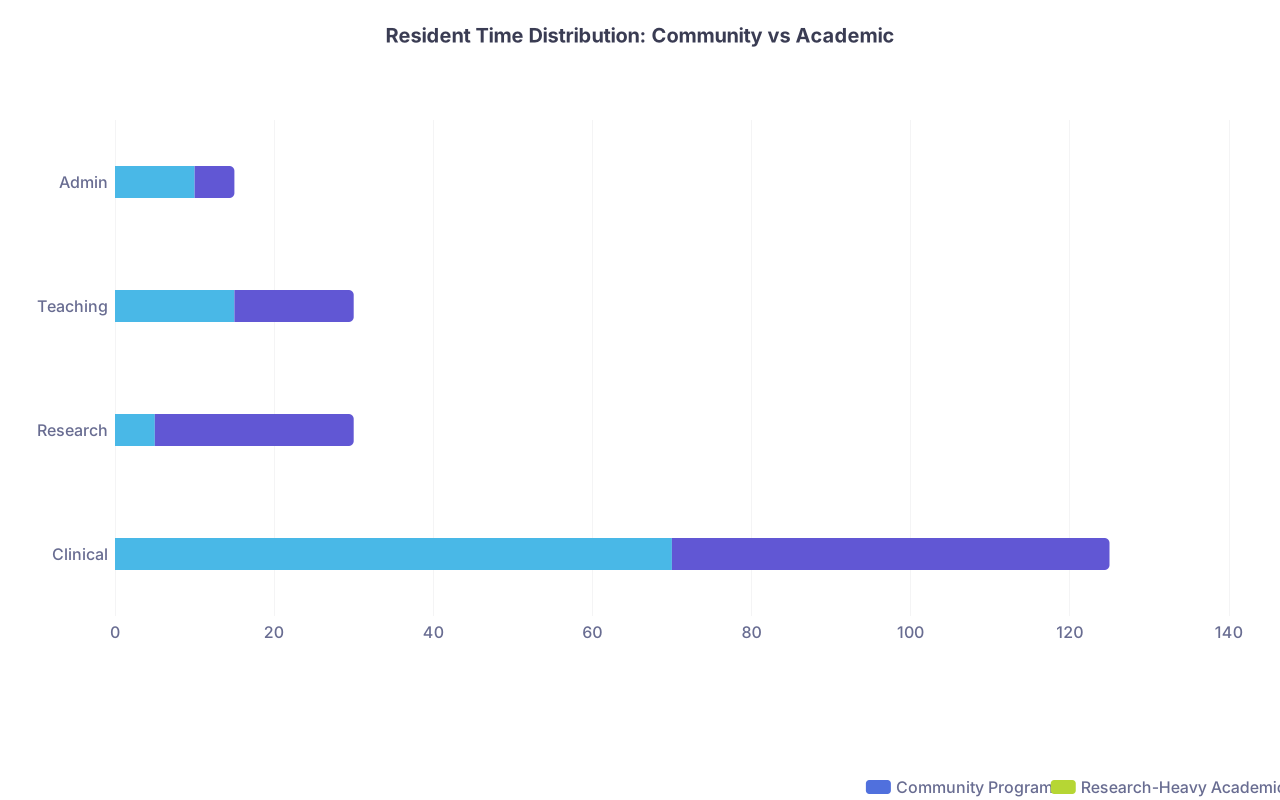
| Category | Community Program | Research-Heavy Academic |
|---|---|---|
| Clinical | 70 | 55 |
| Research | 5 | 25 |
| Teaching | 15 | 15 |
| Admin | 10 | 5 |
Productive Things You Can Do if You Hate Research but Feel Behind
If you’re feeling that gnawing “I didn’t do enough, it’s over” anxiety, here’s how to blunt it a bit.
1. Grab a quick‑win project with a short timeline
- Case reports (especially in fields like IM, neuro, EM, peds)
- A small QI project that you can at least write up descriptively
- A retrospective chart review already in motion where they just need extra hands
No, it’s not too late unless you’re literally submitting ERAS tomorrow. Even a project in progress can be listed appropriately (“In preparation,” “Data collection ongoing”).
2. Document what you already do on the wards in a more “scholarly” way
- Lead a journal club session and actually prepare for it
- Help revise a clinic guideline, template, or workflow
- Create a patient education handout and get faculty co‑sign
These things show that you think beyond just “see patient, write note, move on.”
3. Outline how you’ll engage with scholarship as a resident (without pretending you’ll be in a lab)
When asked in interviews:
“I’d like to be involved in quality improvement or outcomes projects related to [specific area you actually care about]. I’m interested in practical, patient‑facing questions, like how we can improve [X] in a real‑world setting.”
That sounds thoughtful and honest. Not like you’re promising an RCT you’ll never do.
A Quick Reality Check
Programs care more about:
- You being reliable
- Not scaring off nurses and patients
- Not being a walking professionalism problem
- Not being unable to think critically
than they care about you loving bench work.
I’ve seen plenty of residents with “meh” research but stellar clinical skills become absolute favorites among attendings. They get strong letters. They get fellowships. They get jobs. Nobody in five years will care that they didn’t have 10 PubMed IDs.
What does get remembered:
- The resident who constantly skipped research meetings and blew off deadlines
- The resident who complained nonstop about “pointless research” in front of faculty
- The resident who clearly faked their “research passion” and then delivered nothing
Don’t be any of those. You can be:
- Clinically focused
- Respectful of scholarship
- Honest about your preferences
- Good enough at playing the game to get through it
That’s totally survivable.

| Step | Description |
|---|---|
| Step 1 | You dislike research |
| Step 2 | Focus on clinical strengths |
| Step 3 | Reconsider specialty or target less research-heavy programs |
| Step 4 | Frame research as critical thinking tool |
| Step 5 | Highlight QI, teaching, journal clubs |
| Step 6 | Answer interview questions with honest, balanced language |
| Step 7 | Specialty research-heavy? |
FAQ (Exactly 6 Questions)
1. If I say I’m “clinically focused” in an interview, is that a red flag?
Not by itself. It becomes a red flag when it sounds like code for “I don’t read, I don’t care about the literature, and I just do what I’m told.” If you say, “I’m primarily clinically focused, but I see value in research as a way to strengthen the evidence behind what we do,” that’s fine. Pair “clinically focused” with “curious” and “evidence‑based,” not “I never want to touch a paper again.”
2. Can I match an academic program if I don’t like research?
Yes—if your numbers are solid, you’ve done some scholarly activity, and you’re not hostile to research. Many “academic” programs are actually clinically heavy with optional research. Look closely at resident schedules, not just the branding on their website. Some “top” places will care a lot. Others will be fine as long as you don’t openly trash research and you show up as a good, teachable clinician.
3. Should I leave research off my application if I hated the experience?
No. If it’s real and you contributed meaningfully, include it. Leaving it off can look like you did even less. What you should do is frame it in a way that focuses on skills gained: critical appraisal, understanding study design, learning to manage data, seeing how evidence is built. Don’t fake that it changed your life. Just show that it made you sharper.
4. Do programs expect me to keep doing research as a resident?
Some do, many don’t. Community programs often have minimal expectations—maybe one QI project or a single scholarly product before graduation. Big academic centers may strongly push research, especially for people aiming at competitive fellowships. If you see “protected research time,” “T32,” or “research tracks” everywhere on their site, assume they want ongoing scholarly work. If that makes you nauseous, apply accordingly.
5. Will my lack of publications kill my chances at fellowship later?
Only for some fellowships and some institutions. Cards/onc/GI at elite academic centers may heavily favor people with research. But fellowships exist across a spectrum just like residencies do. Many solid fellowship programs care more about your clinical performance, letters, and work ethic than about your h‑index. And you can do modest, clinically oriented projects during residency without becoming a full‑time researcher.
6. What’s one concrete thing I can do this month if I’m behind on research?
Find one small, finite project that’s already in motion and join it. Email a resident or attending you like: “I’m hoping to strengthen my application with a small scholarly project. Do you have any ongoing case reports, QI projects, or chart reviews where an extra pair of hands would be helpful?” Then actually do the work, learn enough to talk intelligently about it, and put it on your application as “in progress” if it’s not done. One real, recent, focused project > four imaginary ones you never started.
Open your ERAS activities section (or your draft list of experiences) right now and look at your research entries. For each one, write one sentence on what you actually learned from it—no fluff. That’s the sentence you’ll use when someone asks about it on interview day.