
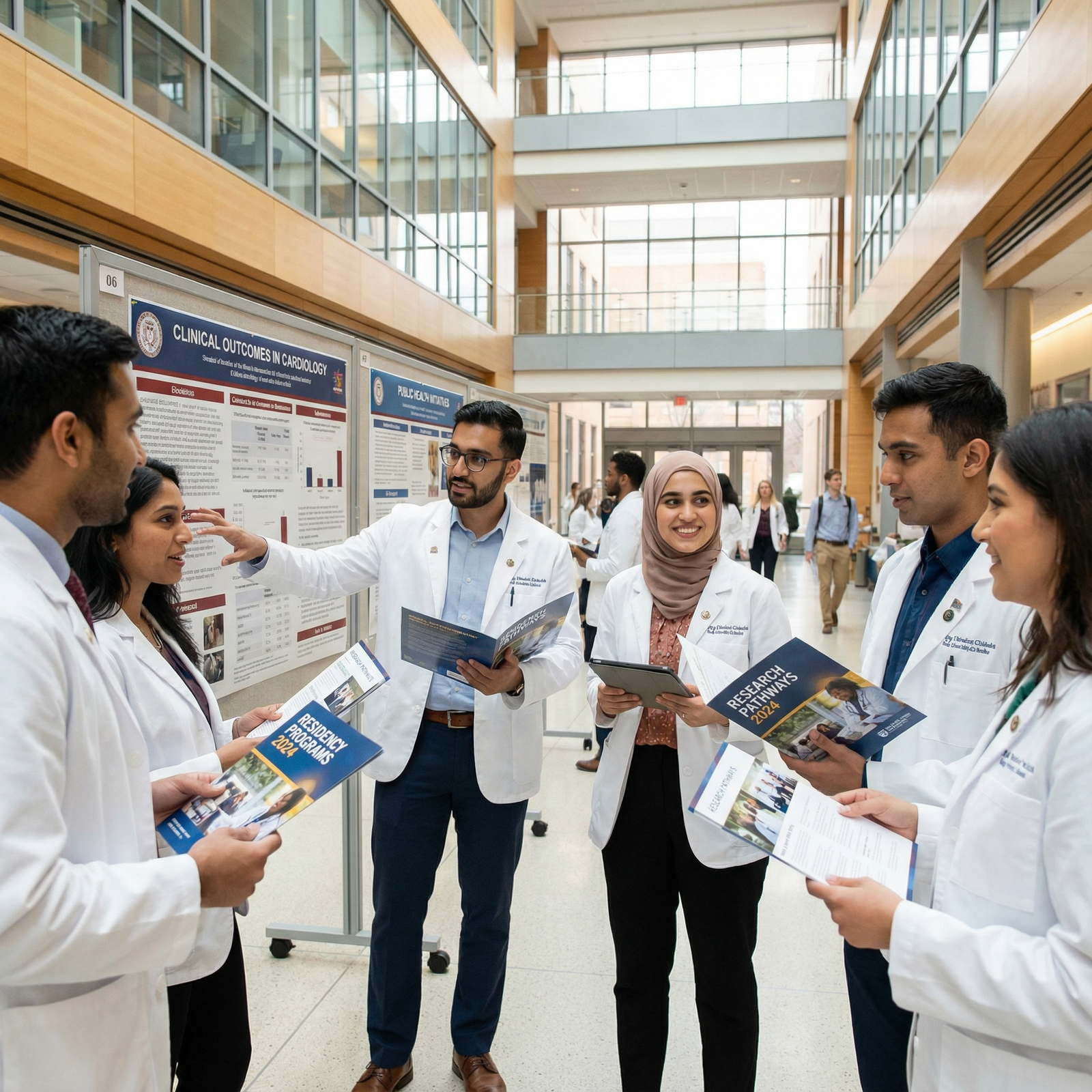
It’s January. ERAS is long gone, you’ve already sent your applications, and you’re staring at your CV thinking: “Oh my god, literally all of my research is in the specialty I ditched.”
Your current nightmare script:
“I have derm papers, but I’m applying to internal medicine.”
“I spent three years on ortho projects and now I’m going into EM.”
“I did basic science cardiology, and now I want psych. They’re going to laugh me out of the room.”
And under all of that is one sickening thought: Did I just completely screw myself by doing the ‘wrong’ research for years?
Let me say this bluntly:
No, your application is not automatically doomed. But you do have to be smart about how you frame it. And yes, programs will notice the mismatch—so you can’t just hope no one asks.
Let’s walk through what actually matters, what programs really think, and how you can make this “wrong” research work for you instead of looking like an anchor around your neck.
What Program Directors Actually Care About With Research
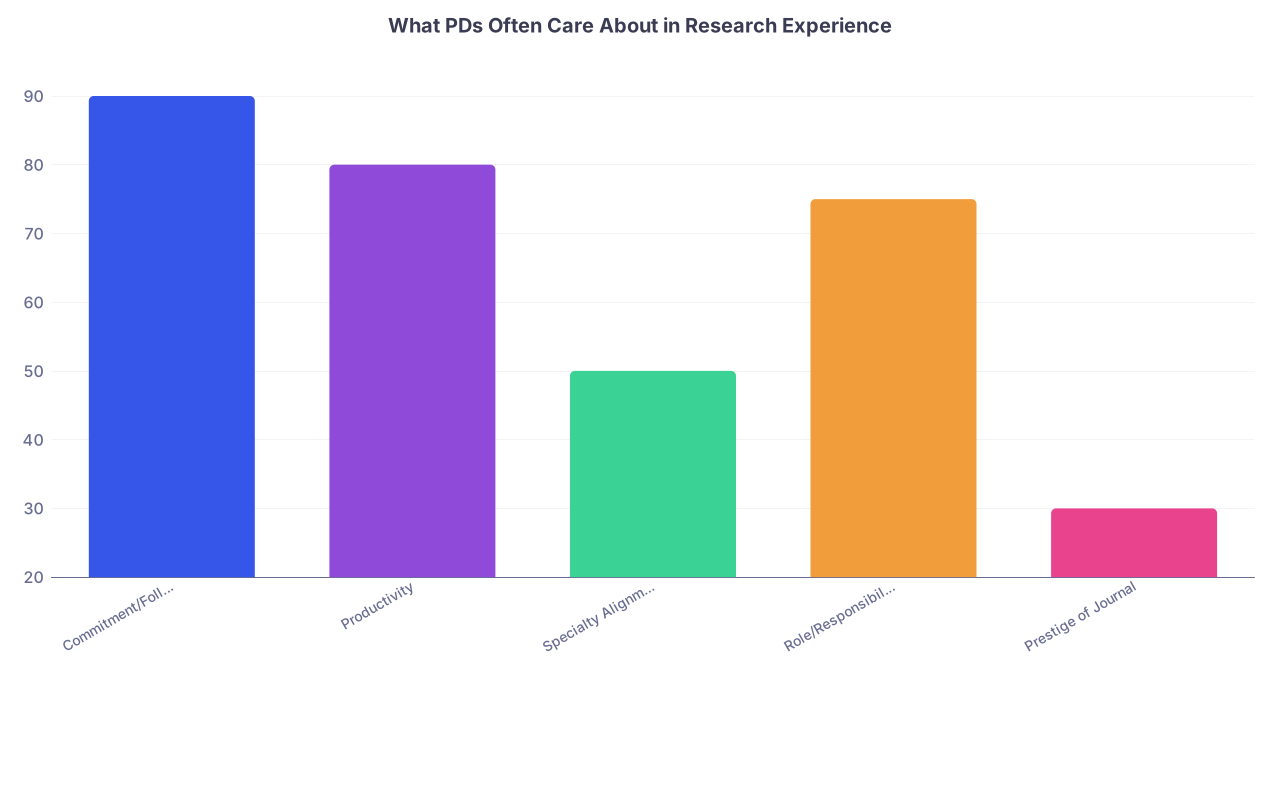
| Category | Value |
|---|---|
| Commitment/Follow-through | 90 |
| Productivity | 80 |
| Specialty Alignment | 50 |
| Role/Responsibility | 75 |
| Prestige of Journal | 30 |
Here’s the part nobody tells you when you’re freaking out over your CV at 2 a.m.:
Program directors don’t sit there thinking, “Ah yes, ortho research for EM? Rejected.”
They’re usually asking much more boring questions, like:
- Can this person commit to something for more than 3 months?
- Can they work in a team, meet deadlines, handle feedback, and not disappear?
- Did they actually do anything, or just list their name on 10 posters they barely remember?
- Does their story make sense, or does it look impulsive and random?
The specific field of your research is third or fourth on the list for most non-ultra-competitive specialties. They care more that you showed up, did work, produced something, and can talk about it like a real adult who understands what they did.
Where does specialty alignment matter the most?
- Very competitive fields (derm, plastics, ortho, ENT, neurosurgery)
- Research-heavy programs (physician-scientist tracks, top academic places)
- When your application is otherwise borderline and they’re looking for a reason to say no
But even in those worlds, I’ve seen matches that technically “shouldn’t” happen on paper because the person explained their path well and had strong general research.
The “Wrong Research” Isn’t the Problem. The Gap in the Story Is.
Here’s the real danger: not that you did psych research and now want anesthesia.
The danger is that your application—and your interview answers—tell no coherent story.
Programs see this all the time:
You:
- 2 years of neurosurgery lab work
- 3 posters, 1 publication with neurosurgeons
- Sub-I in neurosurgery
- Then suddenly: “I’m applying to family medicine because I like continuity of care.”
If you don’t connect those dots, you look: confused, impulsive, maybe like you didn’t get what you wanted and are “settling.”
That’s what scares them. Not your old research topic.
You have to answer, very clearly:
- Why did you pivot?
- When did the change happen?
- What did you do after realizing you were changing directions?
- What from your prior research and experiences actually helps you in this new field?
If those answers are airtight, your old research becomes evidence of maturity and follow-through, not a red flag.
How To Reframe “Wrong” Research For Your New Specialty
Let’s say you did 3 years of ortho research. You’re applying to EM now. On paper, it looks like whiplash.
Here’s how you make it make sense.
1. Translate the Skills, Not the Topic
Programs care way more about what you learned than the fact that your patient population had joint replacements instead of sepsis.
So instead of panicking over “ortho vs EM,” focus on:
- Did you design a study or just collect data?
- Did you manage a database or coordinate with other departments?
- Did you learn to critically read and critique literature?
- Did you present at a conference? Handle Q&A? Get grilled by attendings?
- Did you learn to manage time between research, rotations, and exams?
When you talk about it, you say things like:
“Most of my research was actually in orthopedics, where I worked on postoperative infection outcomes. What I really took from that was how to systematically think through data, manage time-sensitive tasks, and collaborate with surgeons, nurses, and data analysts. That same skill set is what excites me in EM—rapid decisions grounded in evidence and clear communication with a multidisciplinary team.”
No one cares that you said “orthopedics” there. They care about the through-line.
2. Show That the Switch Was Thoughtful, Not Desperate
The absolute worst impression you can give is: “I didn’t match or lost interest late, so I just picked something.”
You need to show: “I changed direction after real experiences and reflection.”
Bad version:
“I originally did a lot of radiology research but later realized I like more patient contact, so I chose internal medicine.”
Better version:
“I came into med school very interested in radiology and pursued multiple radiology projects. As I got further into clinical rotations, I realized that the aspects I found most fulfilling were the complex medical decision-making and the longitudinal relationships with patients and families, which I found most strongly in internal medicine. Over the past year, I’ve deliberately sought out [X, Y, Z] IM experiences to confirm that fit.”
Same facts. Entirely different signal.
How Much Does Specialty-Specific Research Actually Matter?
Let’s just say what you’re afraid to ask:
“Am I screwed if I have zero research in my new specialty?”
Short answer: depends on the specialty, but usually no. With nuance.
| Specialty Type | Specialty-Aligned Research Weight |
|---|---|
| Ultra-competitive (Derm, Plastics, Ortho, ENT, NSG) | Very High |
| Academic IM, Neuro, Rad-Onc | High |
| Mid-competitive (Anes, EM, Gas, OB/GYN) | Moderate |
| Primary care (FM, Psych, Peds) | Low–Moderate |
| Community-focused programs (most specialties) | Low |
If you’re switching into derm or plastics late with zero specialty research… yeah, that’s a real problem. Not impossible, but uphill and very program-dependent.
If you’re switching into:
- EM from surgery
- IM from pediatrics
- Psych from IM
- Anesthesia from surgery or IM
- FM from literally anything
Then your “wrong” research is typically fine, as long as:
- You explain the switch well
- You have at least some clinical exposure in the new specialty (electives, Sub-I, shadowing)
- Your letters support your new direction
I’ve seen:
- A former neurosurgery-hopeful with only skull base tumor research match EM at a strong academic program
- A derm-research-heavy applicant match IM at a top hospital
- A basic science PhD in virology pivot to psych with zero psych research and still match well
Why? Their research showed capability. Their stories showed intentional pivot, not chaos.
What If Your Research Directly Contradicts Your Stated Interests?
This is where people get tripped up in interviews.
You say: “I’m passionate about primary care and serving vulnerable communities.”
They flip to your CV and it’s all:
“Robotic surgery, spine biomechanics, robotic this, robotic that.”
If you don’t address that head-on, they’ll assume:
- You’re just saying what you think they want to hear
- You originally wanted surgery, didn’t get it, and now you’re rebounding
So you confront it.
You’re allowed to say:
“I went into med school thinking I’d be a surgeon. I joined multiple surgical projects and had great experiences from a research perspective. As I got deeper into clinical work, I realized that what I loved wasn’t the OR as much as the pre- and post-op care, the long-term management of chronic conditions, and the counseling. That pushed me toward internal medicine. I’m really grateful for my surgical research because it showed me what I don’t want just as much as what I do.”
That answer reads as mature, not flaky. You didn’t “waste” your research. It was part of the process.
Strategic Things You Can Still Do (Even If It Feels Too Late)

| Step | Description |
|---|---|
| Step 1 | Realize specialty switch |
| Step 2 | Audit existing research |
| Step 3 | Identify transferable skills |
| Step 4 | Update CV descriptions |
| Step 5 | Align personal statement |
| Step 6 | Prep interview talking points |
| Step 7 | Seek small, quick-hit specialty projects |
You can’t go back in time and magically generate 5 publications in your new field. But you can stop making things worse and start making your existing work more aligned.
Here’s what I’d do if I were you, today:
Rewrite your CV bullets to highlight transferable skills.
Stop listing: “Retrospective chart review of lap chole outcomes.”
Start listing: “Designed and executed retrospective outcomes study; managed 500+ patient dataset; performed statistical analysis with [X]; presented findings at [Y].”
That reads like a researcher, not a surgical fan club member.Adjust your personal statement so the change doesn’t look random.
One clear paragraph that acknowledges your prior focus and shows how that led to now. Not an apology. Just a bridge.Prep 2–3 tight answers for the inevitable interview question: “So why the switch?”
If you ramble or get defensive, they pick up on that. Practice until you can say it calmly, in under 90 seconds, without sounding like you’re auditioning for a therapy session.If there’s time, grab one small, fast, specialty-adjacent project.
Case report. QI project. Chart review. Anything that signals: “Yes, I’ve actually set foot in this field on purpose.” This doesn’t have to be massive. It just has to exist.
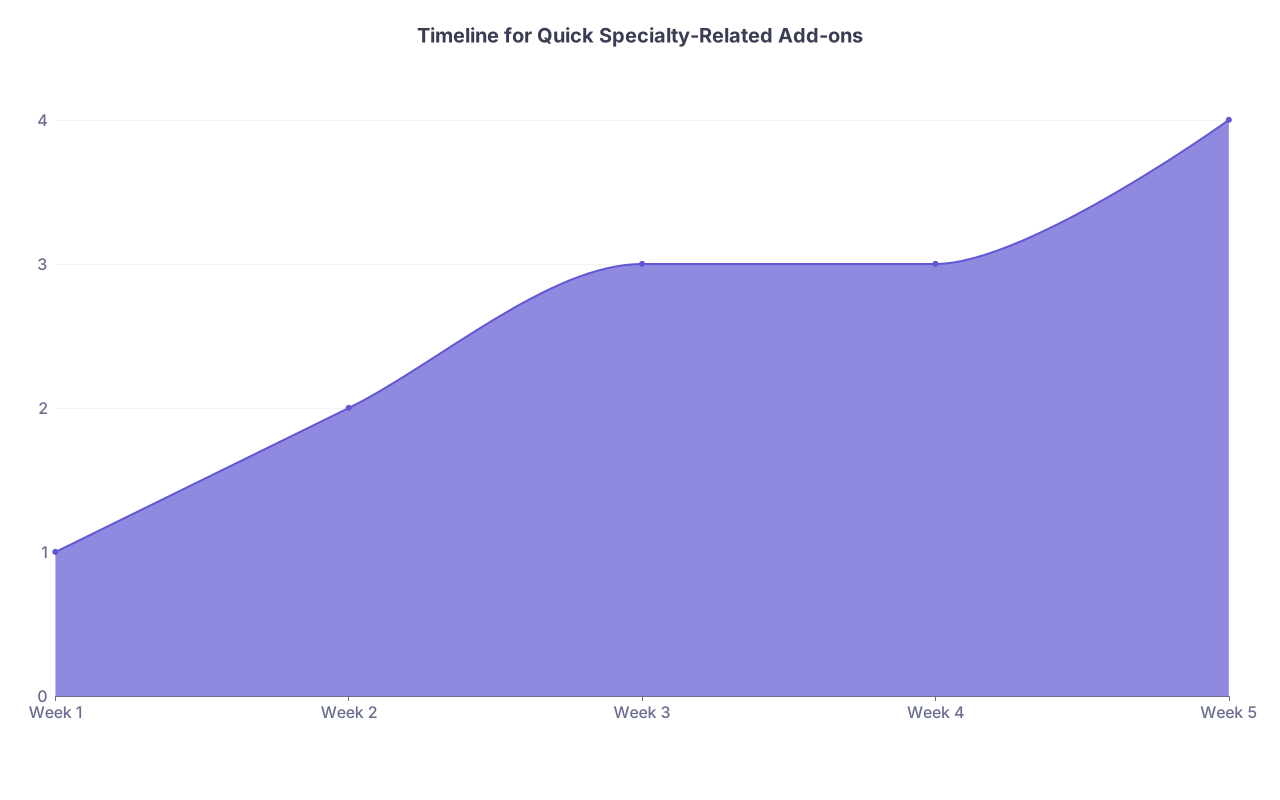
| Category | Value |
|---|---|
| Week 1 | 1 |
| Week 2 | 2 |
| Week 3 | 3 |
| Week 4 | 3 |
| Week 5 | 4 |
Even if it never gets published before Match, you can say:
“I’m currently working on a QI project in EM focused on door-to-needle times for stroke patients.”
That one sentence alone can anchor your new specialty choice.
What Actually Raises Red Flags (More Than “Wrong” Research)
Let me be harsh for a second, because someone has to be.
Programs usually worry more about these things than about mismatched research topics:
- Huge, unexplained gaps in research or activities
- Inflated authorship (suddenly first author on 9 papers? Sure, Jan.)
- Can’t explain your own project in basic terms
- Letters that are generic or weak
- A vibe that you just “fell into” this specialty yesterday
I’ve sat in rooms where PDs shrugged at irrelevant research, but immediately soured on someone who couldn’t answer simple questions like,
“So, what was your role in this project?”
or
“What did the study actually show?”
Your fear is: “My research is in the wrong area.”
Their fear is: “This person doesn’t know who they are or what they want, and might bail on the specialty later.”
You can’t control your past research topic.
You absolutely can control how convincingly you talk about it and how clearly you present your specialty choice now.
A Quick Reality Check About “Doomed” Applications

Everyone thinks their application is the outlier disaster.
You are not that unique.
Lots of people:
- Thought they wanted surgery, then chose anesthesia, EM, or IM
- Did years of lab work in one field and ended up in a totally different one
- Have CVs that look like three different people stapled together
And every single year, they still match. Sometimes extremely well.
Is it easier when your research, rotations, and narrative all line up in a perfectly curated straight line? Yes. Those people exist. They are annoying.
But the match is not reserved for them. Programs are full of people who changed their minds, took detours, or realized late what they actually want.
Your job is not to retroactively erase your old self. It’s to show maturity in how you moved from Old Self to Current Self.
FAQ: Late Specialty Switch & “Wrong” Research
1. Should I leave my “wrong” research off my application?
Usually no. Unless it’s truly minimal or messy, include it. It shows productivity, follow-through, and academic engagement. Trying to hide years of work creates weird gaps and more questions. You don’t need to spotlight it like your life’s passion, but don’t pretend it never happened.
2. Do I need at least one research item in my new specialty to be competitive?
For super competitive academic programs or ultra-competitive specialties? It definitely helps and sometimes is expected. For most mainstream or community programs in IM, FM, psych, peds, EM, anesthesia? It’s nice to have, but not mandatory if the rest of your story is solid and you have strong clinical experiences and letters in the new field.
3. How do I answer “Why did you switch?” without sounding flaky or like I failed at my first choice?
Keep it short, honest, and structured:
- What you originally thought you wanted
- What experiences changed your perspective
- What specifically drew you to the new specialty
- How your prior experiences still help you now
Own the decision. Don’t over-explain, don’t badmouth your old field, and don’t sound like you’re begging them to believe you.
4. What’s one concrete thing I can do this week to make my “wrong” research look better?
Open your CV and rewrite the bullets under each research entry so they emphasize skills and responsibilities, not just the topic. Focus on design, data analysis, teamwork, presentations, and outcomes. Then look at your personal statement and make sure there’s a clear, explicit bridge from your prior focus to your current specialty choice—at least one paragraph that connects those dots.
Open your CV right now and pick one old “wrong” research entry. Rewrite its description so it highlights skills and impact, not just the specialty topic. If it reads like something any good resident in any field would be proud of, you’re finally using that “wrong” research the right way.


