

What if I told you that the most commonly repeated “research” advice for IMGs is based on people misreading a PDF table from NRMP?
Let’s go straight at the myth:
Myth:
“If you’re an IMG and you don’t have multiple publications, you’re basically not competitive anywhere.”
I’ve heard versions of this in WhatsApp groups, in Telegram channels, from “consultants,” and from residents who are just repeating what scared them when they applied. It sounds authoritative. It also happens to be wrong once you actually look at the data and the context.
You do not need a stack of first-author PubMed papers to be a competitive IMG in most specialties. Could they help in certain situations? Yes. Are they mandatory across the board? Absolutely not.
Let’s tear this apart properly.
What the Data Actually Shows (Not What People Say It Shows)
People love to screenshot that infamous NRMP Charting Outcomes table:
- “Matched IMGs in internal medicine have 6.9 research experiences and 3.2 abstracts/pubs/presentations.”
- “Matched IMGs in neurology have X.”
- “Unmatched have fewer.”
Then they jump to: “So you need at least 3–5 publications.”
Wrong conclusion. For three reasons.
1. “Abstracts / Pubs / Presentations” is one big bucket
That NRMP number doesn’t mean “publications.” It’s a combined count:
- Case reports
- Posters
- Oral presentations
- Quality improvement projects
- Peer-reviewed articles
- Sometimes even stuff that barely made it to a local conference
Most IMGs are counting “publications” as PubMed-indexed original research. NRMP is counting almost everything scholarly.
If a matched IMG has a total of 3–4 things in that bucket, that might be:
- 1 case report in a low-impact journal
- 1 poster at a local conference
- 1 oral presentation at their home institution
Not “3 original high-impact papers in JAMA.”
2. Averages hide the most important thing: the floor
Averages are weapons when misused.
If ten applicants have:
- One superstar with 20 publications
- Four applicants with 4–5 each
- Five applicants with 0–1 each
The average might be 5–6. But half the matched applicants had 0–1 pubs.
That’s exactly what happens in competitive programs: a few research-heavy applicants bump the average, and everyone freaks out. What matters to you is not the average. It is:
- Can applicants with 0–1 publications still match?
- In which specialties and types of programs do they do it?
And the answer is yes, they can and do. Every single year.
3. For IMGs, research is not the top predictor of matching
If you actually read NRMP and related data (instead of cherry-picking one table), a different pattern appears. For IMGs, three things consistently matter more than “number of publications”:
- Exam performance (USMLE / equivalent)
- YOG (year of graduation) / recency of clinical work
- US clinical experience + strong letters
Research starts climbing in importance only in:
- Highly competitive specialties (derm, neurosurgery, rad onc)
- Academic-heavy programs
- Cases where you’re trying to compensate for weaknesses elsewhere
For bread-and-butter IMG specialties—internal medicine, family medicine, pediatrics, some neurology and psych—multiple publications are helpful, not required for survival.
Specialty Reality Check: Where Multiple Publications Actually Matter
Let’s be blunt. Whether you “need multiple publications” depends on what you’re aiming at.
| Specialty Type | Typical Research Expectation |
|---|---|
| Community FM / IM / Peds | 0–1 pubs, some scholarly work |
| Mid-tier IM / Neuro / Psych | 1–2 pubs or posters |
| Academic IM / Neurology (US MD) | 2–5+ pubs helpful |
| Derm / Neurosurg / Rad Onc | Multiple strong pubs often |
| Community Prelim / TY Years | Very low research emphasis |
Does this mean you can’t match an academic IM program without 5 papers? No. I’ve seen IMGs match solid university-affiliated IM programs with exactly:
- One case report + one poster
- Or a single meaningful project + very strong letters
Let’s take internal medicine as an example, because that’s where most IMGs end up.
In many mid-tier university IM programs:
- U.S. MD grads with 240+ and some research get priority
- IMGs get serious looks with:
- 1–2 decent scholarly projects
- Clean YOG (not 10 years out)
- Strong US letters
- Solid Step scores or equivalents
Programs care about:
Can this person function? Can they write notes? Can they communicate with patients? Can I trust them at 3 a.m. on cross-cover?
Multiple publications don’t answer any of those questions.
Now, if you tell me you’re an IMG aiming for neurosurgery, derm, plastics, or radiation oncology: yes, now we’re talking about a different game. In those fields:
- Multi-year research fellowships
- Several publications in the specialty
- Strong U.S. academic mentors
That’s often the price of entry. But that’s <10% of what IMGs are chasing.
If you’re an IMG targeting internal medicine, family medicine, peds, psych, or even many neurology spots, building an entire application strategy around “I must have multiple publications” is usually backwards.
The Data Everyone Ignores: Where IMGs Without Heavy Research Still Match
Step out of message-board fantasy land and look at where IMGs actually end up:
- Community internal medicine programs in the Midwest, South, and some Northeast regions
- Community-based family medicine and pediatrics
- University-affiliated but not hyper-research-heavy neurology and psych programs
- Transitional year and prelim spots at a wide range of hospitals
These programs:
- Often list research as “preferred” or “a plus”
- Rarely screen out just because you have zero publications
- Care a lot more about reliable work ethic, exam performance, and US hands-on experience
When program directors speak honestly (at conferences, panels, and yes, occasionally on record), the theme repeats:
“I’d rather have an IMG who’s done one solid QI project and has strong, specific letters from US faculty than someone with 8 random case reports from predatory journals.”
I’ve heard almost that exact sentence from an IM program director at a midwestern university-affiliated program.
So where do multiple publications actually shift the needle for an IMG?
- If you’re borderline on scores, a research record can reassure them: this applicant is academically engaged.
- If you want academic careers long term, research now is a signal you’re not going to disappear after residency.
- If your CV has gaps (older YOG, non-linear path), research can show continued involvement.
But the fantasy that “without 3–5 PubMed pubs you’re dead everywhere” simply isn’t reflected in real match outcomes.
The Ugly Truth: Not All “Publications” Are Created Equal
Another part of the myth: “Just publish anything, anywhere. Quantity matters.”
No. It really doesn’t, not the way you think.
Program directors are not statisticians, but they aren’t blind. They recognize patterns:
- A CV with 7 “publications,” all from obviously predatory journals with suspicious names, makes you look desperate, not impressive.
- A random assortment of case reports across completely unrelated fields suggests box-checking, not real curiosity.
- Multiple low-quality projects hastily done in 6 months are easy to spot from the dates alone.
What actually looks good?
- One or two well-done projects where you can speak intelligently about the question, methods, and results.
- A case report you really understand, where you know the pathophysiology, decisions, and literature.
- A QI project with real outcomes on your ward: reduced falls, improved documentation, anything you can quantify.
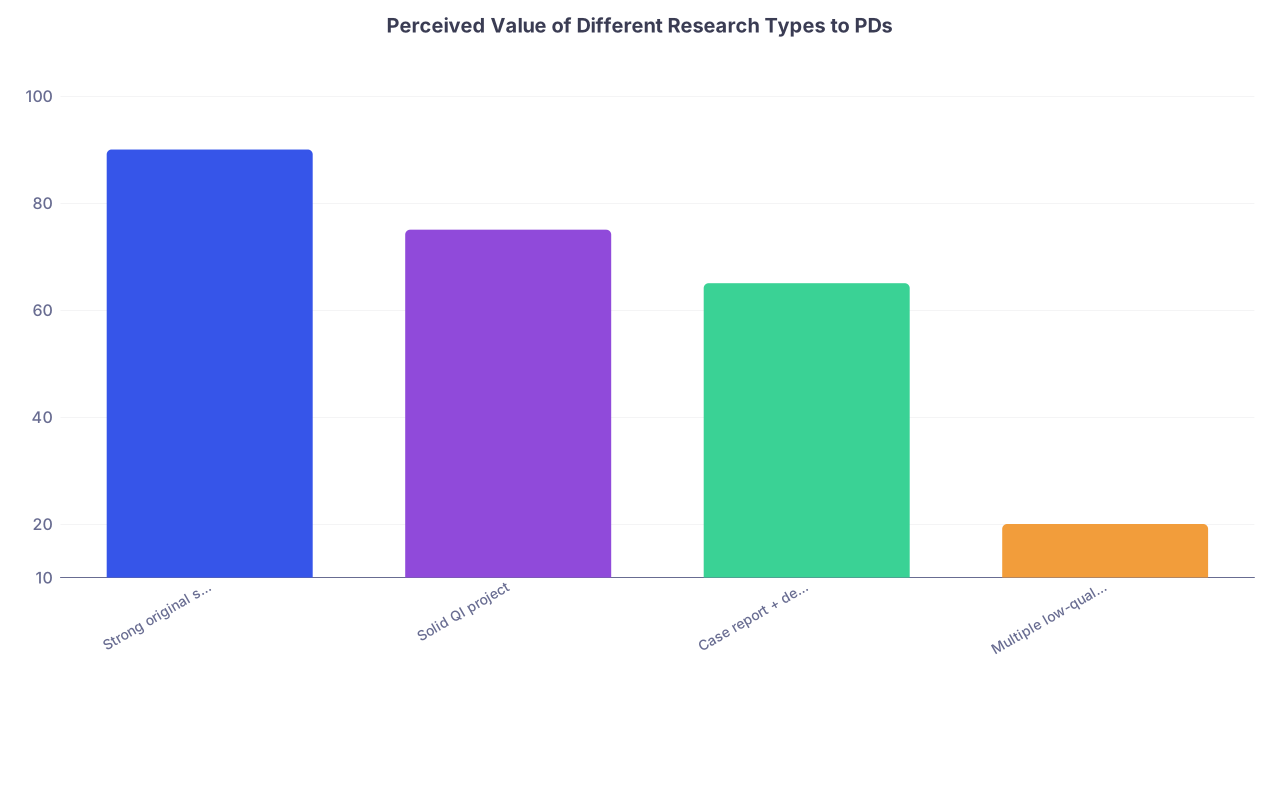
| Category | Value |
|---|---|
| Strong original study | 90 |
| Solid QI project | 75 |
| Case report + deep understanding | 65 |
| Multiple low-quality papers | 20 |
Is this chart approximate? Of course. But it matches the conversations I’ve had with attendings and PDs. One serious, meaningful project usually beats 6 cookie-cutter case reports from spam journals.
The Opportunity Cost IMGs Keep Ignoring
Here’s the part that really bothers me.
I’ve seen IMGs:
- Spend 1–2 full years in unpaid “research fellowships”
- Chase weak projects that never get accepted
- Delay taking Step 2 / OET / language exams
- Forgo U.S. clinical experience they could have obtained
All because someone told them, “Without a lot of publications, you have no chance.”
That tradeoff is often terrible.
For an IMG aiming at IM/FM/Peds/Psych:
- One year of strong US clinical experience with excellent letters + solid exam scores often beats a year of weak research with no clinical contact.
- A 10–15 point higher Step 2 score will open more doors than 2–3 extra low-quality publications in many specialties.
- Recency of graduation (not being >5–7 years out) frequently matters more than your publication count.
Your time is your most precious resource. If you’re using it to chase the wrong signal, you are handicapping yourself.
This is where you need to be ruthless.
Before committing to a massive research push, ask:
- Is this research likely to actually produce something tangible (accepted paper/poster) before I apply?
- Is this project in a real journal or a glorified PDF farm?
- Does this help my long-term goals (academic career, fellowship) or am I just panicking because of Telegram rumors?
What a Rational Research Strategy for IMGs Actually Looks Like
Let me sketch a sane, data-aligned approach instead of the panic-driven one.
If you’re an IMG targeting mainstream specialties (IM, FM, peds, psych, neurology in most settings):
- Make exams and language proficiency non-negotiable core priorities.
- Get some US clinical experience with supervisors who actually write detailed letters.
- Aim for 1–3 genuine scholarly activities:
- A case report from your rotations
- A QI project in your hospital
- A small retrospective study with a mentor who has a track record of publishing
You do not need to chase “multiple publications” at all costs.
If you’re targeting highly academic IM programs or competitive subspecialty fellowships later (cards, GI, heme/onc), then yes, start building a meaningful research base:
- One or two ongoing serious projects
- Try to get involved in data collection, analysis, and writing—not just your name in the middle
- Be prepared to talk through these in detail during interviews
If you are one of the small group chasing hyper-competitive fields (derm, neurosurg, ortho, rad onc, plastics):
- Now we’re talking about a different world where multiple strong publications, often in the same field, become near-essential.
- But you already know that, and you’re not the person who should be taking advice based on generic IMG fear.
For everyone else, the “multiple publications or you’re dead” myth is not just wrong. It’s actively harmful.
How Programs Actually Read Your CV
Think from the program’s side. You’re a PD with 3 minutes per application:
You scan:
- Scores
- YOG
- U.S. experience
- Red flags
- LORs (if time)
Then you glance at research.
What they check (if they care):
- Does this applicant seem academically engaged at all?
- Is there any consistent thread or is it random noise?
- Can I see this person contributing to future QI or scholarly work here?
They’re not doing a citation analysis. They’re not measuring impact factors. They’re checking for signals:
- “No research at all, but strong clinical letters” → still acceptable in many community-heavy specialties.
- “One or two solid projects tied to their story and interests” → good sign.
- “Ten garbage publications in journals I don’t recognize” → suspicion.

| Step | Description |
|---|---|
| Step 1 | Application Received |
| Step 2 | Screen Scores/YOG |
| Step 3 | Check US Clinical Experience |
| Step 4 | Set Aside/Reject |
| Step 5 | Glance at Research |
| Step 6 | Evaluate Letters |
| Step 7 | Decide on Interview |
| Step 8 | Red Flags? |
Notice where research sits: after basic viability, before the deeper holistic assessment. It is not the first or only gate.
The Bottom Line
Let me compress this into what you should actually remember:
You do not need multiple publications to be competitive everywhere as an IMG.
In most IMG-friendly specialties and programs, 0–2 solid scholarly activities combined with strong exams and US clinical experience can absolutely be enough.Quality and context beat raw publication count.
One serious project you understand well usually beats 5 meaningless case reports scattered across predatory journals.Do not sacrifice your core competitiveness (scores, YOG, USCE) for the illusion that more publications will magically fix everything.
Research is one piece of a portfolio, not the entire solution.
Use research strategically. Not fearfully. Not because a Telegram chat told you “3–5 publications or no match.”
You’re not applying to be a full-time researcher. You’re applying to be a resident who can take care of real patients. Act like it.


