
Your mentor leaving does not erase your research. But I know it absolutely feels like it might.
That sinking feeling when you get the email: “I wanted to let you know that I’ve accepted a position at…” And suddenly your brain goes straight to:
Does my research still count?
Will programs think I’m making this up?
Who’s going to vouch for me?
Did I just waste two years?
Let me just say the quiet part out loud: this situation is way more common than anyone admits. Faculty move. Grants dry up. People change institutions mid-cycle. I’ve watched this happen during ERAS season, during NRMP rank meetings, mid-manuscript revisions. It’s messy, but it’s not the death sentence for your application that your brain is telling you it is.
Let’s walk through what actually matters, what’s salvageable, and how to keep this from turning into a story you tell yourself at 2 a.m. about how everything fell apart.
First: Does Your Research Still “Count”?
Short answer: yes. Longer, anxious brain version: it counts, but you need to frame it correctly.
Programs care about what you did, not just who you did it with.
You still:
- Collected data
- Analyzed charts, images, outcomes, whatever
- Wrote abstracts, maybe a manuscript
- Presented at a meeting or at least prepared a poster
- Showed up to lab meetings, journal clubs, IRB hell, revisions
That doesn’t vanish because your PI moved across the country.
On ERAS, your mentor’s institution at the time of the work is still true. The study happened. You were there. The IRB number is real. The timeline is real. You listing that experience is not “shady” just because the PI’s email now ends in @NewUniversity.edu.
Here’s the uncomfortable part: the only time this really becomes risky is if everything about the project is vaporware. No protocol, no draft, no poster, no abstract, no data structure. If literally nothing exists outside of “we talked about maybe doing this,” then yeah—any mentor leaving or not—putting that on ERAS would be sketchy.
But if you have:
- A draft
- Data files
- A poster
- An abstract submission
- Even a half-finished project in REDCap
then that’s legitimate scholarly work.
Programs are not cross-checking a live faculty directory for every research line on ERAS going, “Oh, this attending doesn’t work there anymore, applicant must be lying.” They don’t have the time. They’re screening hundreds to thousands of apps in like… 90 seconds each.
They’re asking:
- Does this applicant seem consistently involved in research?
- Does the story (timeline, roles, output) make sense?
- Is there any obvious BS?
Your mentor moving isn’t BS. It’s academia.
What Actually Changes When Your Mentor Leaves
The panic usually clusters around a few things:
- Letters of recommendation
- Ongoing projects and publications
- How to list the work on ERAS
- What to say if asked in interviews
Let’s go one by one.
1. Letters of Recommendation
This is the part that feels scariest: “If they’re not at my institution anymore, will their letter even matter?”
Yes. Their new institution doesn’t invalidate their opinion of your work.
You still list them on ERAS as:
- Name
- Current title and institution
- (And when they write the letter, they’ll mention they supervised you at Old Institution)
Reviewers see this all the time: “I worked with Dr. X at Institution A; Dr. X is now at Institution B.” Nobody is confused by that.
What can be a problem is if you were counting on:
- A department chair letter from them
- A “home institution” specialty letter
- Someone who was supposed to argue for you in your local rank meeting
If they’re gone, you might lose that political capital inside your own department. That sucks. It’s real. But it’s not the same as, “My letter is worthless.”
Honest strategy?
- Still ask them for a letter. They know your work best.
- Also get at least one letter from someone who’s still at your institution and knows you clinically or academically.
- If your old mentor is well-known in the field, the letter might even look better coming from a big-name person at a big-name new institution.
The fear that someone will say, “Wait, but they weren’t even there this year, how could they write about you?” is mostly in your head. They’ll just assume you worked with them when they were still there. Which you did.
2. Ongoing Projects, Abstracts, and Publications
Here’s where the anxiety usually spirals:
- “Will the paper die?”
- “Can I still be first author?”
- “Who’s going to deal with IRB / revisions / co-authors?”
- “Is it sketchy to list something as ‘submitted’ when my mentor is literally gone?”
Reality: a move doesn’t necessarily kill a project, but it can slow or complicate it.
Most faculty who move will try to bring their projects with them mentally, even if the data can’t literally move institutions because of IRB or data sharing rules. A lot of times they’ll still finish the paper using the original institution’s IRB and co-authors.
What you should do:
Email them directly with something like:
“I’m starting to work on my ERAS application and wanted to clarify the status of our [project title] so I can list it accurately. Is it still moving toward submission? Would you be comfortable if I list it as ‘manuscript in preparation’ or ‘submitted to X journal’ if that’s where we are?”Ask explicitly about authorship:
“Am I still first author on this?”
Get that clarified early. You don’t want to find out in October that you got bumped by some new postdoc at the new institution.If they’re too busy/checked out, ask:
“Would you be okay with me taking the lead on pushing this across the finish line—with your continued oversight by email?”
Some mentors will say: “Yes, please. Here’s the draft. You run with it.”
Others will vanish into admin hell at their new job. That’s rough, but not uncommon.
On ERAS, if it’s not accepted or published yet, list it as:
- “Manuscript in preparation” (if you’re honestly still working on it)
- “Manuscript submitted” (only if it’s actually submitted to a journal)
- “Conference abstract submitted” (if truly submitted)
Do not start inventing acceptance. Programs don’t expect every project to be published. They expect honest status.
Your mentor leaving doesn’t change that calculus. It just makes the odds slightly worse that the paper will get done quickly. Annoying, yes. Disqualifying, no.
3. How To List the Research on ERAS
This part is much simpler than your brain wants it to be.
For the experience entry:
- Use the institution where the work was done.
- Use that department/division as it existed then.
- Your role and dates are still the same.
You can put your mentor as “Supervisor/PI” and if someone cares enough to check and sees they’ve moved, the logical thought is, “Ah, that attending must’ve left. Okay.”
For publications/abstracts:
- Use your official affiliation as it appears (or will appear) on the paper. Usually that’s the institution where you were when the research occurred.
- If your name is on a poster when your mentor was still at Institution A, that stays.
If you’re worried about confusion, you can mention the transition in your description:
“Worked with Dr. X (who has since moved to [New Institution]) on retrospective cohort study of…”
That’s it. Transparent, factual, calm.
4. What To Say If Interviewers Ask About It
This is the moment you’re picturing: sitting in a Zoom interview, attending leans forward:
“So you did this research at University Y… but I see your mentor is at University Z now. What happened there?”
They probably won’t ask this. But if they do, you can keep it boring and straightforward:
“Dr. X accepted a position at [New Institution] midway through the project. We completed [data collection / initial analysis] before they left. We’ve been continuing to communicate by email about the manuscript, and I’m working on [X, Y, Z tasks] currently.”
You don’t have to:
- Explain politics
- Justify their leaving
- Make it dramatic
- Overshare any inside gossip
All they really want to know is: Did you actually do meaningful work, and did you maintain professional continuity?
If the project died, you can still own it:
“We completed the initial analysis and drafted an abstract, but after Dr. X moved institutions, the project stalled and didn’t make it to publication. It was still really valuable for me in terms of [learning study design / data analysis / statistical methods], and it sparked my interest in [field/topic].”
Programs are not docking you because a PI switched jobs. They’d have to dock half the applicants every year if they did that.
What This Does Not Mean About You
Let me push back on a few nasty little thoughts that usually show up around this situation:
“Programs will think I’m lying”: If you can show a poster, a draft, an abstract, or even talk in detail about the methods, nobody sane will think you made it up.
“It looks like I got abandoned”: Faculty leave for a thousand reasons—promotion, spouse job, department drama, money. It’s rarely about the student. Honestly, nobody is reading that into your file.
“I have no one to vouch for me now”: Then find one more person. Clinician. Co-mentor. Another attending you staffed with on service. You’re allowed to have more than one human know you exist.
“All my research is now ‘worthless’”: No. You still learned how to ask a question, design a study, manage data. You can still talk about that in interviews. You can still shape your narrative around it.
Your brain is writing a story where you are uniquely cursed. You're not. You’re just living in academia, where turnover is constant and students are the ones stuck dealing with the fallout.

| Step | Description |
|---|---|
| Step 1 | Find out mentor is leaving |
| Step 2 | Clarify project status by email |
| Step 3 | Confirm authorship & timeline |
| Step 4 | Frame as completed learning experience |
| Step 5 | Decide how to list on ERAS |
| Step 6 | Request letter from old mentor |
| Step 7 | Secure at least one letter from current institution |
| Step 8 | Prepare simple explanation for interviews |
| Step 9 | Active project? |
Concrete Things You Can Do This Week
You want action items because spiraling in your head is exhausting. Fair.
Here’s what I’d actually do over 7–10 days:
Email your mentor
Ask about project status, authorship, and whether they’re still open to writing you a letter. Keep it short and polite. Don’t apologize for asking.Gather evidence of your work
Save copies of:- Drafts
- Abstracts
- Posters
- IRB approvals
- Data dictionaries
This isn’t for ERAS upload; it’s for your own sanity and for future reference.
Identify a backup letter writer at your current institution
Someone who:- Actually knows you
- Can comment on your clinical or academic performance
Even a “smaller name” who knows you well is better than a famous ghost.
Draft your ERAS entries for that research
Write honest, specific bullets: what you did, what you learned, what the project aimed to answer. Don’t obsess about whether it’s “big” enough. Just make it real.Practice your one-sentence explanation
Out loud. Something like:
“Dr. X moved institutions during my research year, but we’ve stayed in touch and are working on getting the project to [submission/publication/abstract stage].”
That’s enough. That’s all a residency PD needs to hear to move on to your next slide.
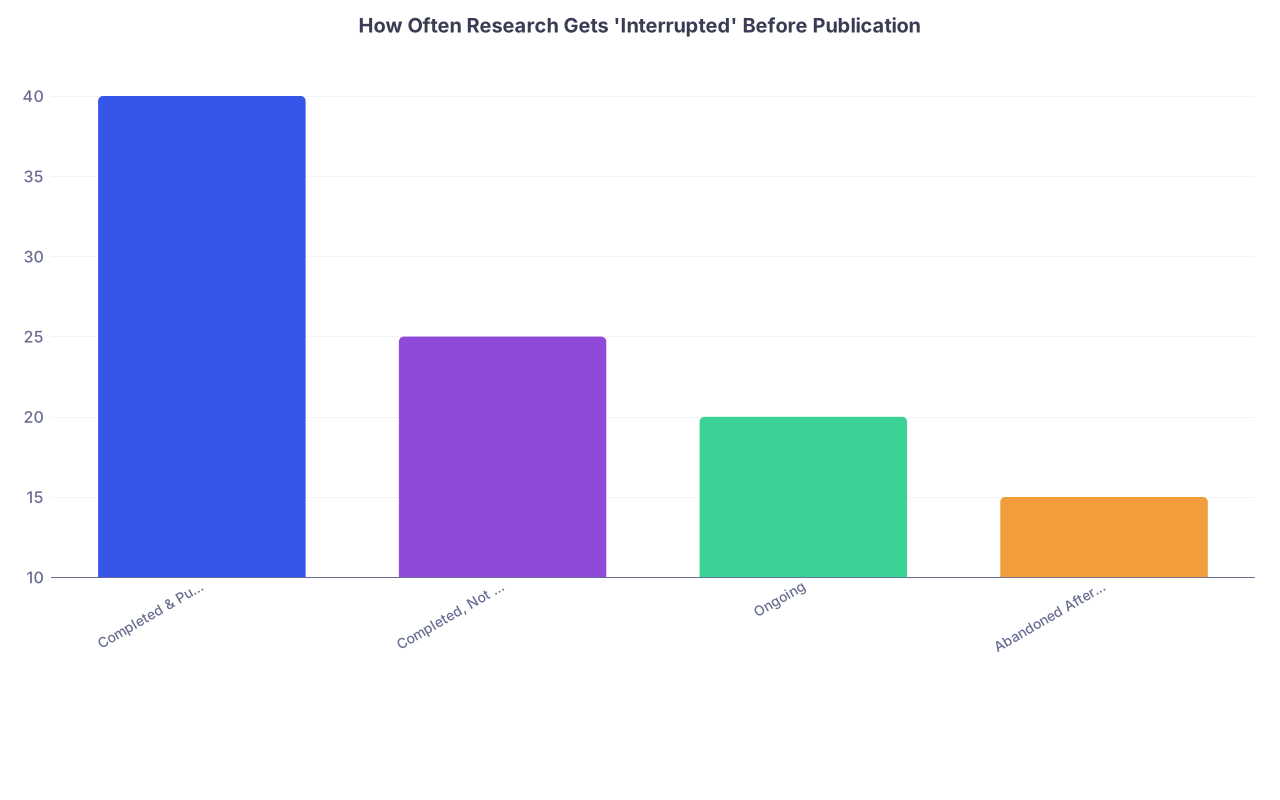
| Category | Value |
|---|---|
| Completed & Published | 40 |
| Completed, Not Published | 25 |
| Ongoing | 20 |
| Abandoned After Mentor Left | 15 |
(Those numbers aren’t from some official database—but they’re directionally pretty close to what I’ve seen in real departments. A non-trivial chunk of projects die for reasons that have nothing to do with the student.)
Quick Comparison: What Programs Actually See vs What You Fear
| Topic | What Actually Happens | What You Probably Fear |
|---|---|---|
| ERAS Research Entry | Still valid, same institution listed | Looks fake because mentor moved |
| Letter from Old Mentor | Still useful, often strong | Automatically discounted or ignored |
| Unfinished Project | Normal, common, explainable | Seen as failure or flakiness |
| Interview Questions | Simple clarification, then move on | Intense interrogation on mentor’s departure |
| Overall Application Impact | Mild at most, if managed thoughtfully | Catastrophic, ruins research credibility |
FAQ (Exactly 5 Questions)
1. Should I still ask my mentor for a letter if they’ve already left the institution?
Yes. If they know you well and can speak to your work, they’re still a strong letter writer. On ERAS, they’ll just list their current institution. In the letter, they can mention they supervised you at the previous place. That’s standard. Just make sure you also get at least one letter from someone still at your home institution so programs see you have current relationships there.
2. How do I list a project that stalled after my mentor left?
You list what you actually did. In the experience section, describe your role and tasks. In the products section, only list outputs that truly exist: “Abstract submitted,” “Poster presented,” or nothing if it never got that far. If it’s just in draft form, “Manuscript in preparation” is fine if you’re actively working on it. Don’t promote it to “submitted” or “accepted” unless that’s 100% true.
3. Will programs think it’s suspicious that my PI no longer works at the institution where I did the research?
No. Faculty move constantly. Reviewers might not even notice, and if they do, the reaction is usually, “Ah, that attending must’ve taken a job elsewhere.” They aren’t digging into department politics. Suspicion only really kicks in if your entire research history looks vague, inflated, or impossible—not because someone switched jobs.
4. What if my mentor stopped responding after they moved?
Annoying, but it happens. Here’s what you can still do: accurately list the work you completed, keep any drafts or materials as proof for yourself, and find another faculty member (co-author, division member, attending who knows you) who can vouch for your involvement. In interviews, you can say: “After Dr. X moved institutions, the project unfortunately stalled, but I learned a lot about [skills] through the process.”
5. Is it better to leave the research off my application if it never got published and my mentor left?
Usually, no. If you did real work, you gained skills and experience that matter. Programs don’t expect every project to end in a PubMed citation, especially at the student/resident level. Leaving it off just because it didn’t become a paper erases a big chunk of your effort and story. Include it, be honest about the outcome, and focus on what you actually contributed and learned.
Key points:
Your mentor leaving doesn’t erase your research, your effort, or your story.
List the work honestly, secure at least one local letter, and have a calm one-liner ready to explain the transition.