71% of residency applicants believe going to a “big research name” automatically improves their Match chances across all specialties.
They’re wrong. And the data is not subtle about it.
The cult of the “research powerhouse” program is one of the most persistent myths in residency applications. Students obsess over NIH funding lists, chase big-name labs they hate, and contort their careers around PubMed entries—often without asking a basic question:
Does this actually help me match where I want, into what I want?
Let’s cut through the mythology.
The Research Powerhouse Myth in One Sentence
The myth: “If I go to a top research medical school or match at a research-heavy residency, I’ll automatically have a better shot at competitive fellowships and academic careers, and programs will value me more because of the name and research intensity.”
Reality: For most applicants, the type and relevance of research—and how it fits with board scores, clinical performance, and letters—matters far more than whether your program sits in the top 10 of NIH funding. The “powerhouse” label is mostly branding.
What the Data Actually Shows About Research and Match Outcomes
Let me start with what’s not controversial: research productivity does correlate with competitiveness in some fields.
Plastic surgery, dermatology, ENT, neurosurgery, radiation oncology, ortho—these specialties consistently show higher averages for number of abstracts, presentations, and publications among matched applicants in NRMP data.
But here’s the part nobody likes to say out loud: a lot of that “research advantage” is just a proxy for something else.
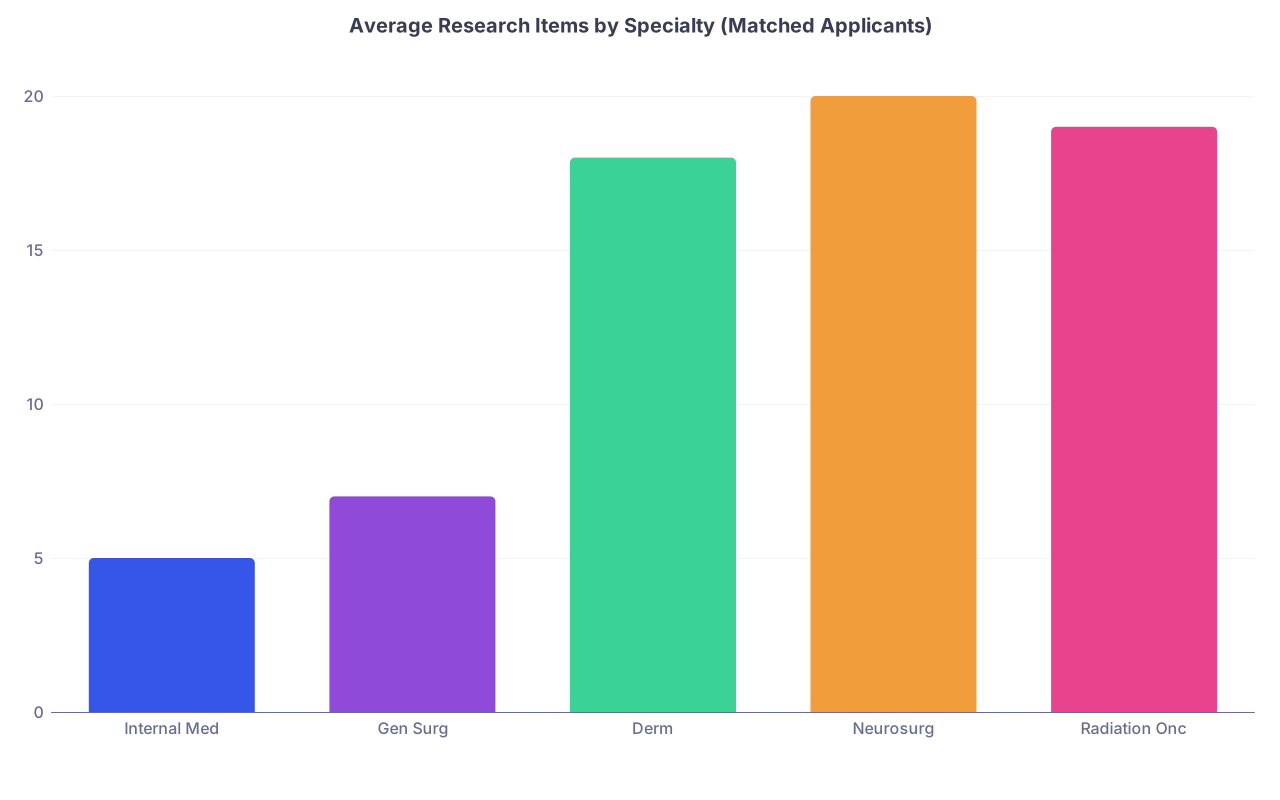
| Category | Value |
|---|---|
| Internal Med | 5 |
| Gen Surg | 7 |
| Derm | 18 |
| Neurosurg | 20 |
| Radiation Onc | 19 |
Look closely at NRMP Charting Outcomes and program surveys:
- Programs in highly competitive specialties care about research because it signals commitment to the field, especially specialty-specific work.
- But across all specialties, when programs are forced to rank what actually matters, research is rarely in the top three.
Program director surveys (for multiple specialties) consistently put these ahead of “research experience”:
- USMLE/COMLEX scores (or now, Step 2 especially)
- Clerkship performance
- Letters of recommendation
- MSPE/Dean’s letter
- Interview performance
- Professionalism and interpersonal skills
Research is usually somewhere in the middle of the pack. Useful, yes. Dominant, no.
Here’s the part that stings: I’ve watched students with 12 publications from “Top 10 NIH” med schools get passed over for applicants from mid-tier schools with 1–2 solid specialty-related projects, better Step 2 scores, and stronger letters.
Because committees don’t rank research institutions. They rank people.
“Top Research Program” vs Actual Match Power: The Disconnect
You’ve seen the flex: “We’re a top 5 NIH-funded institution.” It sounds impressive.
But NIH dollars don’t magically convert into match outcomes for every trainee. They convert into…funded faculty careers. Expensive cores. Statistical support. Sometimes resident opportunities. Sometimes just noise.
Let’s compare what students think they’re getting versus what they actually get.
| Expectation | Reality for Most Applicants |
|---|---|
| Easier match into any specialty | Helps mainly for academic, research-heavy careers |
| More publications automatically | Depends heavily on mentor, time, and project quality |
| Name alone boosts fellowship chances | Fellowship cares more about letters + niche expertise |
| Endless protected time | Often minimal or heavily competed for |
| All faculty want to mentor | A few great mentors, many too busy or disengaged |
I’ve seen this pattern over and over:
A student at a “research monster” med school spends two preclinical summers and multiple electives on huge, slow-moving projects—R01 trials, translational bench work—that don’t mature into first-author anything before applications.
Meanwhile, another student at an “unimpressive” state school jumps on small but focused retrospective studies or QI projects directly with clinically engaged faculty, gets 2–3 quick-turn manuscripts or strong presentations specifically in their target field, and can speak about them fluently on interview day.
Guess who sounds more compelling to a dermatology, EM, or anesthesia program director? The second one. Almost every time.
Where Research Powerhouse Status Actually Matters
Let me be fair. There are places where the “big research name” really does play a role. But it’s narrower than people assume.
1. Physician-scientist / PSTP / research-heavy careers
If you’re aiming for:
- MD/PhD-style careers
- Physician-Scientist Training Programs (PSTP)
- K-award trajectory in academic IM, heme/onc, cardiology, pulmonary/critical care, etc.
Then yes—doing residency or fellowship at a place with massive NIH infrastructure helps. Not because of the logo. Because of the ecosystem:
- Serious bench and translational labs
- Established T32 training grants
- Protected research pathways built into curricula
- People who actually know how to get grants funded
That’s a legitimate use case.
2. Ultra-niche fellowships at elite academic centers
If your dream is something like:
- Advanced heart failure at a top 5 program
- Complex IBD fellowship at a very specific GI program
- Stereotactic and functional neurosurgery at one mega-center
Being in that ecosystem during residency can help. Not required, but helpful.
You get:
- Face time with those fellowship directors
- A chance to prove you’re not just “productive” but reliable in that environment
- Access to that niche patient population and data
But even here, it’s often the relationships and letters, not just the research output, that close the deal.
Where the Research Powerhouse Label is Wildly Overrated
For most people applying to most specialties, here’s the uncomfortable truth:
Choosing a program because “it’s more researchy” while ignoring its clinical structure, teaching culture, and support is a bad trade.
1. For clinically-focused applicants
If you mostly want:
- Solid training
- Board pass
- Reasonable fellowship or community job
You don’t need an ultra-elite NIH engine. You need:
- Program directors who know how to advocate for you
- Faculty who will actually write specific, real letters
- Opportunities that are doable on top of your clinical load
A “mid-tier” program with:
- Well-run QI and clinical research
- Strong mentorship in your target subspecialty
- A track record of placing residents into solid fellowships
…is often a better match for your goals than a mega-brand where you’re the 9th resident trying to get scraps from the same overbooked star PI.
2. For applicants chasing name over fit
There’s a common disastrous trajectory:
- Student picks a med school / residency for research prestige.
- Ends up with no real protected time, unclear mentorship, projects stuck in IRB purgatory.
- Exhausted, burned out, no finished work, no strong narrative.
- Realizes too late that the name on their badge doesn’t automatically translate into a persuasive application.
Meanwhile, some classmate at a “lesser” place:
- Worked on 2–3 small but targeted projects
- Earned glowing letters from people who actually knew them
- Matched to the same or better fellowship.
I’ve watched that movie. More than once.
What Actually Moves the Needle for Your Match
Let’s stop hand-waving and be very specific.
Here’s what programs actually act on when they sit in rank meetings arguing about your name on a list.
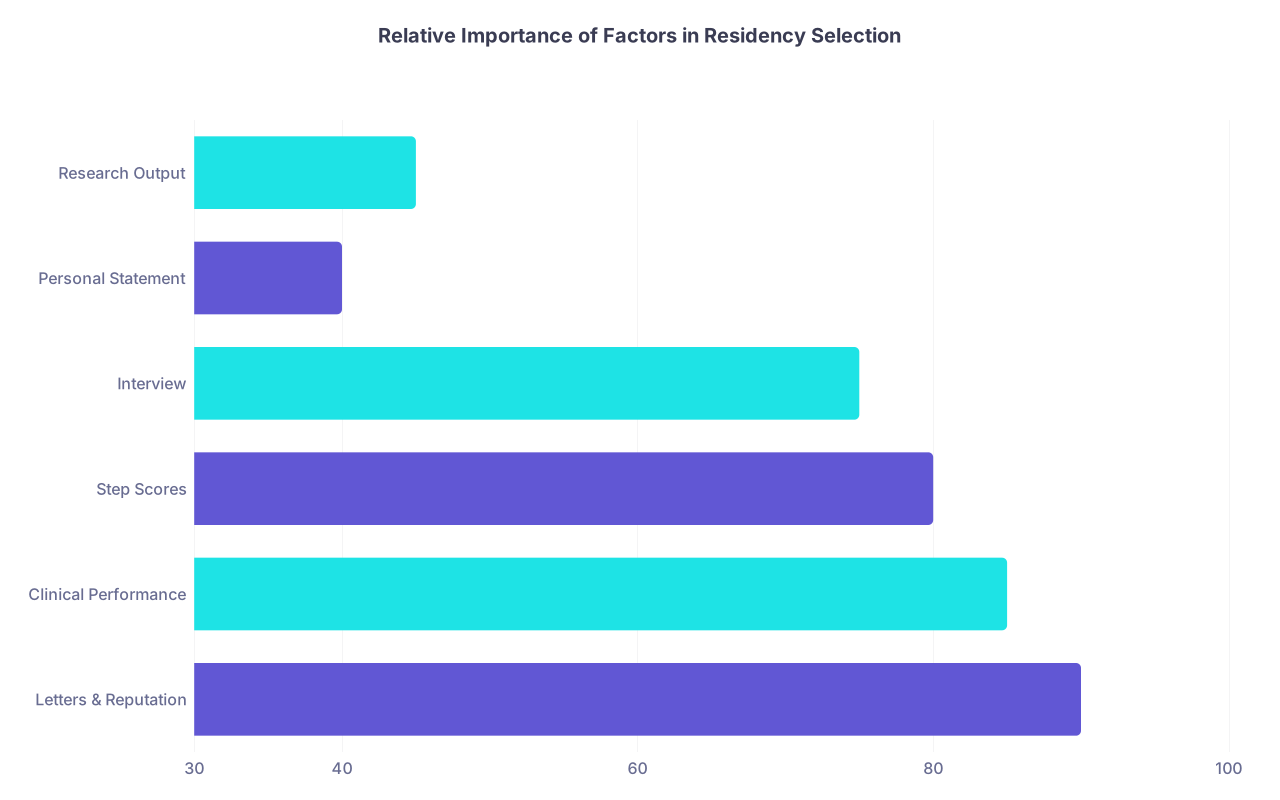
| Category | Value |
|---|---|
| Letters & Reputation | 90 |
| Clinical Performance | 85 |
| Step Scores | 80 |
| Interview | 75 |
| Personal Statement | 40 |
| Research Output | 45 |
These numbers are illustrative, but they match the pattern from repeated PD surveys.
1. Specialty-specific, interpretable research
Not all research is created equal.
A single well-done, clearly your-work, specialty-related project that you can explain in depth is:
- More impressive than 10 low-effort, irrelevant case reports
- Much more valuable than a name on the middle of a 40-author basic science paper you barely understand
- Easier to convert into strong talking points and letters
Programs like:
- Evidence that you commit to a field
- Evidence that you can follow through on complex tasks
- Evidence that you can reflect and learn from data
They don’t need you to have redefined the molecular basis of disease X.
2. Letters from people who actually know your work
This is the biggest hidden variable.
A program director will care far more about:
- A detailed letter from a mid-tier program faculty who supervised you on a serious project and on the wards, and is willing to say “this person is in the top 5% of residents/students I’ve worked with in 20 years”
…than a tepid letter from a world-famous PI who barely remembers your name and says you “completed tasks effectively in the lab.”
The “research powerhouse” environment can help if it puts you next to great mentors. But that’s contingent. Not guaranteed.
3. Coherence of your story
Interviewers sniff out application incoherence instantly.
“I have 20 publications in oncology, but I’m applying anesthesia because I decided late and I don’t really have a good explanation” plays worse than:
“I have 3 oncology-related projects from med school, but once I hit clinical rotations I fell in love with anesthesiology. I then joined 2 anesthesia QI projects and one outcomes paper, and here’s what I learned…”
Programs don’t need research robots. They need humans with a believable trajectory.
How to Evaluate Programs Without Falling for the ‘Powerhouse’ Trap
You want to avoid being seduced by NIH rankings and lab names alone. Fine. Here’s what I’d actually look at.

| Step | Description |
|---|---|
| Step 1 | Identify Career Goals |
| Step 2 | Prioritize strong research pathways |
| Step 3 | Prioritize clinical training & mentorship |
| Step 4 | Assess mentors & track record |
| Step 5 | Risk of overpromising |
| Step 6 | Consider other programs |
| Step 7 | Research-heavy future? |
| Step 8 | Protected time guaranteed? |
| Step 9 | Specialty-specific projects available? |
Questions I’d actually ask on interview day:
- “How many residents in the last 3 years presented at a national meeting in my target specialty?”
- “How is protected time structured? Is it guaranteed or ‘based on service needs’?”
- “Who are the two or three go-to research mentors for residents in this department?”
- “Can you give specific examples of residents who matched into X fellowship and what they did research-wise?”
If the answers are vague hand-waving about “many opportunities” and “we’re top 10 NIH” with no concrete pathways, believe the reality, not the brochure.
The Ugly Truth: Research is Often a Tie-Breaker, Not a Golden Ticket
One more uncomfortable point.
Programs often use research as a tie-breaker among already-strong applicants, not as the primary driver to elevate weak ones.
If you’re:
- Strong clinically
- Have solid Step 2
- Good letters
- Good interview
Then yes, meaningful research can:
- Push you up one notch
- Impress academic programs
- Open doors for specific mentors to fight for you
But if you’re:
- Weak clinically
- Poorly evaluated
- Struggling with professionalism
No amount of “I’m on 7 papers” will erase that. I’ve sat in conversations where PDs said flatly: “I don’t care how many publications. The comments about reliability are concerning. Pass.”
So What Should You Actually Do?
Let me strip this to a few blunt principles.
- Choose med schools and residencies for fit, mentorship, and clinical training first. Research infrastructure is secondary unless you are certain you’re chasing a hard-core research career.
- Aim for fewer, deeper, more relevant projects rather than padding a CV with noise.
- Prioritize mentors who know you over “brand name” labs where you’re replaceable.
- Use research to support a coherent story about your interest in a field, not to cosplay as someone you are not.
If a “research powerhouse” program can give you that in a transparent, structured way—great. If not, it’s just a fancy label.