

It is late November. You are staring at your ERAS-generated “CV” PDF and realizing that the 18 months you spent on a bench project… read like three confused bullet points. “Translational research fellow.” “Worked with mouse models.” “Manuscript in prep.” You know it was real work. You know it matters. But on paper, it is mud.
Let me break down exactly how to fix that.
This is about one problem: how to explain translational research on a residency CV so program directors instantly understand (1) what you did, (2) why it matters clinically, and (3) what it says about how you will function as a resident.
We are not talking about making your CV pretty. We are talking about making it legible to overworked PDs who will give you 10–20 seconds per entry, max.
1. What “Translational Research” Actually Means to a PD
Strip away the academic fluff. When a PD sees “translational research,” they mentally sort it into a few buckets.
Translational research, in your world, probably meant:
- You worked somewhere along the bench-to-bedside pipeline.
- You were trying to connect mechanistic work (cells, animals, assays, omics) to a clinical disease, intervention, or outcome.
- You did not just run Western blots in a vacuum. You had at least a theoretical patient at the end of the chain.
To a residency selection committee, that translates into three things they care about:
- Can you think mechanistically about disease, not just memorize guidelines?
- Can you move a complex project from A to B without constant hand-holding?
- Can you talk about science in language that an ICU attending, a chief resident, and a tired intern will all understand?
If your CV bullets do not show those three, the “translational” label does nothing for you. It just sounds like marketing.
So, rule one: stop leaning on the word “translational.” Show the translation.
2. The Most Common CV Mistakes with Translational Work
I have read hundreds of residency CVs with “translational” slapped on like a sticker. The patterns are painfully similar.
| Mistake Type | Why It Hurts You |
|---|---|
| Over-technical jargon | PD has no idea what you actually studied |
| No clinical connection | Looks like generic bench work |
| Vague role description | Could be anything from pipetting to project PI |
| Outcome-free bullets | No sense of productivity or impact |
| Overstated contribution | Triggers skepticism or annoyance |
Let me translate these into what PDs actually think when they read them:
Hyper-jargon description
“Investigated the role of CRISPR-mediated knockdown of ABCD1 in modulating autophagic flux in murine cardiomyocytes.”
PD thought: “Cardio-ish? Mouse something something. Pass.”Zero clinical anchor
“Studied signaling pathways in endothelial cells exposed to hypoxia.”
PD thought: “Okay. But why? Stroke? Preeclampsia? Pulmonary HTN? No idea.”Role ambiguity
“Worked on a translational oncology project involving patient-derived xenografts.”
PD thought: “Did you design experiments, or did you change cages and cut tails?”No outcomes
“Completed a one-year translational research fellowship in nephrology.”
PD thought: “So… what came out of it? Poster? Abstract? Anything?”Inflated language
“Led a multi-center translational trial focusing on novel immunotherapies in sepsis.” (as an MS3)
PD thought: “No, you didn’t. Next.”
You fix all of this with the same tools: precise framing, clinical linkage, concrete outcomes, and honest role descriptions.
3. Core Template: How to Write a Translational Entry That Lands
You need a mental template. Otherwise you will fall back into lab jargon.
Here is the structure I recommend for each significant translational research entry on your CV:
- One concise “project sentence” that states:
Clinical problem → Translational question → Model or approach. - 1–3 bullets (max) on:
- Your role
- Your methods / skills (in plain language)
- Concrete outcomes (presentations, publications, concrete milestones)
Think in this order: problem → approach → your role → outcome. Not the other way around.
Example: Bad vs Good
Bad (what I actually see):
- “Translational research fellow, Dept. of Cardiology”
- “Worked in a mouse HFpEF model using echocardiography and RNA-seq.”
- “Manuscript in preparation.”
Better:
- “Translational research fellow, Cardiology – mouse model of HFpEF to identify early diastolic dysfunction biomarkers relevant to heart failure clinic patients.”
- Designed and executed in vivo experiments (echo, hemodynamic measurements) to test candidate plasma biomarkers identified from patient HFpEF cohorts.
- Analyzed bulk RNA-seq data with supervised pipelines (DESeq2) under supervision; integrated findings with clinical variables from >300 patients.
- Presented results at ACC 2024 (1st-author poster); manuscript under review at Circulation: Heart Failure.
That second version does a few crucial things:
- It tells the PD: this is heart failure, not random molecular biology.
- It makes explicit that patient samples and patient cohorts were involved.
- It shows you did analysis, not just poured gels.
- It shows a real academic product with a recognizable conference and journal.
Notice I have not used the word “translational” once in the bullets. It is implied. That is the level you want.
4. Tuning Your Language for a Residency Audience
You are not writing for your PI. You are writing for a vascular surgeon at 10 p.m. clicking through ERAS.
So, you need to de-jargon your project without dumbing it down.
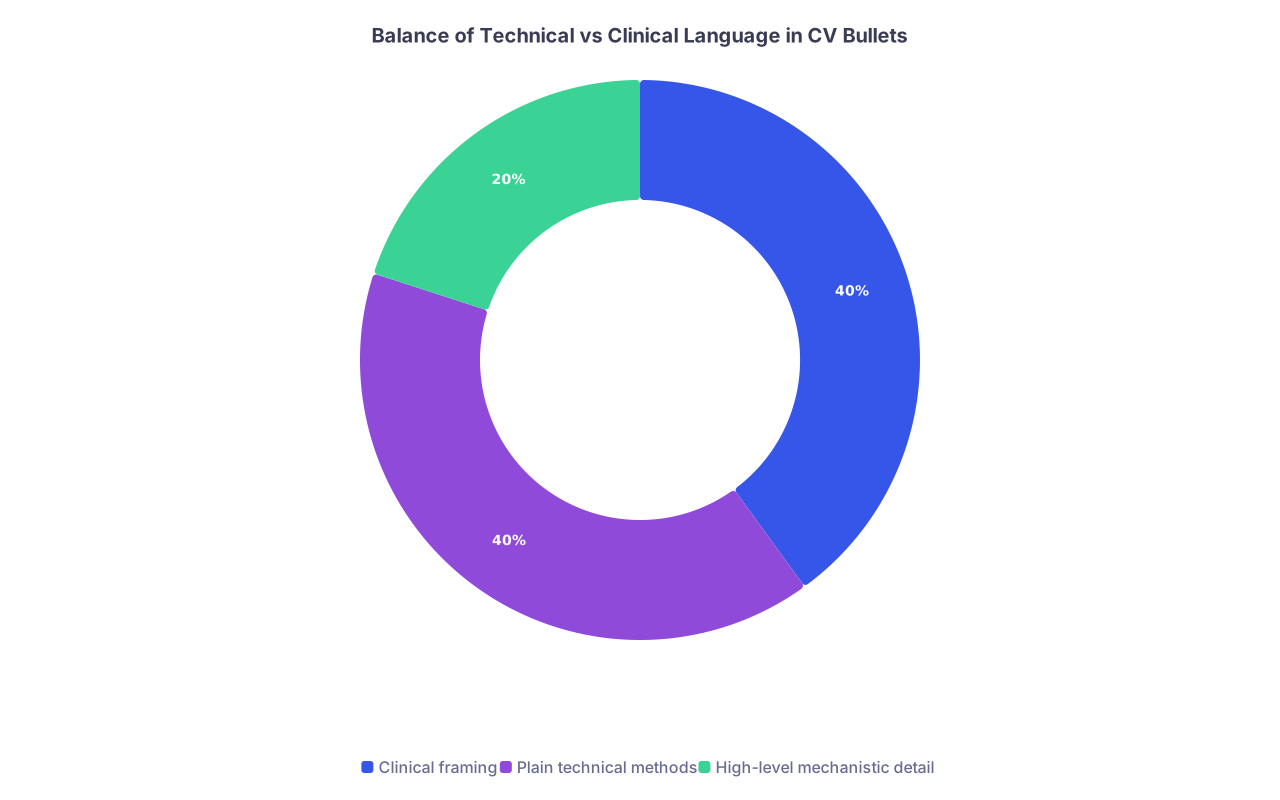
| Category | Value |
|---|---|
| Clinical framing | 40 |
| Plain technical methods | 40 |
| High-level mechanistic detail | 20 |
Aim for something like this balance:
- ~40% clinical framing
- ~40% clear, plain description of what you actually did
- ~20% higher-level mechanistic / pathway detail (if it genuinely matters)
Swap jargon for “clinically fluent” words
Instead of:
- “We examined the role of mTORC1 signaling in satellite cell homeostasis using lineage tracing.”
Try:
- “Studied how a key growth pathway (mTOR) controls muscle stem cells in a mouse model, to understand why patients with chronic steroid use lose muscle mass.”
You still sound like you know what you are talking about. But it is anchored to a patient problem. A medicine PD now sees: muscle wasting, steroids, chronic disease. That is their language.
Name the disease. Name the patient population.
Do not say “neuromuscular disease.” Say “Duchenne muscular dystrophy.”
Do not say “hematologic malignancy.” Say “acute myeloid leukemia.”
PDs search their brains quickly: “Do we see this in our patients?” If yes, you are already more relevant than the generic bench person.
5. Explaining Your Translational Role Without Overselling
You need brutal honesty here. PDs are very good at smelling inflated language.
There are roughly four common roles in translational projects:
- Pure bench / model work that supports a human question.
- Hybrid: you helped with both lab work and human biospecimen / chart data.
- Primarily clinical data analysis of samples or cohorts that came from a translational program.
- “Glue” person: coordinator bridging lab and clinic (consenting, sample processing, database).
Your bullets should make which one you were obvious.
Role phrases that actually help you
Use short, explicit role descriptors, such as:
- “Coordinated patient recruitment and sample collection for…”
- “Independently performed [X] assays on [Y] samples under supervision.”
- “Led data cleaning and statistical analysis for [N] patient dataset.”
- “Contributed to study design discussions and drafted IRB amendments.”
These communicate what residency cares about: independence level, reliability, and complexity of tasks.
Examples by specialty
Let me give you concrete specialty-flavored examples.
Internal Medicine – translational immunology:
- “Studied immune signatures in hospitalized COVID-19 patients to link lab biomarkers with ICU outcomes.”
- Processed and banked >250 patient blood samples; maintained REDCap database with longitudinal clinical variables.
- Performed flow cytometry under supervision to characterize T-cell subsets; collaborated with biostatistician on logistic regression modeling.
- Co-authored 1 original article (JCI Insight, 2023) and 2 abstracts (ATS 2022, 2023).
General Surgery – translational oncology:
- “Evaluated response of patient-derived pancreatic tumor organoids to neoadjuvant chemotherapy regimens used in our surgical oncology practice.”
- Established and maintained >30 matched tumor organoid lines; performed drug-response assays tied to patients undergoing Whipple procedures.
- Built a de-identified linkage between organoid response and surgical pathology outcomes for preliminary correlation analysis.
- Presented 1st-author poster at SSAT 2024; manuscript in revision for Annals of Surgery.
Pediatrics – gene therapy / rare disease:
- “Characterized off-target effects of AAV-based gene therapy vectors in a mouse model of spinal muscular atrophy to inform pediatric clinical trial design.”
- Ran qPCR and histopathology studies to assess vector distribution across organs; summarized findings in internal reports used for FDA submissions.
- Worked closely with clinical SMA team to align pre-clinical dosing with pediatric trial proposals.
- Acknowledged contributor on NEJM 2024 SMA gene therapy trial paper; co-author on 1 review article.
Those are the kinds of entries that make PDs lean forward instead of tuning out.
6. Structuring the Research Section on a Residency CV
If you have meaningful translational work, it should not be buried. But you also should not create a separate “Translational Research” vanity section. That just looks forced.
Basic structure that actually works:
| Section | When to Use |
|---|---|
| Research Experience | For major projects and roles |
| Publications | All peer-reviewed papers, separated by type |
| Abstracts/Presentations | Conferences, posters, oral talks |
| Grants/Scholarships | If you were PI or received competitive funding |
Translational projects go under “Research Experience.” Then, when they yielded outputs, those outputs go under Publications / Presentations with consistent citation style.
Example structure
Research Experience
2022–2024 – Translational Research Fellow, Division of Pulmonary and Critical Care, University X
Project: “Biomarkers of ARDS severity in mechanically ventilated ICU patients and matching mouse models”
- Clinically oriented description and bullets (like we discussed).
Publications
- Smith J, You R, et al. “Plasma angiopoietin-2 as a predictor of mortality in ARDS: integration of human cohorts and mouse models.” Am J Respir Crit Care Med. 2024;209(5):xxx–xxx.
Presentations
- You R, Smith J, et al. “Parallel plasma biomarker profiling in murine and human ARDS.” ATS International Conference 2023, Washington DC. Poster presentation.
Now a PD can easily see: there was a real project, you had a defined role, and it produced something tangible.
7. How to Talk About “Work in Progress” Without Sounding Empty
You will have projects that are not published yet. That is fine. The key is precision.
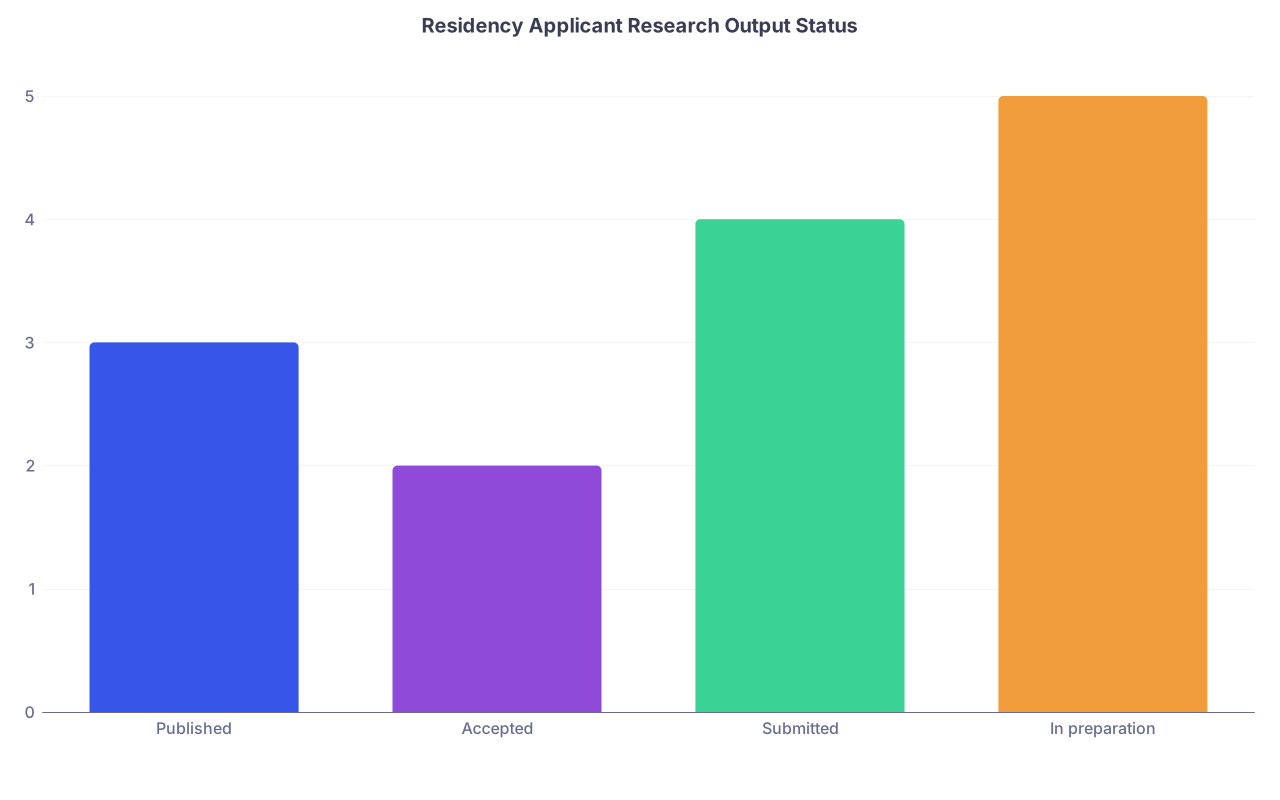
| Category | Value |
|---|---|
| Published | 3 |
| Accepted | 2 |
| Submitted | 4 |
| In preparation | 5 |
Do this:
- “Manuscript under review at [journal name].”
- “1st-author manuscript in preparation; expected submission to [journal tier] by [month/year].”
- “Data collection ongoing; projected [N] participants; abstract planned for [meeting].”
Avoid vague filler like:
- “Manuscript in progress.”
- “Potential for future publication.”
- “Hope to present at national conferences.”
If there is a clear path and actual work done (drafts, figures, data locked), say so. If not, anchor it to specific, concrete milestones you have already achieved.
Example:
- “Data collection completed (n=180 ICU patients); performed preliminary analysis showing association between biomarker X and ventilator-free days. Drafting abstract for SCCM 2025.”
That tells me you are past the “we have a freezer full of samples” fantasy phase.
8. Adapting Your Description to Different Application Components
Your CV, personal statement, ERAS text boxes, and interview answers must tell the same story, just at different resolutions.

| Step | Description |
|---|---|
| Step 1 | ERAS/CV Bullet |
| Step 2 | Experiences Description |
| Step 3 | Personal Statement |
| Step 4 | Interview Answer |
ERAS / CV
Short, factual, role-focused. We already went through that.
ERAS “Experiences” Description Box
This is where you get 700 characters to expand a bit. Use it to:
- Spell out the “why” of the project (the clinical problem).
- Clarify your day-to-day responsibilities.
- Mention any mentorship / team aspect briefly.
Example:
“Worked with a multidisciplinary team (pulmonologists, intensivists, immunologists) to identify plasma biomarkers that predict ARDS severity and mortality. My role focused on processing patient ICU samples, maintaining the clinical database, and coordinating with the lab team running mouse model experiments. This project taught me how to connect mechanistic findings back to bedside decisions, such as ventilator management and prognosis discussions with families.”
Personal Statement
You do not write a “research statement,” but you can weave one translational story in if it connects to why you chose the specialty.
The trick: keep it to one focused vignette, not a long list of techniques. Emphasize what the work taught you about patients, disease, and clinical judgment.
Interview
Your translational work will come up. Guaranteed. Have one clean, 60–90 second answer ready to:
- What was the clinical problem?
- What did your project try to do?
- What was your specific role?
- What did you learn that will make you a better resident?
If the PD wants more mechanistic detail, they will ask. Do not open with “We used a conditional knockout model with Cre-lox recombination…” unless you are explicitly interviewing at a physician–scientist track.
9. Two Real-World Example Rewrites
Let’s take two generic “before” CV lines and convert them.
Example 1: Neurosurgery applicant
Before:
- “Conducted translational research on glioblastoma stem cells.”
After:
- “Studied glioblastoma stem cell resistance to standard chemoradiation to better understand why patients recur quickly after surgery.”
- Performed in vitro assays (sphere formation, viability) testing novel combination therapies suggested by tumor board discussions.
- Helped build a clinical–pathologic database linking tumor molecular profiles with MRI progression patterns in >80 patients.
- Co-authored abstract accepted to SNO 2024; drafting 1st-author manuscript.
Now a neurosurgery PD sees: recurrence, tumor board integration, imaging, patient numbers. That is immediately more compelling.
Example 2: IM applicant with “dry lab” work
Before:
- “Worked on bioinformatics pipeline for translational cardiology project.”
After:
- “Analyzed RNA-seq datasets from human atrial tissue collected during cardiac surgery to identify gene expression patterns linked with postoperative atrial fibrillation.”
- Cleaned and normalized RNA-seq data; used DESeq2 and pathway enrichment tools to generate shortlists of candidate genes.
- Collaborated with electrophysiology attendings to cross-reference findings with clinical risk scores and telemetry data.
- 2nd-author original article accepted at Heart Rhythm; created internal R scripts now used by the lab for other datasets.
Now it sounds like you did real work that touched actual OR patients, not just “ran code in a basement.”
10. When (and When Not) to Call Something “Translational”
Here is the part nobody says out loud: a lot of things labeled “translational” really are just basic science with a disease name bolted on. PDs know this.
Use the label “translational” when:
- There is an explicit, real bridge between bench/model work and specific clinical decisions, trials, or patient outcomes.
- You, personally, were involved in components on both sides (or at least understood and can articulate both).
You can skip the label and just describe the project if:
- You did purely mechanistic work with only a theoretical disease link.
- You never touched patient data, patient samples, or actual clinical questions.
Example where you should not force “translational”:
- “Characterized the structure–function relationship of a new ion channel in drosophila.”
Just call it “basic electrophysiology research relevant to [disease]” if you want the link. For most residency PDs, that distinction is already generous.
Being honest here does two things:
- Protects you in interviews from being cornered into explaining clinical implications you do not understand.
- Signals maturity. You know the difference between real translational work and a grant buzzword.
11. Quick Pre-Submission Checklist
Before you lock your CV / ERAS, run each translational research entry through these questions:
- Could a non-research clinician describe, in one sentence, what disease or patient problem this project was about?
- Is my specific role obvious, concrete, and believable for my level of training?
- Did I avoid gratuitous jargon that my PI would like but a PD would ignore?
- Did I list real outputs (papers, abstracts, talks) and label in-progress work honestly?
- If this comes up in an interview, can I clearly explain it without slides in under 90 seconds?
If you cannot answer yes to those, rewrite until you can.
FAQ (Exactly 5 Questions)
1. Should I create a separate “Translational Research” section on my CV to highlight this work?
No. That usually looks like grandstanding. Put it under a standard “Research Experience” section, but make the translational nature obvious through your project description and bullets. PDs care what you did and why it matters, not what label you stick on the header.
2. How much technical detail is appropriate for residency CV bullets?
One short clause per entry is enough. Mention key techniques or analytic skills if they are widely recognizable (flow cytometry, qPCR, RNA-seq, logistic regression, R, Python). Do not list every assay you ever touched. The emphasis should be on the clinical problem, your role, and the outcome, with techniques as supporting detail.
3. What if my translational project has no publications yet? Will that hurt me?
Lack of publications is not fatal, especially if you have clear, concrete progress. Emphasize milestones: data collection completed, analysis done, abstracts submitted, manuscripts drafted. Program directors are more reassured by a well-described, in-progress project than by a vague claim that you “did research” with nothing to show.
4. I was mostly a cog in a big translational machine. Is that still worth highlighting?
Yes—if you describe your contribution honestly and precisely. Coordinating patient recruitment, processing biospecimens, maintaining databases, or performing standard assays at scale are all valuable experiences. They show reliability, attention to detail, and familiarity with clinical research workflows. Just do not claim ownership of design or analysis if you did not do it.
5. How many translational research experiences should I include if I have several small projects?
Prioritize depth over breadth. For residency, 1–3 well-developed entries are far better than 7 shallow ones. Combine smaller, related projects into a single entry if they share a lab or PI, and highlight the strongest outputs (a publication or major conference abstract). The goal is to show that you can see a complex project through, not that you chased every side project in your department.
Key points, so you do not miss them:
- Stop hiding behind the word “translational.” Lead with the clinical problem, then describe what you actually did.
- Make your role, your methods, and your outcomes explicit, honest, and concrete.
- Write for busy clinicians, not for your PI—if they cannot explain your project in one sentence, it is not residency-ready yet.


