

The popular advice about residency burnout is mostly wrong.
“Take a weekend trip.” “Book a spa day.” “Practice gratitude.” You’ve heard this from program wellness emails, from well-meaning attendings, from co-residents trying to survive. And it feels humane on the surface. But here’s the uncomfortable truth: most of the common “burnout cures” sold to residents are cosmetic fixes slapped onto structural problems.
You do not have burnout because you skipped a yoga class. You have burnout because you are being systematically overloaded in a system designed around your expendability and guilt.
What Burnout Actually Is (And Why Your Spa Day Did Nothing)
Burnout is not “being tired” or “feeling stressed.” Residency is supposed to be stressful. The issue is chronic, unresolvable stress with little control and little recovery time.
The Maslach framework (the most cited in burnout research) breaks it down into three components:
- Emotional exhaustion
- Depersonalization (you start seeing patients as tasks, numbers, annoyances)
- Reduced sense of personal accomplishment
You’ve probably felt all three on a bad month of wards.
Notice what’s not in the definition: lack of self-care, poor gratitude practice, not being “resilient enough.” But residency culture constantly reverse-engineers the blame back onto you.
There’s decent data showing where burnout really comes from in medical trainees: high workload, long hours, low autonomy, chaotic work environments, poor leadership, and misalignment between values and daily work. Not your failure to book a weekend in the mountains.
So when a wellness committee responds to your 80+ hour weeks and constant cross-cover chaos with “Let’s do a mindfulness workshop,” that’s not a solution. That’s a distraction.
Weekend Getaways: Why They Feel Good and Fix Nothing
“Just make it to the weekend, you’ve got that trip to the beach coming up.”
I’ve watched residents cling to that line like a life raft. They spend the week half-dead, clobber themselves with 6 admit-shift-nights in a row, then drive three hours Friday night for 36 hours of “escape.”
They come back Sunday night sunburned, sleep deprived, and behind on notes, laundry, and life admin. Monday morning they’re even more wrecked.
Let me be blunt: the data on burnout recovery doesn’t support the “periodic big escape” model as a primary strategy.
What does help, consistently?
- Regained sense of control
- Sustainable workload
- Regular, predictable rest and recovery
- Supportive team culture and leadership
Weekend getaways give you none of those in a durable way. They create contrast, sure. You get a brief surge of relief because you’re away from the pager and the EMR. But the system you’re burned out from is unchanged when you return. There’s evidence in occupational health research that “relief without change” can actually worsen perceived burnout, because the return feels even more brutal.
You know that whiplash: Saturday you’re eating brunch at 10 a.m., Sunday 10 p.m. you’re already dreading sign-in, and by Monday at 11 a.m. you’re back to sprinting between rooms while the ED calls for beds and your attending wants you “to learn ownership.”
Weekend travel is fine as pleasure. As a burnout cure? It’s lipstick on a dumpster fire.
If anything, residents do better when they protect sleep and basic stability on weekends, instead of trying to live an entire non-medical life in 36 hours.
The “Self-Care” Industrial Complex: Why It Makes You Feel Worse
You’ve seen the flyers:
“Burned out? Come to our wellness yoga class after a 28-hour call!”
This is where the wellness culture becomes actually harmful: it individualizes what is fundamentally a systems problem.
You’re told:
- Meditate more.
- Do gratitude journaling.
- Exercise daily.
- Meal prep.
- Maintain hobbies.
- Call your family.
All with what time, exactly? Between the 14 signouts, the Q3 calls, and the “short” day that somehow ends at 7 p.m.?
The research on physician burnout is very clear: organization-level interventions have roughly double the impact of individual-level ones. That means changes like better staffing, caps that are actually respected, sane scheduling, supportive leadership — these move the needle more than another mindfulness app license.
Yet hospitals keep shoving the burden back onto residents: “Here’s a resilience workshop.” Translation: “We’re not changing the environment, we just need you to tolerate it better.”
The cruel joke is that many residents internalize this. I’ve heard this line in different forms a hundred times: “Other people seem to be handling it. Maybe I just need to be more organized / disciplined / positive.” No. Most of them are not “handling it.” They’re white-knuckling it, same as you.
Individual self-care can help you cope. It doesn’t fix burnout when the core drivers are:
- Constant work compression
- Administrative bloat
- Fear-based evaluation culture
- Lack of real control over your schedule and practice
You don’t meditate your way out of that.
The Myth of the “Perfect Vacation” as Reset Button
There’s a specific belief I see over and over: “I just need a real vacation. Like 7–10 uninterrupted days. Then I’ll come back recharged and ready.”
You probably do need a real vacation. But someone has sold you the fantasy that one good block of PTO will reset months or years of chronic overload.
Look at the occupational health and organizational psychology literature: recovery from burnout is slow. Think months to years, not one week in Cancun.
Typical pattern I’ve seen:
- Resident is crispy by January. Fantasizes about June vacation.
- Uses vacation to finally do basic life maintenance, maybe squeeze in a “real trip.”
- Comes back somewhat better for… two weeks.
- By week three, same system, same dysfunction, same metrics, same RVU and throughput pressure by proxy. Symptoms creep back.
And no, this is not because you “vacationed wrong.”
The problem is simple: you stepped out of a toxic environment briefly, then stepped right back in. A break is good for acute exhaustion, poor for chronic misalignment and learned helplessness. Burnout is the latter.
Where vacation can matter is when it’s used strategically: to reflect, to evaluate whether your specialty, program, or long-term path still fits your values — and to start planning changes, not just recover energy to endure the same pattern.
That’s not how most residents are using it. They’re using it as a survival drip just to keep going.
Things That Actually Move the Burnout Needle
Let’s talk about what works better than another weekend away.
No, you can’t single-handedly redesign GME. But you have more leverage than you think in three domains: control, boundaries, and alignment.
1. Control: Micro-autonomy in a Rigid System
You can’t change the call schedule. You can change how much of your life you outsource to chaos.
Examples I’ve seen help:
- Fixed “non-negotiable” micro-rituals on wards days: 10 minutes alone for coffee at a set time, or a protected 15-minute noon food run you actually enforce with “I’ll be back in 15.”
- Taking ownership of how you preround, call consults, manage your list instead of copying the least efficient senior.
- Negotiating small things: which clinic slots you get, which continuity patients you prioritize, switching one miserable rotation for something slightly less soul-crushing.
The literature on job strain is consistent: perceived control — even small — buffers against burnout. Not because the work is easier, but because your brain stops feeling entirely trapped.
2. Boundaries: Saying “No” Without Saying “No”
Residents are conditioned to say yes to everything. Extra committee? Sure. Covering that shift? Of course. Absurdly late discharges? “I’ll get it done.”
The system runs on your guilt and compliance. That’s not melodrama; it’s operational reality.
You can’t refuse core responsibilities. You can stop auto-volunteering for every non-essential ask that pads someone else’s metrics.
Phrases that work:
- “I can do that, but then X will be delayed. Which do you prefer?”
- “I’m at capacity with clinical work this month. I’d like to help with that project next block.”
- “I can stay until [time], after that I won’t be safe.”
You’re not being difficult. You’re being a professional who understands human limits. The residents who survive with their sanity intact usually discover this mid-PGY2. The ones who never do either burn out or turn into bitter, detached automatons.
3. Alignment: Stop Gaslighting Yourself About Fit
Here’s the dark secret almost no one says out loud: sometimes the “cure” for burnout is getting out. Of a program. Of a track. Occasionally, of an entire specialty.
Burnout is worse when there’s chronic mismatch between:
- What you value
- What the work actually is day to day
If you went into internal medicine for complex diagnostics and longitudinal care and spend most days pushing throughput and filling out prior auths, of course you’re demoralized. That’s not a mindset problem.
I’ve seen people lighten their burnout drastically when they:
- Switched from academic to community track
- Changed fellowship plans to something with better lifestyle fit
- Transferred to a different program with less malignant culture
- Chose a non-clinical or hybrid path (informatics, admin, research-heavy roles)
Those decisions aren’t easy. But pretending you can “wellness” your way around deep misalignment is how people end up five years post-residency wondering why they’re still miserable in a “good job.”
What the Data Actually Says: System vs Individual Fixes
Let’s put numbers on this. When researchers compare interventions, system-level changes usually outperform individual ones.
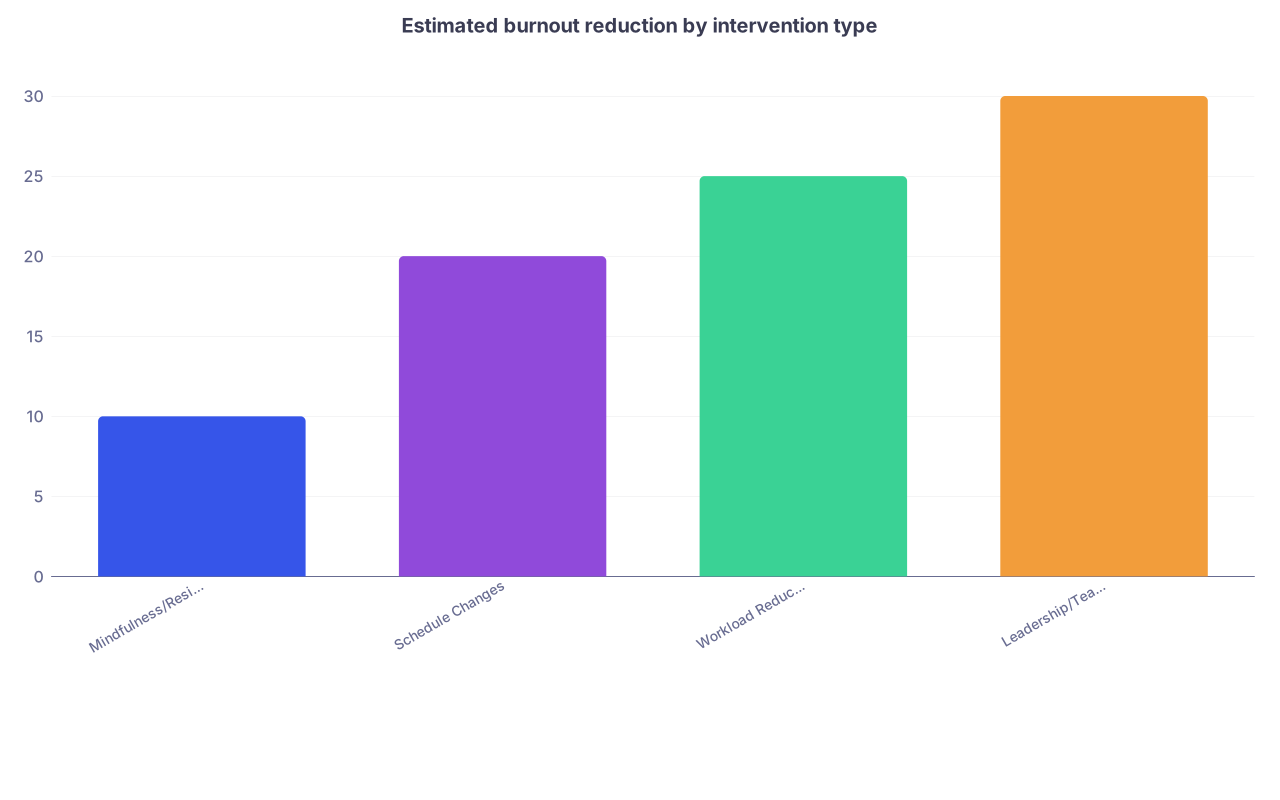
| Category | Value |
|---|---|
| Mindfulness/Resilience | 10 |
| Schedule Changes | 20 |
| Workload Reduction | 25 |
| Leadership/Team Interventions | 30 |
These are representative ballpark effects from multiple meta-analyses in physician burnout, not precise gospel, but the pattern is stable: tweak the system → moderate improvements; tweak the individual → modest improvements.
Yet where does GME pour its energy?
- Free meditation app codes
- “Wellness Wednesdays” with pizza
- Optional workshops after 10-hour clinic days
Meanwhile, caps are “soft,” documentation requirements grow, duty hour violations get buried, and residents are praised for “going above and beyond” while quietly breaking every sane limit.
If you feel like you’re being treated as the problem while the environment gets a pass, it’s because you are. That’s not paranoia. That’s policy.
So What Do You Actually Do Tomorrow?
You still have to show up to work. You’re not going to unionize your hospital between now and next week’s nights block. But you can stop wasting energy on “cures” that don’t work and start using your limited bandwidth on what does.
A more honest approach looks like this:
- Use weekends and vacations to rest and reflect, not to perform the Instagram version of “living your best life” in 48 hours. If travel energizes you, fine — but protect your sleep as fiercely as your brunch.
- Treat self-care as harm reduction, not a solution. Yoga won’t fix your call schedule, but it might keep your back functioning. Do it for that, not because some PDF said it will cure burnout.
- Start drawing small boundaries, even if it feels uncomfortable. Residents often overestimate the backlash and underestimate how much quiet pushback is actually tolerated.
- Be brutally honest with yourself about fit. If your specialty, program, or career path is systematically misaligned with who you are, no weekend escape will change that. Planning an exit or pivot isn’t failure; it’s survival.
- When possible, support or join real structural efforts: unionizing, schedule reform committees that actually have teeth, push for documenting and escalating chronic duty hour violations. It’s slow, but it’s where real change lives.

The One “Wellness” Practice That Isn’t Fake
There’s one practice I’ll actually endorse without rolling my eyes: telling the truth. To yourself. To peers you trust. Sometimes, to leadership.
Not the sanitized “I’m a little tired but learning so much.” The real version:
- “I’m starting to dread coming in.”
- “I don’t feel safe with this level of responsibility and no backup.”
- “If this continues, I won’t last three more years.”
Burnout thrives in isolation and denial. The minute people start naming it plainly, the illusion that “everyone else is fine” cracks. And once that illusion dies, collective pushback becomes possible.
You don’t owe the system your silence. Or your health.

The Bottom Line
Three things to walk away with:
Weekend getaways, spa days, and mindfulness apps are not cures for residency burnout. They’re temporary relief layered onto structural problems. Use them if you enjoy them; don’t expect them to fix what they can’t touch.
Real burnout reduction comes from changes in workload, autonomy, boundaries, and alignment between your values and your actual work. That’s where your limited energy is worth investing.
You’re not burned out because you failed at self-care. You’re burned out because you’re doing high-stakes work in a system that treats human limits as negotiable. Start by rejecting that lie — then build from there.


