

It’s 4:30 pm on December 23rd. You’re on wards. Half your co-interns are talking about flights, someone just mentioned “we’re driving upstate tonight,” and your senior casually says, “I’ll send out the official Christmas–New Year schedule later today.”
You already know what that means: the schedule is not “later today” material. That thing has been fought over, massaged, and politically edited for weeks. Maybe months. You’re just seeing the final draft.
Let me tell you what really happens behind the curtain when residency coverage for holidays gets planned. Because it isn’t random, it isn’t “fair” in the way you think, and you have more leverage than you realize—if you understand how the game is played.
The Unspoken Rules: What PDs and Chiefs Actually Care About
Before you think about “fairness,” understand the priorities that drive holiday coverage. Program directors, chiefs, and schedulers care about a short list of things, in roughly this order:
- The hospital must be safely staffed. At all times.
- Accreditation and duty hours cannot be violated on paper.
- Faculty and nursing leadership must not complain.
- Residents must complain, but not too much.
- The chief wants to survive the year without a mutiny.
Notice what’s missing: “Everyone gets their ideal holiday off.” That’s a luxury, not a requirement.
So when chiefs sit down to plan Thanksgiving, Christmas, New Year’s, Ramadan, Diwali, Eid, Lunar New Year, you name it, they’re juggling:
- Service demands (ICU, ED, night float, OB never shut off)
- Seniority politics
- Religious and cultural holidays
- Previous year promises (“we’ll fix it next year”)
- Contractual or union rules (in some places)
- Whatever mess last year’s chiefs left behind
They’ll never say this out loud, but holiday planning is part logistics, part politics, part damage control.
How the Sausage Gets Made: The Real Workflow
Let’s walk through what usually happens from the inside.
Step 1: The Chief Reality Check
Around late summer or early fall, the chiefs sit down with the master call grid. They look at:
- Which rotations are on which blocks
- Baseline staffing requirements for each service
- Who’s on nights, ICU, ED, wards, electives during late November–early January
They already know which rotations are “doomed” for holidays. Night float blocks that straddle Dec 24–25 and Dec 31–Jan 1. That inpatient MICU block that runs from Week 1 of December to Week 1 of January. The OB block that never slows.
They’ll identify those as “core coverage” positions that must be filled, no matter what. That’s non-negotiable.
Then they build around that.

| Step | Description |
|---|---|
| Step 1 | Start Holiday Planning |
| Step 2 | Check service needs |
| Step 3 | Identify fixed coverage spots |
| Step 4 | Review rotation assignments |
| Step 5 | Apply rules and seniority |
| Step 6 | Collect resident requests |
| Step 7 | Draft schedule |
| Step 8 | Negotiate swaps and fixes |
| Step 9 | Finalize and publish |
Step 2: The Hidden “Rules” They Pretend Are Official
Most programs don’t have a written holiday policy that covers all situations. If they do, it’s vague. What really exists is an unwritten algorithm that older residents pass to younger chiefs.
It usually looks something like this:
- PGY-1s eat more holidays than seniors their first year
- PGY-2/3s “earn” one major holiday off (sometimes two)
- You shouldn’t work both Thanksgiving and Christmas and New Year’s unless something went very wrong
- You shouldn’t work the same major holiday all three years (they try, not always successfully)
- Anyone on elective is fair game for extra coverage if a service is bleeding
Do all programs follow this perfectly? No. But this is the mental framework in most chiefs’ heads.
Here’s the part you won’t see: chiefs will literally have informal notes like:
“Last year Ahmed worked Christmas + New Year’s on nights, we owe him something.”
“Jess is on an easy elective over New Year’s, can we move her onto wards call for 2 days?”
“Daniel requested Christmas off for family, but he ducked out of Thanksgiving last year too…”
No one admits they track that stuff. They do.
How Holidays Actually Get Split: The Big Three (and Everyone Else)
Program leadership usually groups holidays into “tiers.” They won’t necessarily say it out loud, but internally they think like this.
| Tier | Example Holidays | Typical Importance |
|---|---|---|
| 1 | Christmas, New Year’s | Highest |
| 2 | Thanksgiving, Eid, Diwali, Lunar New Year | Medium–High |
| 3 | July 4, Memorial Day, Labor Day | Lower |
Tier 1: The “Battle” Holidays
Christmas and New Year’s are the most politically loaded, especially in programs with a large Christian or culturally Christmas-heavy population.
Common internal rules I’ve heard chiefs say out loud in the workroom:
- “No one works both Christmas Day and New Year’s Day unless they’re on nights or ICU and it can’t be helped.”
- “If you got Christmas off, you’re probably on for New Year’s, and vice versa.”
- “Night float = you’re working something big.”
They’ll often pair them: one group gets Dec 24–25 off but works Dec 31–Jan 1; the other group does the opposite.
ICU and ED? Different story. Those rotations often treat holidays as just “another day,” and they just try to spread nights and days somewhat evenly.
Tier 2: The Quiet Negotiations
Thanksgiving and culturally significant non-Christian holidays get handled more quietly, and this is where a lot of bias and blind spots show up.
In programs that are paying attention, chiefs will ask for preferences early:
“If you celebrate a non-Christmas holiday (Eid, Diwali, Lunar New Year, etc.), email us and we’ll try to prioritize those for you.”
In programs that are lazy—or frankly, culturally narrow—this doesn’t happen. People end up begging for switches in September for something in October or November because the schedule did not even acknowledge those dates.
I’ve watched an intern walk into a chief’s office to say, “Hey, I’m Muslim, Eid is that week, could I…,” and the chief’s face clearly showed they hadn’t even thought about it. Not malicious. Just clueless.
Residents who speak up early and clearly almost always get better outcomes.
Tier 3: “Extra Credit” Holidays
Memorial Day, Labor Day, July 4th. These matter, but they usually fall into one of two categories:
- Already built into standard weekend call schedules
- Covered by “whoever’s on that rotation” without extra wheeling and dealing
You’ll hear stuff like:
“Look, you’re on wards that block, you’ll probably work July 4th. Sorry.”
No conspiracy there. Just low priority compared to December.
How Chiefs Juggle Fairness, Seniority, and Squeaky Wheels
This is the tension they never fully admit to you: they’re trying to make it fair on paper and survivable politically.
Seniority: You’re Not Crazy, It’s Real
Seniors get better deals. I’ve been in rooms where people said things like:
“PGY-3s should not be on call Christmas Day unless absolutely necessary.”
“Interns will be mad either way; they’ll forget by March.”
Is that fair? Not really. Is it common? Almost everywhere.
Programs justify it by saying seniors “paid their dues” earlier, and honestly, sometimes they did. But you should understand that walking in: as a PGY-1, your leverage is lower. Your visibility is also lower. You’re a name on a spreadsheet, not a known entity yet.
That doesn’t mean you’re powerless. It means you have to be strategic in when and how you ask.
The Squeaky Wheel vs the Ghost
Two types of residents get systematically shafted:
- The ghost: never complains, never asks
- The martyr: always agrees to cover, to swap into worse shifts “just to help”
Chiefs remember who’s easy. Not always maliciously. It just happens.
On the flip side, there’s the squeaky wheel. The person who’s in the chief’s inbox every few weeks about swaps, fairness, “wellness,” and policies. Chiefs will roll their eyes but they will also quietly avoid setting that person off if they can help it.
I’ve literally heard:
“Don’t give Sarah Christmas again, she’ll lose it. Give it to Ben, he never says anything.”
Ben is you, if you’re not careful.
You don’t need to be that person, but you do need to register on the chief’s internal “don’t screw this person too hard” radar.
Coverage Mechanics: Who Actually Works What
Let’s break down what holiday coverage really looks like under the hood, because there’s a structure to it.
Inpatient Wards
Minimum coverage is usually:
- Day team: 1 senior, 1–2 interns
- Night float: 1–2 residents
Holiday “adjustments” might be:
- No or minimal admissions after a certain time on the holiday
- Cross-coverage only (no new admits for some services)
- Swing shifts reduced or cut
But the dirty truth: the patients don’t care it’s a holiday. Neither do the ED admissions board or the septic shock rolling in at 2 am.
So wards coverage doesn’t shrink as much as you’d think. Instead, they:
- Combine teams (“Red and Blue teams cover together on the 25th”)
- Offload discharges to the day before or after
- Pray that attendings cancel a few transfers or non-urgent admissions
ICU
ICU coverage for holidays is almost identical to any other day. Critical illness doesn’t take a break.
The only difference is often cosmetic:
- Maybe fewer scheduled family meetings
- Maybe one less fellow if all hell doesn’t break loose
- Sometimes a “light admit” day written into some phantom policy that no one enforces
If you’re on ICU over Christmas, what you’re really getting is: “We’ll bring cookies.” That’s the consolation prize.
ED
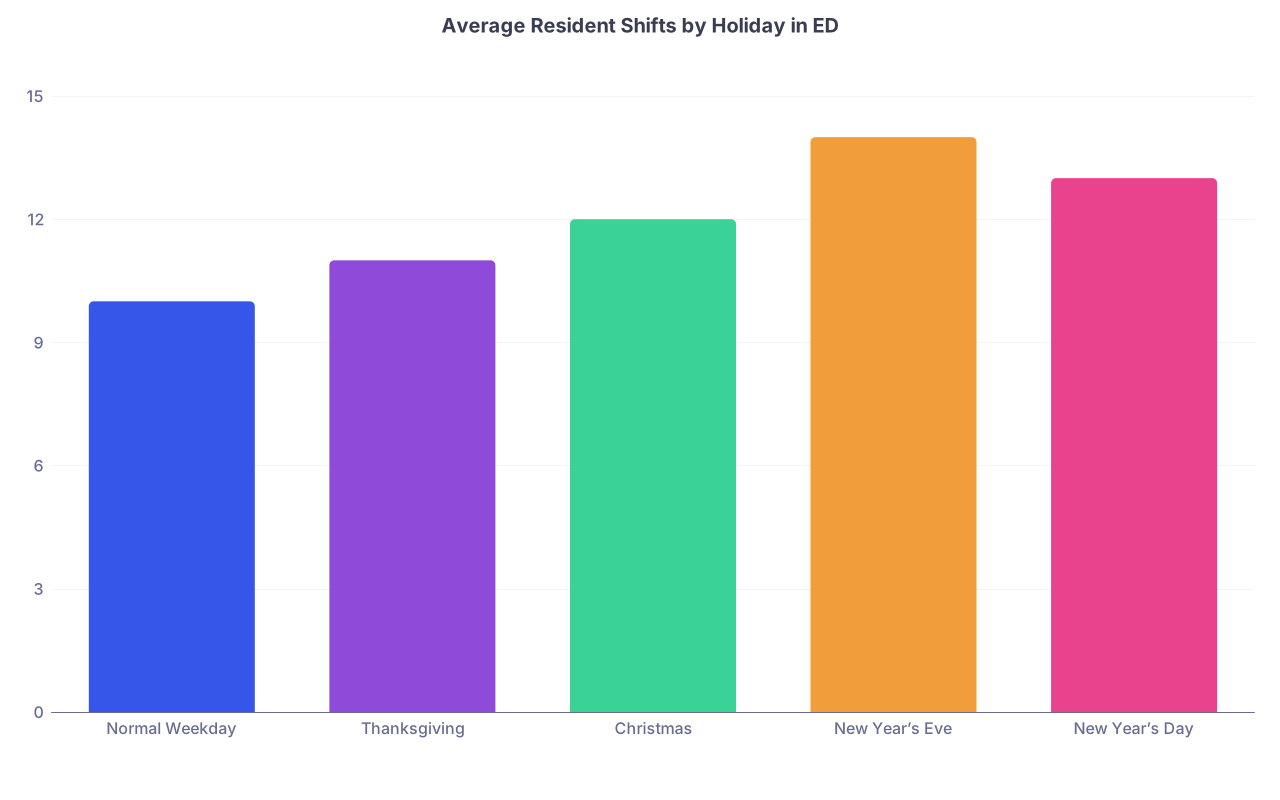
Emergency doesn’t stop, and some holidays are actually busier: alcohol, trauma, psych, weather, family drama.
ED coverage is usually driven by historical volume data, which is why you’ll see charts like this on the scheduling chief’s computer:
| Category | Value |
|---|---|
| Normal Weekday | 10 |
| Thanksgiving | 11 |
| Christmas | 12 |
| New Year’s Eve | 14 |
| New Year’s Day | 13 |
More crowding = more resident shifts. So ED residents often get the worst end of the stick for New Year’s Eve and some weekends attached to holidays.
Elective, Outpatient, and “Easy” Rotations
Here’s a truth no one states clearly: if you’re on an easy elective around the holidays, your chances of being pulled for cross-coverage are high. Chiefs think:
“Better to borrow one body from clinic/elective than crush the ward team.”
So they’ll “borrow” you:
- To cover a night or two
- To take floor calls so the admitting team can focus
- To backfill somebody who got sick or flew standby and missed a connection
If you want your holiday genuinely protected, being on ICU/wards sometimes gives you more schedule stability than being on a cush elective that gets cannibalized.
The “Planning” vs the Reality: How It Falls Apart
Even the cleanest holiday schedule will blow up once it hits reality.
Here’s what actually happens:
- Someone’s flight gets canceled
- Someone gets COVID, flu, strep, or food poisoning
- A family emergency nukes a carefully balanced schedule
- The ED surge is worse than usual, and leadership calls for “emergency coverage”
Then chiefs start dialing and texting.
They look for:
- Residents not post-call
- Anyone on elective
- People who “owe” a favor from a previous swap
- Interns who’ve been seen as “team players”
And in those 24–48 hours, any theoretical fairness becomes a lot more arbitrary. If you want to protect yourself, you need two things:
- Boundaries
- A clear, unemotional “no” when you truly cannot take more
“Sorry, I already have 6 days straight including two calls, I really can’t safely add a seventh” is a lot stronger than “Uhh… I guess I can if you really need me.”
How to Quietly Influence Your Holiday Fate
You can’t control everything. But you’re not helpless. Residents who get better holiday setups do a few specific things.
1. Speak Up Early, and Be Specific
Vague:
“I’d prefer Christmas off if possible.”
Better:
“My sibling is getting married on December 24th, and my whole family is flying in. If there’s any way I could have Dec 24–25 off, I’m more than happy to work New Year’s Eve or New Year’s Day in exchange.”
Specific, documented, with a clear willingness to take a hit elsewhere. Chiefs appreciate that.
The good chiefs will literally mark you on their internal grid:
“Prioritize Christmas off, assign New Year’s.”
2. Offer a Trade, Not Just a Request
If you ask for something, pair it with a concession:
- “I’ll take Thanksgiving if I can have New Year’s Eve off.”
- “I can cover Christmas Day if I can guarantee being off for Eid in April.”
- “I don’t care about New Year’s—put me on that if it helps give someone else Christmas with their kids.”
This makes you part of the solution, not another problem in their inbox.
3. Use Your Seniority Wisely (When You Have It)
By PGY-3, you actually have some leverage. You know the chiefs, you’ve worked with the PD, you’ve done your time.
At that point it’s reasonable to say, calmly:
“I’ve worked Christmas two years in a row. I’d really like to avoid that my last year if at all possible.”
Most chiefs will try to honor that. They do remember—or at least they can check.
4. Don’t Be the Resident Who’s “Always Fine”
Look, I know you want to be low maintenance. Attendings love low-maintenance residents. Chiefs… sometimes exploit them.
You need at least one time where you clearly, respectfully hold the line:
“I’m sorry, I really cannot take an extra 24 this week; my duty hours are already borderline and I’m exhausted.”
That sentence does more for your long-term treatment than you think. It teaches them: “We can’t just throw everything on this person.”
How Programs Try to Sell It to You (And What’s Actually True)
You’ll sit in some meeting where a chief presents a slide about “holiday fairness policy.” Let me decode the language for you.
“We strive to distribute holidays equitably across the year.”
Translation: We’ll try, until reality hits and then it’ll be patchwork.“No resident will work all three major holidays (Thanksgiving, Christmas, New Year’s) in a single year.”
Often true on paper. Look closely at eves vs days vs post-call status.“Religious and cultural holidays will be respected.”
This depends 100% on you actually telling them early and clearly. They’re not tracking Ramadan cycles in their heads.“Elective rotations may be used to support inpatient services during peak needs.”
That nice outpatient elective in December? It’s probably a staffing bank.
This doesn’t mean your program is evil. It means they’re doing triage on schedules the same way you do triage in the ED.
You just need to see the game board clearly.
FAQs
1. Is it reasonable to push back if I’m scheduled for all three big holidays in one year?
Yes. Very. That’s usually against the spirit (and sometimes the letter) of internal policies. Email the chiefs and, if needed, the program coordinator with something factual:
“I’m currently scheduled for Thanksgiving Day, Christmas Day, and New Year’s Eve. My understanding was that major holidays are normally distributed so no one works all three. Is there any way to adjust this, even if it means swapping into another tough weekend?”
Most decent programs will fix that if they can.
2. When should I tell my chiefs about important religious/family holidays?
As early as possible—ideally when they’re first building block schedules or at the latest 2–3 months before the holiday. A quiet one-on-one or clear email works:
“I celebrate Diwali, which falls on [date] this year. If there’s any flexibility, I’d really appreciate having that day off and am happy to work a different weekend or holiday to balance.”
Last-minute requests get much less sympathy. Not because they don’t care. Because the grid is already tight.
3. Do programs actually track who worked what across years?
Good ones do, at least roughly. Chiefs often inherit spreadsheets or mental notes from prior chiefs. But it’s imperfect. If you know you’ve been hit repeatedly—two straight Christmases, for example—bring that history up calmly:
“Just as context, I worked Christmas last year on ICU and New Year’s on nights. If you can help me avoid Christmas again this year, I’d appreciate it.”
You’re not being high-maintenance. You’re giving them information they may have genuinely lost in the chaos.
If you remember nothing else:
- Holiday schedules are built on service needs first, fairness second, and politics third.
- Residents who speak up early, specifically, and with a trade to offer get better outcomes.
- Never assume the system will remember what you “deserve.” You have to remind it—calmly, clearly, and on time.


