
The biggest lie on interview day is “We totally respect work‑life balance here.”
You’re not there to hear slogans. You’re there to figure out: Is this a place that quietly breaks duty hours, normalizes burnout, and gaslights residents about it? Or is it actually livable?
Here’s how you tell—using what people say, how they say it, and what they carefully don’t say.
1. Start With One Core Principle
If you remember nothing else, remember this:
Toxic work‑hour culture is almost never revealed by direct answers. It leaks out in contradictions, body language, and how consistently people talk about time.
Healthy places sound… boringly consistent:
- Everyone’s numbers are in the same ballpark
- Nobody gets weird when you ask specifics
- They talk about systems that protect time, not just “we try our best”
Toxic places have a pattern:
- Interns say one thing, seniors say another, faculty say a third
- People visibly hesitate, laugh nervously, or change the subject
- You hear words like “technically,” “usually,” “depends who you’re with,” “you just get it done”
So you’re not just collecting facts. You’re stress‑testing the culture.
2. The Questions That Actually Work (And How to Read the Answers)
Ask specific, concrete questions – not vibes
Vague questions get canned answers. You need details.
Use these high‑yield questions and what to watch for:
“On your busiest inpatient rotation as an intern, what time do you usually get in and leave?”
- Green flag: “On wards I’m in by 6, out by 5–6 most days; post‑call I’m out by 10–11. ICU is more like 6–6:30.”
- Red flags:
- “It really varies, you know, it depends…” and then no numbers
- Laughter before answering
- “Well… you get there when you need to to take care of your patients”
“How often do you feel you’re actually at 80 hours in a week?”
- Green: “Rarely. I’ve hit low 70s on crazy weeks, but if we approach 80 they shuffle patients or pull in backup.”
- Yellow: “Maybe a couple times a year, but our chiefs track it pretty closely.”
- Red:
- “We never log over 80.” (said too fast, with a smirk)
- “Officially? We’re always under.”
- “We log 60s, but it feels like more.” Translation: everyone lies on duty hours.
“What happens here if someone is consistently staying late or going over hours?”
- Healthy: “Chiefs notice, talk to you, adjust coverage or cap, maybe redesign the rotation.”
- Toxic:
- “You just learn to be more efficient.”
- “It’s part of intern year.”
- “You figure it out; everyone goes through it.” → That’s code for “we do nothing.”
“How strict is your program about post‑call days and days off?”
- Green: “Post‑call you’re out by 10 or 11, and we protect 4 days off per month. If you lose one to some disaster, they give it back.”
- Red:
- “You almost always get your day off.”
- “Sometimes you stay post‑call if it’s busy, but that’s rare.” (It’s not rare.)
- “People like to round on their patients post‑call anyway.” That’s normalized self‑abuse.
“Who fills in when someone’s out sick?”
- Green: “We have jeopardy / backup call, and they actually use it.”
- Yellow: “We divide the work, but they try to keep it reasonable.”
- Red:
- “People don’t really call out.” (Impossible in a real human population.)
- “We just step up as a team.” Translation: you cover two jobs for free.
3. Red‑Flag Phrases You Should Not Ignore
These phrases are giant blinking warning signs. If you hear multiple of these, believe them.
- “We’re a work‑hard, play‑hard program.” → Usually means “work insane hours, drink to cope.”
- “We’re a very resident‑driven program.” → Often means poor attending support and residents doing scut they shouldn’t.
- “We don’t micromanage duty hours.” → They don’t protect them either.
- “If you’re efficient, you’ll be fine.” → Blames you for systemic overwork.
- “We don’t tolerate clock‑watchers.” → They expect you to stay late constantly.
- “The hours are tough, but it makes you a better doctor.” → Romanticizing burnout.
Flip side: Watch for healthy language:
- “We try not to make heroes; if someone stays late, that’s a system problem.”
- “If a rotation is consistently heavy, we redesign it.”
- “We’d rather you be safe and rested than here 90 hours pretending you’re invincible.”
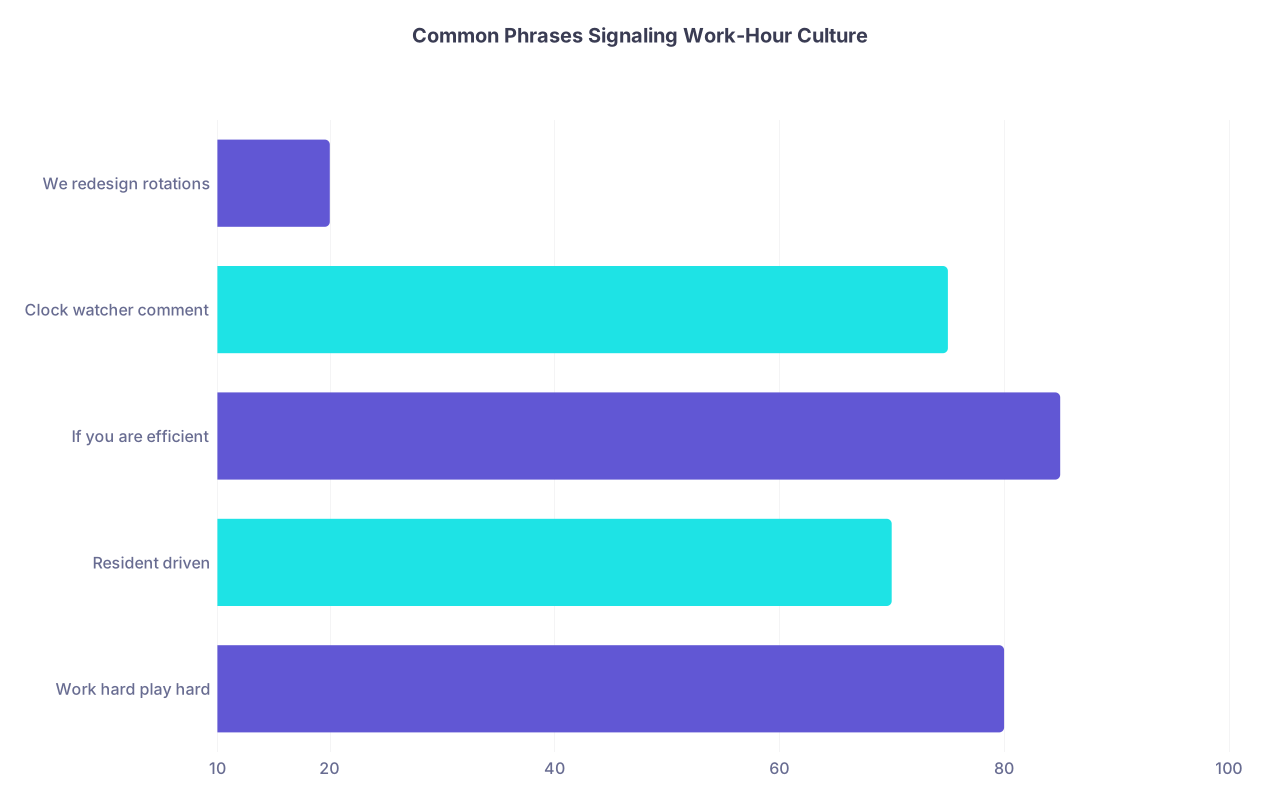
| Category | Value |
|---|---|
| Work hard play hard | 80 |
| Resident driven | 70 |
| If you are efficient | 85 |
| Clock watcher comment | 75 |
| We redesign rotations | 20 |
Numbers here are “probability this indicates a problem” from what I’ve seen and heard residents report. The first four are bad more often than not.
4. How to Read Faculty vs. Resident Answers
Programs with toxic cultures often have a split reality:
- Faculty: “We’re very compliant with ACGME hours.”
- Residents: tight smile, eyes say “Help.”
Here’s how to separate PR from truth.
With faculty
Ask systems‑level questions:
- “How do you monitor and respond to duty hour violations?”
- “What changes have you made in the last 2–3 years to improve workload?”
- “How do you handle services that consistently push the 80‑hour limit?”
Healthy:
- They can name specific changes: capped census, added APNs, redistribution of patients, changed call structure.
- They acknowledge past issues: “ICU used to be brutal; we added a night float and things improved.”
Toxic:
- They say “We’ve never had issues with duty hours.”
- They answer with policy instead of practice: “Residents are required to log honestly” and then nothing else.
- They get defensive: “Our residents are very committed” (non‑answer).
With residents (different PGY levels)
You want pattern consistency.
Ask the same or similar questions to:
- Interns
- Seniors
- Chief residents
If you hear:
- Intern: “On wards I work 70–75 hours easy.”
- Senior: “More like 60–65.”
- Chief: “We’re mostly in the 55–60 range.”
That gap is revealing. Chiefs stop doing the brutal rotations and forget how bad it is. Weight the intern responses more heavily for frontline truth.
5. Subtle Observations On Interview Day That People Overlook
What people show often tells you more than what they say.
1. Body language when you ask about hours
Watch for:
- Glances between residents before answering
- Awkward laughter, someone jumping in to “clarify”
- A resident’s face tightening, then giving a polished answer
If a resident gives a very safe answer with a weird pause, catch them alone later and say: “Off the record, same question.” Most will be more honest.
2. How residents look… and act
You’re not trying to see if people look tired. Residency is tiring. But toxic places have a particular feel.
Green-ish:
- People look tired but functional
- They can joke around, smile, aren’t constantly scanning for pages in a panicked way
- You see some residents actually leaving at reasonable times
Red:
- Everyone looks hollowed out. That flat, checked‑out look
- They keep saying “It’s manageable,” but they act like they’re barely hanging on
- People eating lunch while running, saying things like “This is the first time I’ve sat today”
3. Tour timing and honesty
Ask: “Are we seeing a typical day or a lighter day?”
Healthy responses:
- “This is pretty typical.”
- “It’s actually slightly lighter today; last week was heavier.”
Toxic programs often:
- Avoid letting you anywhere near actual sign‑out or pre‑round times
- Show you only elective clinics with lighter schedules
- Say “Today’s weirdly busy” — but residents clearly don’t believe that
6. Structured Ways to Compare Programs Afterward
Don’t trust your memory. After each interview, quickly score each program on a few work‑hour culture dimensions.
| Dimension | 1 (Bad) | 5 (Great) |
|---|---|---|
| Consistency of answers | Very inconsistent | All aligned |
| Attitude toward duty hours | Dismissive | Proactively enforced |
| Resident affect / burnout vibe | Wrecked | Tired but okay |
| Specific systems to help hours | None | Multiple concrete systems |
| Sick coverage / backup | Informal / guilt | Formal jeopardy |
Right after the day, fill this out with your gut impressions. Patterns show up fast when you compare across 5–10 interviews.
7. Questions for Social Events and Off‑the‑Record Moments
The pre‑interview dinner and those awkward hallway walks are where you get the real intel.
Use softer, story‑based questions:
“What’s the toughest rotation for hours, and how do people get through it?”
- Watch whether “get through it” involves mutual support and reasonable coping, or pure survival and resignation.
“When was the last time you felt, ‘This is too much, I’m drowning’? What happened after that?”
- Do they describe actual support and change, or just “I pushed through”?
“Do people have time for anything outside of work? Kids, hobbies, relationships?”
- If everyone says, “Not really, you just do residency,” that’s a cultural problem, not a personal choice.
“Are there residents here you’d say are thriving, not just surviving?”
- If they can’t name any, that’s telling.
Also: listen for how they talk about co‑residents.
Supportive culture:
- “We cover for each other.”
- “If I’m drowning, someone helps without me asking.”
Toxic:
- “Nobody wants to be the weak link.”
- “You don’t want to be that intern who calls out.”
8. A Simple Mental Flowchart for Work‑Hour Toxicity
Here’s the quick mental model I’d run during and after an interview day.

| Step | Description |
|---|---|
| Step 1 | Ask specific hour questions |
| Step 2 | Toxic leaning |
| Step 3 | Ask about sick coverage |
| Step 4 | Yellow flag |
| Step 5 | Ask about recent changes |
| Step 6 | Yellow flag |
| Step 7 | Observe residents |
| Step 8 | Toxic leaning |
| Step 9 | Safer culture |
| Step 10 | Consistent answers? |
| Step 11 | Formal jeopardy or backup? |
| Step 12 | Concrete examples given? |
| Step 13 | Burnt out vibe? |
You’re not looking for perfection. You’re looking for:
- Consistent stories
- Actual systems, not wishful thinking
- People who look tired but not broken
9. What’s Normal Hard vs. Actually Toxic?
Every residency is hard. So where’s the line?
“Normal hard” looks like:
- 60–70 hour weeks on busy rotations
- A few legitimately awful weeks a year when the service explodes
- You’re tired, but you still recognize yourself
- Program leadership adjusts when something is clearly unsustainable
“Toxic” looks like:
- Regularly hitting 75–80+ hours, but everyone logs 60–70
- Nights where people go 24+ hours without any real chance to sleep, and nobody cares
- Residents joking about “adrenaline and coffee” as survival, not as a one‑off
- Calling out sick is socially punished, even if unofficially
- Chiefs say “It was worse in my day” instead of fixing anything
One quick litmus test: ask, “Would you choose this program again?” and then shut up.
- Healthy: clear “Yes,” maybe with some nuance
- Toxic: long pause, “I mean, I’ve learned a lot,” or “Every program has issues…”
10. Don’t Gaslight Yourself
The last trap: you’ll be tempted to rationalize obvious red flags.
Thoughts like:
- “Maybe I’m just being soft.”
- “Every program probably says this.”
- “It’s a top name; it has to be fine.”
Ignore that. You’re not weak for wanting to sleep and not resent your life. You’re sane.
If three or more of these are true for a program:
- Residents gave obviously canned answers about hours
- You heard multiple red‑flag phrases
- You felt a heavy, burnt‑out vibe from most people
- Nobody could describe clear systems that protect time
Then you should treat that place as high‑risk. Rank accordingly.
FAQ (exactly 5 questions)
1. Is it ever okay to choose a program that seems a little toxic on hours?
Sometimes yes—if it offers something you can’t get elsewhere (very specific fellowship pipeline, location you absolutely need, etc.) and you walk in with your eyes open. But if you do this, treat your own well‑being like a project: find mentors who protect you, set firm boundaries early, and plan realistically for recovery time between brutal rotations. Don’t pretend it’ll magically “feel fine” once you start.
2. Are surgical and procedural specialties just inherently toxic on hours?
They’re usually more intense, yes, but that doesn’t automatically mean toxic. In good surgical programs, residents work hard but still talk about backing each other up, having some life outside, and leadership caring about fixing obviously broken rotations. In bad ones, the abuse is justified as “the way surgery is,” and nobody questions it. The difference is attitude and responsiveness, not just the raw number of hours.
3. What if residents contradict each other about work hours? Who do I believe?
Weight the answers like this: interns > juniors > seniors > chiefs. Interns live in the trenches. Chiefs are half‑administration by PGY‑4/5 and may genuinely forget how bad certain months feel. If an intern says “I’m here 6–7 days a week till 7 pm,” and a chief says “Most are out by 5,” believe the intern.
4. Can I straight‑up ask, ‘Do you break duty hours?’
You can, but you’ll almost never get a clean “yes” even if they do. Better to ask: “In the last few months, has anyone needed to file a formal duty hour violation, and what happened afterward?” That forces them to talk about real cases and responses instead of hypothetical policy.
5. What if every program I like seems tough on hours—am I just doomed?
No. Residency will be hard no matter what, but there’s a huge difference between hard and harmful. Pick the program where people still joke with each other, leadership admits flaws and describes concrete fixes, and residents say “It’s intense, but I feel supported.” You’re not choosing between misery and comfort; you’re choosing between survivable workload with growth versus slow, preventable burnout.
Key takeaways:
- Don’t trust slogans—judge programs by specific answers, consistency, and visible systems that protect time.
- Weigh intern perspectives and body language more than polished faculty lines.
- If residents look broken, speak in red‑flag clichés, and can’t name any real support, believe that over the brochure.