

The way most residents handle moonlighting near the 80‑hour cap is dangerous, sloppy, and traceable. You do not want to be the example your program director brings up at the next CCC meeting.
You’re in a specific, high‑risk situation: you’re moonlighting, you’re close to the 80‑hour ACGME cap, and you’re not sure what to adjust—shifts, logging, or your expectations. I’m going to tell you exactly what to change, in what order, so you protect your license, your residency standing, and your sanity.
Step 1: Get brutally clear on your real hours
Do this before you change anything.
You can’t make smart decisions if you’re lying to yourself. And most residents undercount by at least 5–10 hours a week.
Here’s what counts toward the 80‑hour rule:
- All residency clinical hours (in-house, clinic, OR, L&D, consults)
- In-house call (every minute you’re in the building)
- Home call hours actually spent in the hospital
- At‑home call hours when you’re actively working (charting, phone orders, telehealth)
- Moonlighting hours—internal or external—if your moonlighting requires you to hold a license and independently bill or cover patients as a physician
What usually gets “forgotten”:
- Evening notes and charting done at home
- Pre‑rounding early “off the clock”
- “Just finishing notes” after you’ve technically signed out
- Brief curbside calls from the ED or nursing homes during off time that turn into real work
For the next 2 weeks, track your hours honestly in a simple way:
- Use a phone note or Google Sheet.
- Log start and end times for:
- Residency work (door in to door out)
- Moonlighting shifts (entire block you’re covering, not just busy periods)
- Off‑site work (charting, calls)
After 14 days, calculate your average weekly hours. If you’re above 78, you’re already too close.
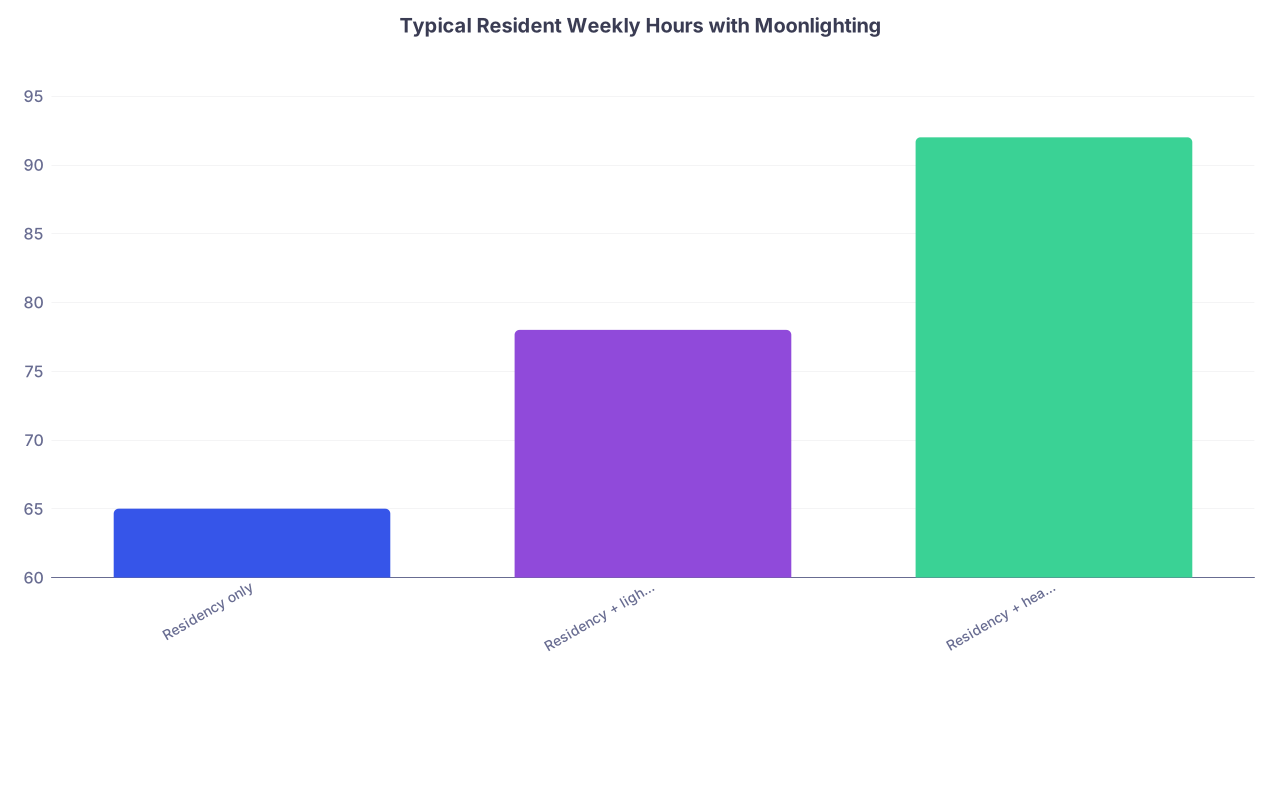
| Category | Value |
|---|---|
| Residency only | 65 |
| Residency + light moonlighting | 78 |
| Residency + heavy moonlighting | 92 |
If your number is:
- 80+ – You’re already in violation. This is now a damage control situation.
- 76–80 – You’re living in the gray zone. One busy week and you’re cooked.
- 70–75 – You can moonlight, but you need rules.
- <70 – Either you’re in a lighter rotation or you’re undercounting. Check yourself.
Step 2: Decide your non‑negotiable line (and stop pretending it’s 80)
The 80‑hour cap is not a target. It’s the legal wall you hit right before the program, hospital, and maybe you get in trouble.
If you aim for 80, you’ll overshoot. Because:
- Rotations fluctuate.
- Codes and emergencies happen.
- Notes pile up.
- You get stuck in sign‑out or in the OR.
Set a personal cap that is actually safe.
For most residents:
- 72–75 hours/week = aggressive but not insane
- 75–78 hours/week = high‑risk zone
- 80 hours/week = red line, not a weekly plan
Pick your number now. Then treat it as law for yourself.
Example: You decide 74 hours/week is your absolute personal limit. If your residency week is already scheduled at 68–70 hours (heavy ICU, wards, q4 call), you get 4–6 hours of moonlighting that week. That’s it.
If this sounds too strict, you’re exactly the person who will end up at 86 hours and hoping GME doesn’t audit.
Step 3: Rank what matters: money, training, safety, or relationship with your program
You can’t optimize for everything.
Here’s the actual tradeoff: some combination of money, clinical experience, and reputation vs. your health, safety, and compliance. You need to choose your priorities on purpose rather than by drifting.
Use this quick ranking (1 = most important right now):
| Priority Option | Rank (1–4) You Decide |
|---|---|
| Immediate extra income | |
| Protecting residency evals | |
| Long‑term clinical growth | |
| Physical and mental health |
Be honest. If you’re in crushing debt, money might be #1 for 6–12 months. That’s fine—but then you accept the necessary limits around safety and hours instead of pretending you can do everything.
Step 4: Adjust your moonlighting before you touch your duty hour reporting
Most residents get this backwards. They start adjusting the logging first (a.k.a. “massaging hours”) and leave their schedule unchanged. That’s how you end up:
- Exhausted
- Unsafe
- And now also vulnerable if GME ever investigates
First knob to turn: moonlighting, not your honesty.
Here are concrete ways to adjust, ranked from “minimal change” to “maximal change.”
A. Switch from in‑house to lower‑intensity moonlighting
If your moonlighting is brutal (busy ED shift, cross‑cover 200 patients, codes all night), swap it for something less insane:
- Telehealth shifts (with clear start/stop times)
- Outpatient urgent care with defined clinic hours
- Nicer community hospitalist moonlighting with predictable volume
You still get income, but you’re not wrecked for your main job.
B. Shorten individual moonlighting shifts
Instead of a 12‑hour overnight, convert to:
- 6–8 hour evening shifts
- 4–6 hour weekend blocks
Yes, you’ll sometimes make less per shift. But fragmented fatigue is much more survivable than a 28‑hour run followed by post‑call plus notes plus “just a quick moonlighting shift.”
C. Reduce frequency
Set hard caps based on rotation intensity:
- Heavy rotations (ICU, wards, trauma, night float): max 1 shift every 1–2 weeks or none at all.
- Moderate rotations (ED, consults, subspecialty inpatient): 1 shift per week at most.
- Light rotations (research, elective, certain clinics): short bursts of 2 shifts/week can make sense.
If your schedule currently ignores rotation intensity, fix that first.
Step 5: Build a rotation‑specific moonlighting plan
Stop deciding week by week based on how desperate you feel for cash that Friday.
Create simple rules like this:
| Rotation Type | Base Residency Hours | Moonlighting Max/Week |
|---|---|---|
| ICU / Wards q4 | 70–75 | 0–4 hours (often 0) |
| ED / Night Float | 65–70 | 0–1 short shift |
| Clinic-heavy | 55–60 | 1–2 short shifts |
| Research/Elective | 40–50 | 2–3 shifts (carefully) |
Then apply them for the next 3 months:
- Look at your master schedule.
- Mark high‑risk blocks (ICU, wards, nights) in red.
- Mark moderate blocks in yellow.
- Mark electives/research in green.
- Layer in moonlighting only on yellow/green weeks, and stay under your personal cap.
You’ll earn less in your worst rotations and more in the easier ones. That’s exactly what should happen.
Step 6: Clean up your duty hour logging—without lying
Here’s where people get afraid.
You should absolutely log accurately. But you also don’t need to log like a martyr who includes every 7‑minute charting fragment at home.
The right approach is:
- Count all actual work that’s substantial and regular.
- Don’t inflate or dramatize trivial add‑ons.
Examples that SHOULD count:
- You routinely stay 45–60 minutes past sign‑out to finish notes 3–4 days a week.
- You regularly come in 30–45 minutes early to preround because census is insane.
- You’re on home call and in practice you’re in‑house 4–6 hours overnight.
Examples that don’t need to be obsessively logged:
- A one‑off 10‑minute night call doing a refill.
- The occasional 5–10 minutes finishing one note at home.
- Rare, unusual weeks that are outliers (you can flag them separately if your program wants that data).
The rule: don’t erase patterns. You can round small noise.
If you’re currently under‑logging by 5–8 hours a week to make your moonlighting fit? That’s not “rounding.” That’s falsifying.
And yes, GME offices sometimes audit patterns, especially if there’s a sentinel event or if a program is already under scrutiny.
Step 7: If you’re already over 80: immediate triage
Let’s say your honest 2‑week average is 82–90 hours. That’s common. And it’s a problem.
Here’s your 7–10 day action plan:
- Cancel or defer all moonlighting for the next 1–2 weeks.
- Log your residency hours accurately for those 2 weeks.
- Fix your schedule for the next month:
- Eliminate moonlighting from your next high‑intensity rotation.
- Stack any moonlighting you must do into your safest weeks.
- If you’re consistently at 75–80 from residency alone, you have a duty hour problem even without moonlighting. That’s when you consider discreetly talking to:
- Your chief residents, or
- Program coordinator / APD who actually handles scheduling.
Do not walk into your PD’s office saying, “I’m over 80 because of moonlighting.” You fix your moonlighting first. Then, if the problem persists solely from residency work, you bring data.
Step 8: Decide who needs to know—and how honest to be
This part is political. Let’s not pretend otherwise.
Your options:
Silent adjustment
You quietly fix your moonlighting schedule, tighten logging to be accurate, and stay under the 80‑hour cap. No conversations needed. This is ideal if you caught the problem early.Partial transparency with chiefs
You say: “My hours have been tight lately, I realized with notes and a couple of outside shifts I was flirting with 80. I’ve already cut back on the extra work, but I wanted to make sure my clinical schedule isn’t consistently pushing me to the limit.”
Translation: you own the fix, ask for help if needed, and don’t present them with a problem you’re dumping in their lap.Formal disclosure (higher risk, sometimes necessary)
This is more relevant if:- Your program mandates approval for all moonlighting.
- You’re internal moonlighting through the same health system.
- Your hours are unsalvageable without schedule help.
In that rare case, you bring a clean, specific ask:
“I’m at 74–76 hours weekly right now with residency alone on ICU. I’d like to either delay my approved moonlighting until [lighter block], or cap it at [x] hours so I remain compliant.”
Notice what you’re not doing: begging for forgiveness after 6 weeks of 90‑hour work weeks and falsified logs.
Step 9: Watch for the three red flags that mean you’ve already pushed too far
Forget the hour count for a moment. If any of these are true, you’re already over the line:
You’ve fallen asleep driving home. Even once.
That’s your last warning, not a funny story.You’re missing basic details in patient care:
- Rewriting the same order twice.
- Forgetting to follow up critical labs.
- Showing up on the wrong floor or wrong OR at the wrong time.
People are commenting:
“You look wrecked.”
“Are you okay? You seem out of it.”
Nurses, co‑residents, and attendings notice this before you do.
If you’re seeing these, you don’t “tweak” your moonlighting. You stop it temporarily. Immediately. And you build back later from a safer baseline.
Step 10: Use data, not vibes, for your money-picture
Most residents wildly overestimate how much moonlighting is necessary vs nice to have.
Do this once:
Calculate your actual monthly need:
- Fixed costs: rent, loans (minimums), utilities, food, transport, required fees.
- Add a modest buffer (10–15%).
Look at your residency salary after tax.
The gap between those two numbers is what moonlighting needs to cover. Not your fantasy lifestyle, just your survival plus sanity.
Then:
- Convert that dollar gap into hours of moonlighting per month, given your typical pay rate.
- Spread those hours into your safest rotations only.
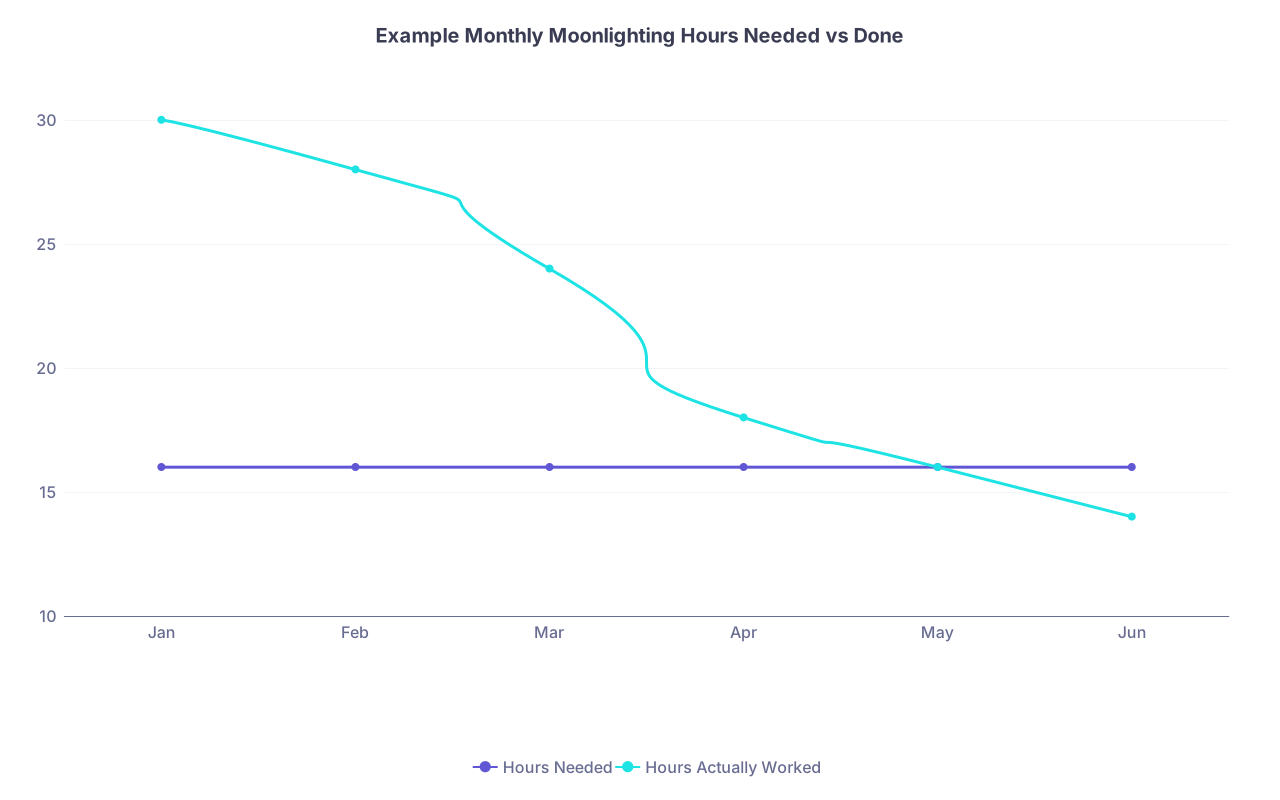
| Category | Hours Needed | Hours Actually Worked |
|---|---|---|
| Jan | 16 | 30 |
| Feb | 16 | 28 |
| Mar | 16 | 24 |
| Apr | 16 | 18 |
| May | 16 | 16 |
| Jun | 16 | 14 |
If your “needed” number is 12–16 hours/month but you’re doing 40+, you’re trading huge amounts of safety and time for marginal extra income. That might be okay briefly (saving a spouse’s visa, paying emergency debt), but don’t pretend it’s sustainable.
Step 11: Protect your future self: a simple ongoing system
You don’t need complex apps. You need a repeatable check.
Once a week (pick a fixed time, like Sunday nights):
- Look at last week’s total hours:
- Residency (from your log)
- Moonlighting (from your shifts)
- If you hit:
78 hours → no moonlighting for the coming week.
- 75–78 hours → you can do at most one short shift on a light day.
- <75 hours → you can follow your pre‑planned rotation rules.
Every month:
- Recalculate your needed moonlighting hours based on your spending.
- Adjust the next month’s moonlighting schedule accordingly.
Do this for 3 months and you’ll stop constantly flirting with the 80‑hour cliff.
Quick scenario walkthroughs
Scenario 1: PGY‑2 IM resident, ICU month, already booked 4 moonlighting shifts
Facts:
- ICU rotation: averaging 68–72 hours/week.
- Moonlighting: 4 ED shifts this month, each 8 hours, all nights.
Problem: 68–72 + 32 = 100+ potential hours on bad weeks. And that’s assuming you undercount nothing.
Fix:
- Immediately cancel 2 of the 4 moonlighting shifts.
- Move the remaining 2 to the next lighter month if possible.
- Log your ICU hours accurately this month.
- For future ICU/wards: no more than 1 short (4–6 hour) shift every 2 weeks, if at all.
Scenario 2: Surgical resident, culture of under‑reporting, wants to moonlight
Facts:
- Your co‑residents all log 75 even on 90‑hour weeks.
- Chiefs say: “If you log true hours, we’ll all get screwed.”
- You’re offered lucrative trauma moonlighting.
Blunt truth: You’re already in violation as a program. Adding moonlighting on top is pouring gasoline on a fire.
Realistic path:
- Moonlight only on truly light rotations (research, clinic) when your honest hours are <60.
- During heavy blocks, assume you’re 80+ no matter what the logs say—no moonlighting.
- Keep personal, private records of your real hours in case you ever need to defend your decisions.
Scenario 3: Psychiatry resident, 55‑hour average weeks, wants to aggressively pay debt
Facts:
- 55 residency + 20 moonlighting = 75 hours. That’s actually doable.
- You’re far from the 80 cap but getting mentally drained.
Plan:
- Keep your total under 70–72 on average.
- Reserve 1 weekend per month with zero clinical work.
- Treat any major life stressor (family illness, exams, relationship crisis) as a reason to cut moonlighting for that month.
You actually have room. Just don’t fill it automatically because the hours exist.
FAQ (exactly 4 questions)
1. Do external moonlighting hours always count toward the 80‑hour ACGME limit?
Yes, if you are functioning as a physician (using your license, billing, managing patients independently), those hours count as work hours and should be reported. Programs and GME offices differ in how aggressively they police external moonlighting, but from a safety and compliance standpoint, you should assume all independent clinical work counts. “But everyone else ignores it” won’t help you if something goes wrong and hours get audited.
2. What if my program quietly expects us to under‑report hours—am I supposed to blow the whistle?
You do not have to be a martyr, but you also should not blatantly falsify. The practical middle ground: log honestly enough that your average week reflects reality, even if you don’t micro‑log every 5‑minute add‑on. If your true hours are regularly 80+ from residency alone, fix moonlighting first, then consider discreet conversations with chiefs or a trusted faculty member. Only escalate formally if patient safety or resident safety is clearly compromised and nothing changes.
3. Is it ever reasonable to go over 80 hours for a short time if I need the money?
Medically and legally, no, but let’s be real: many residents will do it for a week or two during a financial crunch. If you cross 80 at all, it should be: rare, time‑limited (1–2 weeks max), followed by a deliberate “cool‑down” period with zero moonlighting and lower total hours. And you accept that you’re taking on risk—of fatigue, of error, and of getting burned if anyone looks closely at your logs. That’s not something to normalize or turn into a habit.
4. How do I know if I should stop moonlighting completely vs just cut back?
If your residency weeks alone are 75+ hours on multiple rotations, or you’ve had safety red flags (near‑miss accidents driving, repeated clinical mistakes, people commenting you look unsafe), you should stop moonlighting completely for at least 1–2 months. Use that time to reset sleep, evaluate your finances clearly, and see if your baseline residency workload is already unsustainable. If, after that, you’re averaging <70 hours with good functioning, then you can reintroduce limited moonlighting using rotation‑based caps and a clear weekly/hourly plan.
Open your last 4 weeks of schedules right now and do the math: residency hours + moonlighting hours, honestly counted. If any week hits 78 or more, block out your next heavy rotation and remove moonlighting from it today.


