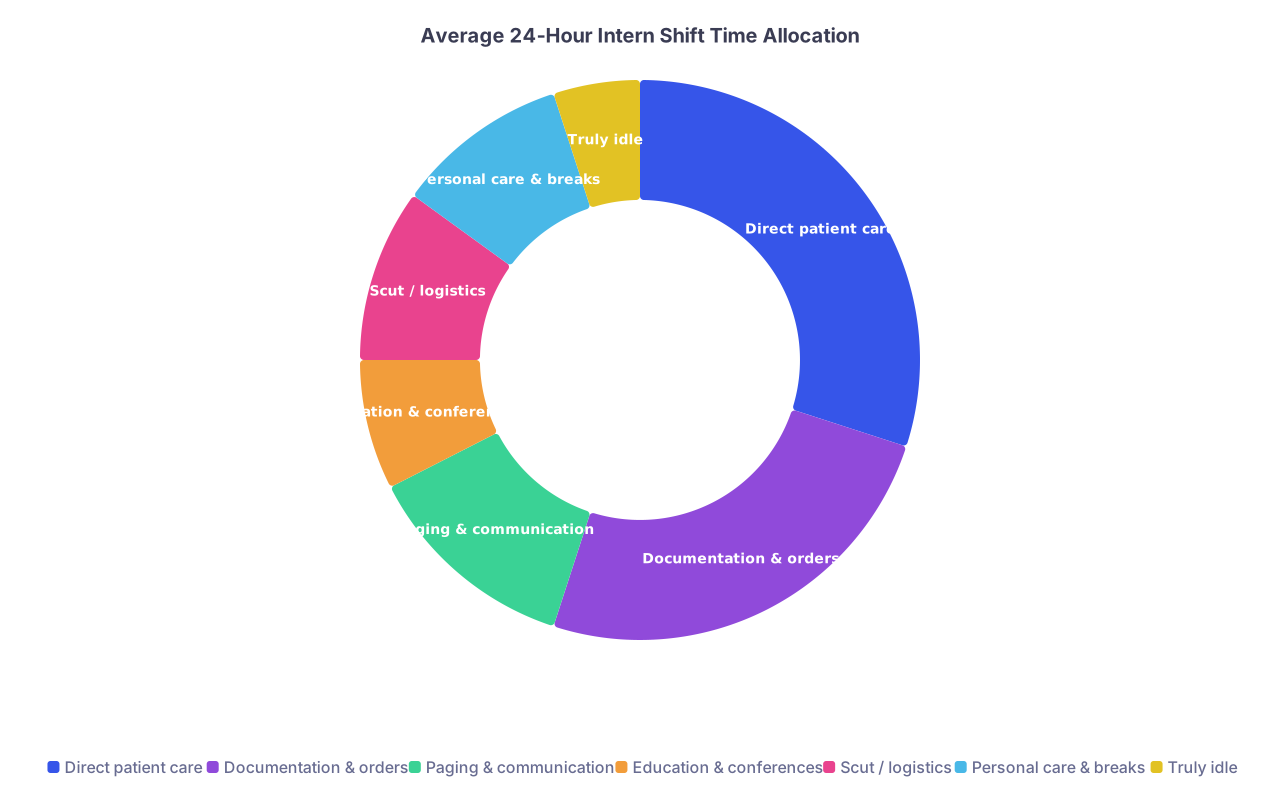
| Category | Value |
|---|---|
| Direct patient care | 360 |
| Documentation & orders | 300 |
| Paging & communication | 150 |
| Education & conferences | 90 |
| Scut / logistics | 120 |
| Personal care & breaks | 120 |
| Truly idle | 60 |
The mythology of internship says you spend your days “taking care of patients.” The data says otherwise.
Once you start timing what interns actually do minute by minute, the romantic picture dies fast. I am talking about people literally standing in hallways with clipboards or iPads, logging every task: order entry, walking, answering pages, waiting for CT, writing H&Ps at 2 a.m. When you aggregate that across hundreds of shifts, the pattern is brutally clear.
You are doing less “doctor stuff” than you think. And more clerical, coordination, and sheer waiting than anyone wants to admit.
Let’s quantify that.
What Time-Motion Studies Actually Measure
Time-motion studies are not surveys. They are not vibes. They are structured observation.
A typical intern time-motion study in internal medicine or surgery looks like this:
- 20–50 interns followed
- 2–5 full shifts per intern
- Every activity classified into predefined categories, often logged in 1–5 minute increments
Categories look something like:
- Direct patient care (in room talking, examining, counseling, family meetings)
- Indirect patient care (chart review, orders, documentation, sign-out)
- Communication (pages, phone calls, talking with nurses / consultants)
- Education (rounds teaching, didactics, reading)
- Administration / logistics (“scut”: forms, transport, chasing imaging, bed control)
- Personal (food, restroom, micro-breaks)
- Idle / waiting (literally nothing active: waiting for transport, waiting for labs, stuck in an elevator)
When you compress this into percentages, the results are uncomfortably consistent across specialties and countries.
The Real Hour Breakdown on a 12–14 Hour Day
Let me anchor this in numbers. Multiple published studies in internal medicine and surgery converge on roughly the same distribution. To make it concrete, assume a 13-hour day (for math ease). That is 780 minutes.
Here is a composite, rounded to the nearest 5 minutes, that lines up with several large studies:
| Category | Minutes / 13h day | % of shift |
|---|---|---|
| Direct patient care | 120–150 | 15–20% |
| Documentation & orders | 210–240 | 27–31% |
| Paging & communication | 90–120 | 12–15% |
| Education & conferences | 60–75 | 8–10% |
| Scut / logistics | 60–90 | 8–12% |
| Personal care & breaks | 45–60 | 6–8% |
| Idle / waiting | 15–30 | 3–5% |
Convert that to a 24‑hour call (roughly scaling with some penalty for night disruption) and you get very close to the doughnut chart at the top.
Key point: direct, in-room patient care is generally under 20% of your shift. Often closer to 12–15% in heavy documentation environments. In some surgical studies, it drops near 10% on certain days.
If you feel like you spent “all day on the computer,” you are not exaggerating.
Direct Patient Care: The Part You Thought Would Be Your Job
Let’s isolate the “real doctoring” — actually in the room, interacting with patients.
Time-motion data usually splits direct care into:
- Initial assessments and H&Ps
- Daily rounds and focused exams
- Procedures (lines, paracenteses, suturing, etc.)
- Family discussions / goals of care conversations
For a 13-hour ward day, a very typical breakdown:
- New patient admissions: 2–3 patients, 20–30 minutes each in room → 40–90 minutes
- Follow-ups: 10–15 patients, 3–5 minutes at bedside each (not counting charting time) → 30–75 minutes
- Procedures: highly variable; some days 0, some days 2–3 procedures totaling 30–60 minutes of hands-on time
Net: about 90–150 minutes of true, in-room, talking-plus-examining time.
So on a standard day you might:
- Spend 12 minutes kneeling at the bedside explaining new heart failure to a scared 60‑year‑old
- Then spend 40 minutes documenting that same encounter, reconciling meds, updating problems, and clicking your way through order sets
The ratio is brutal. Roughly 1 minute talking to a patient for every 2–3 minutes spent charting about that patient.
The data shows that if you feel guilty about “not being in rooms enough,” you are responding to a system that mathematically does not allow much more. You’re not lazy. The calendar is.
Documentation and Orders: The Black Hole
This is the dominant time sink, and it has only grown with EHR complexity.
On a typical ward or ICU shift:
- Notes (H&Ps, daily progress, discharge summaries)
- Order entry (meds, imaging, labs, consults, “hold PT,” DVT prophylaxis, etc.)
- Review (labs, radiology reports, vitals trends, nursing documentation)
Time-motion studies consistently show interns spending 25–40% of their shift doing this. In some EHR-heavy institutions it pushes above 40%.
For a 13-hour day, that looks like:
- 12–15 progress notes: ~10–15 minutes each → 120–225 minutes
- 2–4 H&Ps: 20–30 minutes each including writing → 40–120 minutes
- Orders and result review scattered through the day → 40–80 minutes
You can quickly see why many interns say, “I spent 9 hours documenting.”
- Fewer formal notes, but endless order entry and result review
- Less support staff, more direct responsibility for every small order (fluids, PRNs, imaging, restraints)
Some studies find night interns still logging 30%+ of their time in the EHR, just with a higher proportion in orders and cross-coverage notes rather than extensive progress notes.
This is the core mismatch: residency marketing sells “patient care”; time-motion studies show “computer care.”
Paging, Calling, and Hallway Conversations: The Hidden Third Job
The studies that actually separate “indirect care” into documentation vs. communication expose another giant chunk of your day: talking, but not to patients.
This includes:
- Answering and returning pages
- Calling consults
- Calling radiology about critical / delayed reads
- Nurses asking for clarification, new orders, or status updates
- Talking to pharmacists, PT/OT, social work, case management, bed control
- Team discussions in hallways and work rooms
Numbers are surprisingly consistent: 60–120 minutes of every 13-hour day. Call it 10–20% of your shift. In systems with heavy paging culture and poor messaging tools, it is often at the upper end.
A realistic hour-by-hour picture from one large study looked like:
- 4–8 pages per hour during peak times
- 1–2 consult calls per hour on admitting days
- 10–20 “micro-conversations” per day with nurses and other team members, often 30–90 seconds each
That sounds trivial until you stack it. Thirty 1-minute interruptions is half an hour. Thirty 3-minute interruptions is an hour and a half. And that is on top of the context switching cost.
Time-motion analysts usually see this pattern:
- Intern starts note → gets paged 4 minutes in
- Switches to call radiology → interrupted by attending question
- Returns to note 15 minutes later, rereads prior text to reorient
- Repeat 40 times over a shift
The data does not just show you “time spent communicating”; it also shows fragmentation. And fragmentation murders efficiency.
Education: The Thing Everyone Pretends Is Central
Look at your program’s brochure and you would think teaching is the primary use of your time. The stopwatch says otherwise.
Across multiple residency time-motion studies:
- Formal didactics and noon conferences: 30–60 minutes per day (when not canceled)
- Teaching rounds where someone is actually teaching (not just data recitation): another 20–40 minutes
Realistic total: 60–75 minutes per 13-hour day, or 8–10%.
Often less on heavy admit days, call nights, and weekends. Many interns privately admit that they attend maybe half of their scheduled noon conferences because “we were slammed,” “cross-cover was insane,” or “someone had to stay on the floor.”
On ICU rotations, the nominal teaching time may be higher, but the interruptions and competing tasks mean that your focused learning time is still not large.
The data is blunt: residency is a full-time service job with part-time education layered on top. Not the other way around.
Scut and Logistics: The Work That Should Be Automated or Delegated
“Scut” is not just running to radiology. Time-motion studies break this category down into:
- Arranging transport, chasing down wheelchairs, calling for porters
- Hunting down equipment (ultrasound, Doppler, special bed, wound vac supplies)
- Manual paperwork (FMLA forms, disability papers, pre-certification forms)
- Repeating phone calls to the same service because no one answered the first time
- Physically carrying blood products or imaging discs in under-resourced settings
Quantitatively, this usually accounts for 8–12% of the day: 60–90 minutes on average. But variance is huge. Certain hospitals and rotations (surgery, ED, night float without coordinator support) see higher scut loads.
The data pattern is familiar:
- Systems with better ancillary staff and robust transport services → lower “scut time”
- Places where “the intern does everything” → massive scut spikes, especially off-hours
This is not just annoying. It directly cannibalizes patient-facing and educational time. Every 20 minutes spent wrestling with a fax machine is 20 minutes you are not at the bedside or reading.
Personal Time and Breaks: Your Body Is Not an Afterthought (But the System Treats It Like One)
Measured, not remembered, interns typically log:
- 20–40 minutes for meals over 13 hours
- 20–30 minutes scattered as bathroom breaks, standing by a window, micro-rests
So 45–60 minutes total “personal” time. Call it 6–8% of the shift.
But the distribution is ugly. Many days you get:
- Zero protected 30-minute block for a real meal
- A 7-minute inhaled lunch between admissions
- A bathroom break at 5 p.m. when you realize you have not gone since 8 a.m.
Night shifts often skew this. Some interns report 2–3 short “lulls” where they sit for 10–15 minutes, which technically count as “personal” or “idle,” but the constant threat of the pager undermines any actual rest.
Time-motion data does not capture your cortisol levels. But it clearly captures the fact that personal time is fragmented, unpredictable, and easily sacrificed when the census spikes.
“Idle” Time: The Minutes That Feel Like Hours
Studies usually code “idle” as:
- Waiting for elevator or transport
- Waiting on hold on the phone
- Standing outside a patient’s room waiting for a procedure or family meeting to start
- Sitting in the workroom with nothing urgent yet queued (rare)
This typically logs as 15–30 minutes per day, 3–5% of the shift.
Subjectively, those idle minutes feel huge because they are rare and often occur when you are exhausted. Objectively, they are a rounding error compared to documentation and EHR work.
So no, you are not “wasting tons of time” sitting around. The data shows the opposite. Your true downtime is minimal and fractured.
How Time Use Shifts by Rotation
Not all months are equal. The mix of tasks changes, but the overall pattern — high indirect care, low direct care — persists.
Let me give you approximate distributions for three common settings, as documented in several residency programs.
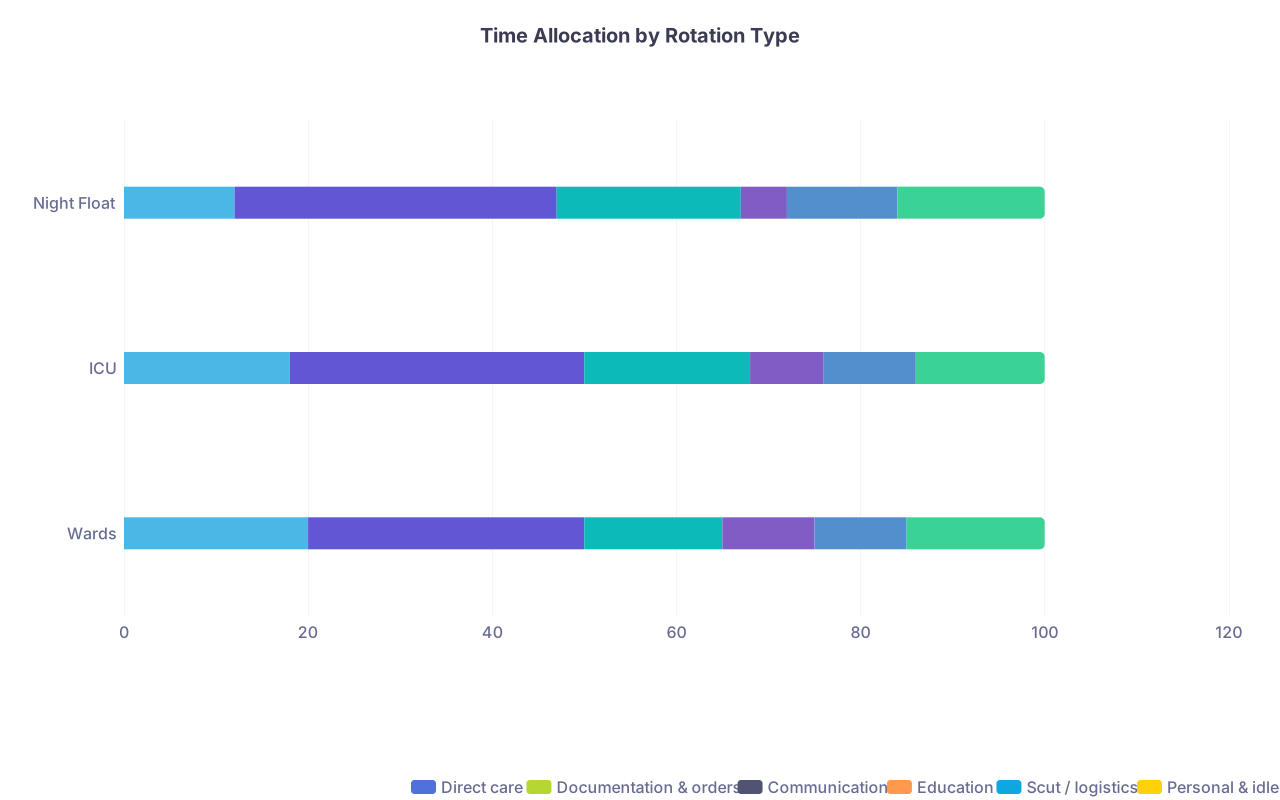
| Category | Direct care | Documentation & orders | Communication | Education | Scut / logistics | Personal & idle |
|---|---|---|---|---|---|---|
| Wards | 20 | 30 | 15 | 10 | 10 | 15 |
| ICU | 18 | 32 | 18 | 8 | 10 | 14 |
| Night Float | 12 | 35 | 20 | 5 | 12 | 16 |
General medicine wards
- Heavier on progress notes, discharge summaries, and multi-disciplinary coordination
- Direct care: often 15–20%
- Education: better if your program protects noon conference
ICU
- Direct care a bit higher in procedures and complex exams, but still diluted by documentation
- More communication with consultants, families, and nurses; higher paging load
- Education: more bedside teaching but often eaten by acuity
Night float / call
- Spikes in cross-cover pages and rapid response / code events
- Documentation is still high, but more focused on brief notes and orders
- Education time drops; no noon conference, limited formal teaching
Bottom line: there is no rotation where you suddenly get 50% of your time at the bedside. It does not exist in current systems.
Where You Actually Lose Time: The Friction Points
If you are looking at this like a process engineer, the problem is not that interns are “inefficient humans.” The problem is friction baked into the workflow. Time-motion data repeatedly identifies the same culprits:
- Fragmented EHR workflows: flipping between 4–7 screens to complete a single task
- Redundant documentation: writing the same information in multiple note types or fields
- Poor paging policies: non-urgent pages sent stat, unclear triage, no batching
- Lack of support staff off-hours: interns doing transport, paperwork, basic logistics at 2 a.m.
- Communication bottlenecks: needing 3–4 calls to track down a consultant or attending
Every 30-second friction repeated 60 times per day is 30 minutes gone. Scale that to a 6‑day workweek and you are losing 3 hours. Across a year of internship, that is over 150 hours of your life.
You feel this drain viscerally. The numbers back up the intuition.
What You Can Actually Control (A Little)
You cannot re-architect your hospital’s EHR. But you can claw back meaningful time at the margins if you treat this like a personal time-motion study.
Batch work aggressively
Stop refreshing labs every 3 minutes. Check them in defined blocks and address all changes in one pass per cluster of patients. The data on context switching is brutal: each unplanned task switch creates a 20–30% efficiency penalty.Template and standardize
Well-designed note templates, dot phrases, and checklists cut total documentation time by 15–30% in several internal studies. Not sloppy copy-paste; intentional snippets for common problems and plans.Negotiate paging rules with your team
Quick huddle with charge nurses at the start of the shift: what is page-worthy, what can be bundled, how to signal truly urgent issues. When units did this systematically, studies saw a 10–20% reduction in non-urgent pages.Protect at least one real break
Even a single 15–20 minute uninterrupted meal block improves performance and reduces error rates in cognitive work. That is not wellness fluff; it is basic human factors engineering.Use micro-reviews
Instead of reading up on conditions in 30-minute chunks you never get, use 3–5 minute bursts tied to a specific problem (DVT prophylaxis in cirrhosis, for example). That maps better to how your time is actually fragmented.
You are not going to turn a 30% documentation day into a 10% one. But a 30% day down to 25% is realistic. That is 40–60 extra minutes for patients or sleep.
How This Affects Burnout and Satisfaction
When researchers correlate time-use data with burnout scores, a clear pattern emerges:
- Higher fraction of time in direct patient care → higher professional satisfaction
- Higher fraction in documentation and scut → higher emotional exhaustion and depersonalization
Not surprising. You did not go into medicine to be a data entry clerk.
A lot of residents describe a similar turning point: “I started to feel better when I accepted that I was playing the documentation game strategically, not failing at being some idealized doctor.” That shift in mindset matters.
The numbers will not change quickly. But you can change how you interpret them:
- When 70% of your day is EHR, you are not a bad intern. You are a typical intern in a documentation-heavy system.
- When you fight for and preserve those 90 minutes of high-quality bedside time, you are maximizing the only part of the day that meaningfully connects to why you are here.
Visualizing the Reality
To wrap the quantitative picture into something you can see at a glance, here is a simple “intern day” plotted across major categories for a 24-hour call. These numbers approximate several composite datasets:
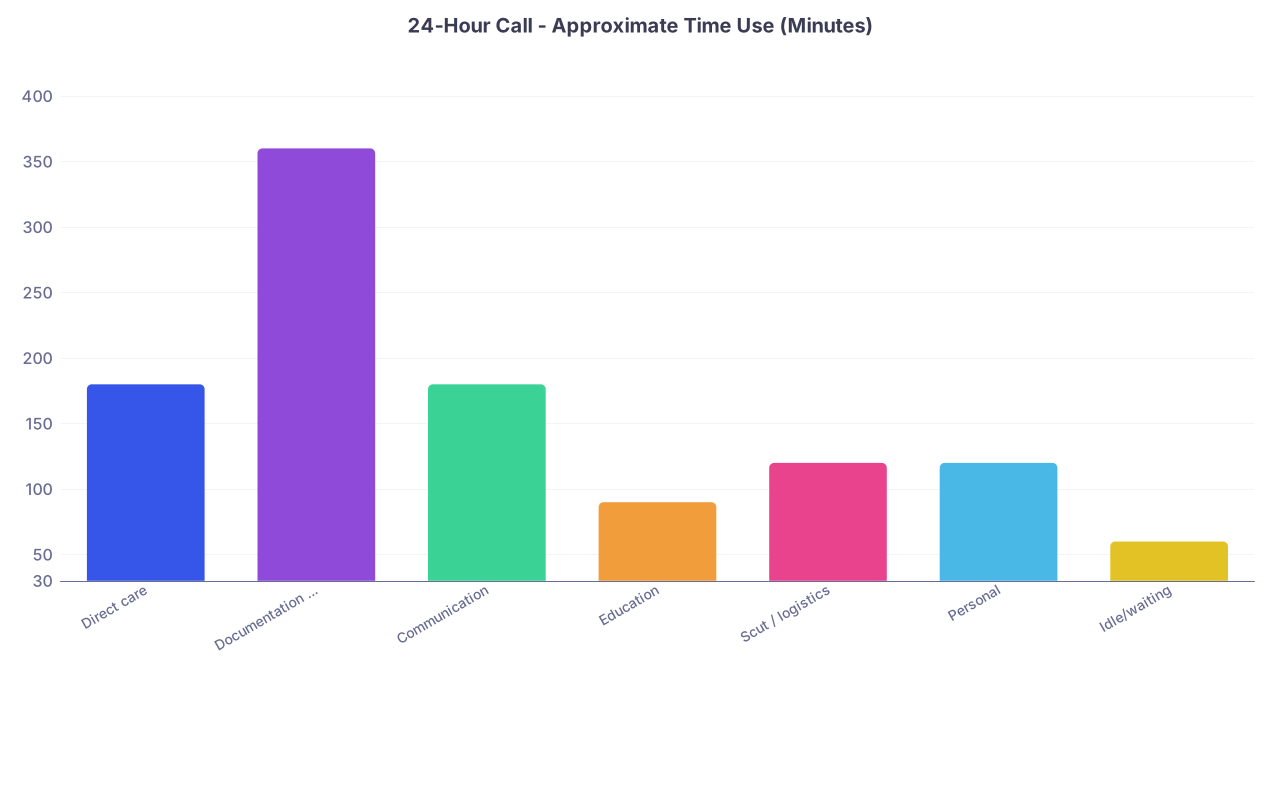
| Category | Value |
|---|---|
| Direct care | 180 |
| Documentation & orders | 360 |
| Communication | 180 |
| Education | 90 |
| Scut / logistics | 120 |
| Personal | 120 |
| Idle/waiting | 60 |
Look at that bar for documentation and orders. That is the job you actually have. Everything else is squeezed around it.
The Compressed Reality
The romantic version of internship says: “You spend your days saving lives.” The time-motion data says:
- You spend about 15–20% of your shift directly with patients, and 30%+ documenting what you did.
- Another 20–30% gets eaten by paging, communication, and logistics — work that is essential but structurally chaotic.
- Education and personal time together usually occupy under 20% of your day. Unless the system changes, your only rational move is to treat time like a scarce resource and manage it ruthlessly.
That is where your hours actually go. Not where anyone wanted them to go. But where the stopwatch says they do.