
The way most residents structure a 12‑hour call night is wrong. They let the pager dictate everything. You are going to flip that. You will run the night on your terms, hour by hour, with a plan that actually survives real‑world chaos.
We will assume:
- 12‑hour night call (e.g., 7 p.m. – 7 a.m.)
- You are covering floor patients + new admits
- Typical IM, surgery, or hybrid hospitalist‑style call
Adjust the specific times to your schedule, but keep the sequence and logic.
60 Minutes Before Call: Pre‑Shift Setup (T‑60 to T‑0)
At this point you should still be at home or just arriving to the hospital.
T‑60 to T‑45: Mental and physical prep
- Eat a real meal. Not just a granola bar.
- Caffeine: light dose now, not a gallon. You want smooth alertness by Hour 2–3, not tachycardia at sign‑out.
- Empty your bladder, grab gum or mints, and pack:
- Stethoscope
- Pen + small notepad (yes, paper still wins at 3 a.m.)
- Phone charger / portable battery
- Snacks that you can eat one‑handed
- Small water bottle
T‑45 to T‑30: Skim the battlefield
If you have EMR access from home or early at the hospital:
- Pull up your patient list from the prior night if you have continuity.
- Scan:
- Anyone on pressors, HFNC, or borderline vitals.
- Fresh post‑ops or recent transfers out of ICU.
- Patients with DNR/DNI or complex goals of care.
You are identifying who is most likely to blow up between midnight and 5 a.m.
T‑30 to T‑0: Arrive and orient
- Get to the call room or workroom.
- Log into EMR, open:
- “My List” for the night.
- Active orders window.
- Messaging/pager system.
Set up your workstation now. Not at 1:17 a.m. when the rapid response hits.
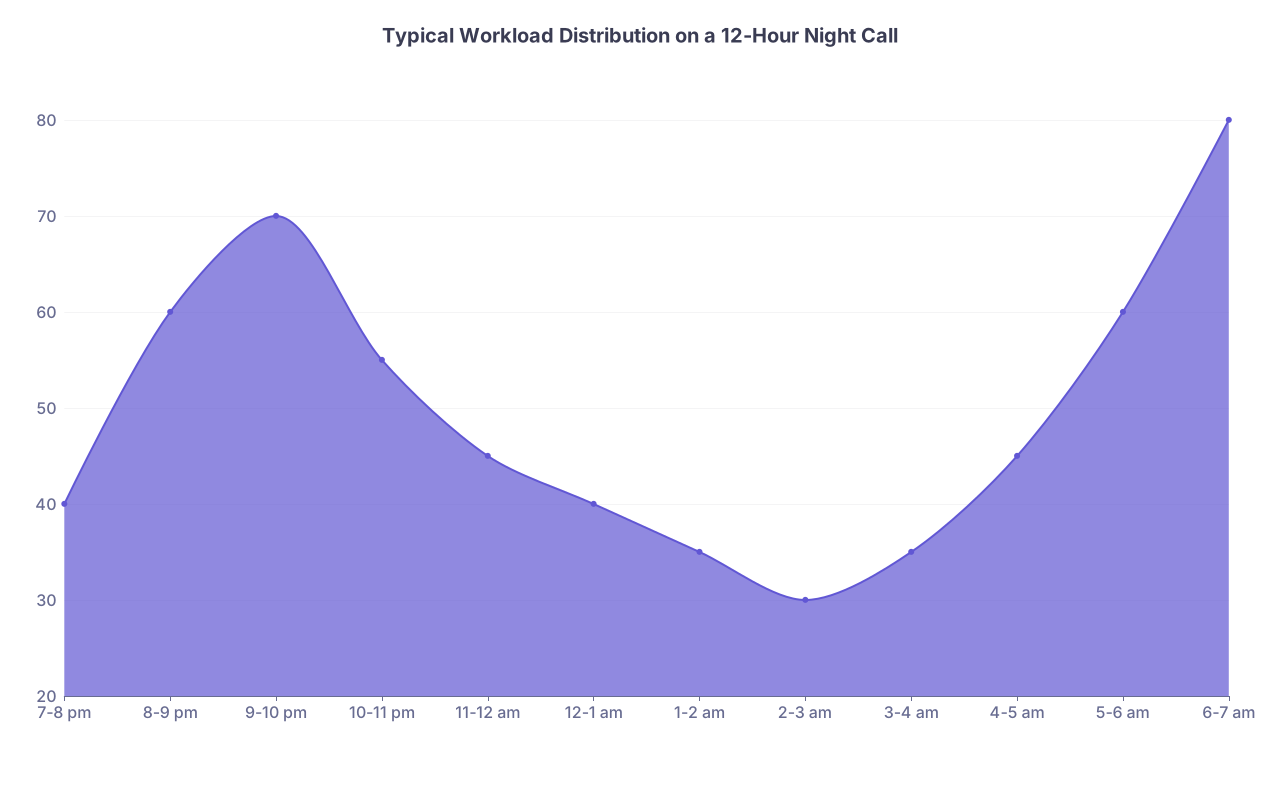
| Category | Value |
|---|---|
| 7-8 pm | 40 |
| 8-9 pm | 60 |
| 9-10 pm | 70 |
| 10-11 pm | 55 |
| 11-12 am | 45 |
| 12-1 am | 40 |
| 1-2 am | 35 |
| 2-3 am | 30 |
| 3-4 am | 35 |
| 4-5 am | 45 |
| 5-6 am | 60 |
| 6-7 am | 80 |
Hour 1: 7 p.m. – 8 p.m. | Sign‑Out and Triage Setup
This is the hour that makes or breaks the night. Do not treat it like casual chit‑chat.
7:00 – 7:20 | Receive sign‑out with intent
At this point you should:
- Demand structure from the day team:
- “Sickest patients first.”
- “Anyone you are worried about crashing?”
- For each patient, get a one‑liner and a night plan:
- “If pain uncontrolled → escalate to IV hydromorphone.”
- “If SBP < 90 → 500 mL LR bolus, recheck; call if still low.”
- Specifically ask:
- “Who is likely to call me?”
- “Any pending critical results or consults?”
Write these in your own words on your sign‑out sheet. The EMR is not enough at 3 a.m.
7:20 – 7:35 | Build your lists and flags
Right after sign‑out, before the pager goes nuclear:
- Separate your list into:
- “High risk” (recently unstable, new post‑ops, advanced age + multiple comorbidities).
- “Routine” (stable, low‑risk).
- Mark:
- Code status and limitations of care.
- Consultants involved (so you know who to bother at midnight).
7:35 – 8:00 | First proactive lap
If you are in‑house and allowed to leave the workstation:
- Walk by or briefly see:
- Any patient on your high‑risk list.
- Anyone the day team said “made me nervous.”
- Quick checks:
- Look at the patient. Not just the monitor.
- Ask the bedside nurse: “Anyone you are worried about for tonight?”
If you are covering a huge census, you will not see all of them. See the ones that are most likely to generate a 2 a.m. disaster page.
Hour 2: 8 p.m. – 9 p.m. | Admissions and Stabilization Block
The second hour is usually when the first wave of admissions and “early night” issues hit.
At this point you should:
- Decide your work queue every 15–20 minutes:
- New admit vs cross‑cover page vs documentation.
8:00 – 8:30 | First admit, first structure
For each new admit:
Chart first, then patient.
- Scan ED note, vitals trend, labs, imaging.
- Form a provisional differential before you walk in.
Focused H&P, not a novel.
- Get the key story, exam, and red flags.
- Do not over‑document chronic details you will never use tonight.
Orders while you remember.
- Admission orders in before moving to the next thing.
- Include:
- DVT prophylaxis.
- Diet.
- Code status.
- PRNs (pain, antiemetics, bowel regimen, sleep).
8:30 – 9:00 | Clean up and anticipate
Between pages and admits:
- Close loops on the first admit:
- Put in consults early; specialists also triage by time received.
- Check your high‑risk patients’ vitals and labs again:
- Anyone trending worse already?
- Do not let work pile into an amorphous blob. Finish tasks for Patient A before you start B, unless the pager forces you otherwise.
Hour 3: 9 p.m. – 10 p.m. | The “Everything at Once” Hour
By now, nurses are calling about:
- Pain control.
- Nausea/vomiting.
- “Patient cannot sleep.”
- Mild vitals abnormalities.
At this point you should:
9:00 – 9:30 | Batch low‑acuity pages
If three different nurses call you within five minutes:
- Ask: “Anything urgent or unstable right now?”
- Mentally separate:
- Must see in person (shortness of breath, chest pain, acute confusion, MAP tanking).
- Can handle by order / phone (bowel regimen, minor pain adjustments, melatonin).
Handle low‑acuity issues in batches:
- Open all those charts.
- Place similar orders together.
- Use order sets and pre‑built phrases ruthlessly.
9:30 – 10:00 | Second admit and safety scan
- If a second admit arrives, repeat the structure from Hour 2.
- Before the hour ends, quickly:
- Refresh vitals on high‑risk list.
- Check for new critical labs flagged by the EMR.
If you are not checking trends at least once this hour, you will eventually get burned by a slow, silent decompensation.
Hour 4: 10 p.m. – 11 p.m. | Calm the Floor, Then Yourself
This is often when the floor starts to quiet slightly. Not always. But often.
At this point you should:
10:00 – 10:30 | Proactive comfort and PRN pass
Scan your list for:
- Patients with:
- No PRN pain meds.
- No PRN antiemetics.
- No bowel regimen on opioids.
- No sleep aid in an anxious insomniac.
Adjust now:
- Add basic PRNs to likely offenders.
- Clarify parameters in orders:
- “Hold if SBP < 100 or RR < 12.”
- “Use non‑opioid first, then escalate.”
That 10 minutes of anticipatory ordering saves you 6 separate pages between midnight and 4 a.m.
10:30 – 11:00 | Quick recharge + documentation burst
- Eat a snack.
- Hydrate.
- Knock out:
- Remaining H&P documentation for earlier admits.
- Any brief cross‑cover notes for significant overnight events.
Rule: do not let notes slip past midnight if you can avoid it. Your brain will be worse later. Not better.
Hour 5: 11 p.m. – 12 a.m. | Pre‑Midnight Stability Check
Midnight is a psychological threshold. Use the hour before it to tighten things up.
At this point you should:
11:00 – 11:30 | Systematic vitals and labs review
Do a structured check:
- Filter vitals:
- SBP < 100 or > 180.
- HR > 110.
- RR > 24.
- O2 sat < 92% (unless COPD baseline).
- For each outlier:
- Look at the trend. Single spike vs sustained.
- Check last exam and nursing notes.
Then labs:
- Focus on:
- Potassium, sodium, creatinine, lactate.
- Hemoglobin drop.
- New troponin, D‑dimer, or imaging results.
Decide now:
- Who needs repeat labs at 2–4 a.m.
- Who needs you at the bedside before you let the night deepen.
11:30 – 12:00 | Mini‑lap and nurse check‑ins
If physically possible, walk past:
- Anyone with:
- Borderline pressures.
- Rising oxygen requirement.
- Active infections / sepsis under treatment.
- Ask each bedside nurse:
- “Anyone on your assignment you are worried about tonight?”
Nurses will often know who is going to crash before the vitals do. Listen.
Hour 6: 12 a.m. – 1 a.m. | The Midnight Wave
This is when:
- Labs drawn at 22:00 come back ugly.
- Patients who “could not sleep” become agitated.
- ED starts pushing to move admits before they hit 8‑hour metrics.
At this point you should:
12:00 – 12:30 | Handle critical data decisively
Critical lab calls you:
- K = 2.8, or 6.1.
- Hgb dropped from 10 to 7.2.
- Lactate 4.5.
Your sequence:
- Pull up chart immediately.
- Verify trend and context.
- Call nurse:
- Check current vitals.
- Is the patient symptomatic?
- Put in clear orders:
- Electrolyte replacement with repeat level time.
- Transfusion thresholds and parameters.
- Additional imaging if needed.
Document the key events with a brief note. If someone decompensates at 3 a.m., you want a timestamped trail of your reasoning.
12:30 – 1:00 | Admit or be admitted by chaos
If you get another new admit:
- Same structured approach: chart → focused H&P → orders → brief note.
- Resist the urge to do a full 45‑minute textbook history. Protect your bandwidth.
If you are momentarily quiet:
- Take 10 minutes: stretch, deep breaths, brief mental reset.
- Then look ahead to 4–6 a.m. labs and orders you might pre‑empt.
Hour 7: 1 a.m. – 2 a.m. | Deep‑Night Maintenance
This is usually the lowest‑energy hour. Your job is not to drift.
At this point you should:
1:00 – 1:30 | Batch “routine” cross‑cover care
You will get pages like:
- “Patient wants something stronger for pain.”
- “No bowel movement in 3 days.”
- “Blood pressure 160/90, asymptomatic.”
Handle them systematically:
- For pain:
- Confirm PRNs tried and timing.
- Avoid stacking sedatives and opioids blindly.
- For constipation:
- Add or escalate bowel regimen.
- Avoid ordering 3 different laxatives at the same time.
Write small cross‑cover notes only if:
- You change something major.
- There is a potential medico‑legal hook (blood pressure, anticoagulation, new chest pain, etc.).
1:30 – 2:00 | Micro‑rest if allowed
If:
- All high‑risk patients are checked.
- No pending critical labs.
- No active ED admits.
Then:
- Sit in a quiet room.
- Silence nonessential notifications (but not critical alerts).
- Set a 15–20 minute timer if your program allows micro‑naps.
If micro‑sleep is not possible, at least get off your feet, hydrate, and break from screens for a few minutes.
Hour 8: 2 a.m. – 3 a.m. | The Danger Zone for Missed Decompensation
This is when residents get sloppy. Fatigue is real. So you need structure even more.
At this point you should:
2:00 – 2:30 | Structured decompensation sweep
Run a quick, non‑negotiable algorithm:
- Sort your patient list by:
- Last set of vitals.
- Highest MEWS/NEWS/early warning score, if your EMR has it.
- For each flagged patient:
- Check last 6–12 hours of vitals.
- Check fluid balance and oxygen needs.
- Read the last nursing note.
If anything makes you uneasy:
- Go see the patient.
- Do a focused exam.
- Decide: can they stay on the floor or do they need escalation?
Document short notes for near‑rapid‑response situations. They protect you and clarify the picture for the day team.
2:30 – 3:00 | Repair work and catch‑up
Use this time to:
- Fix incomplete tasks:
- Unsigned orders.
- Incomplete notes.
- Consult requests not yet acknowledged (if you need to escalate, this is when you ping again).
- Tighten orders for the morning:
- Standing labs vs unnecessary daily labs you can stop.
- Med timing that is ridiculous (warfarin due at 03:00? Move it).
You are quietly reducing friction for your 5–7 a.m. self.

Hour 9: 3 a.m. – 4 a.m. | The Second Wave of Trouble
If something bad is going to happen out of the blue, a lot of it happens here. Patients are at their most delirious, hypoxic, and hypotensive.
At this point you should:
3:00 – 3:30 | Delirium, agitation, and reality checks
Common pages:
- “Patient trying to climb out of bed.”
- “Pulling at lines and tubing.”
- “Acute confusion.”
Do not just throw haloperidol at everything.
Sequence:
- See the patient if possible.
- Check:
- Vitals.
- O2 sat.
- Glucose.
- Ask the nurse:
- “Any changes in meds? Any missed doses? New pain?”
Adjust:
- Treat pain if present.
- Fix hypoxia, infection, metabolic issues.
- Use medications for agitation only with clear parameters and monitoring.
3:30 – 4:00 | Another micro‑reset and safety check
If things are stable:
- Short break, stretch, water.
- Then quick EMR scan:
- New imaging read backs.
- New lab results.
- Orders that got held, missed, or refused.
Your goal is to prevent a 5 a.m. fire drill.
Hour 10: 4 a.m. – 5 a.m. | The Pre‑Dawn Prep Hour
Now the night pivots from survival to handoff preparation.
At this point you should:
4:00 – 4:30 | Morning labs and orders alignment
Labs drawn around 4 a.m. will start to post.
- When a concerning result hits:
- Same drill: trend → talk to nurse → treat → document.
- For borderline results:
- Decide: address now vs leave clear guidance for day team.
Also:
- Clean up silly med times (fix Q6h meds so they do not hit at 5 a.m. and 11 a.m. if that makes no clinical sense).
- Stop unnecessary NPOs if appropriate.
4:30 – 5:00 | Build your handoff skeleton
Open your sign‑out doc or tool:
- For every patient with overnight events:
- One‑line update.
- What you did.
- What you are still worried about.
For new admits:
- Make sure:
- Final med reconciliation is at least roughly correct.
- There is a clear assessment and plan by problem.
You are writing the story the day team will inherit. Do it while you still remember it.
Hour 11: 5 a.m. – 6 a.m. | Transition to Daylight
This hour is deceptive. The hospital wakes up and you are running on fumes.
At this point you should:
5:00 – 5:30 | Final patient‑facing tasks
- See:
- Any patient who got significantly worse overnight.
- Any new admit you did not physically lay eyes on yet (if that is expected on your service).
- Repeat focused exams if:
- You escalated oxygen.
- You started pressors or significant IV fluids.
- You had a near‑rapid‑response situation.
If you think someone might need ICU transfer, start that process now. Do not dump it on the day team at 7:02 a.m. with no warning.
5:30 – 6:00 | Lock in your documentation
You should be:
- Closing:
- All H&Ps for the night’s admits.
- Brief event notes for decompensations, major med changes, or code status discussions.
- Verifying:
- Pending consults have been placed.
- Key orders are active and not accidentally discontinued.
This is not perfection time; it is safety and clarity time.
| Phase | Main Focus |
|---|---|
| 7-10 p.m. | Sign-out, early admits, triage |
| 10 p.m.-1 a.m. | Comfort orders, labs, stabilization |
| 1-4 a.m. | Decompensation sweeps, delirium |
| 4-7 a.m. | Labs, ICU decisions, handoff prep |
Hour 12: 6 a.m. – 7 a.m. | Handoff Like a Professional
This is where many residents blow it. They survive the night and then give a lazy, chaotic sign‑out. Do not be that person.
At this point you should:
6:00 – 6:30 | Final review and prioritization
- Do one last:
- Vitals scan.
- Check for new critical labs.
- Review of any pending imaging reads.
Flag 3 categories of patients for the day team:
- Actively unstable / high risk
- Likely to need decisions or procedures today
- Stable but with key follow‑ups (cultures, imaging, therapy changes)
Write them clearly at the top of your sign‑out.
6:30 – 7:00 | Deliver concise, actionable sign‑out
During handoff:
- Start with:
- “Sickest patients and any near‑rapid‑response events.”
- Use a tight pattern for each important patient:
- “Mr. X, 76, septic shock from pneumonia. Overnight: norepinephrine started via peripheral, now on 0.08. Lactate down from 4.5 to 2.9. Still febrile, on cefepime + azithromycin. Need: formal central line + consider ICU transfer if pressors escalate.”
For less critical patients:
- “No events” truly means no events. Do not waste time.
After sign‑out:
- Make sure:
- Pager is transferred.
- Any last‑minute critical information is explicitly spoken, not just typed.
Then you walk away. Not lingering. You did your part.
Your Next Step
Print a one‑page version of this timeline or write your own condensed version. Before your next 12‑hour call, sit down 15 minutes early and sketch out your hour‑by‑hour plan on a notepad, using these headings: 7–8, 8–9, 9–10, … 6–7. Then, on call, actually follow it for one night and see what breaks. Adjust. That is how you turn chaos into a predictable, survivable workflow.