
It’s 6:00 p.m. the day before your very first call shift. Your phone just buzzed with tomorrow’s schedule reminder: “Call: 6 p.m.–7 a.m.”
You’ve heard the horror stories. Cross-cover pages every 3 minutes. Admission marathons. The “can you just” consult at 3:45 a.m. You’ve also seen the zombies leaving call, clutching coffee and mumbling “It wasn’t that bad” with thousand-yard stares.
Here’s the reality: the first 24 hours before that initial call will either set you up for controlled chaos… or make you the person sprinting between codes with a dead pager and no password to the EMR.
I’m going to walk you through those 24 hours chronologically. At each point: what you should be doing, checking, packing, and mentally rehearsing.
24–18 Hours Before Call: Big Picture Setup (Previous Evening)
At this point you should stop pretending tomorrow is “just another day.” It’s not. You’re about to be the doctor other humans page when something goes wrong.
Goal for this block: Confirm logistics, gather intel, and make sure the system recognizes you as a functional human (ID, passwords, access).
1. Confirm the boring but critical logistics
Between 6–8 p.m. the night before, you should:
Check your schedule:
- Exact start and end time of call (don’t guess).
- Type of call: in-house vs home call; ward vs ICU vs ED vs night float cross-cover.
- Which attending and senior resident you’re with.
Confirm where you physically need to be:
- Sign-out location (e.g., “6 p.m. in 7W conference room”).
- Where you’ll sleep if in-house (call room number, how to get key or code).
- Where to park overnight and whether your badge opens the night entrance.
Check access:
- Test your ID badge on main doors if you’re already at the hospital.
- Make sure you can log into the EMR, ordering system, and paging system.
- Verify your on-call pager number and that it’s actually assigned to you.
If any of this is unclear, you email/text now. Not at 5:55 p.m. tomorrow when sign-out has already started.
18–14 Hours Before Call: Intel Gathering & Mental Map
Assume it’s now around 10 p.m. the night before. You shouldn’t be deep-diving patient charts yet. But you do need a basic mental model of how the night will run.
Goal: Know the structure, expectations, and where to find help.
2. Clarify your role and expectations
At this point you should message or briefly talk with:
- The senior resident you’ll be on call with.
- Or, if there’s no senior, the chief or recent intern who just did that call.
Ask them specific questions, not vague “Any tips?” nonsense. For example:
- “How are admissions divided between teams overnight?”
- “Who handles cross-cover pages after midnight—you or me or both?”
- “Do we write full H&Ps overnight or focused admits with sign-out to days?”
- “What’s the etiquette for calling you overnight—everything, or only sick patients?”
- “How does sign-out usually run? Any attendings who are particular about format?”
You’re trying to build a skeleton of the night:
- When you arrive.
- How sign-out flows.
- How admissions are assigned.
- What to wake people up for.
- When you can realistically eat and maybe close your eyes.
Take notes. Do not trust your stressed brain to remember this tomorrow.
14–12 Hours Before Call: Tools & Templates
It’s probably around midnight if you’re reading this linearly. You should not be awake then before a 14-hour call, but if you are, stay efficient.
Goal: Set up your physical and digital tools so you’re not inventing systems at 2 a.m.
3. Build your “night toolkit”
You want a small, tight set of tools—a go-bag for your brain.
At this point you should have ready:
Printed or saved sign-out templates, for example:
- A simple one-page sheet with:
- Patient name / MRN / room.
- Problem list.
- Overnight “if/then” plans (e.g., “If BP < 90, give 500 cc LR and recheck.”).
- A simple one-page sheet with:
Note templates in the EMR (or at least text snippets):
- Admission H&P skeleton.
- Brief cross-cover note (“Called for X, found Y, did Z, plan A-B-C…”).
Cheat sheets:
- Common order sets (DVT prophylaxis, insulin sliding scale, pain control).
- “What to do when…” quick scripts:
- “SBP 80s”
- “K = 6.0”
- “Chest pain on the floor”
- “Blood cultures positive at 3 a.m.”
Reference apps loaded and logged in:
- Epocrates / UpToDate mobile / MDCalc / local antibiogram.
- Hospital-specific guidelines PDF (sepsis bundle, insulin protocols, etc.)
You shouldn’t be designing your first H&P template while a nurse is paging you about a crashing patient.
12–10 Hours Before Call: Sleep Prep Window (Early Night)
This is where most interns screw up. They stay up anxious, scroll, read about rare arrhythmias, and then roll into call already exhausted.
Goal: Protect sleep like it’s a medication order for yourself.
4. Lock in your sleep plan
Assume your call starts at 6 p.m. tomorrow.
At this point (the night before) you should:
Decide: Are you going to sleep in two blocks or just one big one?
- Reasonable plan:
- Normal sleep tonight (e.g., 11 p.m.–6 a.m.).
- Then a nap day-of (more on that later).
- Reasonable plan:
Set hard cutoffs:
- Stop screens 30–45 minutes before bed.
- No caffeine within 6–8 hours of planned sleep.
- Keep light low and environment quiet.
If you’re anxious:
- Lay out a small notepad by your bed. When your brain says “What about X on call?” you write it down and promise your brain you’ll look at it tomorrow. This sounds trivial. It works.
You want to enter call night with at least one normal night’s sleep under your belt. Showing up already depleted is how you miss subtle but important things.
10–8 Hours Before Call: Morning-of – Baseline Reset
Now it’s the morning of your call day. Say it’s 7 a.m. Your shift starts at 6 p.m. That’s a long runway. Use it intelligently.
Goal: Set your body and brain at a calm baseline—not wired, not sedated.
5. Morning reset and light review
At this point you should:
- Wake at a normal time (6–8 a.m.), not noon. You’ll get a nap later.
- Eat a normal breakfast with protein and complex carbs:
- Eggs and toast, yogurt and granola, whatever your version is.
- Light movement:
- 20–30 minutes walk, short workout, stretch. Not a marathon. You want blood flowing, not total fatigue.
Do not spend your entire morning obsessively reading ICU management if you’re on general medicine call. Targeted review only.
Pick 3–4 topics that are high-yield for your call type:
- Ward call (medicine/surgery/peds):
- Chest pain.
- Shortness of breath.
- Hypotension.
- Fever/possible sepsis.
- ICU call:
- Ventilator basics.
- Pressor names/doses.
- Sedation and delirium.
- ED call:
- Chest pain workup.
- Abdominal pain DDx.
- Stroke alert protocol.
Spend 30–60 minutes max. That’s it.
8–6 Hours Before Call: Admin & Environment Setup
Late morning to early afternoon now. Around 10 a.m.–12 p.m.
Goal: Clear your personal and administrative decks so the night doesn’t implode your life.
6. Clear life clutter
At this point you should:
Handle non-negotiables:
- Pay any bills due today or tomorrow.
- Answer urgent family messages (“I’m on call tonight, may be slow to reply.”).
- Reschedule anything early the next morning that you will not realistically be human for.
Prep your post-call plan:
- Transport home: Are you driving home? Public transit? Getting picked up?
- Food for after: Something you can microwave or grab without effort.
- Decide your post-call sleep strategy:
- 2–4 hour nap, then awake, then normal bedtime.
- Or, if you know your system: straight through until mid-afternoon with hard wake-up alarm.
You don’t want to be on the phone at 5:30 p.m. moving an appointment or explaining to someone why you can’t be at brunch.
6–4 Hours Before Call: Nap & Caffeine Strategy
This is early afternoon now. Around 12–2 p.m. Your call starts at 6 p.m. This window is where you create your “second day” of energy.
Goal: Bank rest and time your caffeine so you’re sharp at midnight, not crashing.
7. Execute the nap plan
At this point you should:
Nap sometime between 1–4 p.m. (adjust based on your start time):
- Duration: 60–90 minutes.
- Dark room, white noise if needed.
- Phone on Do Not Disturb except for true emergencies.
Manage caffeine:
- If you drink coffee, have your last full dose no later than 3–4 p.m.
- Keep a smaller dose (half cup, tea, or a small energy drink) for around 9–10 p.m. during call, not now.
- Do not pre-game with 3 energy drinks “just in case.” I’ve watched that crash. It’s ugly.
The nap is non-negotiable if you can possibly pull it off. Treat it like a mandatory pre-op order.
4–3 Hours Before Call: Pack and Gear Up
It’s now about 2–3 p.m. Call at 6 p.m. This is your packing and gear window.
Goal: Build your call bag so you don’t need to leave the floor for basic survival.
8. Pack your call bag
At this point you should lay everything out on a bed or table and check it against a list.
| Category | Items to Pack |
|---|---|
| Identification | Hospital ID, driver’s license |
| Tools | Stethoscope, penlight, pens, notepad |
| Tech | Phone charger, portable battery, pager |
| Food | Snacks, simple meal, water bottle |
| Comfort | Extra socks, light jacket, lip balm |
| Hygiene | Toothbrush, toothpaste, deodorant |
More concretely, what should be in there:
Absolute essentials:
- Hospital ID badge.
- Stethoscope.
- Pens (plural) + a Sharpie.
- Small notebook or folded sign-out sheets.
- On-call pager (with fresh batteries if applicable).
- Phone + charger + ideally a portable battery pack.
Food and hydration:
- 1–2 real meals that survive room temp:
- Leftovers, sandwich, microwavable bowl, etc.
- Multiple snacks:
- Nuts, granola bar, string cheese, fruit.
- Large refillable water bottle.
- 1–2 real meals that survive room temp:
Comfort items:
- Extra pair of socks.
- Light fleece or jacket (hospitals are cold at 3 a.m.).
- Lip balm, hand lotion (you will wash your hands 50 times).
- Earplugs + eye mask if you have any chance to sleep.
Hygiene:
- Toothbrush + small toothpaste.
- Deodorant.
- Contact lens stuff / glasses if needed.
You’re trying to avoid the “I’m starving at 2 a.m. and the cafeteria closed at 8” problem. This happens constantly. Do not be that person.
3–2 Hours Before Call: Clinical Context & Sign-out Prep
Now it’s ~3–4 p.m. You’re getting close. This is when you shift from generic prep to this specific call.
Goal: Know the landscape of patients you’re inheriting.
9. Pull the list and scan for landmines
At this point you should:
Print or pull up:
- The current census for the teams you’ll cover.
- Any active consult lists you might be responsible for overnight.
Quickly scan for:
- Patients in higher-acuity areas (step-down/tele).
- Anyone with:
- Recent rapid response or code.
- Borderline vitals.
- New oxygen requirement.
- Fresh post-op status.
- Pending critical labs or imaging expected to result overnight.
You’re not pre-rounding. You’re trying to identify which patients are going to page you at 1:37 a.m.
Make a short “watch list” on your sign-out sheet:
- “Mr. X – GI bleed yest., hgb stable but watch for melena/BP.”
- “Ms. Y – HF, Lasix increased, risk hypotension/electrolytes.”
- “Mr. Z – new AFib w/ RVR, rate okay now, but watch.”
This gives structure to your mental bandwidth when the pager explodes.
2–1 Hour Before Call: Arrive Early, Own Your Space
If your call starts at 6 p.m., you should be physically in the hospital by 5–5:15 p.m.
Goal: Be settled before sign-out, not running in flustered at 5:59.
10. Early arrival checklist
At this point you should:
Go to your call room:
- Find it.
- Make sure your badge/keys work.
- Drop your bag, plug in chargers, put snacks in a visible spot.
- Set out your toothbrush, extra clothes if you brought them.
Check workstations:
- Identify 1–2 computers you can use (ideally near your primary floors).
- Log into EMR and paging system to make sure credentials work before pages start.
Confirm with your senior:
- Where exactly sign-out will happen.
- Expected structure (“We go team by team” vs “one big group”).
- Any known hot issues tonight (“Two unstable GI bleeds just came up”).
This is also the moment to physically locate:
- Nearest bathroom.
- Nearest snack/food option if you somehow forgot food.
- Code cart location for at least your main floor.
1 Hour to 15 Minutes Before Call: Final Mental Setup
It’s 5–5:45 p.m. This is where your mindset can either settle or spiral.
Goal: Enter sign-out calm, oriented, and ready to write fast.
11. Prep for sign-out like it’s your pre-game huddle
At this point you should:
Set up your sign-out workspace:
- Open EMR to patient census.
- Have your sign-out sheets in front of you.
- Pen in hand, pager on vibrate but visible.
Decide on your note-taking strategy:
- Some people circle “sick” patients.
- Some star tasks that must be done before midnight.
- Some create a left-hand column for “to-do tonight.”
During sign-out itself (yes, still prep, because this is your first call):
- For each patient, insist on:
- One-liner (who is this, why in hospital).
- Current status (stable/unstable).
- Concrete “if/then” overnight plans.
- Ask clarifying questions in the moment:
- “If her BP drops below what number do you want me to do something?”
- “If the troponin comes back slightly elevated, do I call you or just trend?”
You’ll feel annoying. You’re not. You’re being safe.
First 15 Minutes of Call: Transition to Ownership
Now sign-out is done. The day team is leaving. The pager is officially yours.
Goal: Transition from “receiving information” to “I’m the doctor on call.”
12. Immediate post sign-out actions
At this point (first 15–30 minutes) you should:
- Review your to-do list and:
- Star anything with a timeline (e.g., “Recheck BMP at 10 p.m.”).
- Number the first 3 things you’ll do right now.
- Check pagers/notifications:
- Clear any “low” urgency pages you can handle quickly (Tylenol for pain, nausea meds) to show you’re responsive and to declutter.
- Touch base with your senior:
- “I’m going to go see Mr. X first because of Y, then handle Z labs.”
- Confirm they’re okay with that plan.
If your hospital allows, this is a good time for a quick 5-minute walk through one or two rooms of your “sickest” patients, just to see them with your own eyes before something happens.
You’ll feel like you should constantly be doing something. That’s fine. Just make sure it’s the right something, in the right order. This final 15-minute shift from prep to ownership is where that happens.
Visual: The 24-Hour Pre-Call Timeline
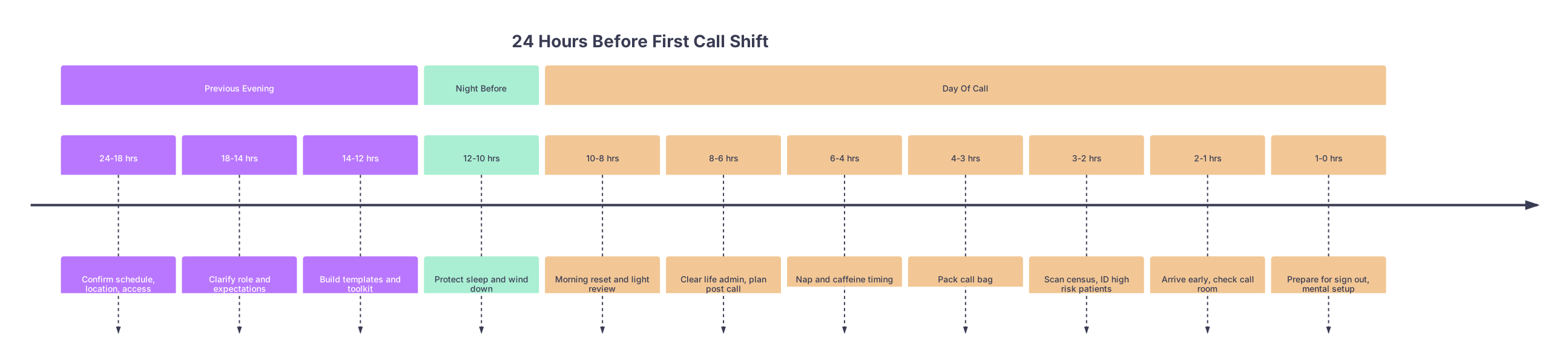
| Period | Event |
|---|---|
| Previous Evening - 24-18 hrs | Confirm schedule, location, access |
| Previous Evening - 18-14 hrs | Clarify role and expectations |
| Previous Evening - 14-12 hrs | Build templates and toolkit |
| Night Before - 12-10 hrs | Protect sleep and wind down |
| Day Of Call - 10-8 hrs | Morning reset and light review |
| Day Of Call - 8-6 hrs | Clear life admin, plan post call |
| Day Of Call - 6-4 hrs | Nap and caffeine timing |
| Day Of Call - 4-3 hrs | Pack call bag |
| Day Of Call - 3-2 hrs | Scan census, ID high risk patients |
| Day Of Call - 2-1 hrs | Arrive early, check call room |
| Day Of Call - 1-0 hrs | Prepare for sign out, mental setup |
Energy and Focus Curve: Plan, Don’t Hope
Your brain won’t function the same at all hours. You want to time things around that.
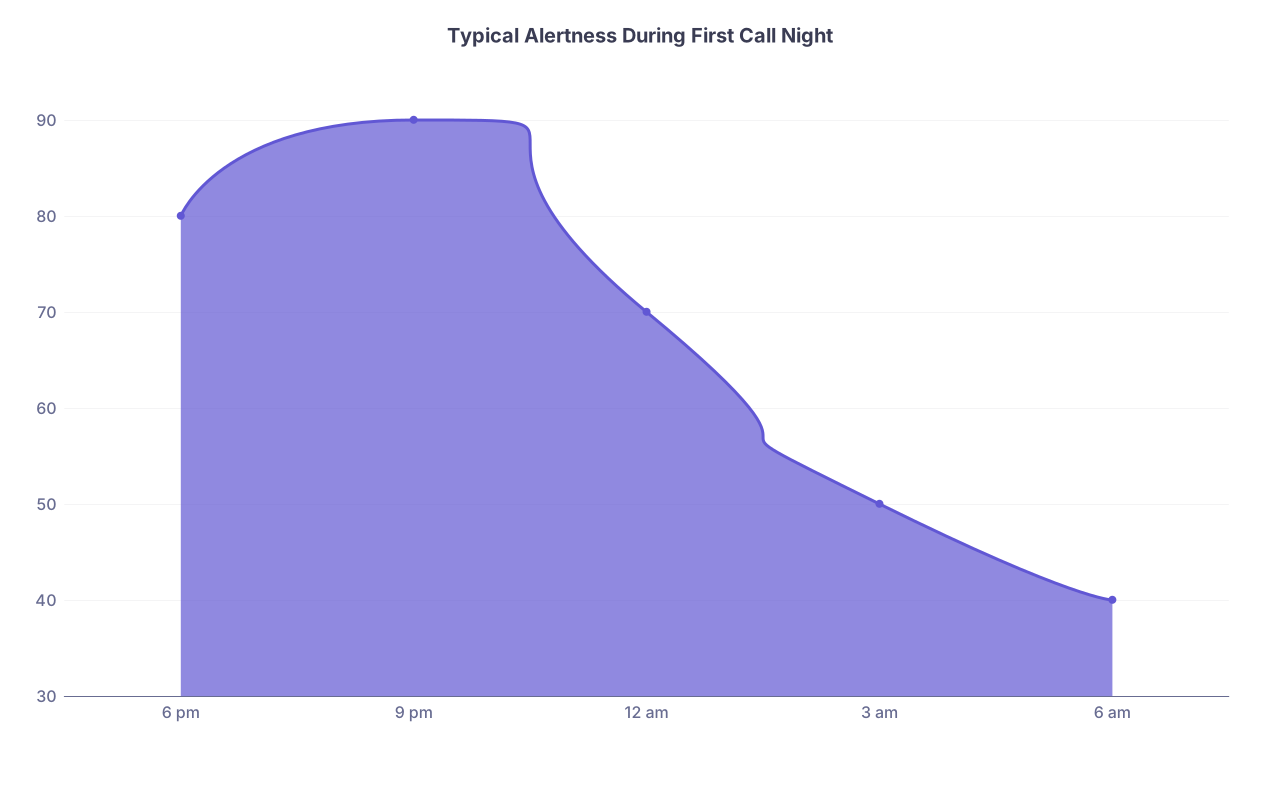
| Category | Value |
|---|---|
| 6 pm | 80 |
| 9 pm | 90 |
| 12 am | 70 |
| 3 am | 50 |
| 6 am | 40 |
Roughly:
- 6–9 p.m.: You’re relatively fresh. Good time for new admits and heavier thinking tasks.
- 9 p.m.–12 a.m.: Still decent. Clear tasks, reassess sick patients.
- 12–3 a.m.: Cognitive slowdown. Minimize unnecessary deep-dives; stick to structured approaches.
- 3–6 a.m.: Worst window. This is why earlier prep and clear “if/then” plans matter.
Knowing this cycle helps you front-load complex work and preserve safety when you’re tired.
Final 5-Minute Pre-Call Reset
Right before sign-out starts, take 60–90 seconds alone if you can.
At this point you should:
- Take 3 slow breaths.
- Mentally run through your rules:
- When in doubt, examine the patient.
- Vital signs are real data. Respect them.
- Call for help early, not late.
Then step into sign-out like you belong there—because after all this prep, you actually do.
Key Takeaways
- The first 24 hours before your initial call shift are not “extra time”—they’re when you build the systems that will keep patients safe and keep you from falling apart at 3 a.m.
- Front-load logistics, tools, and sleep; then use the last 3 hours for targeted clinical prep, early arrival, and a structured sign-out.
- Go in with a clear hierarchy in your head: see the patient, trust vital signs, and never hesitate to call for help.