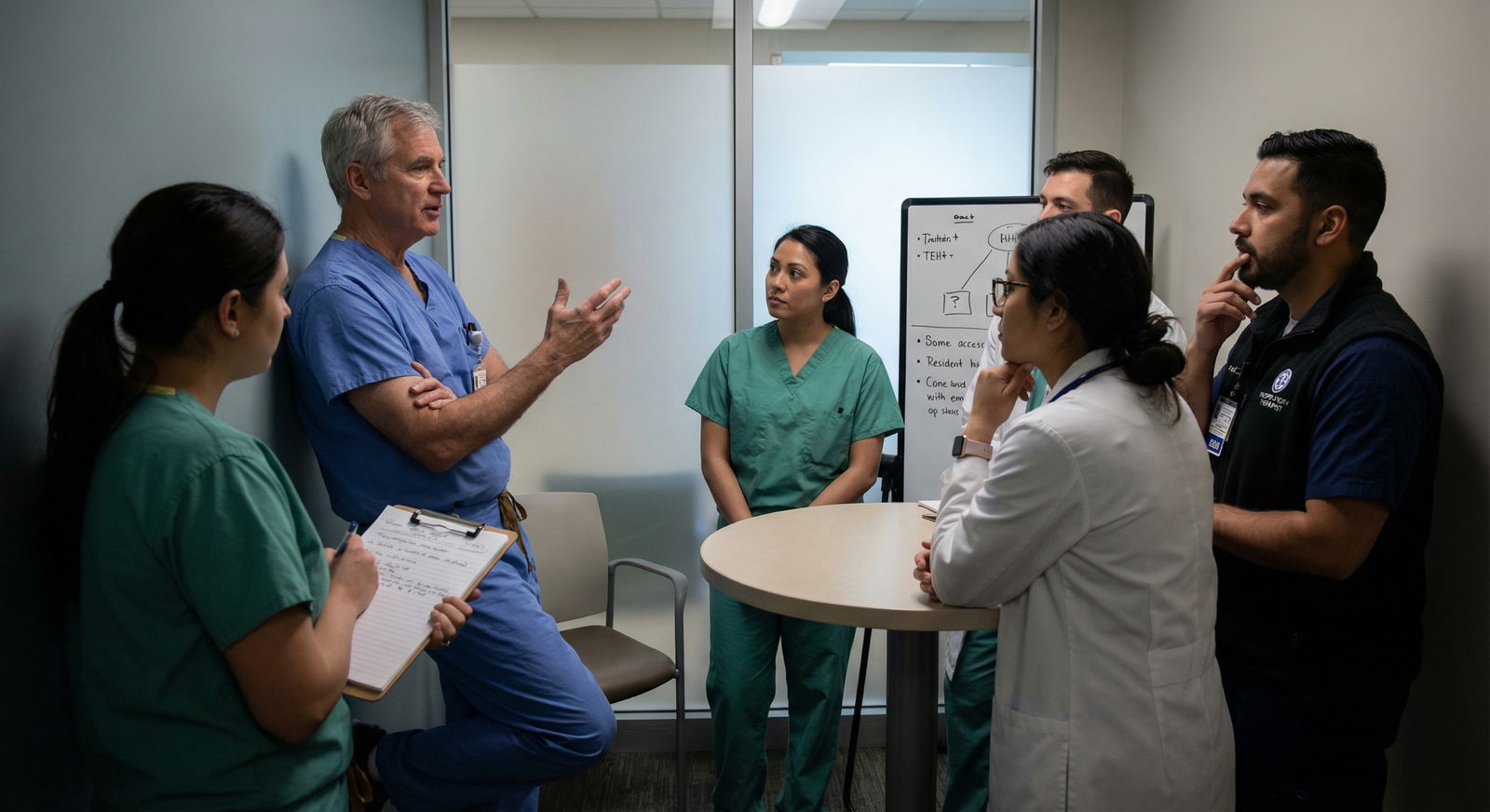
It is 2:37 a.m. You are a PGY‑1 on night float. Your pager just exploded with:
- A rapid response overhead page
- A nurse asking for pain meds
- The ED calling about an admission
- Your senior telling you, “Go see the rapid, I will take the admit”
Fast forward two years. Same time of night as a PGY‑3. This time you are the one saying, “I will take the unstable patient, you grab the ED admit and call me after you see them.”
This is the shift. PGY‑1 to PGY‑3 is a steady transfer of responsibility from “doer” to “decider.” Your on‑call life is where that transformation is most obvious.
Let me walk you through, chronologically, how your role changes year by year—and roughly month by month—so you know what should be on your radar at each point.
Big Picture: How On‑Call Changes From PGY‑1 to PGY‑3
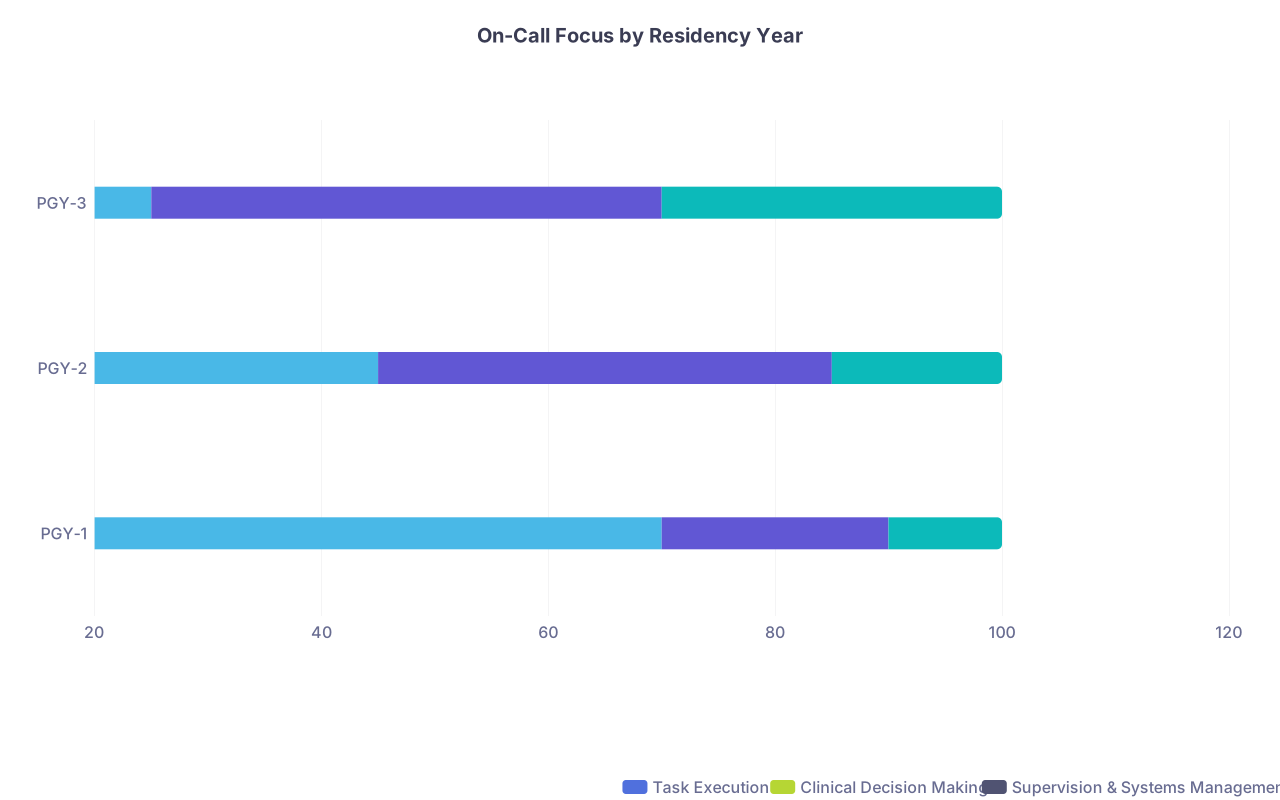
| Category | Task Execution | Clinical Decision Making | Supervision & Systems Management |
|---|---|---|---|
| PGY-1 | 70 | 20 | 10 |
| PGY-2 | 45 | 40 | 15 |
| PGY-3 | 25 | 45 | 30 |
Quick frame of reference:
- PGY‑1: Micro-level. You respond, you write notes, you place orders, you call consults.
- PGY‑2: Meso-level. You prioritize, you anticipate, you start running the list and backing up juniors.
- PGY‑3: Macro-level. You run the whole service overnight, triage, supervise, and make the hard calls.
Think of each year as a different job, not just a different pay grade.
PGY‑1: Survival, Reps, and Learning the System
You start here: overwhelmed, slow, and constantly behind.
Months 1–3: The “I Have No Idea What I’m Doing” Phase
At this point you should:
- Learn the pager and escalation norms of your program
- Memorize the “who to call” tree (ICU, ED, hospitalist, surgery, OB, etc.)
- Accept that everything will take you 3 times longer than it will in 6 months
Your on‑call nights are mostly:
- Cross‑cover pages: low urine output, pain control, fever, “patient looks pale”
- Very basic triage: sick vs not sick
- Presenting to your senior: “I saw Mr. Smith in 524B for shortness of breath…”
Your primary responsibilities:
Show up physically to the bedside.
Don’t manage anything remotely that makes you uneasy. You need the exam time.Communicate upward—constantly.
If you are not sure what to do, your senior should know you are unsure. No shame.Build basic call habits:
- Always have: stethoscope, pen, small notepad, alcohol wipes, brain sheet
- Write vital signs and trends by hand before you call anyone
- Check last notes and key labs before you respond (unless it is a code / rapid)
Night‑by‑night, you are building a mental library: “I have seen this before.”
Months 4–6: Getting Faster and Less Afraid
Somewhere in this window, you stop feeling like a hazard. You are still green, but you can at least keep your head above water.
At this point you should:
- Handle straightforward pages without calling the senior every time
- Recognize true emergencies within 10–20 seconds of stepping in the room
- Have a simple structure when you call your senior:
“This is 1) who, 2) the problem, 3) what I think, 4) what I have done.”
You will notice:
- Nurses start trusting you a bit more: “Can you look at 612 first, they’re not right.”
- ED attendings stop talking over you quite as much during sign‑out.
- You can staff 2–3 issues in one phone call to your senior instead of one at a time.
Core PGY‑1 on‑call skills:
- Pattern recognition: “Fever + hypotension + recent surgery = bad. Move.”
- Call rhythm: Rapidly: chart review → bedside exam → orders → update senior.
- Knowing what is NOT your job yet: Arguing bed placement, refusing admissions, “negotiating” consults. That is senior work. Watch how they do it.
Months 7–12: The Reliable Workhorse
Late PGY‑1, you are the person running around the hospital, doing the physical work of medicine.
At this point you should be able to:
- Independently handle most cross‑cover issues (electrolytes, pain, HTN, AFib RVR)
- Present clear plans that your senior mostly agrees with
- Maintain a running list of active issues on your patients overnight
Your on‑call job now is:
- Volume: 30–60 pages in a night. You are the shock absorber for the service.
- Execution: Orders, notes, consents, calls to families, updates to the day team.
- Early leadership: Informally backing up an even newer intern on busy nights.
This is where you start to see the gap between a merely “hardworking” intern and a good one. The good PGY‑1:
- Anticipates: checks critical labs before nurses call about them
- Pre‑writes: admission orders while listening to sign‑out
- Clarifies: makes sure the day team did not leave vague “if X, then Y” plans
The Transition: End of PGY‑1 to Early PGY‑2
You flip from follower to partial leader.
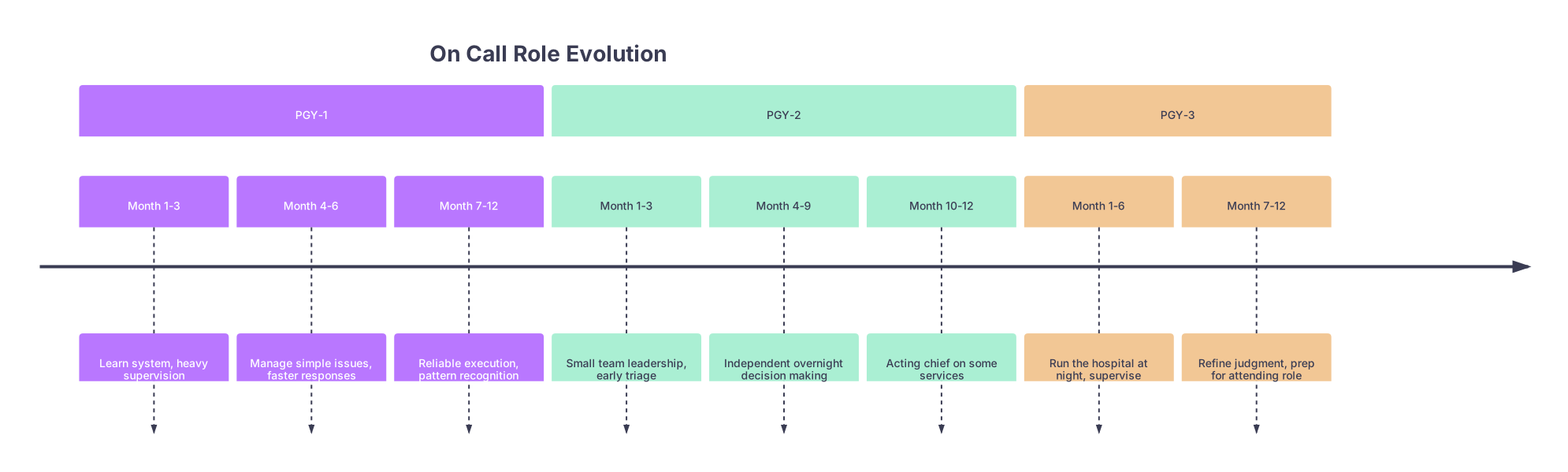
| Period | Event |
|---|---|
| PGY-1 - Month 1-3 | Learn system, heavy supervision |
| PGY-1 - Month 4-6 | Manage simple issues, faster responses |
| PGY-1 - Month 7-12 | Reliable execution, pattern recognition |
| PGY-2 - Month 1-3 | Small team leadership, early triage |
| PGY-2 - Month 4-9 | Independent overnight decision making |
| PGY-2 - Month 10-12 | Acting chief on some services |
| PGY-3 - Month 1-6 | Run the hospital at night, supervise |
| PGY-3 - Month 7-12 | Refine judgment, prep for attending role |
The last 2–3 months of PGY‑1 and the first few of PGY‑2 are awkward. You still feel like a junior, but suddenly people expect decisions from you.
At this point you should:
- Start asking seniors and attendings why they choose one path over another
- Listen carefully to how they phrase things to consultants and ED attendings
- Pay attention to how they triage: who they see first, what they defer, what they ignore
This is the mental scaffolding you will lean on when you are the one in charge at 3:00 a.m.
PGY‑2: From Workhorse to Field General
PGY‑2 is where your on‑call role explodes in complexity.
On many services and at many programs, PGY‑2 is the first year:
- You are the senior on call for a subset of the hospital
- You staff PGY‑1 calls, not the other way around
- You start getting direct calls from ED attendings, ICU, and consultants
Months 1–3: Training Wheels Senior
You are now:
- Taking sign‑out on the whole night team list
- Assigning tasks to juniors (“You grab 732, I will see the GI bleeder”)
- Seeing admissions first, then staffing with the attending the next morning
At this point you should:
- Develop a personal triage system: who to see now, who can wait 30–60 minutes
- Learn to say, “I will call you back in 5 minutes,” then actually do it
- Start making provisional plans before calling your attending:
“This is Ms. X, new chest pain, I think we should rule out ACS and admit to telemetry.”
Your nights will feel chaotic. Because you are running the chessboard and moving the pieces. You will also feel every bad page. Because now you are responsible for what the interns do or do not do.
Months 4–9: Independent Senior Overnight
This is the meat of PGY‑2 call in most programs.
At this point you should be:
- Comfortable supervising 1–3 interns or juniors at night
- Handling most admissions without running every detail by the attending
- Comfortable giving simple, clear instructions over the phone:
- “Do not give more fluids, call the ICU now.”
- “Draw a VBG, lactate, blood cultures, start broad spectrum antibiotics.”
- “Get an EKG and troponin before I get there.”
You are juggling:
- New admissions (sometimes several at once)
- Sick cross‑cover patients
- Interns calling you with “something feels wrong”
- Bed management pressure: “Can we move this patient to the floor from ICU?”
The real PGY‑2 on‑call growth areas:
Prioritization under pressure
Ten tasks, one body. You decide:- Who is unstable
- Who can be “held” with nursing support and orders
- Which consults actually need to come see the patient now vs morning
Owning the list
You do not just react anymore. You:- Scan the census and find problems before they find you
- Adjust plans left by the day team when they are unrealistic overnight
- Proactively call the MICU or surgery when a patient is circling the drain
Mentoring while exhausted
Interns learn from you. They watch how you handle codes, angry families, pushy consultants. Your behavior here, even when tired, is what they assume is “normal.”
Months 10–12: Acting Chief, Depending on Program
Late PGY‑2, you may function as near‑PGY‑3 on call:
- Running code blues
- Deciding who goes to ICU vs step‑down
- Backing up other PGY‑2s on busy nights
At this point you should:
- Be comfortable telling an attending, “I disagree, this patient is too unstable to leave the ICU.”
- Be able to justify your decisions with data, not just vibes.
- Start thinking one shift ahead: “If I send this patient to ICU now, I save three people from decompensating by morning.”
The mental shift: you are not just protecting tonight. You are protecting the entire service.
PGY‑3: You Run The Show
By PGY‑3, you are the safety net. The quasi‑attending at night. The one people default to when things go wrong.

Months 1–6: Hospital at Night = Your Unit
On many services, PGY‑3 call means:
- You are the senior for multiple teams (medicine A/B/C, or OB + GYN, etc.)
- Nursing and ancillary staff come to you first when something feels bad
- You directly interact with hospital administration (bed control, transfer center)
At this point you should:
Be able to walk into any room and within 60 seconds separate:
- “Sick, call ICU now”
- “Borderline, let us stabilize on the floor”
- “Not sick, but loud”
Run debriefs after codes and rough nights, in plain language
Protect your interns and juniors from nonsense: unnecessary consults, unsafe discharges, punishment for reasonable mistakes
A typical PGY‑3 night:
- 5–10 new admissions, divided among juniors
- 1–2 truly unstable patients that you personally manage
- Constant small decisions: “Can this patient go to step‑down? Can we accept this transfer? Do we really need neurosurgery tonight?”
You are also the emotional buffer. You keep the team from unraveling when there is a bad death or when everyone is drowning in admissions.
Months 7–12: Refinement and Attending Rehearsal
By late PGY‑3, you are (or should be) functioning very close to attending level on night call, with the obvious difference that there is still a real attending backing you.
At this point you should:
Rarely be surprised by overnight events—because you anticipated trouble earlier
Call attendings not for basic questions but for true dilemmas:
- “We have no ICU beds and three borderline patients, this is my proposed triage plan.”
- “ED wants to admit this clearly unsafe discharge; I am pushing back for these reasons.”
Actively teach on call:
- 5‑minute chalk talks between admissions
- Quick feedback after interns handle a rapid response: “Good job, next time add this.”
This is rehearsal for your first job.
Year‑by‑Year: What You Should Be Focusing On
| Year | Primary Focus | Secondary Focus |
|---|---|---|
| PGY-1 | Safe execution | Communication basics |
| PGY-2 | Triage and supervision | Anticipation and planning |
| PGY-3 | Global responsibility | Teaching and systems work |
PGY‑1: Build a Safe Floor
At this point you should focus on:
- Showing up for pages
- Doing careful exams
- Calling for help early
If you leave PGY‑1 being safe, thorough, and not a disaster on nights, you are ahead of many.
PGY‑2: Learn to See the Board
Here, your job is to see patterns, not just individual tasks:
- Cluster orders and calls to reduce nursing friction
- Anticipate who will crash and pre‑empt it
- Supervise without micromanaging
PGY‑3: Think Like an Attending, Act Like a Senior
Final year on call means:
- Making decisions with incomplete data
- Taking responsibility for the team’s choices
- Managing up (attendings, administration) and down (interns, nurses)
You should leave residency comfortable walking into a dark hospital you have never seen before and still being able to run the place overnight.
Practical On‑Call Checklists by Year

PGY‑1 Night Call Checklist
- Review code status on all your patients
- Know who your senior is and how they like to be contacted
- Star your “sickest 5” on the list
During shift:
- For every page: vitals, last note, last labs, then bedside
- Call senior early for: chest pain, new confusion, SBP < 90, O2 sat < 90%
- Keep a running to‑do list—cross things off as you go
- Sign out clearly: what happened, what you are worried about, what still needs to be done
- Ask your senior for 1 thing to improve for next call
PGY‑2 Night Call Checklist
Before shift:
- Look at the entire team census: identify high‑risk patients
- Meet with interns: set expectations (“Call me for X, Y, Z; update me every 2–3 hours.”)
- Clarify with attending what they want to be called for overnight
During shift:
- Triage: make a simple 1–2–3 priority list every hour
- Scan vitals list once per block (q2–3 hours) to catch silent deterioration
- Teach briefly when possible: 2–3 minute pearls during downtime
After shift:
- Debrief with interns: “What was hard? What confused you?”
- Email or tell your attending about any major overnight events, admissions, or near misses
PGY‑3 Night Call Checklist
Before shift:
- Review ICU capacity, bed availability, and active ED holds
- Scan the board for “problem patients” across teams, not just yours
- Coordinate with nursing leadership / charge nurse: any pressure points tonight?
During shift:
Maintain a mental “hospital snapshot” every 1–2 hours:
- Who is in trouble
- Where beds are
- Which services are slammed
Back up other seniors if they are drowning
Call attendings or admin early when systems issues threaten patient safety
After shift:
- Identify 1 system problem from the night (e.g., delay in getting imaging, repeated lab issues) and actually report it
- Give targeted feedback to at least one junior: something they did well, something to refine
FAQ (4 Questions)
1. I feel useless as a PGY‑1 on call. Is that normal?
Yes. Every competent resident I know felt useless at first. Your job in early PGY‑1 is not to be brilliant; it is to be present, careful, and willing to ask for help. Competence comes from reps, not self‑confidence.
2. When should I start “acting like a senior” as a PGY‑2?
By 2–3 months into PGY‑2, you should be making initial plans before calling your attending, running the list proactively, and giving interns clear instructions. You are not pretending to know everything; you are practicing structured decision making while still closely supervised.
3. How much should a PGY‑3 involve the attending overnight?
More than your ego wants, less than your anxiety demands. Major decompensations, ICU transfers, unclear disposition decisions, and anything that might end up in an incident review should involve the attending. Straightforward admissions and routine cross‑cover generally do not.
4. What is the biggest mistake residents make on call at each level?
PGY‑1: Not calling for help soon enough.
PGY‑2: Trying to handle too much alone and losing track of the big picture.
PGY‑3: Focusing only on crises and neglecting teaching and system fixes that prevent future crises.
Key points:
- Your on‑call role evolves from task executor (PGY‑1) to triage and team lead (PGY‑2) to hospital‑wide decision maker (PGY‑3).
- At each stage, focus on the next level up: as a PGY‑1 learn how seniors think, as a PGY‑2 learn how attendings think, as a PGY‑3 start thinking like the person who will replace your attending.