
Is It Better to Pre-Chart at Home or in the Hospital? Pros and Cons
What do you do when you’re finally walking out of the hospital after a brutal day…and you remember you still have 12 patients to pre-chart for tomorrow?
Let me be direct: there is no universal “right” answer. But there is a right answer for you, your program, and your current rotation. You just need a clear way to decide.
This breakdown will give you that.
First: What Are You Actually Trying to Optimize?
Residents who obsess over where to pre-chart usually skip the more important question: what are you optimizing for right now?
On any given rotation you’re juggling:
- Sleep and basic survival
- Learning and clinical reasoning
- Speed and efficiency
- Visibility and perception (how attendings view you)
- Program rules about duty hours / working from home
You can’t maximize all of those. So your decision about home vs hospital has to be tied to what matters most this month, on this rotation, with this attending culture.
Here’s the short version of the framework I’ve seen work:
- If you’re on a malignant or surgically intense rotation → bias toward pre-charting in the hospital.
- If you’re on a sanity-threatening ward month and you’re drowning → bias toward tightly bounded, minimal pre-charting at home.
- If your program frowns on or forbids at-home charting (HIPAA, duty hours, access limits) → do not be the test case. Stay in-house.
Now let’s go through the actual pros and cons.
Pre-Charting at Home: Pros, Cons, and Who It’s Best For
Pros of Pre-Charting at Home
Psychological decompression (for some people)
You leave the hospital, shower, eat something other than vending machine food, maybe sit on your couch. Then you crack open the charts. For a lot of residents, that reset is huge. You’re less irritable, less distracted by overhead pages, fewer people asking “hey can you just quickly sign this?”Fewer interruptions
In-house, you’re a magnet for random work: “Can you adjust this order?” “Can you see this ED admit?” “Can you co-sign this note?” At home, it’s just you and the chart. If your home environment is quiet, you can often pre-chart faster and with better focus.Better control of your time
You can choose: 30–40 minutes at night vs 45–60 minutes in-house with interruptions. Or early morning pre-charting before you commute, especially if you’re the type who wakes up anxious and would rather channel that into work.More humane “off” feeling after sign-out (if used correctly)
In practice, many residents do something like:- Leave at sign-out
- Eat, shower, 20–30 minutes of life
- Set a hard 30–45 minute pre-chart block
- Close laptop, done, no “just one more patient”
That discrete block can feel mentally cleaner than “I’ll just stay another 45 minutes and then drive home half-dead.”
Can be a learning tool
When you’re not racing to get to sign-out, you can take 1–2 minutes per interesting case to read a guideline or quick UpToDate blurb while pre-charting. If you try to do that at 6:45 pm in the hospital, your senior will physically pry the mouse from your hand.
Cons of Pre-Charting at Home
Now the part people underestimate.
Work creep and zero boundaries
Home chart access is how a lot of residents slide into 70–80 hour weeks without realizing it. You “just check tomorrow’s list,” then respond to a message, then read the new CT from 9 pm, then you’re redesigning the insulin regimen at 10:30. That is how burnout metastasizes.Duty hour and documentation risk
Officially, ACGME duty hours apply whether you’re physically in-house or working from home. Many programs say “don’t chart from home” precisely because they don’t want the liability of off-the-record extra work.
If your program monitors logins or has a clear policy, ignore that at your own risk. I’ve seen residents called into a meeting because their login timestamps made their hours look insane.Home is no longer actually “home”
If you always sit on that same couch where you supposedly relax, and that’s also where you’re grinding through patient lists at 10 pm, your brain stops associating that space with rest. You will feel “on call” in your own apartment.Family/partner friction
If you live with someone, they hear “I’m done for the day” and then watch you open the laptop for another hour. That gets old fast. You say “I’m almost done” and you’re not. They resent the laptop. You resent being interrupted. The dynamic gets bad.Tech and privacy pitfalls
- Spotty VPN
- Forgotten token or key fob
- Charting on public Wi-Fi (airport, café) – do not do this
- Leaving the screen visible to others at home
One breach or complaint can nuke at-home access for your entire program.
Who Should Prefer Home Pre-Charting?
Bias toward home if:
- You have a quiet, stable home setup with decent internet
- Your program explicitly allows remote charting
- You’re able to enforce real limits (e.g., “max 45 minutes, then log out no matter what”)
- You’re on a rotation where the morning is brutal and the evening is relatively predictable
And you should avoid home pre-charting if you know you have poor boundaries or every “quick check” turns into 90 minutes.
Pre-Charting in the Hospital: Pros, Cons, and When It’s Mandatory

Pros of Pre-Charting in the Hospital
Clean boundary: when you leave, you’re done
This is the biggest upside. You suffer a little longer in-house, but once you walk to your car, the workday is over. No VPN, no “let me just check that lab.” For a lot of people, this is the only way they get real mental separation.Immediate access to nurses/team/attendings
While you’re pre-charting, you can poke your senior: “Hey, this patient’s sodium was 118 yesterday, do you want hypertonic if it drops again?” Or walk over to the nurse: “How is Mr. X doing with the high-flow?”
That kind of quick clarification is much harder from home and can change your pre-chart plan.Better alignment with team expectations
Some cultures fully expect that “work is done at work.” In those environments, the resident who always bolts early “to do it at home” gets branded as less committed, even if they’re actually working longer overall. It’s dumb, but it’s real.Fewer technical headaches
The EHR works. The printers work. You don’t have to fight VPN outages or remote desktop lag.
When you’re tired, tech friction is the last thing you want.Clearer documentation of duty hours
Your badge swipes and computer logins roughly match your recorded hours. Program leadership is less likely to decide you’re violating duty limits or hiding work if your in-house time matches the workload.
Cons of Pre-Charting in the Hospital
Interruptions and random tasks
You sit down to “just pre-chart for 20 minutes” and get paged to the ED, asked to consent a patient, or pulled into a family meeting. That 20 minutes becomes 60, and you still end up finishing the list at home.You’re staying in a place that drains you
The hospital is not restful. Fluorescent lights, beeps, overhead codes, phones. Staying an extra 30–60 minutes on a hard month can be the difference between “tired” and “I hate my life.” That’s not dramatic—it’s exactly how residents talk by week three of wards.You pay in commute fatigue
Finishing everything in-house means your commute home is later, darker, and more dangerous if you’re exhausted. That’s not a small thing. Falling asleep at the wheel after call is not rare.You might pad your day when you don’t need to
If your list is small or you’ve already rounded mentally, you can often safely do minimal pre-charting in 10–15 minutes at home. Forcing yourself to stay in-house “because it looks good” is posturing, not professionalism.
Who Should Prefer In-Hospital Pre-Charting?
Bias toward in-hospital if:
- Your program or attending explicitly expects it
- You’re on ICU, ED, or surgical services where overnight changes are constant
- You struggle with boundaries and tend to let home work balloon
- You’re early in training and still building speed—having your senior nearby is helpful
And it’s non-negotiable in programs that prohibit remote charting or on rotations where patient status changes minute to minute (e.g., SICU nights).
Comparing Home vs Hospital at a Glance
| Factor | Home | Hospital |
|---|---|---|
| Interruptions | Low (if home is quiet) | High |
| Work-life boundary | Often blurry | Much clearer |
| Team visibility | Lower | Higher |
| Tech reliability | Depends on VPN | High |
| Policy / duty hours | Sometimes gray area | Easier to document |
| Mental decompression | Better for some, worse for others | Often worse while still there |
A Simple Decision Flow You Can Actually Use

| Step | Description |
|---|---|
| Step 1 | Check program rules |
| Step 2 | Pre-chart in hospital |
| Step 3 | Pre-chart at home with time limit |
| Step 4 | Remote charting allowed |
| Step 5 | Rotation high acuity |
| Step 6 | Home environment quiet |
| Step 7 | Good personal boundaries |
| Step 8 | Need to leave on time today |
If you want a strict rule: when in doubt as an intern, do more in the hospital. As you get faster and understand your attendings better, you can safely shift some work home—intentionally, not by default.
Practical Tips for Both Approaches

If You Pre-Chart at Home
- Set a hard time cap (e.g., 30–45 minutes). Use an actual timer. When it goes off, stop.
- Do only true pre-charting: skim overnight events, labs, vitals; jot bullets. No full notes, no message inbox deep dives.
- Have a specific spot at home (table/desk), not your bed or couch. When you leave that spot, you’re done.
- Turn off mobile notifications for your EHR after your pre-chart block. Seriously.
If You Pre-Chart in the Hospital
- Batch it. Aim to do it in one consolidated block near the end of your day, not in 5-minute scattered segments.
- Communicate: “I’m going to sit and pre-chart for tomorrow for 20–30 minutes unless something urgent comes up.”
- Use a simple checklist template for each patient: overnight events, vitals trend, new labs, active problems, to-do items. The more standardized, the faster it goes.
- If your list is small and stable, don’t pre-chart out of habit. Sometimes the best move is to go home and sleep.
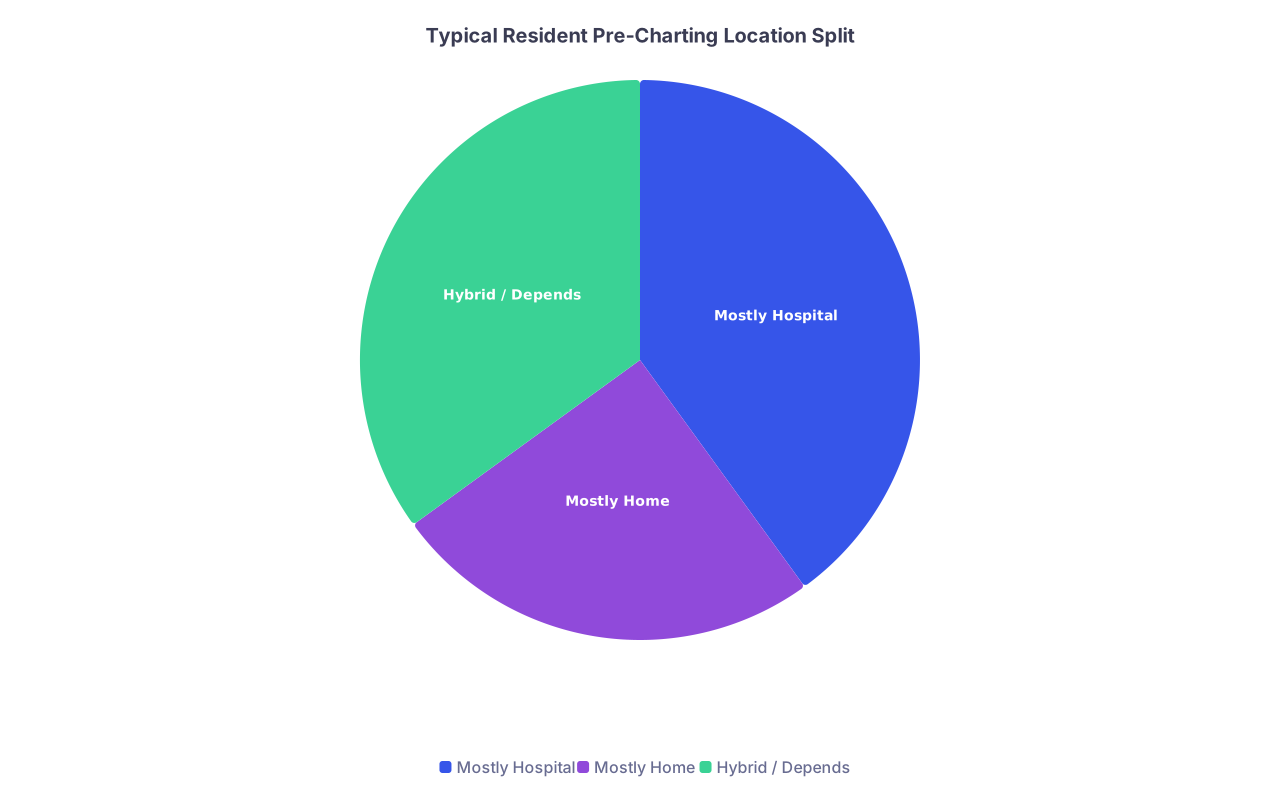
How Residents Actually Split Their Time (Rough Reality Check)
| Category | Value |
|---|---|
| Mostly Hospital | 40 |
| Mostly Home | 25 |
| Hybrid / Depends | 35 |
In most programs I’ve seen:
- ~40% of residents do almost all pre-charting in the hospital
- ~25% do a big chunk at home
- ~35% do a true hybrid that changes by rotation, call schedule, and attending preference
The strong residents aren’t the ones who “pick a side” and die on that hill. They’re the ones who adapt their strategy by month and protect their sleep like it’s an ICU bed.
FAQs
1. Is pre-charting at home a duty hour violation?
It can be. Duty hours apply regardless of location. If your home pre-charting time means you’re working more than 80 hours per week averaged over four weeks, yes, that’s a violation. Many programs expect you to log that time; others unofficially ignore it. Ask your chiefs how your program handles it and don’t lie on your duty hour logs. It always comes back to bite someone.
2. How much time should I spend pre-charting per patient?
For most ward patients: 2–5 minutes each once you know them. New or complex patients might take 5–10. If you’re spending 15+ minutes pre-charting a single stable patient, you’re overdoing it. Your goal is a mental update and a short to-do list, not a full re-workup every morning.
3. What exactly should I do when I pre-chart?
Keep it tight. Check: overnight events, vitals trend, new labs/imaging, new consult notes, active issues, and 2–4 concrete plans or questions for the morning. That’s it. Do not start writing full notes or rewriting the problem list at 9 pm. Save that for after rounds when you actually know what the attending wants.
4. Is it unsafe to pre-chart at home because things change overnight?
No, as long as you treat pre-charting as a draft. On rounds, you must re-check for new vitals, labs, and events before presenting. Unsafe is anchoring on last night’s plan and ignoring new data, not the location where you pre-charted. I’ve seen bad anchoring both from home and from in-house work.
5. What if my attending expects us to pre-chart in the hospital, but I work better at home?
You follow the attending’s expectations on that rotation. Period. You can still make it more efficient—batch your in-house pre-charting, use a timer, cut non-essential tasks—but openly ignoring their stated preference will only hurt you. Off that rotation, you can revert to what works better for you.
6. How do I stop home pre-charting from eating my entire evening?
Impose structure. Choose a fixed window (e.g., 8:00–8:40 pm), set a timer, and physically put your laptop away when you’re done. Mute EHR notifications after that. And decide ahead of time what “good enough” looks like instead of trying to make everything perfect.
7. As an intern, should I default to home or hospital for pre-charting?
Default to hospital your first few months. You’ll learn expectations, get real-time input from seniors, and avoid hidden duty hour issues. Once you’re faster and understand the culture, you can experiment with short, bounded home pre-charting blocks on rotations where it makes sense.
Key points:
- There’s no universal best place to pre-chart; your decision should fit your rotation, program rules, and your own boundaries.
- Home pre-charting wins on flexibility and focus but is dangerous for work creep and burnout if you’re not strict.
- In-hospital pre-charting gives cleaner boundaries and better alignment with expectations but costs you extra time in a draining environment.