
What if the resident who finishes notes early, leaves on time, and is never “seen suffering” actually ends up the better doctor than the one staying until midnight “for the learning”?
You already know the stereotype. The “gunner” resident grinding late, volunteering for every admission, charting at 11 pm with bleary eyes and a half‑eaten granola bar. Worshipped as “hard‑working.” Quietly held up as the standard.
And then there’s the efficient resident. Lists are tight, handoffs are clean, notes are short, and somehow they’re out the door within duty hours without leaving chaos behind. In many programs, the whispered verdict is the same: “Good worker, but doesn’t really love the medicine.” Or the more poisonous version: “Yeah they’re efficient, but they’re not getting as much exposure.”
Let’s tear that apart.
Where This Myth Comes From (And Why It’s Wrong)
The myth is simple: more hours = more learning. More admissions = more learning. More “face time” = more commitment. Therefore, if you are efficient enough to avoid drowning, you must be cutting corners on education.
There are three problems with this.
First, the data on learning and performance does not support the “more hours is always better” story. Second, a lot of what we call “hard‑working” is just inefficient workflow, bad systems, or martyr culture dressed up as virtue. Third, we conflate visible struggle with depth of learning.
If you’ve ever heard an attending say, “Back when I was a resident, we admitted 15 per call and stayed until the work was done — that’s how we learned,” you’ve seen this myth in the wild. It’s nostalgia mixed with survivorship bias.
The reality: beyond a certain point, adding more hours or more “reps” doesn’t increase learning. It just adds fatigue and errors.
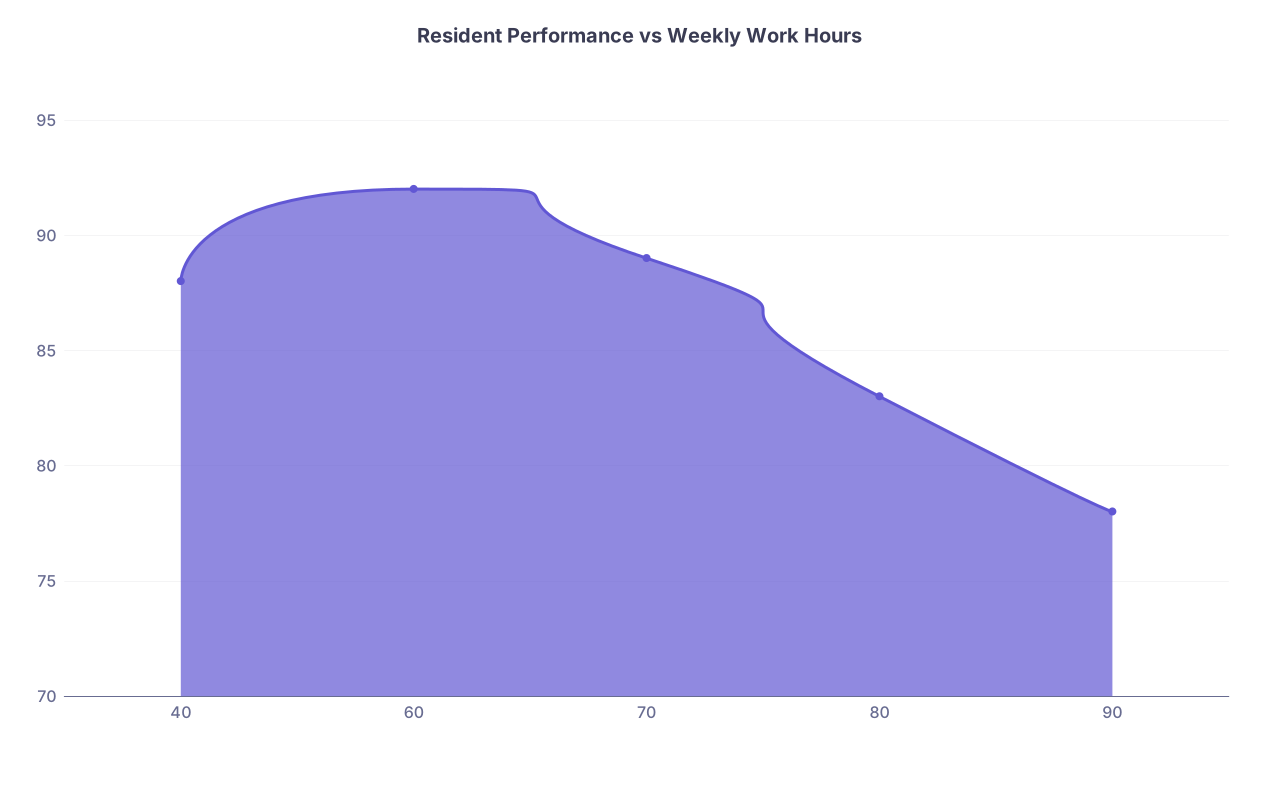
| Category | Value |
|---|---|
| 40 | 88 |
| 60 | 92 |
| 70 | 89 |
| 80 | 83 |
| 90 | 78 |
That’s a stylized summary, but it tracks with decades of literature: clinical performance and retention peak around moderate workloads, then fall as fatigue and cognitive overload kick in.
If you’ve ever read the NEJM classic from Landrigan et al. on extended work shifts in interns, or the multiple RCTs on duty hour reforms, you’ve seen the pattern: past a threshold, more hours mean more errors and worse outcomes. They do not mean better training.
So no, efficiency does not automatically mean less learning. Often it’s the opposite.
What The Evidence Actually Shows About Learning In Residency
Let’s talk about how people actually learn medicine as residents.
You are not a blank slate being filled with “cases.” You’re an overloaded, sleep‑deprived human with limited working memory juggling tasks, documentation, communication, and the occasional chance to think. The variable that really matters is not “How many hours were you in the building?” but “How many high‑quality cognitive cycles did you spend on real clinical reasoning, feedback, and reflection?”
That’s where efficiency comes in.
1. Time-on-Task ≠ Learning Quality
A resident who stays three extra hours writing bloated notes, re‑entering orders, and chasing down misplaced consults is not learning more medicine. They’re doing more clerical work with a slowing, error‑prone brain.
The educational psych people have known this for ages: learning follows something closer to a diminishing returns curve than a simple straight line. Early exposure to a task produces big gains. Repetitions after that produce smaller and smaller gains, and after fatigue sets in, you start going backward.
In practice:
- The first 3 admissions of the night? Decent learning.
- Admissions 4–6? Some learning, but mostly pattern repetition.
- Admissions 7–10 at 3 am? You’re copy‑pasting your own thinking and praying you don’t miss a lab.
The efficient resident recognizes this and streamlines the low‑yield stuff so they can stay sharp for the high‑yield stuff.
2. Cognitive Load: The Silent Learning Killer
You’ve seen this: cross‑cover night. Your pager is going off every three minutes. Five tasks are open. Someone’s hypoxic, someone needs DVT prophylaxis orders, someone’s family is angry. At some point your brain flips into pure survival mode.
Cognitive load theory says when working memory is maxed out, new learning doesn’t stick. You may get through the night. You will not remember the nuanced teaching point about that mixed metabolic acidosis.
Efficient residents are basically self‑defensive about cognitive load. They pre‑chart before rounds, they template and batch tasks, they close loops early. That’s not laziness. That’s creating mental bandwidth so when the complex ICU patient arrives, they can actually think instead of just reacting.
And if you want a survival tip: protecting your brain from useless clutter is one of the highest‑yield “educational” moves you can make.
Types of Residents: Who Really Learns More?
Let’s compare archetypes. You’ve met all three.
| Resident Type | Visible Hours | Task Style | Likely Learning Quality |
|---|---|---|---|
| The Martyr | Very high | Disorganized | High early, then falls |
| The Efficient | Moderate | Structured | Consistently high |
| The Bare Minimum | Low | Avoidant | Low |
The Martyr stays late, never says no, drowns in work, and is celebrated as “dedicated.” Early in the year they learn a ton because everything is new. By month 6 they’re chronically exhausted, skimming notes, and forgetting what they read yesterday. Patients might love their bedside manner, but ask them to integrate three guidelines and they glaze over.
The Bare Minimum resident cuts out as soon as possible, avoids new admissions when they can, does surface‑level thinking. Yes, they learn less. Not because they’re efficient — because they’re disengaged.
The Efficient resident is the one people quietly resent. Finishes notes on time, anticipates discharges, doesn’t volunteer for unnecessary scut, and somehow still knows the literature on their cases. You can call it luck, but I’ve watched this pattern for years: they’re not “getting away” with anything. They are reallocating time from garbage tasks to thinking, reading, and talking about cases that matter.
Who do you think understands their patients better by the end of the year?
The Hidden Confounder: Visibility vs Reality
A lot of this myth is about optics.
Programs often still evaluate “work ethic” with proxies: how late you’re seen in the hospital, how quickly you say “yes” to extra work, how many hours you’re logged on the EMR.
Those are terrible measures of learning.
Residents tend to internalize this. So they perform struggle. Leave the hospital late even when their work is done. Don’t use down time to read because they’ve been taught that “looking relaxed” means they’re not working hard enough.
If you’re honest, you’ve probably judged that co‑resident who seems strangely calm. “Must not be seeing enough.” Or, “They’re not as committed.” I’ve watched those “lazy‑looking” residents crush boards, fellowship interviews, and attending life later. Why? Because behind what looked like calm was ruthless prioritization.
You know what actually correlates with learning?
- Getting specific feedback and using it to adjust.
- Doing deliberate practice on weak skills.
- Having protected time and enough energy to read, synthesize, and ask questions.
Not hanging around charting until the attending leaves.
What Efficient Residents Actually Do Differently
If you strip away the mythology and just watch what efficient residents actually do, the pattern is pretty consistent.
They shorten any task that doesn’t add clinical value or learning value.
They template smartly. Not bloated auto‑text paragraphs, but structured notes that pull in only what’s needed and make thinking visible in a few lines. They pre‑decide default orders for common problems. They standardize where possible so their brain is free where it matters.
They batch tasks. They don’t check the EMR every 90 seconds. They don’t answer every non‑urgent question the instant it appears. They cluster: “I’ll check all labs at these three points. I’ll clarify all orders with the nurse when I’m already on the floor.”
They prioritize learning opportunities. When consults fight over minutiae, they listen once, ask the core question (“What would make you change your plan?”), and move on. When something new and complex comes in — a septic shock patient, a weird vasculitis, a complex psych case — they lean in. They may even pick up that admission and drop something low‑yield to make room.
The lazy resident drops everything low‑effort too. The difference is they don’t fill that gap with learning. They fill it with hiding.
You know which one you are.
But What About “Reps”? Don’t You Need Sheer Volume?
This is the most legitimate objection. Skills in medicine do need repetition: procedures, cross‑covers, admitting, running codes. You can’t become good at LPs if you only do three of them.
The question is not “Do reps matter?” It’s “How much marginal benefit is there to the 8th similar rep of the night when you’re exhausted and documenting like a robot?”
There’s research in procedural training that shows skills plateau quickly once you reach basic competence. After that, gains come from targeted practice on errors, not just more random cases. Same logic applies to H&Ps and standard ward admits.
You absolutely need enough clinical volume. If you are avoiding volume, that is a problem. But once the baseline is met, the game shifts:
- You gain much more by doing 5 thoughtful admissions and debriefing them than by doing 10 rushed, half‑remembered ones.
- You gain more by running 3 codes and getting feedback on your leadership and decisions than by standing in the back of 15 and holding the backboard.
The efficient resident isn’t allergic to volume. They’re allergic to pointless volume. They say yes strategically.
Duty Hours, Burnout, And The Lies We Tell Ourselves
We should talk about burnout, because it sits in the background of this whole myth.
Old‑school thinking says suffering is a prerequisite for competence. The 28‑hour call warriors often boast, half joking, “I survived that; you can too.” What they don’t say is how many details they forgot, how many errors they barely caught, how many times they learned the wrong lesson because they were too fried to see what actually happened.
Studies on resident burnout show the obvious: high burnout is associated with worse perceived patient care, more errors, and lower self‑reported learning. Yet programs still act like the most exhausted resident is the most committed.
The efficient resident fights this. They protect sleep when they can. They respect their own cognitive limits. They leave on time without guilt when the work is done and patients are safe. That’s not selfish; that’s educational self‑preservation.
And no, going home is not “missing learning.” You’re not meaningfully learning nephrology by wandering the wards at 9 pm rereading your own notes.
Practical Survival Tips: How To Be Efficient And Learn More
Let’s make this actionable. If you’re in the trenches and want to reject the martyr myth without sabotaging your training, here’s how to do it without turning into the Bare Minimum resident.
Focus obsessively on pre‑round efficiency. The goal is not a beautiful note; it’s a clear mental model of what’s happening with each patient before rounds. Skim vitals and labs first, look for trajectory, then ask one question: “What decision do I need to make for this person today?” If you can answer that before rounds, rounds become an education session, not a fact‑gathering panic.
Steal tiny reading blocks. Ten minutes immediately after a case decision to read the guideline or UpToDate summary on exactly that question is exponentially more powerful than an hour of random reading at 11 pm when you’re half asleep. Efficient residents are opportunistic with this.
Make your notes serve your brain, not the other way around. A focused problem list with three bullets reflecting your reasoning is more educational than a 2‑page novel you’ll never read again. When attendings say they want to “see your thinking,” give them your actual thinking, not EMR detritus.
Ask for surgical feedback. Not “any feedback?” but “I’m working on being more concise on rounds — was that better today?” or “On that DKA patient, was my management sequence reasonable, or what would you have done differently?” Efficient residents compress the feedback loop. That’s where learning lives.
And yes, when a legitimately high‑yield case arrives — the crashing patient, the unusual pathology — step up. Take that hit. But don’t also volunteer to “help” with three discharge med recs you won’t learn from just to look busy.

| Step | Description |
|---|---|
| Step 1 | Incoming Tasks |
| Step 2 | Do personally and deeply |
| Step 3 | Standardize and batch |
| Step 4 | Delegate or minimize time |
| Step 5 | Seek feedback |
| Step 6 | Free cognitive bandwidth |
| Step 7 | Improved learning |
| Step 8 | Clinical value or learning value? |
What To Ignore When People Judge Your Efficiency
You will get side‑eyed for this. Some attendings and co‑residents like visible suffering. It validates how they trained. You leaving on time triggers them.
Here’s what you can safely ignore:
- Snide “half‑day?” comments when you leave at 5:30 with everything done.
- Accusations that you “don’t love medicine” because you protected your post‑call day to sleep instead of sitting in conference barely conscious.
- The implication that unless you’re as miserable as they were, you’re not real.
What you cannot ignore:
- Feedback that your notes are missing key safety elements.
- Concerns that you’re dumping work on others or not owning your patients.
- Evidence that you’re skipping real learning opportunities in the name of being “efficient.”
If you are meeting your responsibilities, keeping patients safe, owning your list, and still carving out time to read and think, you are not gaming the system. You’re doing residency the way it should have been designed.
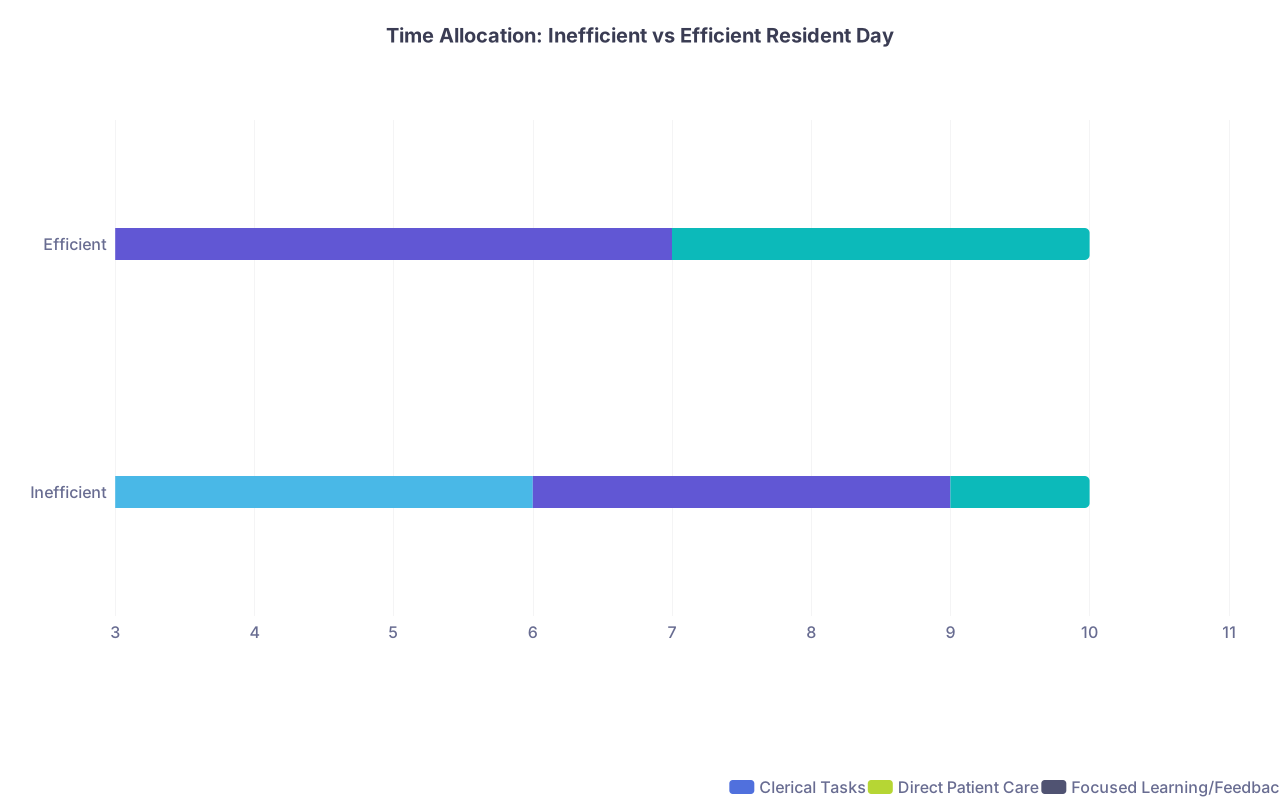
| Category | Clerical Tasks | Direct Patient Care | Focused Learning/Feedback |
|---|---|---|---|
| Inefficient | 6 | 3 | 1 |
| Efficient | 3 | 4 | 3 |
The Bottom Line: Myth vs Reality
The myth says: efficient residents learn less, care less, and are less “serious.” Reality is almost the opposite.
Here are the three points I want you to remember:
- Past a basic volume threshold, more hours and more chaos do not equal more learning. They mostly equal more fatigue and more errors.
- Efficiency is not laziness. When done right, it’s deliberate protection of your limited cognitive bandwidth so you can think, read, and get feedback on what actually matters.
- The resident who learns the most is not the one who suffers the most. It’s the one who owns their patients, cuts the noise, and invests their best brain hours in real clinical reasoning — then goes home when the work is done.