
It’s late February. You and your partner are on FaceTime, both in scrubs, both exhausted. Your interview seasons are mostly done. Your spreadsheets are a mess. You’re long-distance already—or about to be—and now you’re staring down this question:
“Do we try to do second looks together? Or just trust our guts and rank?”
You’ve heard people say second looks “don’t matter” for ranking. You’ve also heard couples say, “Our joint second look weekend literally changed our rank list.” You’re somewhere between broke and very broke. Your schedules are a disaster. And every program email is vague: “Second looks are optional, not evaluative, but we love to see you again!”
Here’s how to handle this like an adult with limited time, money, and emotional energy.
1. First Reality Check: What Second Looks Actually Do (and Don’t Do)
Let me be blunt: second looks are almost never about improving your chances with the program. They’re about improving your decisions.
Programs will tell you they’re “non-evaluative.” For most places, that’s 95% true. The remaining 5%? Occasionally, a second look confirms a “red flag” or solidifies a good impression. But if you’re doing the couples match or coordinating with a long-distance partner, you’re not going for points. You’re going to answer three questions:
- Do we see ourselves living here together for 3–7 years?
- Are both of our programs livable, not just on paper but in real life?
- What does our daily life look like here—commute, call, groceries, nearest human we like?
Where people screw this up is thinking second looks are about re-running interview day with more small talk. That’s a waste.
Second looks should focus on:
- Real schedules
- Call rooms and work rooms
- How attendings actually treat residents
- What the city/neighborhood feels like at 7 pm on a Tuesday
- Whether your partner’s program feels compatible with yours (distance, culture, schedule)
If your only goal is “remind them I exist,” stay home. You can do that with one targeted email.
2. Should You Even Do Joint Second Looks?
Before you book a single flight, decide whether joint second looks make sense at all. For some couples, they’re gold. For others, they’re a time and money sink.
Here’s a quick way to look at it:
| Situation | Joint Second Look? |
|---|---|
| You have multiple overlapping cities where both interviewed | Strongly consider |
| You’ve never visited the city one of you is interviewing in | Strongly consider |
| Both of you are torn between 2–3 city pairs | Strongly consider |
| Your lists barely overlap geographically | Maybe 1–2, not more |
| You’re already financially tapped from interview season | Very selective / likely skip |
Now the real filter: what are you actually trying to decide?
Good reasons to do a joint second look:
- You’re trying to compare A vs B as a couple (e.g., Boston vs Chicago).
- One or both of you have “head vs heart” conflict and need reality to ground the decision.
- You have serious concerns about lifestyle—cost of living, safety, commute, support system.
Bad reasons:
- “Everyone else seems to be doing second looks.”
- “Maybe if we show up together, they’ll rank us higher as a couple.”
- “We just want to feel less anxious.” (The trip may actually increase your anxiety.)
If you cannot clearly state what decision the second look will help you make, do not go.
3. Strategy Before Logistics: Pick Targets Like a Grown-Up
You can’t second look everywhere. And you definitely can’t second look everywhere together.
Here’s how I’d approach it: start with your joint map, not your individual maps.
Step 1: Identify overlap cities
- Where did you both interview, in the same city or within a reasonable distance (≤60–90 minutes)?
- Make a list of those places—even if you think some are “lower tier” for you. Your priorities might shift after seeing reality.
Step 2: Separate fantasy from actual possibilities You know the cities I’m talking about:
- The coastal big-name programs that both of you loved, but one of you is mid-tier on paper
- The city with one dream program and one “backup” where the backup never emailed again
Be honest about where you’re likely to match together. If it’s a reach for one of you plus a reach for the other, a second look won’t magically fix that. You don’t need to see a city you’re 5% likely to end up in.
Step 3: Choose 1–3 joint trips max If you’re both in med school or in prelim years, you’re tired and underpaid. Do not pretend you can do five joint second looks unless you like being miserable.
Your short list should be:
- Cities with multiple viable program combinations for you both, or
- Cities that are your likely “compromise reality” (maybe not dream-tier, but very probable)
Those are the places worth seeing together.
4. How to Build a Joint Second-Look Weekend That Actually Works
Once you’ve identified your target city (or two), you plan like this.
Step 4.1: Block the date, then email programs
Do not over-engineer the perfect day before reaching out. Rough dates first. Then contact coordinators.
Example script you can both customize:
Subject: Second Look Visit – Couples Match Candidate
Hi [Coordinator Name],
My partner and I are participating in the couples match (I’m applying to [Specialty] at [Program]; they’re applying to [Specialty] at [Their Program/Institution]). We’re planning a joint second-look visit to [City] on [date range].
I wanted to ask if there might be an opportunity that week to briefly meet a resident or two, see the resident work room/ICU/clinic space, and get a better sense of the day-to-day schedule. We understand this is not evaluative and are happy to work around your team’s needs.
Thank you for your time and help,
[Name], AAMC ID [ID]
Same thing for your partner with their program.
You’re not asking for a full re-interview day. You’re asking for targeted, practical exposure.
Step 4.2: Plan your shared time vs program-specific time
Do not just glue yourselves together every second. You’re each joining your own program, not forming a two-person unit.
A good structure for a 2–3 day joint second look:
Day 1:
- Morning: You at your program, your partner at theirs
- Afternoon: Swap notes solo, walk neighborhoods near each program
- Evening: Meet up, do groceries run, see where you’d actually live
Day 2:
- Morning: Shadow/meetings at the other person’s program (if allowed: some programs are strict about non-applicants)
- Afternoon: Apartment scouting, commute checks, hospital-to-hospital travel time
- Evening: Sit down and debrief—structured, not vague
Day 3 (optional):
- One last hit of neighborhoods, coffee shops, gyms, childcare options if relevant
- Short, specific conversations with residents you clicked with during interviews
You’re trying to answer: “What does a Tuesday in October look like here for both of us?”
5. What To Look For (That You Won’t See on Interview Day)
Second looks are where the gloss falls off. That’s a good thing.
Here’s where to keep your eyes open:
Culture reality vs culture pitch
On interview day, you saw handpicked residents in their best clothes saying all the right things.
On a second look, pay attention to:
- Residents’ body language at 2 pm
- How people talk about nights/weekends—resentful or “it’s rough but fair”
- Whether senior residents seem protective of juniors or burned out and disengaged
- How staff talk to residents (nurses, clerks, consultants)
If you’re doing this as a couple, pay attention to consistency between your two programs. If your program feels collegial and your partner’s feels malignant, that mismatch will bleed into your relationship.
Schedules and commute game
You and your partner need to understand:
- Your most common start times (5:30, 6:00, 7:00?)
- Commuting patterns—public transit, parking, traffic at your specific shift times
- How hard it is to get from your hospital to theirs after a shift
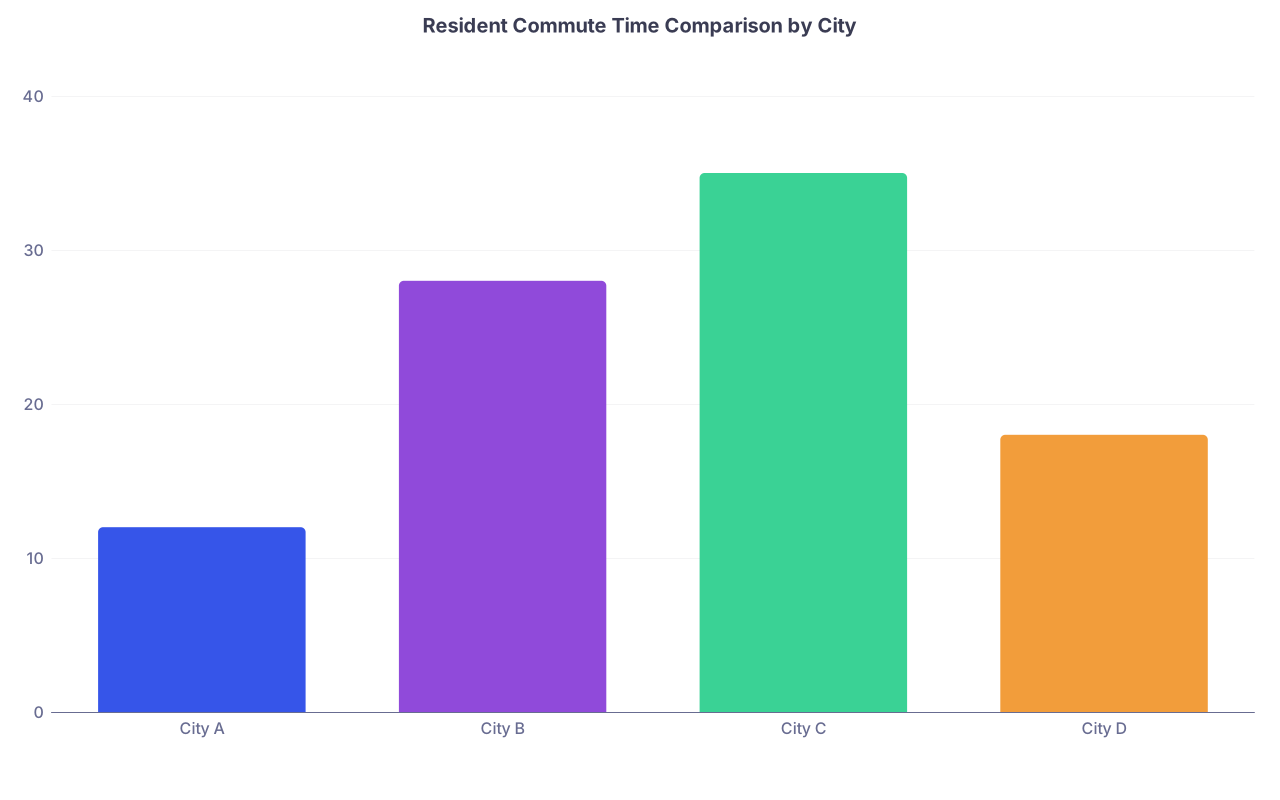
This is not minor. A 40-minute commute each way for both of you vs a 10–15 minute commute changes how much actual time you have together.
Grab real data during second look:
- Ask a resident: “Where do you live, and how long does it actually take you door-to-door?”
- Plug it into maps at different times of day—7 am, 5 pm, 11 pm.
| Category | Value |
|---|---|
| City A | 12 |
| City B | 28 |
| City C | 35 |
| City D | 18 |
That kind of difference? It’s your future Tuesday nights together. Or not together.
Money and cost-of-living reality
Second looks are the moment where “we could totally make it work in San Francisco” meets Zillow.
Do this together:
- Pull up actual rental listings near your likely hospitals
- Check parking costs or transit passes
- Walk into a normal grocery store, not Whole Foods, and look at prices
- Ask residents bluntly: “Are people able to save? Or is everyone just surviving?”
If both of you are in training-level salaries in a high-cost city, the margin for error shrinks. Knowing that before you rank is smart, not negative.
6. Emotional Landmines: When You and Your Partner See Different Things
Here’s where couples get into trouble with joint second looks.
Scenario I’ve seen too many times:
- One partner falls in love with City X again on second look.
- The other gets a pit in their stomach seeing their program’s actual call schedule.
- Now you’re not clarifying the list. You’re fighting about it.
You need a structure for debriefing these trips that’s not just “so, what did you think?”
Try this after each day:
- Give each person solo time first (30–60 minutes).
- Take notes separately—what you liked, didn’t like, and what surprised you.
- Then answer these three questions out loud, one at a time:
- What got better than interview-day impression?
- What got worse?
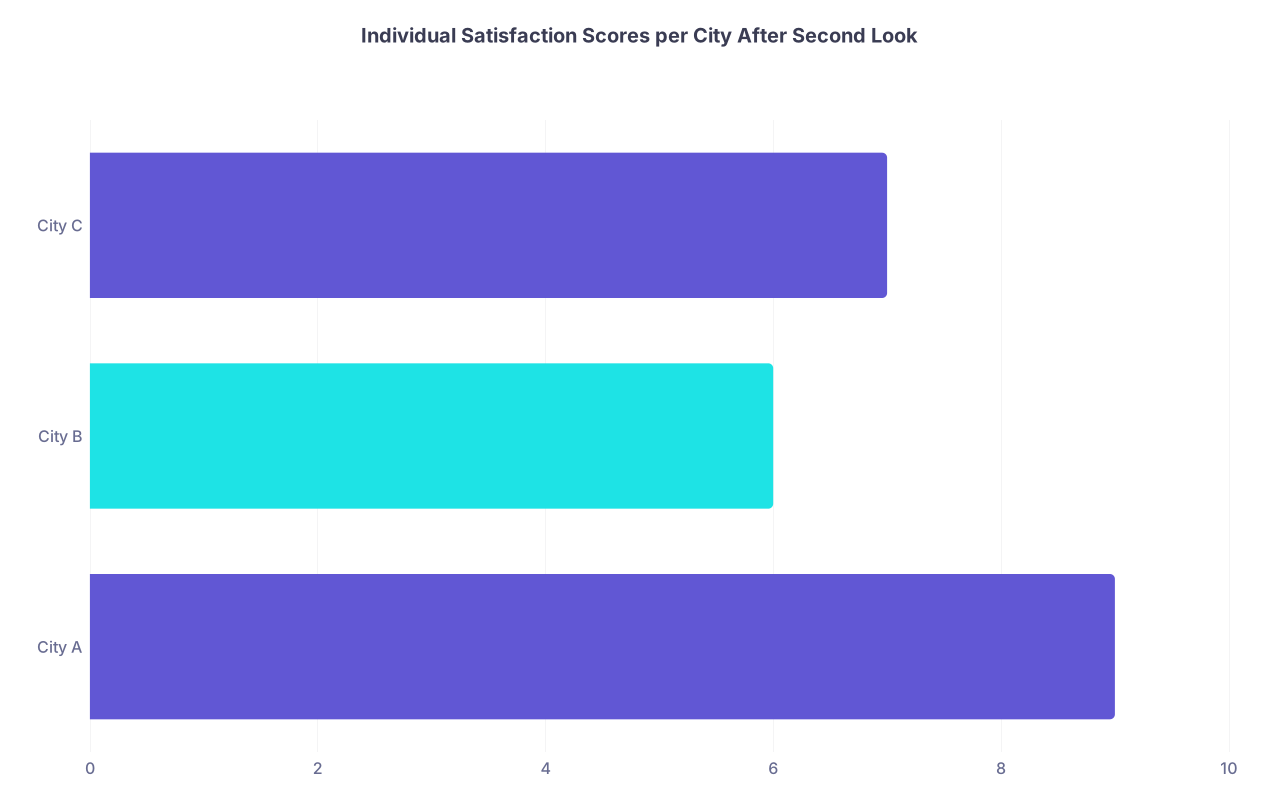
- On a scale of 1–10, how livable does this feel for me personally?
Important: Only after you exchange individual scores do you talk about “us as a couple.”
You might find:
- You’re both at 8/10 individually → strong couple option
- One is at 9/10, the other at 4/10 → this will breed resentment
- Both are 6–7/10 → maybe not a dream, but a very workable compromise
Do not gaslight each other’s impressions. If your partner says, “That program felt cold,” you don’t respond with, “But the residents were so accomplished.” You respond with, “What made it feel cold to you?” Then actually listen.

| Step | Description |
|---|---|
| Step 1 | Plan Joint Trip |
| Step 2 | Visit Programs |
| Step 3 | Each Rate Own Program |
| Step 4 | Discuss Individual Scores |
| Step 5 | High Couple Priority |
| Step 6 | Consider Lower in Rank List |
| Step 7 | Middle Tier Option |
| Step 8 | Both >= 7? |
| Step 9 | One <= 4? |
7. Don’t Let Second Looks Hijack Your Rank List
Last trap: over-weighting recency.
Second looks happen close to rank list deadlines. Your brain will try to crown the last city you visited as “clearest” simply because it’s freshest.
Don’t fall for that.
Two protections:
Freeze your pre-second-look rank list
Before any travel, write out your provisional couples rank list. It doesn’t have to be perfect. But it gives you a baseline.After each trip, ask: “Does this city/couple combo move more than one slot? Why?”
If you can’t articulate a concrete reason beyond “it just felt right in the moment,” be cautious.
Think of second looks as tiebreakers and reality checks, not a license to completely rewrite your priorities based on one intense weekend.

8. Logistics: Money, Time Off, and Not Burning Yourself Out
Let’s talk practicalities, because they matter.
Money
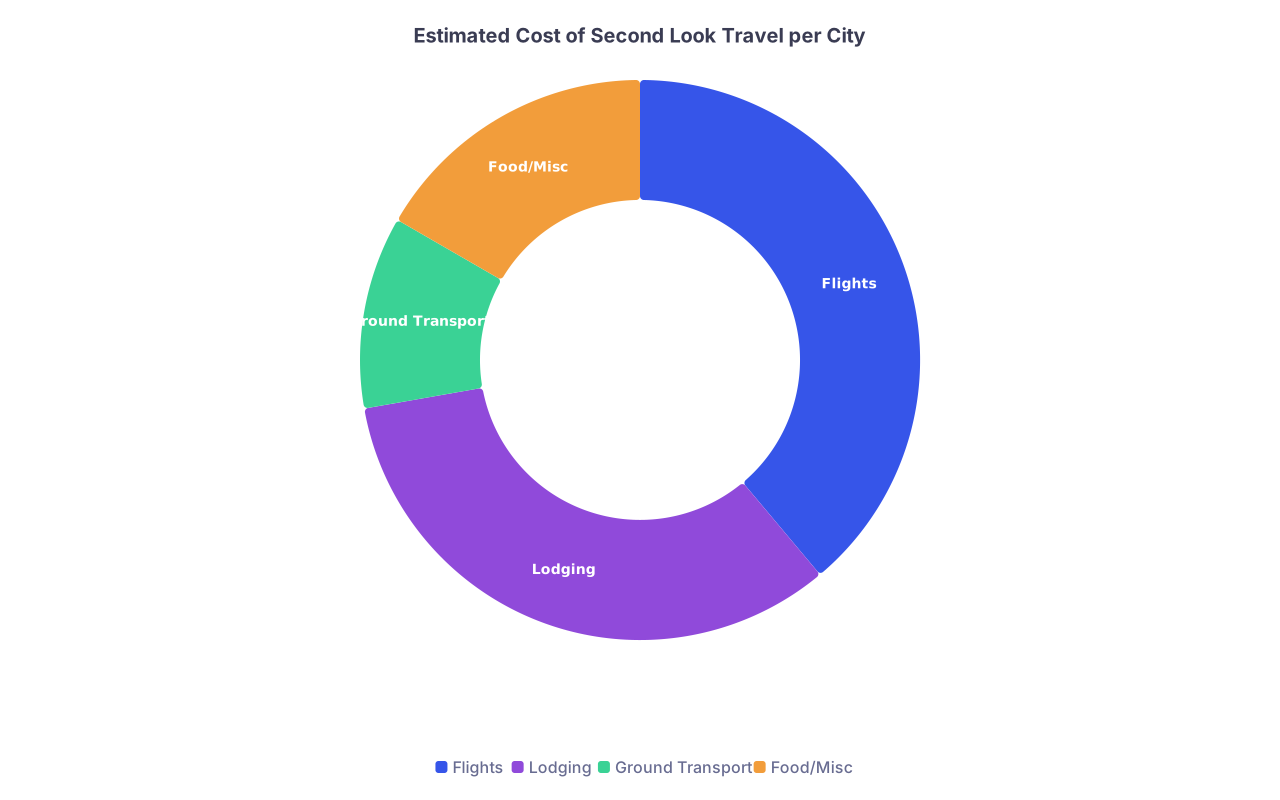
You’ve already dropped thousands on interviews. Joint second looks are a luxury, not a requirement.
Ways to keep this sane:
- One city instead of three
- Stay with friends or residents who offer (people really do this)
- One shared rental car at most; Uber/Lyft + public transit when possible
- Two nights max per city in most cases
If the choice is: “Second look in a low-yield city” vs “Pay off credit card interest a bit faster,” choosing the latter is not a failure. It’s maturity.
Time Off
If you’re a fourth-year with electives, you have more flexibility. If you’re an intern or prelim, this gets harder. Be realistic about what you can get without blowing up relationships with your chiefs or attendings.
When asking for time off:
- Be specific and early
- Offer to swap calls or help fill a future hole
- Don’t expect special treatment because you’re couples matching—no one else cares as much as you do
| Category | Value |
|---|---|
| Flights | 350 |
| Lodging | 300 |
| Ground Transport | 100 |
| Food/Misc | 150 |
9. If You Decide Not to Do Joint Second Looks
Skipping second looks is not some disaster. Most couples match without them.
If you opt out, at least do this:
- Set up separate Zoom/phone follow-ups with residents at each program for both of you. Ask the same hardcore questions you would’ve asked in person.
- Use Google Street View and actual apartment listings to approximate reality.
- Map commutes, day and night.
- Have the same structured scoring conversation you’d have after an in-person trip.
You can mimic 70–80% of what second looks give you without leaving your couch if you’re focused.

10. When You Two Just Don’t Agree After the Trips
Sometimes joint second looks make the conflict worse. You loved City A. Your partner walked into their program there and thought, “Absolutely not.”
Here’s the mature way through:
Name your non-negotiables
- Do you absolutely refuse to live in a certain region?
- Do you absolutely refuse a certain program culture?
- Are there family/health constraints that change the math?
Decide whose career is more constrained right now Not more “important.” More constrained. Example:
- One of you is going into neurosurgery with few spots per city.
- The other is going into IM with tons of slots.
The neurosurgery partner’s geography is tighter. That has to matter.
Create a “mutual respect minimum” You both need to be at least, say, 6/10 on any city you rank in your top 5 as a couple. No one gets to drag the other into a 9/10 vs 2/10 situation and call that “supportive.”
If second looks reveal that your experiences are wildly divergent at the same places, that’s not a failure. That’s data you needed. Use it to shape a list where you won’t hate each other in PGY-3.
| Category | Value |
|---|---|
| City A | 9 |
| City B | 6 |
| City C | 7 |
FAQ (Exactly 4 Questions)
1. Will a joint second look help us match together more successfully?
Not in any official sense. Programs don’t bump you up just because you showed up again holding hands. Where it does help is in building a smarter couples rank list—choosing cities and combinations you can both live with. That indirectly helps you “match better together” because you’re less likely to sabotage your own list with unrealistic or mismatched choices.
2. Do programs judge us if we don’t do a second look?
No. Most applicants do not do second looks, and programs know that. If anything, some faculty are mildly suspicious of applicants who seem to be “shopping” too aggressively. A clear, polite follow-up email and smart questions can do as much for your impression as flying back in. Second looks are for you, not a requirement to prove interest.
3. Should we always visit both of our programs in a city on a joint trip?
If logistically possible, yes. You don’t need full tours, but you should at least see each other’s hospitals, neighborhoods, and likely commute. You’re not just ranking “City X.” You’re ranking “My residency at Program A in City X plus your residency at Program B in City X.” Skipping your partner’s environment and only focusing on your own is short-sighted.
4. What if we can only afford one joint second look—how do we choose the city?
Pick the place that’s both: (1) realistically likely for you as a couple (not double-reach fantasies), and (2) hard to read from afar. If your home city is on the list, you don’t need a second look there—you know it already. Use your one trip for a city where you have multiple viable combinations and enough uncertainty that seeing it together could actually move it significantly up or down your list.
Key takeaways:
- Joint second looks are tools for your clarity, not for impressing programs.
- Plan them around realistic couple options, not fantasy cities, and limit them to 1–3 at most.
- Use them ruthlessly: focus on daily life, commute, culture, and cost, then have hard, structured conversations with your partner about what you both saw.