
Second Looks When You’re Switching Specialties Late in the Game
Switching specialties late and using “second look” visits to do it is high‑risk, high‑reward territory—and most people handle it badly.
If you’re in this situation, you’re juggling three problems at once:
- You’re behind the typical exploration curve.
- You need programs to believe this isn’t a panic move.
- You have one or two chances—in person—to prove it.
Let’s walk through what you actually do. Step by step. No fantasy scenarios.
First: Be Brutally Clear On Your Situation
Before we talk about second looks, you need to define which of these you are:
| Scenario | Where You Are | Main Second Look Goal |
|---|---|---|
| MS4 pivoting before Match | No prior residency | Prove genuine interest, not last-minute flail |
| Prelim/transitional year switching | In PGY-1 | Show fit and reliability despite switching |
| Categorical resident switching out | In PGY-1+ | Overcome program-risk fears, show maturity |
| Reapplicant after no match in old field | Applying again | Rebuild narrative, show growth and clarity |
Your strategy changes depending on which box you’re in.
If you don’t know why you’re switching—beyond “I hate my life on this service”—you’re not ready for a second look. Programs can smell vague dissatisfaction. It reads as “problem resident” or “unrealistic student.” That will kill you faster than a low Step 2.
You need, in plain language, answers to:
- What exactly pushed you away from your prior field?
- What exactly pulls you toward this new one?
- What have you done already to explore the new field (not in your head, in real life)?
- Why is this not going to happen again in 2 years?
Write those out. If your answers are fuzzy, your second look will be fuzzy. And then useless.
What Second Looks Actually Do (And Don’t Do) When Switching
When you’re switching late, second looks are not about “seeing the city again” or “vibe checking” the residents. That’s a luxury use.
You’re using a second look as:
- A credibility repair tool (“Yes, I know I’m late. Here’s why you can trust me anyway.”)
- A risk management conversation (“Here’s why I won’t bail again or fall apart.”)
- A fit demonstration (“I’ve done my homework on your program, not just this specialty.”)
What second looks can do for you:
- Move you from “risky, maybe no” to “worth discussing at the rank meeting.”
- Give faculty a concrete story: “I met her on the second look, she understood our patient population, had a clear reason for switching.”
- Answer silent doubts that their email will never say out loud.
What they cannot do:
- Overwrite consistently poor evaluations.
- Magically erase a messy prior departure from another specialty without a coherent explanation.
- Make up for almost zero exposure to the new field.
So, this is not your primary fix. It’s the final polish on a narrative that’s already mostly built.
When a Second Look Helps vs Hurts in a Late Switch
You shouldn’t automatically do second looks everywhere. That’s amateur hour.
Here’s when they help you:
- You’re switching into a less competitive field (e.g., from ortho to IM, from derm to psych) and you have at least some prior clinical exposure in the new field.
- You’ve got a home department that supports your story and is willing to email or call on your behalf.
- You’re a prelim or TY and your current PD is on board with your switch (or at least neutral and not actively sabotaging you).
- You already interviewed and sensed mild interest but concern—second look gives them reassurance.
They’re more dangerous when:
- You have no coherent explanation beyond “lifestyle” but you’re aiming at lifestyle fields (derm, rad onc, PM&R, anesthesia). Program directors have heard that song too many times.
- You’re clearly running from a toxic situation, and you overshare or sound bitter in person.
- You have weak performance in the new field’s rotations and no updated, strong letters.
Rule of thumb:
If your narrative becomes more compelling when spoken out loud to a reasonable human, second looks help you.
If your story gets more confusing the more you talk, second looks expose you.
Build Your Late-Switch Story Before You Show Up
Let’s say you’re:
- MS4 who thought you were going into surgery, did a sub‑I, realized you hate the OR atmosphere, and now want internal medicine.
- PGY‑1 prelim in surgery, switching to radiology.
- Categorical family medicine intern realizing you genuinely need to be in psychiatry.
All salvageable if done correctly.
Your story needs three beats. Tight, simple, repeatable:
What you thought you wanted—and why it was rational at the time.
Not “I was an idiot.” More: “I loved acute care, procedures, and the team intensity, surgery seemed like the right translation of that.”What changed—with specific experiences, not vague vibes.
Example: “On my sub‑I I noticed I dreaded OR days but loved running the medicine service on consults. I realized it was the longitudinal thinking and diagnostic workups that I kept being drawn to.”Why this new specialty is a better long-term fit—and what you’ve done to prove it.
Concrete: extra electives, research pivot, mentors in the new field, call shifts, clinic time, case discussions.
If your explanation is under 90 seconds, you’re doing it right. You’re not writing a memoir; you’re giving them a risk assessment summary.
How to Ask for a Second Look When You’re Switching
Do not send some generic “I’d love to visit again” email. Your email itself is part of your credibility test.
Here’s a template you can adapt (don’t copy‑paste word for word; people can tell):
Subject: Second Look Request – [Your Name], Late Switch to [Specialty]
Dear Dr. [PD Last Name],
Thank you again for the opportunity to interview with [Program Name] on [date]. Since then, I’ve formally committed to switching from [old specialty or status] to [new specialty], after additional mentorship and clinical exposure.
Because I am making this transition later than most applicants, I want to be sure that [Program Name] and I are truly a good fit. I would be very grateful for the chance to return for a brief second look to better understand your residents’ day‑to‑day experience and to answer any questions about my path into [new specialty].
I’m currently available on [2–3 specific date ranges], but I’m happy to work around your schedule or meet virtually if that’s easier.
Thank you for considering this request.
Sincerely,
[Name, current role, contact info]
Key moves in that email:
- You explicitly name that you’re switching late. No hiding.
- You frame the visit as mutual fit checking and addressing questions.
- You show flexibility and respect for their time.
If you already matched somewhere else and are trying to switch post‑Match, this needs extra care. You MUST be aligned with your current PD and honest about your current status. If they discover you’ve been cagey about being already in a program, you’re done.
How to Structure the Second Look Day (So It Doesn’t Drift)
If they let you come back, don’t just “shadow randomly.” You need a plan.

| Step | Description |
|---|---|
| Step 1 | Arrive and brief check in |
| Step 2 | Meet resident or chief |
| Step 3 | Shadow on core service half day |
| Step 4 | Meet faculty or APD |
| Step 5 | Tour and informal resident time |
| Step 6 | Short wrap up with faculty or coordinator |
Your real priorities on that day:
- Show you understand what the work actually looks like.
- Give 1–2 faculty members and 1–2 residents a chance to say, “Yes, this person fits here.”
- Calm any anxieties they have about your late pivot.
Concrete actions:
- Ask the coordinator ahead of time: “Is it possible to spend 2–3 hours on [specific service] or in [clinic type] that represents typical junior work?”
- Ask to meet with an APD or faculty member who’s involved in selection—even if just 20 minutes.
- Eat with residents if offered. That informal chat is where they decide if they’ll support you.
Do not:
- Turn it into a complaint tour about your previous specialty or program.
- Oversell. Desperation is loud. Stay calm, curious, and clear.
- Try to “correct” your whole application in one day. You can’t.
What To Say Out Loud: Scripts That Work
You’ll repeat variations of your story all day. Here’s how to keep it clean and non‑cringey.
When a resident asks, “So you were originally going into [X]?”:
“Yeah, I was pretty set on [X] initially. On my sub‑I and early internship I realized I was consistently more engaged by [specific aspects of new field]. After a lot of discussion with mentors, it became clear that [new specialty] actually lines up better with what I enjoy day to day and how I want to grow long term.”
When a faculty member goes straight for it: “Why the switch, and why now?”:
“I went into [old field] for solid reasons—[give 1–2]. On rotations, especially [specific block], I found that I was energized by [diagnostic work / longitudinal care / procedures / complex psych dynamics—be concrete] and more drained by [other aspects].
I took that seriously. I met with [mentor names or roles], did additional time in [new specialty setting: clinic, service, consults], and the pattern held. The decision is late, but it’s a thoughtful one, and I’ve done the work to be sure this isn’t another pivot in two years.”
When addressing concern about risk:
“I completely understand that changing specialties late raises red flags. What I can tell you is that this wasn’t impulsive. I stayed professional in my current role, I sought honest feedback, and I made sure I wasn’t just running from stress. The kind of thinking and patient interactions in [new specialty] match how I naturally work. That’s why I feel comfortable committing to it.”
You’re aiming for composed, self‑aware, not defensive.
If You’re Already a Resident: Extra Landmines
This is where people really get burned.
Programs worry about three things with a late‑switch resident applicant:
- Professionalism and reliability. Did you leave chaos in your wake?
- Performance ceiling. Are you switching because you couldn’t cut it, or because of real misalignment?
- Future risk. Are they inheriting someone who might bail again or stir drama?
You must walk in with:
- A neutral or positive letter from your current PD (or, if impossible, a believable explanation why not and substitute senior mentor letters).
- Clear proof you didn’t just torch your old program: no AWOLs, no fired‑from‑call stories, no massive professionalism flags.
- Specific examples of good feedback from your current role that translate to their field.
When asked about your current program:
- Do not bash. At all.
- You can say: “Good people, solid training in [X]. I realized the core career trajectory wasn’t right for me, and after talking with my PD, we agreed switching is the better long‑term choice.”
If your current PD is not supportive, you need a very tight, calm explanation that doesn’t make you sound like a disaster. This is where you get advice from a trusted, senior faculty ally before you ever go on a second look.
Handling Competitiveness Reality (Some Fields Won’t Take You)
Let’s be blunt:
Switching late into derm, plastics, ortho, ENT, rad onc, or similarly hyper‑competitive fields is almost always a multi‑year project, not something a second look solves. You’re trying to jump into a moving train that’s already full.
Second looks there are mostly about:
- Getting someone to remember your face and story for the next cycle.
- Earning an honest assessment: “You should probably do X, Y, Z before reapplying.”
- Building relationships for research or a prelim year strategy.
In contrast, switching into IM, psych, FM, peds, anesthesia, neurology, or pathology late is very doable with:
- Strong letters from people embedded in that field.
- A clean, believable explanation.
- Good evaluations and no big professionalism problems.
Know which game you’re playing. Second looks are leverage. They are not magic.
Logistics: Timing, Money, and How Many Second Looks
Timing:
- Best window: After your application has been read and ideally after interview, but before rank meetings. For many programs, that’s mid‑January to mid‑February.
- If you’re a resident switching mid‑year, this becomes more flexible, but you still want to cluster visits rather than randomly showing up throughout the year.
How many:
- Quality over quantity. Two to four well‑targeted second looks where your late switch will matter are better than eight superficial drop‑ins.
- Prioritize: places where your mentors know people, programs that already showed some interest, and programs explicitly open to non‑traditional paths.
Money:
- Second looks are usually on your dime. Travel, maybe a day or two of lost income if you’re a resident.
- Do the math. If you’re flying across the country for a program that hasn’t shown any real warmth and you have no connections there, that’s a bad gamble.
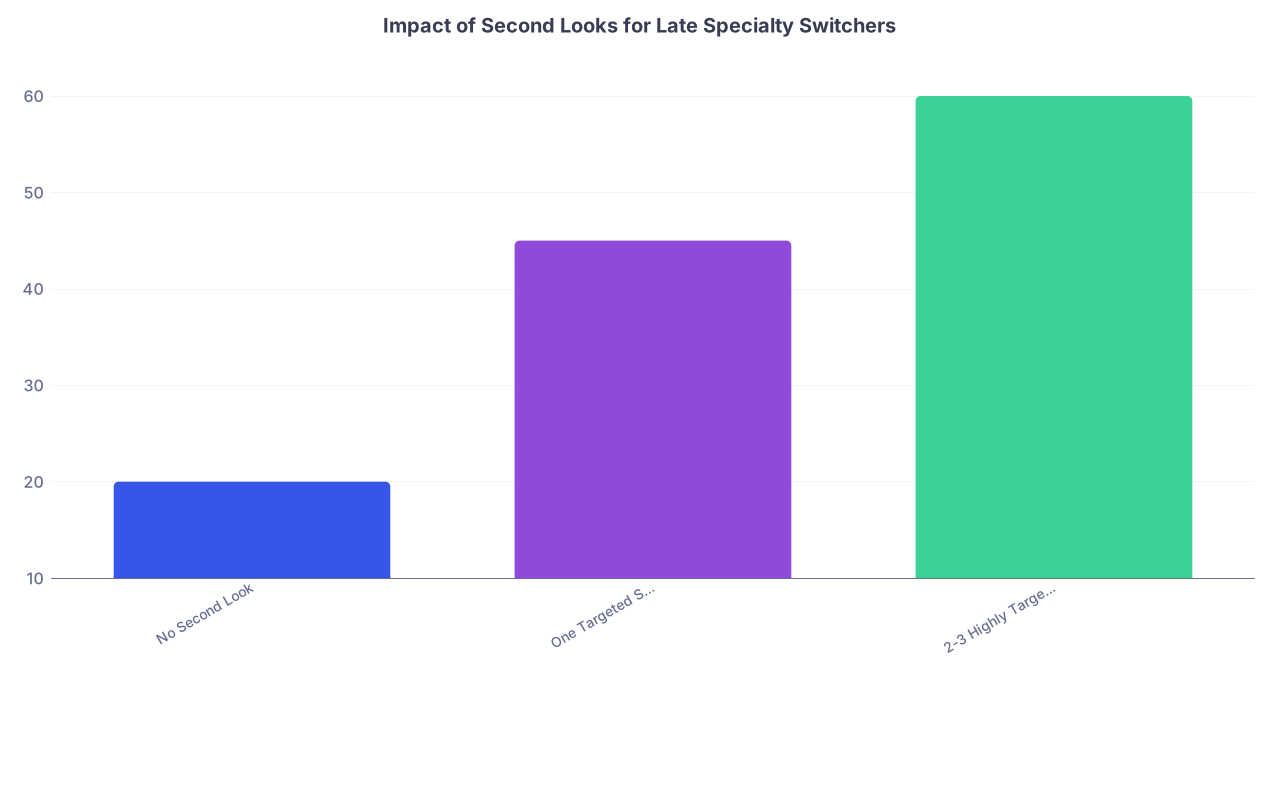
| Category | Value |
|---|---|
| No Second Look | 20 |
| One Targeted Second Look | 45 |
| 2-3 Highly Targeted Second Looks | 60 |
(Think of those numbers as “chance you’ll be seriously discussed as a late switcher,” not match probabilities. But the pattern is real: smart targeting beats passive waiting.)
Red Flags You Must Avoid During Second Looks
I’ve watched people tank their chances in a single afternoon. Don’t repeat their mistakes.
Avoid:
- Oversharing personal meltdown details. “I had a breakdown on call, I cried in the stairwell every night” might be true, but that’s for your therapist, not your PD. Translate: “I realized the clinical environment and pace were not sustainable for me long‑term.”
- Contradicting your written application. If your personal statement says you’ve wanted [new specialty] “since childhood,” but you tell people you only realized it two months ago after hating your surgery rotation, they’ll think you’re dishonest or disorganized.
- Trash‑talking your old field. You can criticize fit. Not character. Not intelligence. Not professionalism.
- Looking clueless about the new field’s reality. Don’t tell psych programs you chose them for lifestyle, then be unable to discuss severe psych, involuntary holds, or overnight work. Same with IM and ICU nights, etc.
On the flip side, small green flags you can plant:
- Ask residents: “What do you think people misunderstand about this specialty before they start?” Then connect their answer to something you’ve already thought about.
- Know the program: mention specific rotations, tracks, or clinics they offer that align with where you’re headed.
- Sound like you’ve read their day‑to‑day reality, not just their website brag paragraphs.
If They Say No to a Second Look
Sometimes programs will say, “We don’t offer second looks,” or “We’re not able to accommodate that this year.” That’s not necessarily a rejection.
Your move:
- Respond briefly: “Totally understand. If there’s anyone on your faculty I might speak with briefly by phone or Zoom to answer any questions about my late switch, I’d really appreciate even 10–15 minutes.”
- If they ignore that too, fine. Let it go. Rank them based on your priorities and move on.
Do not:
- Show up uninvited “just to say hi.” You’ll look unprofessional and boundary‑blind.
- Send multiple follow‑up emails begging for a visit. One ask and one brief follow‑up is enough.
Bottom Line: How to Use Second Looks Strategically in a Late Switch
If you’re pivoting specialties late in the game, second looks are not optional fluff; they’re one of the few tools you have to override the default suspicion.
Use them to:
- Present a clear, rehearsed, honest story of why you’re switching now—and why this time it sticks.
- Give real humans (residents and faculty) a reason to vouch for you at the rank table.
- Demonstrate that you’ve moved from “panic and burnout” to “deliberate, mature decision.”
If you remember nothing else:
- Do your narrative work before you step foot on a second look.
- Target a few programs where a second look will actually move the needle.
- Talk like someone programs can trust—not someone trying to escape a bad year at any cost.