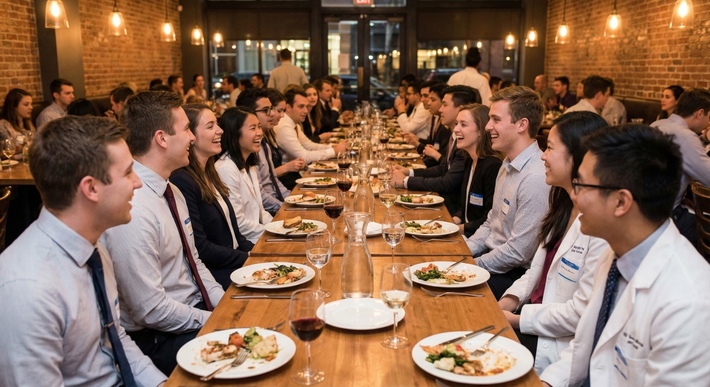
What if your entire impression with a program gets decided not by your interview… but by one awkward happy hour where you say almost nothing?
Yeah. That’s the exact nightmare that plays in my head too.
You get the email: “We’d love to invite you for a Second Look! There will be a dinner with residents and a casual happy hour after.”
And your brain goes:
Not “Yay, they like me.”
But: “Cool, can I tank my entire rank list in one evening by being weird and quiet?”
Let’s actually talk about this. Second looks, social anxiety, staring at a plate of bruschetta while everyone else is laughing like they’ve known each other for 10 years. How much does it matter? How do you not shut down? And what if you already had That One Weird Dinner?
Do They Secretly Judge You at Second Look Dinners?
Short answer I keep hearing from residents: not nearly as much as we think.
But my brain doesn’t believe that, so let’s break it down.
There are really three different “realities” at play:
What we fear is happening:
Every resident is secretly scoring us from 1–10 on “vibe,” will tell the PD we’re socially incompetent if we’re quiet for 10 minutes, and our rank list will drop from #2 to “never.”What actually happens in competitive, toxic-ish programs:
Sometimes, yes, they pay attention to “fit” way too much. They might say things like “He seemed a little awkward” in a rank meeting like that’s data. I’ve heard it. It’s gross, but it’s real in some places.What happens in most normal programs:
People are tired, hungry, half-checking their phones. They’re trying to be nice. They’ll remember:- The one applicant who was rude
- The one who made a weird/offensive comment
- The one who monologued arrogantly
Everyone else blends into the “seemed normal enough” bucket.
You being quiet, soft-spoken, or visibly nervous? Generally not a big deal.
You being dismissive, drunk, or condescending? Way bigger deal.
If it helps, here’s how residents actually think about these events:
| Situation | What You Think | What Residents Usually Think |
|---|---|---|
| You’re quiet at dinner | “They think I’m boring” | “Long day, they’re probably tired” |
| You ask 2–3 basic questions | “I seem unprepared” | “Ok, they’re trying to engage” |
| You stutter or talk fast | “I sound incompetent” | “Yeah, interviews are stressful” |
| You leave happy hour early | “They’ll think I’m rude” | “They probably have a flight” |
| You don’t drink alcohol | “I seem uptight” | “Totally normal, lots don’t” |
The bar is lower than your anxiety tells you. They are mostly trying to answer:
“Could I stand being on call with this person?”
That means: kind, not creepy, not arrogant. Not “life of the party.”
What Actually Happens at Dinners & Happy Hours
Let me paint the picture, because walking into this blind makes the anxiety 10x worse.
Typical dinner vibe
Restaurant. Semi-loud. Long tables. You sit with 3–5 residents and a couple other applicants. Conversation is usually:
- Where you’re from
- Where you go to med school
- Why this specialty
- What the city is like
- Random resident complaints about EMR, call, cafeteria food, etc.
Everyone repeats the same answers 17 times because there’s rotation of people and the same questions.
The conversation is not:
- Intense pimping on guidelines
- A secret oral exam
- A hidden “mini-interview”
Honestly, it’s small talk on repeat with some program info sprinkled in.
Typical happy hour vibe
Usually at a bar or brewery, sometimes a lounge, sometimes at a resident’s apartment. Noise level: high. Lighting: low. People are standing, moving around. Clusters form.
You will have:
- A drink in your hand (alcoholic or not, both normal)
- 1–2 residents who adopt you briefly, chat, then drift off
- At least 1 awkward moment where you’re just… standing
This is where social anxiety screams, “Everyone sees you alone, they all think you’re weird.”
Reality? Half the room is in their own head wondering if they seem awkward.
“I’m Socially Anxious. Should I Even Go to a Second Look?”
This is the question that makes my stomach flip.
Here’s my honest take:
Go if:
- You’re genuinely torn between a few programs and want real vibes
- You might live in that city for 3–7 years and need to feel it out
- You want to see how residents treat each other when faculty aren’t around
Skip (or be selective) if:
- A program is already low on your list and a second look won’t change that
- Travel money/time is killing you and adding stress
- Your mental health is on thin ice and extra social performance might break you
Second looks are useful. They are not mandatory. Not going almost never kills your shot.
Some programs actually say: “Second look will not be used in ranking decisions.” Are they always 100% pure about that? Maybe not, but they also know it’s an equity issue. They’re not going to mass-tank people who didn’t come.
If you’re anxious and still choose to go, at least be honest about your purpose:
“I’m going to gather intel, not to audition as The Most Charming Human Alive.”
Survival Plan for the Socially Anxious (That Doesn’t Require Becoming Extroverted)
Let’s be real: “Just be yourself!” is useless advice when your default self in groups is frozen, sweaty, and mentally rehearsing sentences 4 times before you say them.
You need a script and constraints.
1. Use a low-effort formula for small talk
Think: 1 question, 1 follow-up, then bail or let it die naturally.
Good starter: “So what’s your favorite / least favorite part of this program?”
That usually leads to:
- Call schedule
- Attendings
- Autonomy
- How they like living there
Other easy questions to rotate through:
- “Where did you train for med school?”
- “If you had to redo the match, would you rank here first again?”
- “What do interns struggle with most when they start?”
- “How’s the teaching on busy days?”
- “What’s the city like if you don’t have a car / if you have kids / if you’re a night owl?”
You don’t need 50 clever questions. You need like… 5. Max.
2. Pre-accept that silence will happen
You will have 10–30 second gaps. Maybe more. They will feel like an hour. They are not.
At a table, silence is normal. People eat. Servers interrupt. Someone checks their phone. You do not have to constantly carry the conversation.
What helps:
When a silence hits, mentally label it as “normal group rhythm,” not “proof I’m failing.” Literally tell yourself that in your head.
3. Aim for “pleasant and curious,” not “impressive”
You don’t have to:
- Be the funniest
- Dominate conversation
- Perform your CV
You do want to:
- Not interrupt constantly
- Ask 1–2 thoughtful questions
- React to what they say like a normal human
If their intern says, “Our ICU month is rough,” your job isn’t to respond with, “Well at my home program we…”
It can be: “How do you guys support each other on those rotations?” or honestly “Wow, that sounds brutal.”
You’re a person, not a brochure.
4. Set a “minimum engagement quota”
If your social battery dies early, use numbers. For example:
- Ask at least 3 residents a real question
- Have at least 2 conversations that last more than 3–4 minutes
- Stay at happy hour for 45–60 minutes, then you are allowed to leave
Once you hit your quota, you’re done. You’re not bailing. You’re protecting your sanity.
Alcohol, Leaving Early, and Other Things That Feel Risky
This stuff always feels like a minefield, especially if you already feel watched.
“Do I have to drink?”
No. Absolutely not. Lots of residents don’t drink. Lots of attendings don’t drink. Get a club soda with lime and 98% of people will assume it’s a gin and tonic and move on.
If someone explicitly asks, you can say:
- “I’m good with soda tonight, early flight.”
- “I don’t really drink, but I’m happy to hang out.”
Nobody reasonable will care. If they do care, that tells you a lot about the culture—and it’s not good.
“Can I leave early?”
You can. The trick is to do it cleanly.
Example script: “Hey, this was really great, I have an early [flight / drive / hotel checkout] tomorrow so I’m going to head out. Thanks so much for organizing this.”
Say goodbye to 1–2 people, not the entire bar. Then leave. Don’t hover awkwardly at the door second-guessing yourself.
Most residents are not clocking what time you left. They’re thinking about whether they have to round tomorrow.
“What if I say something dumb?”
You will. Everyone does. The real danger is not one awkward sentence. It’s repeated red-flag behavior.
Bad:
- Rude jokes
- Comments that sound racist/sexist/classist
- Bashing other programs or applicants
- Acting like you’re “above” certain patient populations
Awkward but harmless:
- You forget someone’s name
- You repeat a question someone else asked earlier
- You laugh at the wrong moment
- You fumble a sentence
They forget the harmless stuff by the next morning.
What If You Already Had a Horrible Second Look?
This is the 3 a.m. special: replaying every moment of a dinner you think you ruined.
Maybe you:
- Barely talked
- Were obviously anxious
- Left after an hour
- Felt totally invisible
Your brain: “They think I’m weird, I’m dropping 10 spots on their rank list.”
Here’s the uncomfortable truth: You will never know exactly how much, if at all, it affected anything. Rank meetings are a black box.
But from what I’ve heard and seen:
- Huge red flags can hurt you
- Being quiet/anxious almost never tanks you
- Programs care way more about how their residents acted than your awkwardness
They’re asking residents:
“Did anybody seem really off or inappropriate?”
Most of the time, your name doesn’t even come up. Which hurts the ego, but helps the match.
If you truly think you might’ve come off as disinterested or cold at a program you actually love, you can send a brief, non-cringey follow-up:
“Thank you for hosting the second look last week. I really appreciated the chance to hear from your residents, especially about [specific thing]. I’m very excited about the possibility of training at [Program].”
That’s it. No apology tour. No “Sorry I was quiet.” Just anchor one positive memory.
Quick Mental Reframe: Why Second Looks Aren’t an Exam
One last thing, because I keep needing to remind myself:
Second looks are not an exam where you get graded on performance.
They’re more like… a mutual, extremely inefficient site visit.
They’re there so:
- You can see if the residents look dead inside
- You can see if people laugh together or only complain
- You can physically feel whether you’d tolerate 3 a.m. in that hospital
They’re not there so you can audition as the most extroverted, charismatic, never-awkward future chief resident.
You are allowed to be:
- A bit shy
- A bit quiet
- A bit anxious
And still be exactly the type of doctor they want. Because, newsflash, hospitals are full of introverts and anxious overthinkers. The entire system runs on them.
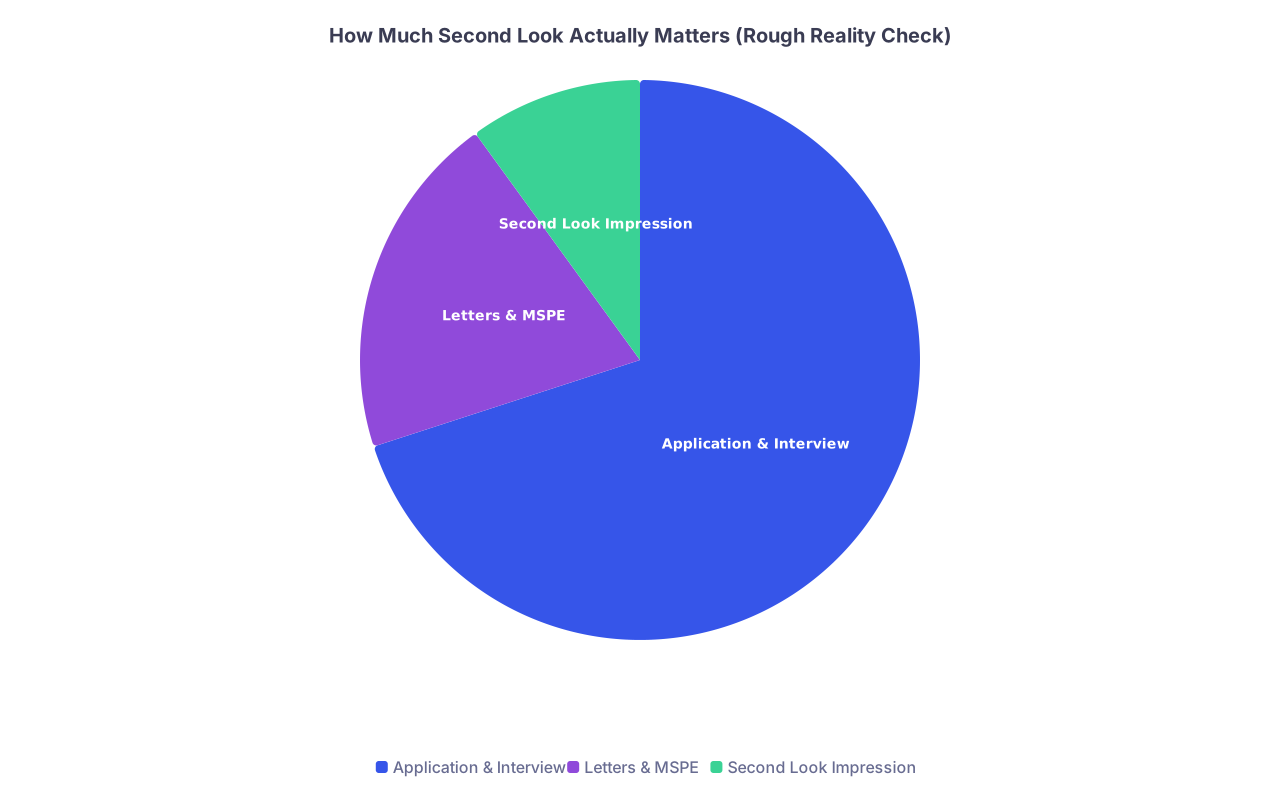
| Category | Value |
|---|---|
| Application & Interview | 70 |
| Letters & MSPE | 20 |
| Second Look Impression | 10 |

| Step | Description |
|---|---|
| Step 1 | Arrive at Restaurant |
| Step 2 | Find Resident Group |
| Step 3 | Normal Interaction |
| Step 4 | Dinner Ends |
| Step 5 | Stay 45 to 60 min |
| Step 6 | Go Back to Hotel |
| Step 7 | Day Over More Data Collected |
| Step 8 | Conversation Starts |
| Step 9 | Happy Hour? |

FAQs
1. If I skip a second look, will a program rank me lower?
Usually no. Most programs know not everyone can afford or schedule second looks. They’ve already formed their main impression from your interview day, application, and letters. Second looks are usually more for you than for them. Unless a program explicitly says “attendance is strongly encouraged” (rare), skipping doesn’t automatically drop you.
2. What if I’m the quietest person at the table?
Then you’re the quietest person at the table. That’s not a crime. As long as you’re polite, make some eye contact, ask a couple questions, and don’t look actively miserable, you’re fine. There’s always at least one introverted resident quietly rooting for you because they remember being you.
3. Is it bad if I only stay at happy hour for 30–45 minutes?
No. That’s honestly what a lot of people do—even residents who have to be up early. Stay long enough to talk to a few people, get a feel for the culture, then leave with a normal excuse: early flight, long drive, need to pack. You’re not obligated to close the bar down to prove interest.
4. How many questions should I ask so I don’t seem uninterested?
You don’t need to interrogate anyone. If in the whole evening you ask 3–6 real questions and respond thoughtfully to their answers, that’s more than enough. It’s not a quota contest. Residents notice more if you’re fake-interested or clearly reciting a list than if you’re just quietly curious.
5. What if I have a panic episode or feel like I might cry?
Step away. Bathroom, outside, hotel lobby—whatever. You’re allowed to take 5–10 minutes to breathe. Splash water on your face, do box breathing (inhale 4, hold 4, exhale 4, hold 4), remind yourself: “This is not life or death. It’s just dinner.” If it’s really bad, it’s ok to quietly excuse yourself and leave. One hard night doesn’t define your entire application.
Open your notes app right now and write down 5 simple questions you can ask residents at a second look. Just 5. That way, the next time you’re sitting at a loud table staring at your water glass, you don’t have to invent anything—you just pick one and say it.