
You’re Here
You graduated last year. You’re out of formal training. Match Week is coming, and you’re staring down the possibility—or reality—of entering SOAP with a “gap year” on your record and either zero or very few interviews.
You’ve done some work this year. Maybe a research job, maybe a prelim year you did not (or could not) continue, maybe non-clinical work, maybe nothing structured because life hit hard. Now you’re refreshing your email, thinking:
“Programs are going to see I’ve been out a year and just pass.”
Some will. Not all. Your job now is to ruthlessly position yourself as one of the exceptions.
Let me walk you through how to handle SOAP when you are:
- An MD/DO graduate
- Out of training for about a year (no current residency spot)
- Short on interviews
- Trying not to let this be the end of your clinical career
This is fixable. But not if you just sit and “hope the algorithm is kind.”
Step 1: Be Honest About the Problem (And Its Impact)
You’re not just “unlucky.” You’re fighting against several biases programs have:
- They prefer “fresh” grads.
- They worry about skill atrophy after a year off the wards.
- They question “Why did nobody else pick them up?”
- They worry about visa/board eligibility timing (for IMGs especially, but even some US grads).
So your strategy has to do three things:
- Minimize the perceived risk of your gap.
- Maximize your clinical readiness story.
- Make it as easy as possible for programs in SOAP to say “Yes.”
This is not about “deserving” a spot. This is about risk management from their side and targeted messaging from yours.
Step 2: Get Your Story Tight—Before SOAP Opens
When you’re out of training a year, your “gap explanation” is not optional. If you do not control the narrative, programs will assume the worst.
You need a 3-part narrative:
- What happened
- What you did with the time
- Why you’re ready now
Here’s the basic framework:
One sentence: What happened
“I graduated from X in 2024 and did not match into residency in the main cycle.”Two to four sentences: What you did this year
Clinically adjacent or clinically active is best. Examples:- Research with clinical exposure
- Working as a clinical research coordinator
- Scribe, telehealth support, quality improvement role
- Significant family/health issue followed by re-entry via observership, shadowing, or part-time work
Two to three sentences: Why you’re better prepared now
- You improved specific weaknesses (Step 2 score, clinical evaluations, communication skills)
- You stayed clinically engaged (chart review, patient contact, M&M reviews, case reports, observerships)
- You’re ready to start tomorrow—no retraining from zero needed
This narrative shows up in:
- Your ERAS “Experiences”
- Your updated Personal Statement (short, SOAP-focused version)
- Emails you send to PDs/coordinators (more on that later)
- Your response when asked in any SOAP interviews
Messy, rambling explanations kill you here. Keep it crisp and unemotional. You’re not making excuses; you’re explaining context and progress.
Step 3: Target the Right Specialties and Programs in SOAP
With a gap year and limited interviews, this is not the time for pride.
Programs in SOAP are filling unfilled spots. You need to think like them:
- “Who can safely care for our patients with minimal extra work from us?”
- “Who is likely to stay and not cause trouble?”
- “Who can start and pass Step 3/boards on time?”
You’re looking at:
- Community Internal Medicine
- Family Medicine
- Psychiatry (mid- to lower-tier programs)
- Pediatrics (some community programs)
- Transitional Year / Preliminary IM or Surgery (if you’re okay with a multi-step path)
Avoid the obvious traps:
- Highly competitive specialties (Derm, Ortho, ENT, Optho, Uro—SOAP here is nearly fantasy)
- Top-tier university categorical IM/Psych/FM that already passed on you once
- Programs with explicit “graduated within the last 3 years” and you’re pushing that limit with other red flags
Be ruthless and realistic. Your goal is a foothold in residency, not your dream fellowship in one move.
Here’s a simple way to think about relative chances:
| Specialty | SOAP Chance for Gap-Year Grad | Notes |
|---|---|---|
| Family Medicine | Higher | Many community programs |
| Internal Med | Moderate | Better at community sites |
| Psychiatry | Variable | Some open, some very picky |
| Pediatrics | Moderate-Low | Depends on region |
| Surgery Prelim | Moderate | Rough but doable path |
Not perfect data, but directionally right from what I’ve seen.
Step 4: Fix Your Application Material—Fast
If you’re entering SOAP, your base ERAS app is already built. But there are levers you can still pull.
Personal Statement: SOAP Version
You do not need a brand-new novel. You need a 3–4 paragraph, specialty-specific, direct statement that does:
- One short paragraph: Why this specialty, grounded in something real
- One paragraph: What you’ve done since graduation and what you learned
- One paragraph: What you bring right now to a residency team
- One closing line: “I’m ready to contribute from day one.”
Do not:
- Write a therapy session about the pain of not matching
- Blame your school, advisors, or personal circumstances
- Apologize 15 times
You are not begging. You are offering value with context.
Experiences: Update for This Year
If your “gap year” isn’t in ERAS as a real experience, fix that.
Create at least one entry for your current/most recent activity:
- Title: Clinical Research Coordinator / Medical Scribe / Research Fellow / Family Caregiver / Observership at X
- Dates: Accurately cover the year
- Description: 3–5 bullet-style sentences (yes, ERAS allows paragraph-style but think short, impactful lines), focusing on:
- Patient exposure
- Clinical reasoning, notes, orders input (if applicable)
- Communication with teams
- Any QA/QI, protocols, or guideline-based care familiarity
If you really did nothing structured for months, be honest but strategic. I’ve seen people write:
“Assisted with caregiving for an ill family member while independently reviewing [specialty]-relevant guidelines, reading [key textbooks], and participating in virtual CME lectures.”
Then you back that up by actually having some CME certificates if they ask.
Letters of Recommendation
In SOAP, new letters are hard to add in time, but if you have:
- A recent attending from an observership or job
- A PI from research who is clinically active
- A prior residency PD (if you left a program)
Get them to email a short, strong letter directly to interested programs once SOAP opens and you contact programs. ERAS won’t update in time, but PDs will often accept emailed PDFs in this specific chaos window.
Step 5: How to Rank and Apply During SOAP
When SOAP opens, you get a limited number of applications per SOAP round. You cannot spray ERAS at 200 programs.
You need a strategy.
Use this flow:
- Prioritize categorical FM/IM/Psych/Peds in less-desired geographic areas. Rust belt, rural South, central Midwest, etc.
- Within those, prioritize community and smaller university-affiliated programs.
- Only after exhausting reasonably realistic categorical options should you add prelim/TY spots.
Here’s a simple decision tree:

| Step | Description |
|---|---|
| Step 1 | Unmatched MD DO with gap year |
| Step 2 | Apply to community and mid-tier first |
| Step 3 | Focus on prelim TY and prelim IM |
| Step 4 | Add less desirable regions |
| Step 5 | Wait for responses |
| Step 6 | Rank prelims based on training quality and location |
| Step 7 | Any categorical FM IM Psych Peds open? |
| Step 8 | Used most SOAP applications? |
If you apply to 45 categorical spots and 5 prelim/TY in the first round, that’s usually better than 20 categorical, 20 prelim surgery, 10 random “dream” university programs.
You are not in “preference” mode. You are in “probability-weighted survival” mode.
Step 6: Direct Communication During SOAP (The Right Way)
You’re going to want to email every PD and coordinator. Most people do this badly.
Do not send a 700-word autobiography with attached transcripts and a plea.
Send a short, structured email when you have applied to that program in SOAP:
Subject: “SOAP Applicant – [Your Name], MD – Interested in [Program Name]”
Body (something like):
“Dear Dr. [PD Name] and [Coordinator Name],
I have applied to your [Specialty] residency program through SOAP. I am a 2024 MD graduate from [School], currently working as [brief current role]. Over the past year, I have remained clinically engaged through [1–2 concrete points].
I am specifically interested in your program because [1–2 program-specific details that are actually real]. I would be grateful for consideration for any available positions and am prepared to start with a strong foundation in [clinical skills relevant to specialty].
Thank you for your time and consideration.
Sincerely,
[Name, MD]
AAMC ID: XXXXXXXX
Phone: XXX-XXX-XXXX”
That’s it. Clean. Respectful. Shows you’re active, not stale.
Send these selectively to programs where you’re genuinely a fit, not every single listing.
Step 7: Interviewing as a Gap-Year SOAP Candidate
If you get a SOAP interview invite, that PD is already open to you despite the gap. Your job is not to talk them out of it.
Key points to hit:
Own the gap, don’t dodge it.
“I didn’t match last year because [scores/late exam/preferred only competitive specialty/etc.]. I used this year to [specific constructive actions].”Emphasize current clinical readiness.
Talk about:- Recent patient interactions
- Reading you’ve done (guidelines, UpToDate, specific board resources)
- Any simulation, workshops, CME, ACLS/BLS recertification
Signal stability and commitment.
PDs fear attrition. Explicitly say: “If I match here, I intend to complete my training here. I’m not using this as a stepping stone to switch specialties in a year.”Have one strong, recent patient story.
Something that shows you thinking clinically this year, not only from med school.
Expect these questions:
- “So what have you been doing since graduation?”
- “Why do you think you didn’t match last year?”
- “Why our program/this specialty now?”
- “How will you handle the transition back to full-time clinical work after time away?”
Prepare specific answers. Not vibes.
Step 8: Plan B in Case SOAP Fails
You need to emotionally make room for the possibility that SOAP does not work out. That doesn’t mean you give half-effort; it means you don’t implode if it goes badly.
If SOAP doesn’t pan out, you need a very different kind of year—one that makes you more matchable next cycle, not less.
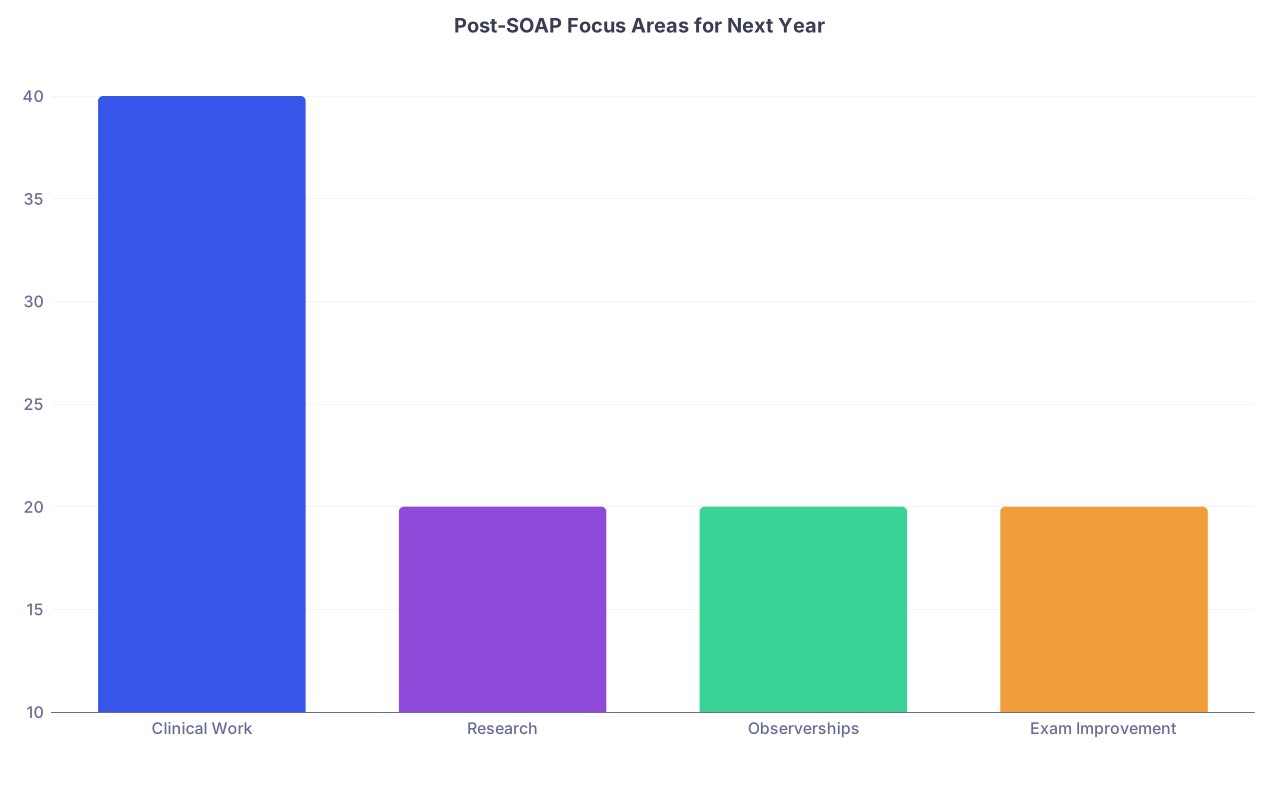
| Category | Value |
|---|---|
| Clinical Work | 40 |
| Research | 20 |
| Observerships | 20 |
| Exam Improvement | 20 |
Priority list if you miss in SOAP:
Get into something clinically adjacent with patient care and chart exposure.
- Hospitalist extender, research coordinator, scribe, urgent care assistant, etc.
- Or structured observerships with letters.
Take and pass Step 3 early (if you’re eligible and scores support it).
PDs love “low-risk” exam profiles.Build 1–2 new, recent letters from US clinicians who can say, “I’d trust this person with my patients.”
Strip out unrealistic targets for next year and decide on a matchable specialty. No more applying to Derm + 3 FM programs as backup.
I’ve seen people with 2–3 gap years still get in—because they finally treated the in-between years as preparation, not dead time.
Step 9: Mental Framing (Because This Week Will Mess With You)
SOAP week is brutal. You’ll see classmates celebrating. You’ll be living in a spreadsheet and your inbox.
Three things to keep straight in your head:
- This is not a referendum on your worth as a physician. It’s a messed-up logistics and optics game plus some merit.
- Your job is not to get every program to like you. Your job is to be the obvious low-risk choice for a handful of programs that need reliable bodies.
- You cannot control program behavior; you can control how clear, current, and competent you look on paper and on Zoom.
Set a schedule for yourself SOAP week:
- Defined times to check email and NRMP portal
- Pre-written templates for PD emails
- Updated CV and short personal statement ready in one folder
- 1–2 trusted people to reality-check your thinking, not 15 anxious group chats
Concrete Example: What This Looks Like Done Right
Let me sketch a scenario I’ve actually seen some version of:
- US-DO, graduated 2024, Step 1 pass, Step 2 CK 219
- Applied broadly to IM and Psych, got 4 interviews, didn’t match
- Spent year working as clinical research coordinator in cardiology at a community hospital, with some patient contact and chart work
- Took Step 3 in January, passed
SOAP strategy:
- Tight IM and FM SOAP personal statements with 1 paragraph on the research job and 1 paragraph on readiness
- ERAS updated with research coordinator position and a brief observership in FM clinic
- Email to 25–30 community FM/IM programs in less competitive regions, leaning on:
- “I’m already working in a community hospital environment”
- “Just passed Step 3 and can focus fully on residency”
- Two short, strong recent letters emailed directly by research attending and FM clinic preceptor
Outcome: 3 SOAP interviews (2 FM, 1 IM). Matched FM at a midwestern community program.
Was it glamorous? No. Was it real and repeatable? Yes.
Quick Visual: SOAP Week Actions
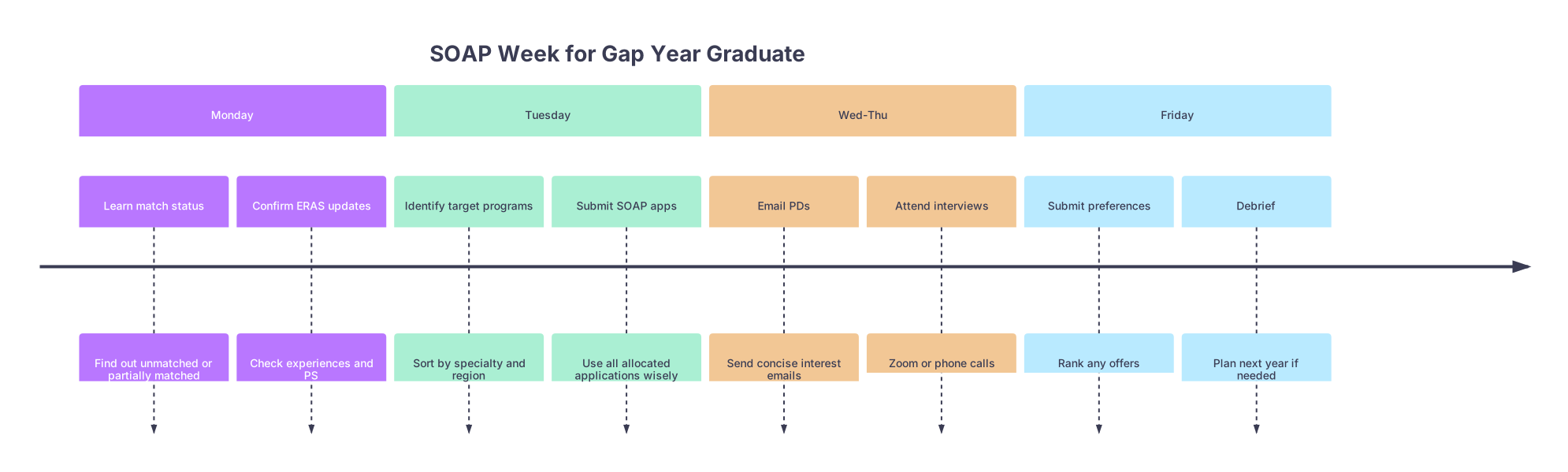
| Period | Event |
|---|---|
| Monday - Learn match status | Find out unmatched or partially matched |
| Monday - Confirm ERAS updates | Check experiences and PS |
| Tuesday - Identify target programs | Sort by specialty and region |
| Tuesday - Submit SOAP apps | Use all allocated applications wisely |
| Wed-Thu - Email PDs | Send concise interest emails |
| Wed-Thu - Attend interviews | Zoom or phone calls |
| Friday - Submit preferences | Rank any offers |
| Friday - Debrief | Plan next year if needed |
FAQ (Exactly 3 Questions)
1. Should I still apply in SOAP to my “dream” specialty if I’m a year out and had no interviews there?
If you mean something like Derm, Ortho, ENT, or similarly hyper-competitive fields—no, not as any meaningful portion of your SOAP applications. You can toss one or two apps if it helps you sleep, but do not waste your limited SOAP slots there. With a year out and limited interview history, your realistic foothold is in broader-access fields (FM, IM, Psych, Peds, prelim/TY). Get in the system first. You can rethink long-term direction later, but there is almost no conversion from “gap-year plus no prior interviews” to “SOAP into elite competitive specialty.”
2. Does taking Step 3 before SOAP significantly improve my chances as a gap-year grad?
If your Step 2 is reasonably solid (≥220ish for MD, slightly higher comfort range for DO/IMG) and you pass Step 3, yes, it helps. It tells PDs: “No exam risk, no licensing delay.” In SOAP, that matters because they’re making fast decisions with incomplete data. If your Step 2 is very shaky or you’re at real risk of failing Step 3, then rushing it is a bad move. But if you can pass it before SOAP and not tank your score, it’s one of the cleanest ways to offset the anxiety about your time out of training.
3. If I do not match in SOAP, is it ever smart to take another full “off” year to regroup?
A completely non-structured “off” year will make things worse, not better. The only time it’s reasonable is if there’s a serious medical or family crisis—and even then, you must later show a credible re-entry plan. From a PD’s viewpoint, each year out of training is decay. If you miss in SOAP, you need the next 12 months to be as clinically adjacent as possible: job in a hospital, observerships, research with patient contact, Step 3 completion, fresh letters. Another vague “gap” year with no clear growth is basically a soft exit from the residency pipeline.
Today, do one concrete thing: open your ERAS experiences section and make sure this past year is represented with a clear, clinical-leaning entry. No blank space. No mystery. Then draft a 3-paragraph, specialty-specific SOAP personal statement that explains your year and shows you’re ready to work now. That’s your floor. Build from there.