
The fantasy that a big attending paycheck will magically fix your loans is dangerous. The first five years after residency will decide whether you crawl out of debt or stay chained to it for decades.
I’m going to walk you year-by-year through a five-year post-residency timeline to move from “I owe more than I make” to “I’m stable, protected, and in control.” This is not fluffy “budget better” advice. This is: at Month 1 do this, by Year 3 you should have that.
Assumptions I’ll work with:
- You’re finishing residency or fellowship with high six-figure federal loans (and maybe some private).
- You’re becoming an attending making roughly $220–400k (mix of hospital-employed and private practice logic).
- You’re in the US; student loans here are their own special hellscape.
You’ll adapt details, but the sequence is what matters.
Month 0–6 Post-Residency: Lock Down the Foundation
This is triage. If you get these first 6 months wrong, you’ll bleed money for years.
Weeks 1–2: Full Financial Snapshot
At this point you should:
- Know exactly what you owe.
- Know exactly what you earn.
- Have a provisional repayment plan chosen, not “I’ll figure it out later.”
Do this in the first two weeks of attending life:
List every loan
- Log into StudentAid.gov. Export the full list.
- For each loan: balance, interest rate, type (Direct unsubsidized, Grad PLUS, etc.).
- Separate federal vs private.
- Note if you have any pre-2010 Perkins, FFEL, or older consolidation loans that might not be PSLF-eligible without reconsolidation.
Clarify your employment path
- Are you working:
- At a 501(c)(3) hospital or academic center? (PSLF-eligible)
- For-profit hospital, private group, or locums-only? (PSLF usually off the table)
- This single distinction will shape your next five years.
- Are you working:
Estimate your real take-home pay
- Request HR stub or use last resident pay stub + contract.
- Include:
- Federal, state, FICA
- Health insurance
- 401(k)/403(b)/457 contributions (even if you plan to change these later)
At this point you should have one page that reads:
- Total federal loans: $X at Y% average
- Total private loans: $X at Y% average
- Job: PSLF-eligible? Yes/No
- Monthly net income: $X
Weeks 3–6: Choose a Strategy and Stop the Bleeding
Decision fork: public-service → PSLF vs no PSLF → aggressive payoff/refinancing.

| Step | Description |
|---|---|
| Step 1 | Finish Residency |
| Step 2 | Use IDR Plan |
| Step 3 | Certify Employment Yearly |
| Step 4 | Compare Refi vs Federal |
| Step 5 | Choose Aggressive Payoff |
| Step 6 | PSLF Eligible Job? |
If you have a PSLF-eligible job:
At this point you should:
- Be enrolled in an income-driven repayment (IDR) plan.
- Have your employment certified.
Steps:
Pick your IDR plan
- For most new attendings now, SAVE (successor to REPAYE) is the default winner:
- Payment = % of discretionary income.
- Interest benefit reduces negative amortization pain.
- If married, taxation weirdness, or older plans (PAYE, IBR) in play, spend money on a one-hour student loan consult. It’s worth it.
- For most new attendings now, SAVE (successor to REPAYE) is the default winner:
File your PSLF paperwork
- Submit PSLF Employment Certification Form as soon as you start.
- Set a recurring annual reminder (phone + calendar) to re-certify.
Park extra cash early
- For the first 3 months as attending, do NOT increase lifestyle.
- Open a high-yield savings account:
- Target: $10–15k as an early emergency cushion.
- Keep making the required IDR payment only. Do not prepay principal if you’re serious about PSLF. That’s wasted generosity to your servicer.
If you’re not PSLF-eligible:
At this point you should:
- Be in a safe federal plan while you analyze.
- Not have refinanced yet unless you’re absolutely sure.
Short-term: move into a reasonable federal plan
- Use SAVE or the lowest-payment IDR to buy yourself 3–6 months of breathing room while you:
- Learn your true income.
- Decide how aggressive you can be.
- Use SAVE or the lowest-payment IDR to buy yourself 3–6 months of breathing room while you:
Set a temporary spending rule
- For 3 months, lock in a “resident plus 20–30%” lifestyle. Not full attending lifestyle.
- Every dollar you don’t inflate is a future debt kill shot.
By Month 6: decide on refinancing
- If:
- Debt-to-income ratio is <1.5:1 (e.g., $250k debt, $300k salary), and
- You are strongly not going to a PSLF-eligible job,
- Then start comparing private refinance offers (Laurel Road, SoFi, Earnest, etc.).
- Do not refinance before:
- You have $10k emergency fund, and
- You’re sure you won’t qualify for IDR forgiveness or PSLF later.
- If:
Month 7–12: Stabilize Cash Flow and Protect the Downside
You’ve survived the transition. Now you prevent a future disaster.
At this point you should:
- Have a consistent repayment plan.
- Be insured against the big three: disability, death, malpractice (the last via employer).
Protect Your Future Earnings
Own-occupation disability insurance
- Non-negotiable.
- If your attending contract is signed, buy an individual “own specialty” disability policy within these first 12 months.
- If you delay and your health changes, you’re stuck.
Term life insurance (if anyone depends on you)
- Spouse, kids, co-signed loans → you need 20–30-year level term.
- Do not buy whole life. You’re trying to dig out of debt, not fund someone else’s commission.
Build a Realistic 12-Month Cash Plan
At this point you should:
- Know your monthly surplus with moderate lifestyle.
- Have automatic transfers set up.
Set 3 specific goals for Year 1
- Example:
- Build 3 months of expenses in emergency savings.
- Max out 401(k)/403(b) up to employer match at least.
- Begin either:
- Extra principal payments (if not PSLF), or
- Taxable investing (if PSLF).
- Example:
-
- Day of paycheck:
- 401(k)/403(b)/457 contribution pulled by employer.
- Automatic transfer:
- $X → high-yield savings (until emergency fund is at goal).
- Then $X → either:
- Extra loan payment (non-PSLF path), or
- Brokerage account (PSLF path).
- Day of paycheck:
Lifestyle cap for Year 1
- Set a specific cap: e.g., housing ≤20–25% of gross income.
- Delay major lifestyle upgrades:
- Buying a house
- Luxury car leases
- Long expensive vacations
You’re not punished; you’re on a sprint. Five years of controlled choices beats 25 years of “I’ll always have payments.”
Year 2: Pick a Lane and Press the Gas
By the end of Year 1, the dithering phase is over. In Year 2, the strategy becomes aggressive and intentional.
At this point you should:
- Have chosen PSLF/IDR forgiveness vs aggressive payoff.
- Be aligning investments and lifestyle with that path.
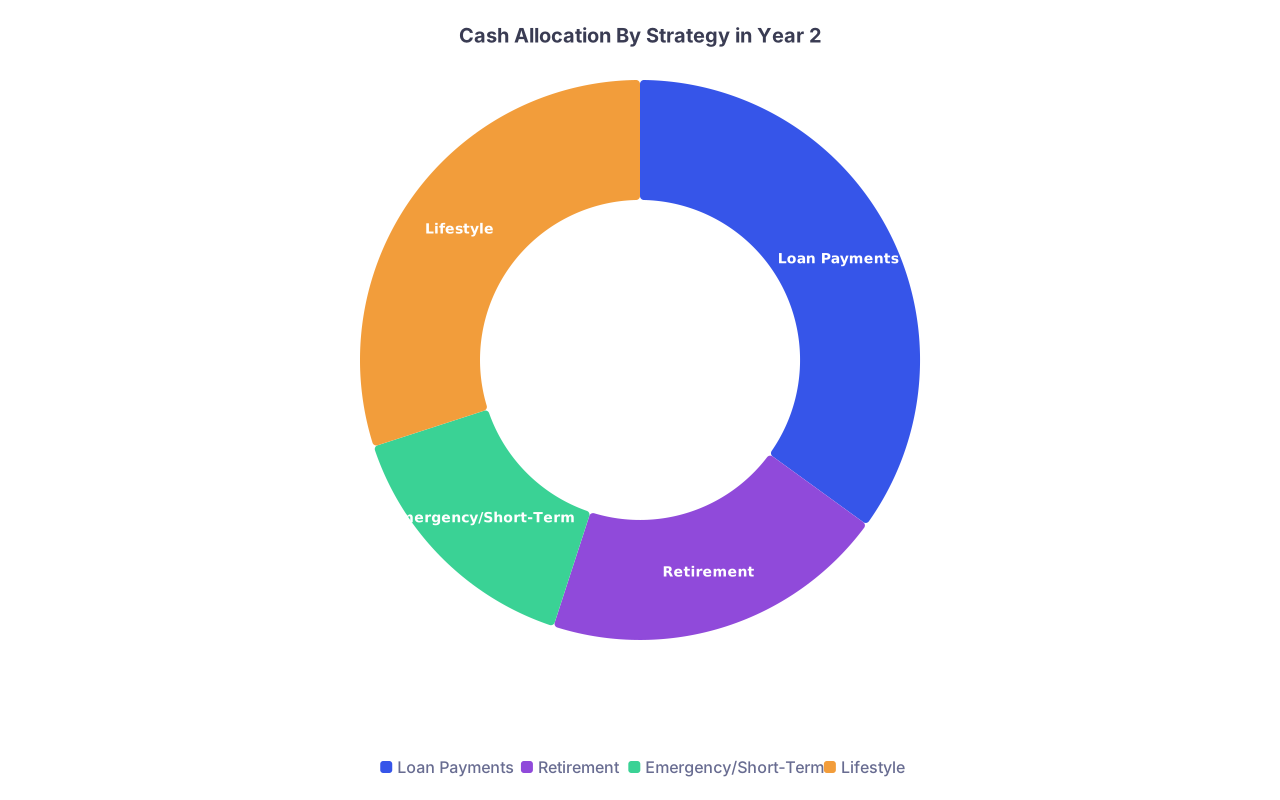
| Category | Value |
|---|---|
| Loan Payments | 35 |
| Retirement | 20 |
| Emergency/Short-Term | 15 |
| Lifestyle | 30 |
If You’re on the PSLF / Forgiveness Track
Goal: Minimize required payments, maximize investing, and avoid losing eligibility.
Annual PSLF hygiene
- Re-certify income.
- Keep a personal folder with:
- Copies of each PSLF form.
- Pay stubs, W-2s.
- Watch for servicer errors like the rest of us.
Invest aggressively
- At this point you should:
- Max employer match at minimum.
- Strongly consider:
- Max 401(k)/403(b): $20k+ per year (check current limits).
- Max Roth IRA or backdoor Roth if income too high.
- The money you don’t send to loans should be compounding for you, not sitting in checking.
- At this point you should:
Avoid moves that nuke PSLF
- Don’t:
- Refinance federal loans to private.
- Drop to PRN-only non-qualifying roles without recalculating your 10-year PSLF horizon.
- If you plan to leave public service, run the math before changing jobs.
- Don’t:
If You’re on the Aggressive Payoff Track
Goal: High savings rate + concentrated loan attack.
Refinance once, carefully
- At this point you should:
- Have your emergency fund at least 3 months expenses.
- Feel secure in your job and specialty demand.
- Then:
- Shop multiple lenders the same week.
- Decide between:
- 5-year variable (if you’ll pay off in ≤3–4 years and can stomach rate risk), or
- 5–10-year fixed (safer, still aggressive).
- At this point you should:
Set a specific debt-free date
- Example: “I will have all non-mortgage student debt gone before the end of Year 5.”
- Reverse-engineer monthly required payment + extra principal.
Create a “loan snowstorm,” not just snowball
- Yes, you can use snowball (smallest balance first) for motivation.
- But if your rates differ, I’d prioritize highest interest rate first.
- Automate extra payment on the chosen loan each month.
Year 3: Consolidate Stability and Avoid Lifestyle Creep
This is where many attendings blow it. Year 1 they’re cautious. Year 2 they’re confident. Year 3 they quietly let spending expand to swallow every raise and bonus.
At this point you should:
- Feel less panicked about money.
- Be resisting the temptation to normalize a bloated lifestyle.
Midpoint Check: Where You Should Stand
Rough benchmarks by end of Year 3 (not perfect, but realistic targets):
| Category | Target Range |
|---|---|
| Emergency Fund | 3–6 months expenses |
| Retirement Savings | 1–1.5x your annual salary |
| Federal Loans (PSLF) | 36+ qualifying payments logged |
| Non-PSLF Loans | 40–60% of original balance paid off |
If you’re nowhere close, you either:
- Live too large,
- Have a very low income relative to debt,
- Or your plan is misaligned (PSLF vs payoff).
Year 3 Actions
Reassess your contract and income
- By now, you:
- Have a sense of productivity bonuses.
- Know what call actually pays.
- Use this year to:
- Negotiate if possible.
- Consider switching jobs if your current role sabotages your financial plan (e.g., staying in low-paying private practice with massive loans and no PSLF).
- By now, you:
Guardrail: % of income to fixed obligations
- Keep:
- Housing (rent/mortgage, taxes, insurance) ≤25–30% of gross.
- Total debt payments (loans + car + credit card) ≤35% of gross.
- If you’ve crept beyond this, you’re choking your ability to buy your freedom.
- Keep:
Decide on housing, intentionally
- If you haven’t bought a home yet, Year 3 is a reasonable time to consider it, if:
- You’ll be in the area 5+ years.
- Your loans are under control (PSLF track) or halfway done (aggressive payoff).
- Don’t use “I’m a doctor” as justification for buying too much house.
- If you haven’t bought a home yet, Year 3 is a reasonable time to consider it, if:
Year 4: Optimize, Don’t Overcomplicate
By Year 4, the basics should be on autopilot. You’re not “figuring out loans” anymore; you’re optimizing everything around them.
At this point you should:
- Have a stable savings rate.
- See visible progress: shrinking balances or growing investable net worth.
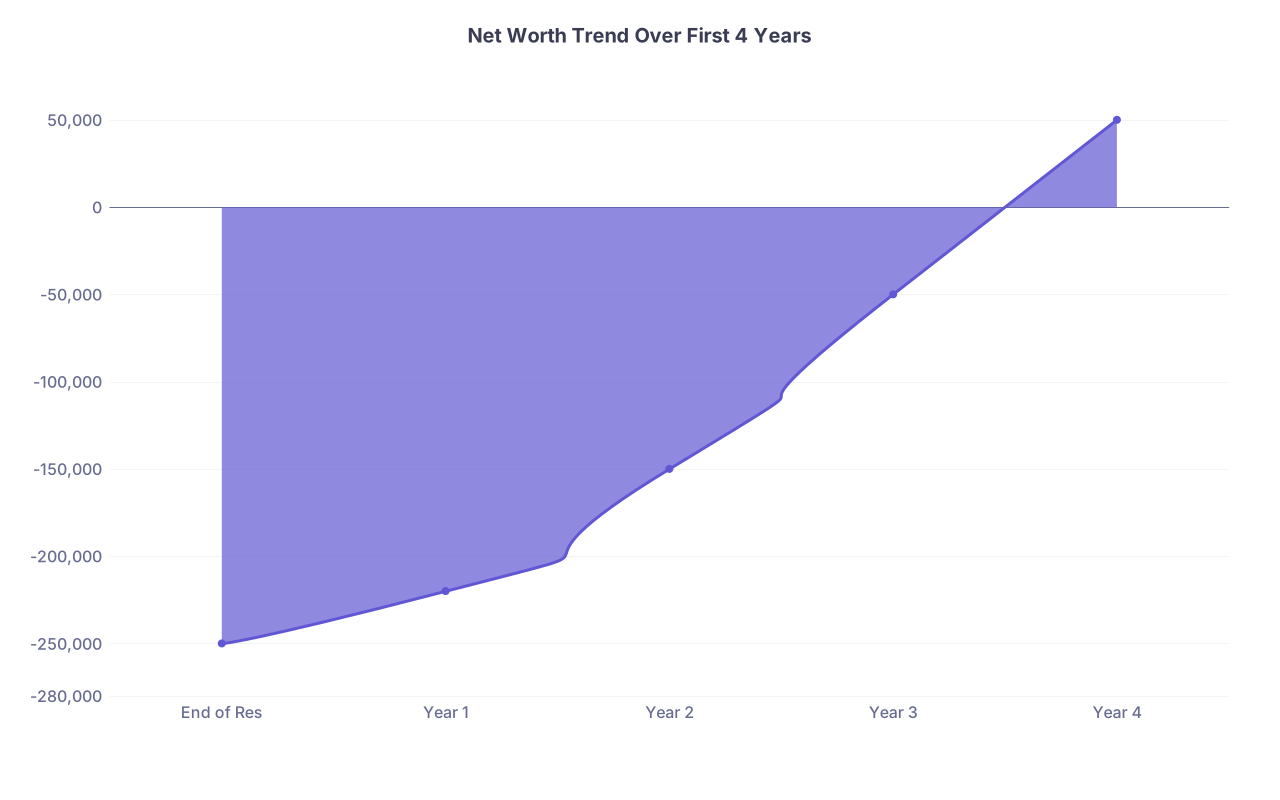
| Category | Value |
|---|---|
| End of Res | -250000 |
| Year 1 | -220000 |
| Year 2 | -150000 |
| Year 3 | -50000 |
| Year 4 | 50000 |
For PSLF/IDR Track in Year 4
Run a forgiveness projection
- Estimate:
- Remaining required payments (out of 120 for PSLF, or 20–25 years for IDR).
- Expected balance at forgiveness.
- Confirm:
- Tax treatment: PSLF is tax-free; traditional IDR forgiveness currently taxable (subject to policy changes).
- Start mentally setting aside money in case tax law doesn’t magically save you.
- Estimate:
Maximize tax-advantaged space
- At this point you should be:
- Maxing work retirement accounts.
- Strongly considering:
- Backdoor Roth IRA.
- Possibly an HSA if you have a high-deductible plan.
- At this point you should be:
Tilt toward wealth building
- Keep required IDR payment + emergency savings.
- Direct all additional surplus into:
- Broad-market index funds.
- Maybe a down payment fund if you’ve waited on housing.
For Aggressive Payoff Track in Year 4
Your mission: cross from “very indebted” to “nearly free.”
Push principal like it’s a side job
- At this point you should:
- Be putting 20–30% of take-home toward loans (if you’re serious about payoff in ~5 years).
- Any unexpected income:
- Bonuses
- Side-gig locums
- Tax refunds
- → Straight to principal.
- At this point you should:
Consider micro-lifestyle cuts for macro impact
- Example:
- Dropping monthly expenses by $1,000 and redirecting to loans is $12k/year.
- Over two years at 6–7%, that’s tens of thousands saved.
- Example:
Schedule a payoff date
- Not “sometime in the next few years.”
- Choose: “I will make the final payment December of Year 5.”
- Build yourself a visual tracker. People roll their eyes at this until they see how motivating it is.
Year 5: Transition From “Indebted” to “Stable”
This is the year the identity shift happens. You move from “attending with a huge loan problem” to “attending with a plan and margin.”
At this point you should:
- Either be debt-free (non-PSLF path) or well past the halfway mark to forgiveness (PSLF).
- Have a positive net worth or be on the edge of it.

Year 5 Milestones to Aim For
Here’s what “stable” usually looks like after five disciplined years:
| Area | Non-PSLF Track | PSLF/IDR Track |
|---|---|---|
| Student Loans | Paid off or <10% remaining | 60–100 qualifying PSLF payments |
| Emergency Fund | 6 months expenses | 6 months expenses |
| Retirement | 2–3x annual salary saved | 2–3x annual salary saved |
| Net Worth | Positive, growing | Approaching breakeven or positive |
Final Loan Push (Aggressive Payoff Path)
If all goes to plan, this is your kill year.
Finish them
- If your loan balance is down to the last $20–50k, treat it like an emergency.
- Two options:
- Cut hard for 6–12 months and wipe it.
- Add temporary extra shifts/locums with the explicit purpose: “Every dollar goes to the last loans.”
Reclaim loan payment cash flow
- When the loans are gone:
- Do NOT immediately convert that $3–5k/month into lifestyle.
- For at least 6–12 months, redirect that exact amount into:
- Taxable brokerage account, or
- Accelerated mortgage payoff if that’s your next goal.
- When the loans are gone:
Mid-Forgiveness Stability (PSLF/IDR Path)
If you’re on PSLF, five years post-residency might look like:
- 6–9 years of qualifying payments total (including residency/fellowship).
- Clear line of sight to the end.
At this point you should:
Validate your PSLF record
- Confirm your payment count with servicer.
- Fix discrepancies now, not in Year 9 or 10 when you discover they miscounted.
Build “forgiveness hedge” wealth
- Continue:
- Maxing tax-advantaged accounts.
- Investing taxable surplus.
- The goal:
- If policy changes or PSLF implodes, you’re not ruined; you have assets.
- Continue:
Visual Five-Year Overview
Here’s how the focus shifts year by year:
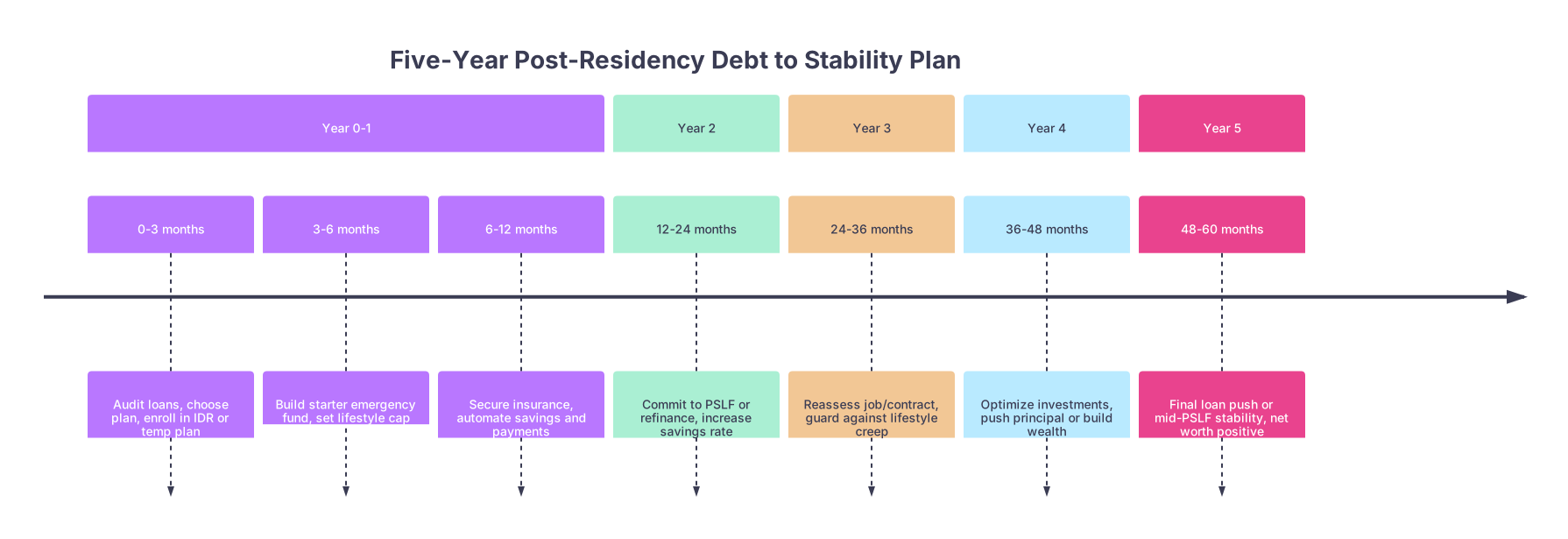
| Period | Event |
|---|---|
| Year 0-1 - 0-3 months | Audit loans, choose plan, enroll in IDR or temp plan |
| Year 0-1 - 3-6 months | Build starter emergency fund, set lifestyle cap |
| Year 0-1 - 6-12 months | Secure insurance, automate savings and payments |
| Year 2 - 12-24 months | Commit to PSLF or refinance, increase savings rate |
| Year 3 - 24-36 months | Reassess job/contract, guard against lifestyle creep |
| Year 4 - 36-48 months | Optimize investments, push principal or build wealth |
| Year 5 - 48-60 months | Final loan push or mid-PSLF stability, net worth positive |
What “Stable” Actually Means After Five Years
Let’s define the thing you’re aiming at, so you recognize it when you get there.
By the end of Year 5, financial stability post-residency means:
Your loan plan is boring
You’re either:- Done with loans, or
- Just making predictable PSLF/IDR payments and letting forgiveness come.
Your net worth is climbing automatically
Retirement contributions and investments happen without drama. You don’t need heroics every month.A single bad month doesn’t sink you
If you had to replace your car, take unpaid leave, or handle an emergency, you wouldn’t panic or go back into high-interest credit card debt.Money is a tool, not a chronic stressor
You still think about it. But you’re not waking up at 3 a.m. rehearsing loan balances in your head.

Two Final Rules That Matter More Than Any Spreadsheet
Decide once, automate ruthlessly
The enemy isn’t math. It’s decision fatigue.
Pick your path (PSLF vs payoff), automate contributions and payments, and stop rethinking everything every month.Control lifestyle for five years, buy freedom for thirty
If you keep your lifestyle ratcheted just one notch below what you “could” afford for these first five attending years, you buy an enormous amount of freedom: to change jobs, reduce call, work part-time, or walk away from toxic environments.
You don’t have to be perfect. You do have to be deliberate. The five-year clock starts the day you walk out of residency.