
The fastest way to burn out in first year is to let medical school erase who you are and then try to rebuild yourself from exam scores and other people’s approval.
You are not “a 72 on the anatomy midterm.” You are not “the dumb one in PBL.” You are not “the only person who still has no research.” You are building a professional self‑concept. And if you do it passively, the environment will do it for you. Badly.
Let me break this down specifically.
What “Professional Self‑Concept” Actually Means (Not the Fluffy Version)
Strip away the jargon. Professional self‑concept in first‑year is basically four things:
- What you believe a “real doctor” is like.
- Where you see yourself in that picture.
- How you explain your own successes and failures.
- How you behave under stress when nobody is watching.
Most schools talk about “professional identity formation” in abstract terms. Reflection essays. White coat ceremonies. A few ethics lectures. That is the glossy layer. Underneath, the real shaping happens in:
- How attendings talk about “good students.”
- How your classmates brag or self‑deprecate.
- Who gets praised, who gets ignored, who gets subtly mocked.
- How the curriculum rewards speed, recall, and conformity.
If you do not actively build a resilient identity, you will absorb whatever the hidden curriculum hands you. That is where you see first‑years go from confident, interesting human beings in August to exhausted, anxious score-obsessed shells by April.
Professional self‑concept in first‑year sits at the intersection of:
- Self‑efficacy – “I can learn this, even if it is hard.”
- Values – “This is the kind of physician I’m becoming, and this is non‑negotiable.”
- Belonging – “I actually fit here, even if I’m different in X/Y/Z ways.”
- Boundaries – “I can say no without feeling like a failure.”
If one of those is missing, the whole structure becomes fragile.
The First‑Year Identity Shock: Why Everything Feels Off
You walk into M1 with some established identity pillars:
- You were probably top 5–10% of your undergrad.
- People told you you were “the smart one” or “the hardworking one.”
- You had a life with non‑medical hobbies and relationships.
- You had a simple metric of success: grades and acceptance letters.
Then first‑year hits and several things happen almost immediately:
The competence inversion
Everyone around you was also “top 5–10%.” That label loses meaning. Your previous A+ effort barely scrapes by as average. The volume of content makes your old study strategies feel childish. You start thinking, “Maybe I was never that smart. Maybe I gamed the system and it finally caught up.”The comparison flood
You are suddenly surrounded by people who:- Finished a PhD before med school.
- Have three first‑author publications.
- Worked as an ICU nurse for 8 years.
And they talk about it. Constantly. Your brain does a dumb, automatic thing: “They are real medical people. I am an impostor.”
The value squeeze
Preclinical years are optimized for testable content, not for meaning. You spend 6 hours memorizing the urea cycle while the part of you that wanted to help vulnerable patients quietly dies in a corner. That gap between why you came and what you are doing daily starts to hurt.The time erosion
Sleep, movement, friends, relationships, faith communities, art, sports, whatever made you you—those get squeezed out if you are not careful. You start saying, “When this unit ends, I’ll get back to…” Then you do not.
This is the identity shock: your old self‑concept is stripped of many of its supports, but you have not yet built a new professional one. That in‑between space is where people crumble.
The students who survive first year psychologically are not the ones with the highest IQs. They are the ones who are deliberate about what will and will not define them.
Three Commonly Broken Identities in M1
I see the same three fragile identity patterns in first‑years over and over. They look fine on the surface. They are not.
| Pattern | Core Belief | Typical Trigger |
|---|---|---|
| The Score Identity | "My worth = my exam performance" | First low exam score |
| The Chameleon Identity | "I must blend in to belong" | Being different in background/interests |
| The Martyr Identity | "Real doctors sacrifice everything" | Chronic overwork and guilt |
1. The Score Identity
Core script: “If I am not at the top of the class, something is fundamentally wrong with me.”
Manifestations:
- Refreshing grade portals like social media.
- Needing to know “the mean and SD” to interpret any score.
- Feeling irrational shame over a pass in a pass/fail course.
- Avoiding new study methods because “if this fails, I’ll know I am actually dumb.”
The problem: You built your whole self‑concept on being exceptional in a narrow academic context. Medical school widens the sample size. You are still smart, but you are not unique there. If you do not separate your identity from performance early, every setback becomes an existential crisis.
2. The Chameleon Identity
Core script: “I only belong if I look, talk, and act like everyone else.”
Manifestations:
- Hiding major parts of yourself (religion, politics, cultural background, sexual orientation, socioeconomic history) because “that is not how people are here.”
- Joining every “prestige” thing (student interest groups, research projects, free clinics) because others are, not because you care.
- Laughing along when people make subtle digs at patients who look like your family, or at non‑traditional students, then feeling gross later.
The problem: Chameleons avoid immediate friction but pay with chronic disconnection. The more you edit yourself to fit some unspoken “ideal med student” image, the harder it becomes to feel authentic and grounded.
3. The Martyr Identity
Core script: “If I take care of myself, I am less serious than those who suffer for this.”
Manifestations:
- Wearing sleep deprivation as a badge of honor.
- Feeling guilty for taking one evening off to see your partner or family.
- Saying yes to every extra task because “that is what committed people do.”
- Getting physically ill by midterms and calling it “just part of the grind.”
The problem: Once you normalize self‑harm in the name of medicine, it becomes almost impossible to re‑establish boundaries later in residency. You are rehearsing a version of professionalism that will burn you out fast.
These patterns are not personality traits. They are learned responses to the pressure cooker of first year. Which means you can unlearn them.
The Four Pillars of a Resilient Professional Identity in M1
Let us go concrete. Resilient identities in first year usually rest on four pillars:
- Non‑negotiable values
- Deliberate, not accidental, comparison
- Process‑based self‑respect
- Protected personhood outside medicine
1. Define Your Non‑Negotiable Values (Before the System Defines Them for You)
If you do not name your values, the environment will hand you a default set: prestige, scores, publications, and reputation. That cocktail makes you brittle.
Instead, articulate 3–5 values you refuse to sacrifice, even if everyone else does. Not generic fluff like “excellence.” Real, behavior‑level values.
Examples I have seen from solid, grounded M1s:
- “I will not lie to patients, even to make a story ‘funnier’ on rounds.”
- “I will protect 7 hours of sleep on average. I am more dangerous as a tired doctor than as a slightly less prepared one.”
- “I will continue to attend my religious service once per week, even during exams.”
- “I will always treat the janitorial staff with the same respect as attendings, no exceptions.”
- “I will not participate in mocking classmates, even the arrogant ones.”
Notice something: these values are behavioral. You can check at the end of the week whether you lived them or not.
If you want a simple exercise:
- Take 20 minutes. Write down why you applied to medical school in disgusting detail. Real stories, not AMCAS essay fluff.
- Underline phrases that are actually about how you want to practice (e.g., “listening deeply to patients who are ignored”).
- From those, extract 3–5 “I will…” statements you can live now as an M1, not later as an attending.
That becomes your professional identity skeleton. Classes, exams, rotations will hang off that over time.
2. Use Comparison as a Tool, Not a Weapon
You will not “stop comparing yourself.” That is a waste of energy. Your brain ranks and compares things automatically. The trick is to control how and to whom you compare.
Set two rules:
Rule 1: Lateral comparison, not vertical
Compare yourself mostly to past you, not to the star resident who already matched derm and happens to be tutoring your small group. Ask, “Am I attending more in small group than I did last block?” “Do I understand renal slightly better than last week?” Tiny, boring metrics. That is where resilience lives.Rule 2: Curiosity over judgment
When someone outperforms you, instead of “They are better than me,” consciously translate it to: “They are ahead of me in this dimension. What did they actually do to get there?”
Then you pick: copy a useful piece of their strategy, or decide it conflicts with your values and move on.
I watched one M1 spiral because her lab partner always finished anatomy dissections faster. She concluded: “He is naturally gifted at this; I am hopeless.” When I actually asked him what was going on, his answer: “I scrubbed in with a general surgeon for a year before med school. I’m basically doing repetition 200; she’s doing repetition 4.”
Context matters. Without it, comparison is just self‑harm.
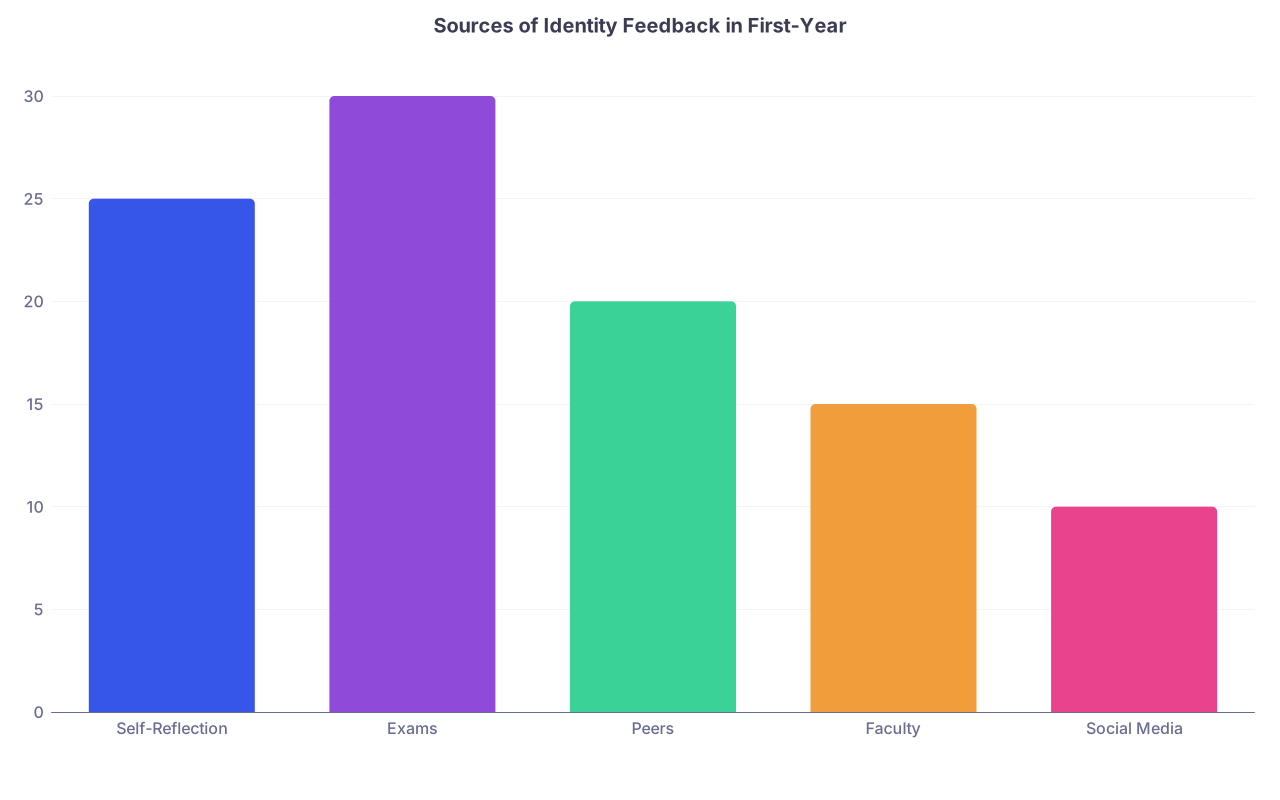
| Category | Value |
|---|---|
| Self-Reflection | 25 |
| Exams | 30 |
| Peers | 20 |
| Faculty | 15 |
| Social Media | 10 |
3. Build Process‑Based Self‑Respect
If your respect for yourself tracks exam outcomes perfectly, you are in trouble. You need criteria that you can hit consistently, even when an exam goes badly.
Good process‑based identity anchors in M1:
- “I am someone who shows up prepared enough to ask a coherent question in small group.”
- “I am someone who completes my Anki review every weekday before 11PM.”
- “I am someone who apologizes within 24 hours when I screw up in team settings.”
- “I am someone who reads at least one patient story or humanities piece per week to keep medicine human.”
You want behaviors that are:
- Controllable by you.
- Independent of other people’s reactions.
- Not destroyed by one bad day.
A quick weekly check-in template I often recommend to first‑years:
- One way I acted like the kind of physician I want to be.
- One decision I regret and why.
- One small behavior I will tweak this week (not a grand personality overhaul).
This is not “gratitude journaling for vibes.” It is structured identity training.
4. Protect a Version of You That Has Nothing To Do With Medicine
Here is the part medical culture quietly suggests you should feel guilty about: you must protect some slice of your identity that has nothing to do with being a physician.
Not because “balance” is trendy. Because when medicine inevitably hurts you—bad patient outcomes, unfair attending, exam failure—you cannot have your entire self kneecapped.
Concrete examples I have seen work:
- A classmate who was a serious pianist scheduled 30 minutes every Sunday evening on a practice room piano. Non‑negotiable. She basically scheduled her week backwards from that.
- A former college soccer player who joined a local adult league and played one game each week, even before exams. He studied around it. His Step scores did not suffer. His sanity probably would have without it.
- A student who made Friday night dinner with their partner sacred. Phones away, study materials shut. That relationship survived M1. Many do not.
Your schedule will not magically leave room for these things. You have to make them immovable. If you schedule them after “whenever I finish studying,” you will never get there.
The Hidden Curriculum: How It Warps Identity (And How To Resist It)
Let us name the actual messages you will hear, directly or indirectly, in first year:
- “Research is everything if you want a competitive specialty.”
- “If you are not exhausted, you are not working hard enough.”
- “Real doctors put patients above everything, including their own families.”
- “Non‑traditional backgrounds are inspiring, but real medicine is academic.”
- “Feelings are for humanities electives; here we grind.”
Most of this is nonsense. Or at least, dangerously incomplete.
Spotting Hidden Curriculum Moments
You recognize a hidden curriculum moment when:
- Something inside you recoils or goes quiet, even if everyone else nods.
- A statement is delivered as Absolute Truth, but you can immediately think of counterexamples.
- You find yourself wanting to act against your values to avoid social friction.
Example: An attending says during a case discussion, “Honestly, obese patients never follow instructions; you will see.” Class laughs uncomfortably. A few students say nothing but feel sick.
That is not just an offhand comment. That is a direct attempt to shape your professional self‑concept around contempt and fatalism toward a massive patient group.
How do you respond as an M1 with almost zero power?
- Internally: “I reject that. My professional identity will be one that sees structural factors and individual variation, not lazy stereotypes.”
- Behaviorally: Maybe you cannot challenge them in the moment without retaliation. But you can bring it up in small group later, or debrief with a trusted faculty member who is actually invested in professionalism. You can also log it (for your own sanity, or, if your school is serious about mistreatment, for reporting).
You do not need to be the hero every time. But you also cannot silently swallow every corrosive message without consequence to your identity.
Finding Counter‑Narratives
For every toxic message, you should have one or two real physicians (or residents) in mind who disprove it.
- “You cannot have a family in surgical specialties.” → Know one surgeon who clearly does.
- “Humanities‑minded doctors are soft and impractical.” → Know one palliative care or oncology physician who is clinically razor sharp and deeply human.
- “If you are not gunning for derm/ortho/rads, you are settling.” → Know solid, fulfilled internists, pediatricians, psychiatrists.
If your local environment is too narrow, this is where online communities, podcasts, and books help. Curate your influences as aggressively as you curate your study resources.
Exams, Feedback, and Failure: Identity Stress‑Tests
Exams in first year are not just knowledge checks. They are identity stress‑tests. How you interpret them will shape your professional self‑concept for years.
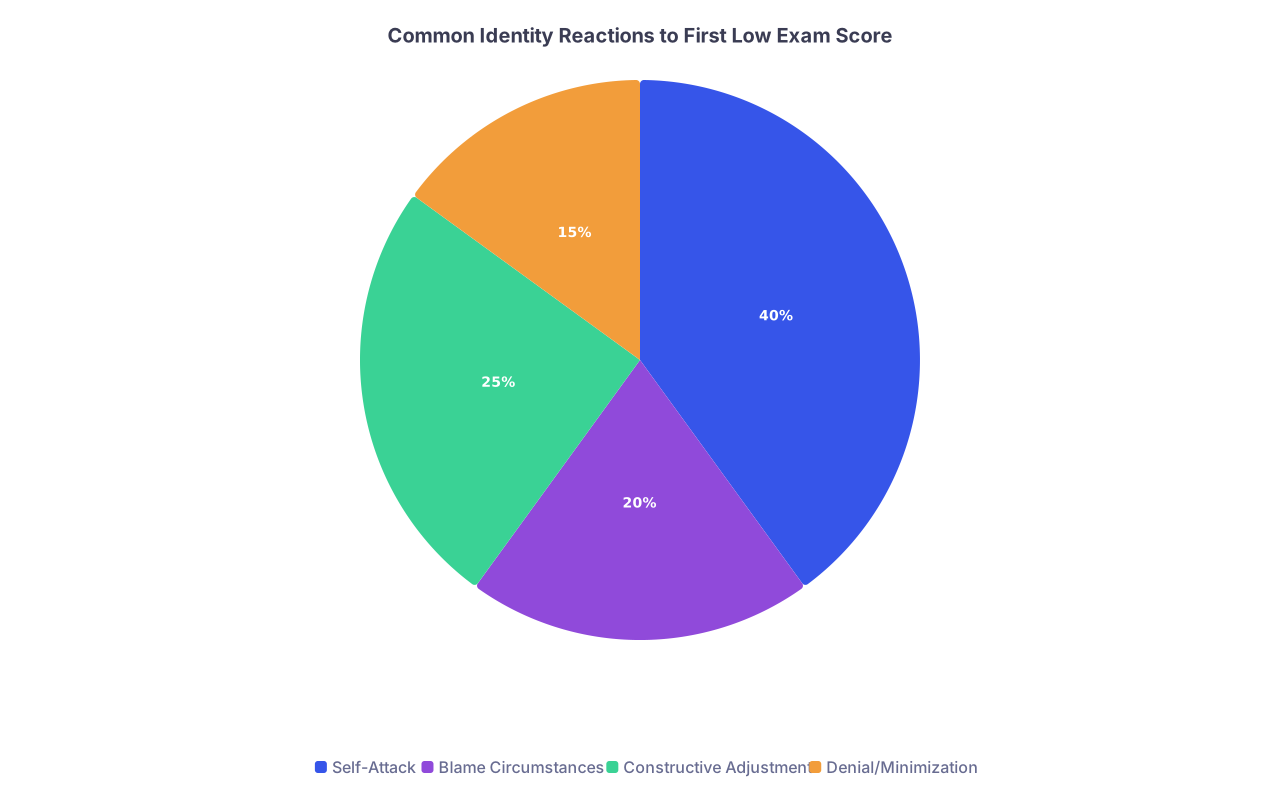
| Category | Value |
|---|---|
| Self-Attack | 40 |
| Blame Circumstances | 20 |
| Constructive Adjustment | 25 |
| Denial/Minimization | 15 |
Let us walk through the script after a bad exam.
Scenario: You score below average on your first big systems exam.
Typical fragile-identity script:
- Thought: “Everyone else is actually smart. I am not cut out for this.”
- Emotion: Shame, anxiety, isolation.
- Behavior: Withdraw from peers, doom scroll, half‑hearted “new plan” that is just more hours, no strategy.
- Identity shift: “I used to be good at school. Now I am the one barely holding on.”
Resilient-identity script:
- Thought 1: “This hurts. But a below‑average score on one exam does not define my overall trajectory.”
- Thought 2: “I need data. Where specifically did I lose points?”
- Behavior:
- Review the exam feedback (or your recall) and categorize errors: content gap vs. test‑taking vs. careless vs. time.
- Book a 30‑minute meeting with faculty or academic support before you design a new plan.
- Talk to one trusted peer honestly about it, rather than pretending you are fine.
- Identity reinforcement: “I am the kind of student who responds to setbacks with analysis, not self‑attack.”
Notice: the resilient script does not feel good in the moment. It just does not spiral your whole self‑concept.
If you want a hard rule: never draw conclusions about your identity in the 24 hours after an exam, good or bad. You are chemically altered by stress and comparison. Delay identity judgments.
Relationships, Cliques, and Who You Let Shape You
Your classmates will shape your professional identity as much as faculty will. Sometimes more.
You do not need to be best friends with everyone. But you do need to be intentional about whose voices you let matter.
Pay attention to:
- People who are relentlessly negative or cynical about patients, faculty, or medicine itself. Chronic sarcasm is not harmless. It rewires what you think is “normal.”
- People who define success only in terms of “competitive specialties,” “top X percentile,” or “prestige programs.”
- People who dismiss your values as naïve whenever you mention them.
You want at least a small circle who:
- Take their work seriously but do not take themselves too seriously.
- Can say, “Yeah, that exam sucked,” and then pivot to concrete planning instead of endless catastrophizing.
- Remember that patients are real human beings, not board questions with legs.
The first friend group you fall into in M1 often happens by proximity (orientation groups, locker neighbors, anatomy lab partners). You are allowed to adjust that once you realize how they influence your mindset.
A Simple Identity Maintenance Routine for First‑Year
You are busy. You do not have time for a 12‑step “professional identity workbook.” Here is a lean, realistic maintenance routine that fits actual M1 life.
Weekly (15–20 minutes, Sunday evening works):
Values check
- Did I act against any of my 3–5 non‑negotiable values this week?
- If yes: what specific situation, and what will I do differently when it happens again?
Process wins
- List 2–3 concrete behaviors I am proud of this week that align with the kind of physician I want to be. Not outcomes. Behaviors.
Boundary audit
- Did I protect sleep / relationships / one non‑medical activity? If not, what micro‑adjustment will I make this week?
Monthly (30–40 minutes):
Identity drift check
- Do I feel more or less like myself than I did a month ago? Why?
- Is there any voice (peer, faculty, influencer) that is consistently pulling me toward a version of doctor I do not want to become?
Narrative update
- In 5–7 sentences, write: “Right now, I see myself as a future physician who…”
- Compare it to last month’s version. Are you becoming sharper and more specific, or vaguer and more cynical?
If you actually do this, even imperfectly, you will be in the top 5% of your class in terms of psychological resilience. No exaggeration.
When To Get Outside Help (And Why That Is Not a Failure of Identity)
There is a threshold where “normal first‑year stress” crosses into “this is eating my identity alive.” Watch for:
- Persistent thoughts like “I do not belong here” or “Everyone would be better off if I left” that last more than a few weeks.
- Complete loss of interest in the parts of medicine that used to energize you.
- Identity collapse outside medicine: blowing up relationships, abandoning all previous hobbies, feeling like a stranger to yourself.
- Using alcohol, stimulants, or other substances to feel like you can keep up or escape.
At that point, trying to “grind through it” is not toughness. It is malpractice toward yourself.
Resources that actually help, if you use them early:
- School counseling services, before you are in crisis.
- A therapist not affiliated with the school if you are worried about confidentiality.
- One trusted faculty mentor (not central administration) who remembers what M1 actually felt like.
- Senior students who seem stable and honest, not the ones posturing as superheroes.
You are not weak for needing help with identity and mental health in first‑year. The environment is designed to destabilize you. Getting skilled support is a rational professional move.
You are not just surviving content in first‑year. You are rehearsing who you will be as a physician when things are hard, unfair, and uncertain—which is most of medicine.
You can let the system do that shaping by default: score‑obsessed, boundaryless, vaguely cynical, quietly empty. Or you build something sturdier:
- Clear values you actually live.
- Comparisons that inform you instead of crush you.
- Self‑respect tied to process, not perfection.
- A protected self that will exist long after your last exam.
First‑year is not the final product. It is the mold. Get the mold roughly right, and you can refine forever. Get it wrong, and you spend residency trying to undo damage under worse conditions.
With a resilient professional identity starting to take shape, you are better equipped to handle the next wave: clinical exposure, real patients, and the unsettling moment when the exam questions become lives in front of you. That shift—from classroom to clinic, from “student” to “almost doctor”—is the next test of who you are becoming. But that is a story for another day.