
The way most first‑years “power through” 6–10 hour study days is fundamentally broken.
You do not have a motivation problem. You have a pacing and focus problem. And the usual advice—“just grind,” “no pain no gain,” “study until you can’t”—is exactly how you torch your attention, your mood, and eventually your scores.
Let me break down how to use micro‑breaks and Pomodoro properly in medical school. Because done right, they turn a chaotic, exhausting day into a set of controlled, high‑focus sprints.
Why Your Current Study Days Feel Terrible
Here is the usual M1 pattern I see:
- You sit down after class with good intentions: “I’m going to study from 5–11 pm.”
- You open Anki, videos, question bank, and a PDF syllabus. All at once.
- You “study” for 90–120 minutes until your brain feels fried.
- You grab your phone “for 5 minutes” and disappear into Instagram, Reddit, or YouTube for 30–40 minutes.
- Guilt hits → you force yourself back to the desk, but attention is shot.
- By 10–11 pm, you are technically at the desk but operating at 30–40% of your actual capacity.
That is not 6 hours of real studying. That is maybe 2.5–3.5 hours of real cognitive work, smeared across an 8–10 hour window.
The fix is not “more willpower.” The fix is better structure: intentional sprints, intentional rests.
That is where micro‑breaks and Pomodoro matter.
The Physiology Behind Micro‑Breaks (Why They Work)
Your brain is not a machine that outputs the same wattage for 4 straight hours. Attention is governed by:
- Prefrontal cortex fatigue (executive control, working memory)
- Default mode network “pull” (mind‑wandering)
- Neurotransmitter dynamics (dopamine, norepinephrine)
- Simple physical fatigue (posture, eye strain, muscle tension, blood glucose)
Sustained, intense focus for 45–60 minutes creates:
- Gradual drop in processing speed
- Increased error rate (especially on questions that require multi‑step reasoning)
- Rising urge to escape (phone, snacks, random web browsing)
A micro‑break is not laziness. It is a scheduled “reset” that:
- Lets your attention system briefly disengage
- Reduces muscular and visual strain
- Gives your brain a tiny gap to consolidate what you just worked on (yes, some consolidation occurs on this scale)
- Prevents the uncontrolled, 30‑minute “doom scroll” that destroys the rest of the block
The key is dose. Too short and it is useless. Too long and you lose momentum and reactivation becomes expensive.
For most healthy, sleep‑adequate adults in med school, the sweet spot is:
- 25–40 minutes of intensely focused work
- 3–7 minutes of a proper micro‑break
Not “30 seconds to check notifications.”
Not “let me just reply to this text.”
A proper break is off‑task, away from the content, without starting a high‑dopamine alternative.
What Pomodoro Actually Is (And How Most Med Students Break It)
The classic Pomodoro method:
- 25 minutes work
- 5 minutes break
Repeat 4 times → take a 15–30 minute longer break
That is adorable for undergrad essays or light reading. For heavy medical content, it often needs adjustment.
Common failure modes I see in first‑years:
Treating the timer as a suggestion.
Timer goes off, you say “I’m in the zone, I’ll keep going” → 80 minutes later you are cooked and then take a 40‑minute “break.” You just lost the entire point.Using breaks for social media hits.
You are not taking a break. You are swapping one attentional task (studying) for another (scrolling) that is more stimulating and more addictive. Coming back feels worse.Over‑fragmenting deeper work.
Some tasks like synthesis notes, long question blocks, or drawing complex pathways need 35–45 minute windows. Strict 25‑minute cuts can interrupt flow just as you are getting into deeper processing.No alignment with task type.
You use the same 25/5 pattern for Anki, question banks, and lecture review. That is lazy structuring. Different tasks have different cognitive loads.
Done correctly, Pomodoro is not a religion. It is a skeleton. You customize it to:
- Your natural attention span
- The phase of the block (learning vs review vs peak exam prep)
- The task you are doing
Choosing the Right Work/Break Ratios for Med School Tasks
Let us get specific. Different tasks, different timings.
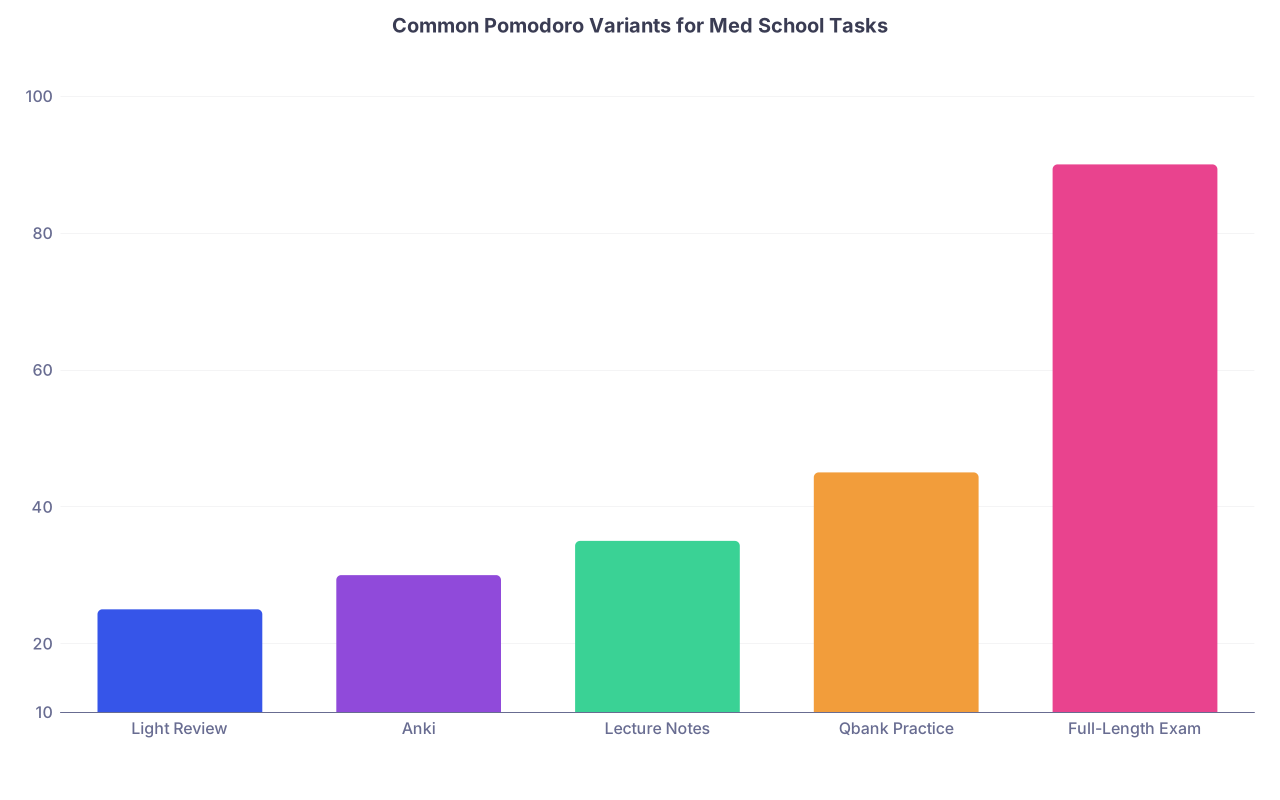
| Category | Value |
|---|---|
| Light Review | 25 |
| Anki | 30 |
| Lecture Notes | 35 |
| Qbank Practice | 45 |
| Full-Length Exam | 90 |
Now, break this down.
1. Anki / Flashcards
Cognitive load: medium, repetitive, sustained recall.
Best ratio for most students: 25–30 min work / 5 min break.
Structure:
- Clear, binary rule: during the 25–30 minute work window you only do cards. No card editing, no deck reorganization, no checking lecture slides “just for a second.”
- During the break, you stand up, stretch, maybe drink water. Phone face‑down, in another room if needed.
- After 2–3 cycles, take a 10–15 minute longer break.
Why 25–30 works: your recall speed is high, and you want enough time to get through a meaningful chunk (80–150 cards) without your brain glazing over.
2. Watching or Re‑watching Lectures / Boards‑style Videos
Cognitive load: medium to high, heavy on comprehension.
Best ratio: 35–40 min work / 5–7 min break.
Structure:
- 1 work block = 1 chunked segment of video (e.g., 35 minutes of Pathoma + active note‑taking).
- Pause the video at natural transition points; do not force the timer to cut you mid‑concept.
- Short micro‑break: step away from the screen, quickly jot down 2–3 key “anchor” ideas from that segment when you return, then move on.
Too short a window here (e.g., 20 minutes) and you end up slicing concepts awkwardly and spending more time re‑orienting than actually understanding.
3. Making or Refining Notes / Concept Maps
Cognitive load: high, synthesis and integration.
Best ratio: 40–45 min work / 7–10 min break.
Structure:
- Use these larger blocks for “heavy lifts”: building a pathway diagram for coagulation, comparing nephritic vs nephrotic syndromes, creating your own mini‑tables.
- You will often hit flow after 15–20 minutes. Let yourself ride it until 40–45, then hard stop.
Here, a full 25 minutes is sometimes barely enough to get past setup and into actual synthesis.
4. Question Bank Sessions (Pre‑exam, System Blocks)
Cognitive load: very high, applied reasoning, test‑like strain.
Best ratio: 45–60 min work / 10–15 min break.
Structure:
- Example: 10 timed questions in 17 minutes → immediate review of all 10 (28–35 minutes) → total 45–50 minutes.
- After the block, walk away. Literally. Stand up, move, maybe step into the hallway.
- Do not start another block immediately “because you feel guilty.” Fatigue from question review is deceptive; it accumulates.
During heavy exam weeks you might do 3–4 such blocks in a day. If you are doing more, performance usually drops and your error analysis becomes superficial.
5. Full‑Length Practice Exams
These are their own beast. For NBME‑style practice, you respect the testing format, but you still build micro‑breaks between blocks:
- Work: 1 NBME block (~60–70 minutes)
- Micro‑break between blocks: 7–10 minutes (bathroom, brief walk, light snack, no content review)
You are training not only knowledge but exam‑day stamina. This is not the time for rigid Pomodoro slicing.
How Micro‑Breaks Should Actually Look
Let me be blunt: if your break involves your phone, you are losing at least half the benefit.
The best micro‑breaks hit three targets:
- Physical reset (muscle tension, posture, circulation)
- Sensory shift (eyes off screen, different distance/depth)
- Cognitive downshift (no structured task, low stimulation)
Concrete options that work well in real life:
- Short walk: 3–5 minutes down the hall, up and down a stairwell, or around your apartment. Not fast enough to sweat, just enough to move and change scenery.
- Mobility / stretch: neck rolls, shoulder shrugs, 1–2 yoga poses, standing hamstring stretch against your chair.
- Visual reset: look out a window at objects far away (20–50 meters) for a minute; let your eyes adjust from near‑screen strain.
- Micro‑mindfulness: 5 slow breaths, exhale slightly longer than inhale. No need for an app, just count to 4 in, 6 out.
Things that ruin the break:
- Opening social media or news. That is not rest, that is replacement stimulation.
- Starting “just one” message thread. You know how that ends.
- Jumping to a different “productive” task (e‑mail, admin, schedule planning). Still cognitively on.
Use a simple rule: if your brain has to process language intensely (scrolling text, chatting, reading articles), it is not a micro‑break.
Sample Schedules for a Long Med School Study Day
Let us build two realistic days: one regular and one heavy exam prep.
Example 1: Regular Weekday After Classes (5–10:30 pm)
This assumes you had 8–12 AM lectures and some afternoon labs, then you study in the evening.
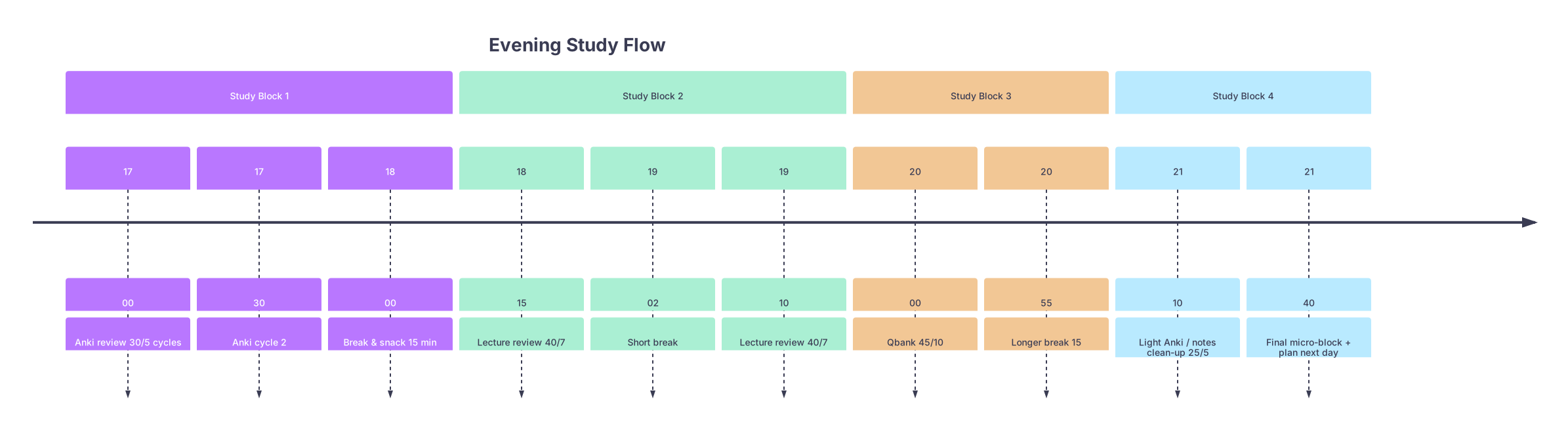
| Period | Event |
|---|---|
| Study Block 1 - 17 | 00 |
| Study Block 1 - 17 | 30 |
| Study Block 1 - 18 | 00 |
| Study Block 2 - 18 | 15 |
| Study Block 2 - 19 | 02 |
| Study Block 2 - 19 | 10 |
| Study Block 3 - 20 | 00 |
| Study Block 3 - 20 | 55 |
| Study Block 4 - 21 | 10 |
| Study Block 4 - 21 | 40 |
Translated to plain English:
5:00–6:00 pm
- 30 min Anki (Pomodoro 30/5)
- 5 min stretch/walk
- 25–30 min Anki
- 15 min real break + small meal
6:15–8:00 pm
- 40 min lecture review (focused, active)
- 7 min micro‑break (walk, bathroom, no phone)
- 40 min lecture review or video (different lecture)
- 7–10 min break
8:00–9:10 pm
- 45–50 min Q‑bank mini‑set + review
- 10–15 min break
9:10–10:00 pm
- 25–30 min lighter Anki / concept map clean‑up
- 5 min micro‑break
- 20–25 min prepping to‑do list for tomorrow and closing tabs
You got about 3.5–4 hours of real focus out of a 5‑hour window. Sustained. Repeatable. That is the goal.
Example 2: Heavy Exam Prep Saturday (9 am–6 pm)
This is for those systems exams where everyone disappears into the library.
9:00–10:30
- Two 30/5 Anki cycles (core cards for the system)
- 10 min break
10:40–12:10
- 45 min Q‑bank block (timed questions)
- 10–15 min break
- 30 min partial block or question review
12:10–1:00
- 50 min lunch break away from desk
1:00–2:30
- 40 min lecture/video review
- 7 min break
- 40 min lecture/video review
2:30–4:00
- 45–50 min Q‑bank second block
- 10–15 min break
- 20–25 min targeted Anki for missed concepts
4:00–6:00
- 35–40 min notes consolidation (pathways, tables, diagrams)
- 7–10 min break
- 35–40 min final Anki / light review
You end with some gas still in the tank instead of crawling out of the library hating life.
Tools and Tactics That Make This Workable
No, you do not need a fancy app. But a few habits and tools massively reduce friction.
Timers That Do Not Pull You Into Your Phone
Options that actually work:
- Physical kitchen timer on your desk. Ugly but effective.
- Simple Pomodoro apps with lock‑screen timers (e.g., Focus To‑Do, Forest, Tide) used in “screen‑off” mode.
- Watch timer (Apple Watch / Garmin) with vibrations only.
The non‑negotiable rule: you do not use the phone for anything else during the work block. Airplane mode if necessary.
Environment Cues
This sounds trivial until you see how many students sabotage themselves:
- Keep only the materials for the current block in front of you. One notebook, one textbook, one app. Not everything.
- Put your phone out of reach and face‑down, preferably in your bag or another room.
- If you are in a communal study room, use headphones to block chatter but do not stream social media during breaks.
Simple Tracking
You do not need a spreadsheet of your life. One small practice is enough:
On a sticky note or in your planner, write:
- “B1: Anki, 30/5 x2”
- “B2: Lectures, 40/7 x2”
- “B3: Qbank, 45/10”
As you go, tick the blocks off. If you get derailed, you can see exactly what you dropped instead of just ending the day with vague guilt.
How to Adjust for Different Personalities and Schedules
Not everyone’s brain works on a 25‑minute cycle. Some of you can deep focus for 70 minutes without blinking. Some of you fragment after 15.
You still need a structure. You just change the length.
| Attention Profile | Recommended Work/Break | Notes |
|---|---|---|
| Short‑span, easily distracted | 20–25 / 5 | Use more, smaller blocks |
| Average span, moderate distractors | 30–35 / 5–7 | Good for Anki + lectures |
| Long‑span, strong focus | 40–50 / 7–10 | Best for synthesis, Q‑bank |
| Very long‑span “hyperfocus” | 60 / 10–15 | Fine, but protect against crash |
If you are not sure where you fall, do this:
- One day, set 25/5 for Anki and see if you feel cut off or bored.
- Another day, do 40/7 for lectures and watch your energy at minute 35–40.
- Track honestly: do you actually maintain high focus, or are you just staying seated?
You want the block to end at the point where you are still 80–90% sharp. Not where you are already spiraling.
Common Mistakes First‑Years Make (And How to Fix Them)
I have seen first‑years at places like UT Southwestern, Michigan, and Mount Sinai all make the same five errors.
1. Making the System Too Complicated
You do not need:
- Color‑coded Pomodoro spreadsheets
- Ten different ratios for ten micro‑tasks
- Constant tweaking
Pick 2–3 default ratios (e.g., 25/5 for Anki, 40/7 for lectures, 45/10 for Q‑bank). Stick with them for 2 weeks before adjusting.
2. Treating Pomodoro as a Productivity Religion
Rigid mindset: “If I do not follow it perfectly, the day is ruined.”
Reality: some lectures run long; some labs blow up your schedule.
Use Pomodoro as rails, not handcuffs. If a session extends by 3 minutes to finish a question review, that is fine. What you do not do is convert that into a 2‑hour marathon because “I felt good.”
3. Using Breaks to Escape Emotion, Not Reset Cognition
On bad days, you will be tempted to spend your breaks avoiding anxiety: endless scrolling, snacking, chatting.
You need to separate two things:
- Micro‑breaks (reset attention)
- Longer, planned breaks (talk to a friend, call family, decompress)
You are allowed to have both. But do not confuse them.
4. Ignoring Sleep and Then Blaming Pomodoro
If you are sleeping 4–5 hours, no timer in the world will rescue your focus. Your blocks will shorten, your “need” for breaks will skyrocket, and everything will feel harder.
On those days, explicitly reduce the total number of blocks and demand less from yourself. Protect the next night’s sleep so the system can actually work.
5. Never Reviewing What Worked
Once every 1–2 weeks, spend 10 minutes asking:
- Which block types feel sharp?
- Where do I always crash (e.g., post‑lunch 2–4 pm)?
- Do I need to move high‑load tasks earlier?
That tiny bit of reflection keeps you from repeating the same broken pattern for an entire semester.
Putting It All Together: A Practical Implementation Plan
Let me give you a simple 7‑day rollout. This is how I would have an overwhelmed M1 start.
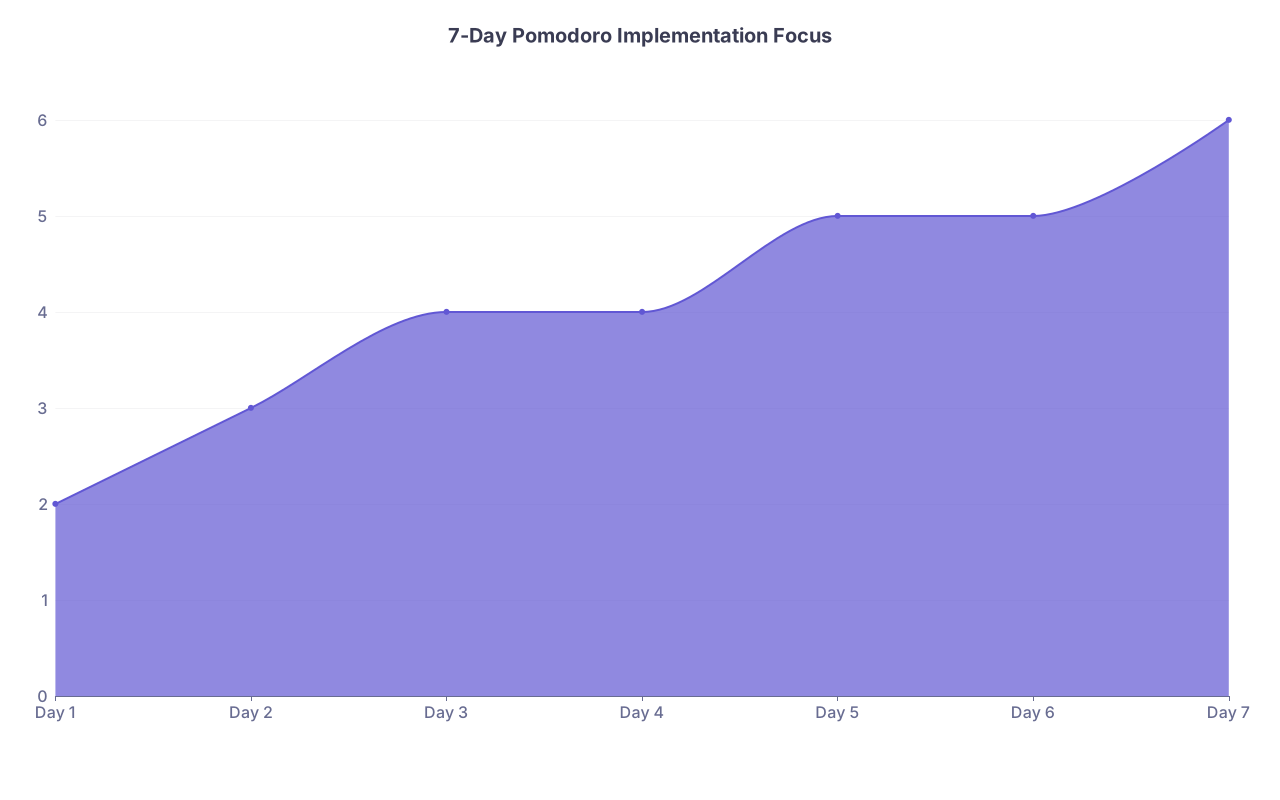
| Category | Value |
|---|---|
| Day 1 | 2 |
| Day 2 | 3 |
| Day 3 | 4 |
| Day 4 | 4 |
| Day 5 | 5 |
| Day 6 | 5 |
| Day 7 | 6 |
Here “values” roughly represent number of structured focus blocks per day.
Day 1–2
- Pick one task (usually Anki) and run it exclusively with 25/5 or 30/5 for 60–90 minutes.
- Focus only on obeying the timer: stop when it says stop, resume when it says resume.
Day 3–4
- Add a second structured block type (e.g., 40/7 lecture review in the evening).
- Keep everything else unstructured.
Day 5–7
- Build a full evening or afternoon with 2–3 blocks:
- One Anki block (25/5 x2)
- One lecture block (40/7 x2)
- One lighter block (notes, planning, etc.)
After the first week, you should feel three things:
- You are less mentally destroyed at the end of long days.
- You can actually predict when your next break is, which calms the “I’m trapped studying forever” feeling.
- Your actual, measurable output (cards completed, questions done, pages meaningfully reviewed) has gone up.
From there, you just scale: more blocks on heavy days, fewer on lighter ones.