Most medical students are terrible at processing difficult cases – they either shove them aside or drown in them.
You are not burned out. Yet.
But if you keep absorbing every difficult case with no structure, no way to metabolize what just happened, you will get there faster than you think.
Let me be specific: “Reflect on this patient encounter” is probably the most vague, unhelpful instruction you get in medical school. You are told reflection matters, that it builds “professionalism,” “empathy,” “resilience.” But nobody hands you a method that actually works when you have an exam in 3 days, you are post-call, and you just watched a code that did not end well.
So I am going to give you one.
This is a stepwise, repeatable method I have used myself and watched students use to process tough cases without collapsing. It works for:
- The first time a patient dies under your team’s care.
- The angry family who says, “You people do not care about my mom.”
- The patient whose values or choices clash with everything you believe.
- The near-miss where you almost wrote the wrong dose.
And it is designed for real constraints: 15–20 minutes between pages, on the bus home, or before you crash at 1 a.m.
Why “just journaling” is not enough
Unstructured reflection turns into one of three things:
- Emotional dumping – pages of “I feel horrible, this is too much,” with no resolution.
- Abstract ethics essay – you jump to “autonomy vs beneficence” and never touch what actually hit you.
- Self-attack – “I am incompetent, I should have done X, I will never be a good doctor.”
None of those build what you actually need:
Cognitive clarity, emotional containment, and actionable learning.
So we are going to structure this. Like you structure a history. Or a SOAP note.
Same brain, different template.
Here is the method, then I will walk you through each step:
- Contain the moment
- Run the “clinical narrative” like a case presentation
- Name and externalize emotions
- Identify the moral/identity conflict
- Extract one learning point and one behavior change
- Close with a deliberate reset
You can do the quick version in 10 minutes. Or the deep version in 30–40 minutes when you are off service or post-call.
Step 1: Contain the moment – stop the bleed
You cannot reflect when your nervous system is still in fight-or-flight. So first: contain.
This is not mindfulness wallpaper. It is damage control.
When something difficult happens – code blue, patient screams at you, your attending tears into you in front of the team – your brain wants to either ruminate endlessly or slam the door and pretend nothing happened. Both are bad.
You need a “containment script” you can run anywhere:
Ground in time and place:
- “I am standing in room 812, 14:35, just after Mr. K died.”
- Or: “I am in the call room, 23:10, after that argument with Ms. L’s daughter.”
Put a temporary frame around it:
- “This was a difficult event. I will process it later. Right now I have to [task].”
- You are not denying. You are postponing with intent.
Minimal physical reset (1–2 minutes max):
- Two slow breaths with a longer exhale (inhale 4, exhale 6–8).
- Relax jaw, drop shoulders.
- Quick body check: “Am I hungry, about to pass out, or about to cry in the hall?” If yes, address the smallest piece you can (water, bathroom, 30 seconds alone).
That is enough in the moment. You tag the event: “This is one I need to come back to.”
Later – same day if possible, but within 72 hours max – you sit down for structured reflection.
Step 2: The “clinical narrative” – present the case to yourself
You already know how to structure chaos: HPI, exam, assessment, plan.
We are going to steal that mindset.
When you sit down to reflect, start with a neutral, factual narrative. Think of it as presenting the case to an attending who was not there.
Write or speak (into your phone if you prefer audio):
Who was the patient? (Age, relevant context, one-line summary)
“Mr. K, 67-year-old male with advanced COPD and metastatic lung cancer, DNR/DNI, admitted for worsening dyspnea.”What exactly happened, stepwise?
“This morning at 09:00, he developed acute respiratory distress. Nurse called the resident. I was in the room helping with vitals. He became hypotensive despite fluids and pressors. Palliative had seen him yesterday; goals of care were clear: comfort-focused, no intubation. He became unresponsive and died at 09:40 with his wife at bedside. I was standing at the foot of the bed.”Who else was involved, and what did they do?
“Resident led management, attending came in halfway, nurse stayed in the room the entire time, RT came briefly. Wife was crying quietly for most of the time; I explained one of the meds when she asked. After he died, resident pronounced, attending spoke softly to wife, I stood behind them.”What did you do and say – concretely?
“I helped with vitals, asked the wife if she wanted water, answered one question about morphine. I avoided the wife’s eyes during the last few minutes because I felt like crying.”
That is it. No judgment, no emotion interpretation yet. Just a clean narrative.
Why this matters:
Students skip this and jump straight into “I feel awful.” The unstructured story in your head often distorts reality. When you force yourself to reconstruct the sequence, you anchor. You start to see the difference between what happened and what your brain is currently yelling.
Step 3: Name and externalize emotions – without editing
Now you switch lenses. Same event, emotional data only.
This is where most medical students underperform. You give yourself 2 emotions max: “stressed” and “tired.” Not enough.
You are going to list emotions like vitals: multiple, specific, and possibly conflicting.
Try this sequence:
Label the obvious ones first.
“Sad, anxious, guilty.”Get more granular. Force at least five distinct emotions.
Use words like: helpless, angry, ashamed, resentful, numb, relieved, frustrated, confused, overwhelmed, disgusted, curious.
For example:- “Helpless – I could not do anything useful.”
- “Ashamed – I avoided eye contact with his wife.”
- “Relieved – it was over; the room felt less tense.”
- “Frustrated – I had no idea what my role should be.”
- “Anxious – I kept thinking I was standing in the wrong place.”
Attach each emotion to a trigger.
Complete the sentence: “I felt [emotion] when [specific moment].”- “I felt ashamed when I realized I was avoiding looking at his wife.”
- “I felt helpless when the resident and attending were making decisions and I could not offer anything.”
- “I felt relieved when the attending said, ‘Time of death…’ and the alarms stopped.”
You are not analyzing yet. You are mapping.
If you struggle with this, there is a simple trick I have seen work repeatedly:
- Set a timer for 90 seconds.
- Rapid-fire write: “I felt…” as many times as you can with a different emotion each time.
- Stop when the timer rings. No justification, no editing.
This step does one thing: it moves you out of the diffuse cloud of “I feel terrible” into a detailed profile you can actually work with.
And it helps you see something crucial: some of your emotions will contradict each other. Being both relieved and guilty, both angry and ashamed, is normal. Naming the tension reduces its sting.
Step 4: Identify the deeper conflict – what actually hurt
Most difficult clinical cases are not just “sad.” They hit you because:
- They smashed into your personal values.
- They exposed a gap between “the doctor I want to be” and “the student I currently am.”
- They made you feel powerless in a system you cannot control.
You need to find that layer.
Ask yourself 3 direct questions:
What felt “wrong” about this situation to me?
Do not sanitize this.- “It felt wrong that I could not offer comfort because I was afraid of crying.”
- “It felt wrong that we went so fast through the code status with the family yesterday.”
- “It felt wrong that I was treated like furniture in the room.”
What did this event say about me, in my own head?
These are the nasty automatic thoughts you would never publish in a reflection essay.- “I am useless.”
- “I am too emotional to handle death.”
- “I am just in the way; no one needs me here.”
- “I am a fraud pretending to be compassionate.”
What identity or value of mine did this threaten?
This is where you hit gold.- “I want to be the kind of doctor who is present with dying patients and families.”
- “I value competence and effectiveness; I felt like dead weight.”
- “I believe patients should die with dignity, and alarms and chaos feel undignified.”
Write one or two sentences that capture the core conflict in plain language.
Example:
“I want to be someone who can show up for dying patients and families, but in this case I froze and avoided the wife, and that makes me feel like I failed both my values and the patient.”
Now you are no longer just “sad.” You know why this case hurt.
Step 5: Extract one learning point and one behavior change
Here is where most “reflection” falls apart. You stop at insight. You feel raw and vaguely enlightened and then nothing in your future behavior changes.
That is useless.
You want two outputs from every structured reflection on a tough case:
- A cognitive or clinical learning point
- A micro-level behavior change you can implement next time
Think small. Surgical precision, not life overhaul.
5a. One learning point
Ask:
- “Clinically, what did I learn or reinforce?”
Could be a guideline, a communication phrase, a systems issue.
Examples:
- “For DNR/DNI patients, it actually matters to know ahead of time what ‘comfort-focused’ concretely means for this person and family.”
- “When a patient is actively dying, the student’s role can reasonably include managing simple comfort tasks and being a presence for the family.”
- “I did not fully understand how pressors impact symptom burden in end-of-life care; I need to review that.”
Write it like a flashcard. One clean sentence.
5b. One behavior change
This is your “next time, I will…” line. Small, actionable, within your control as a student. No fantasy about controlling the whole team or hospital.
Examples related to the case above:
- “Next time a patient is dying and the family is in the room, I will at minimum stand close enough to be visibly available and say one sentence of acknowledgement, such as: ‘I am here with you; if you have questions, let me know.’”
- “When I see a patient with limited prognosis and a documented DNR/DNI, I will ask the resident if I can listen in on or help clarify the goals-of-care discussion.”
- “If I notice myself avoiding a distressed family member’s eyes, I will intentionally look up once and hold eye contact briefly, instead of disappearing into the background.”
Do not pick three. Pick one and make it painfully concrete.
This is how reflection becomes part of your professional growth instead of a homework assignment for your portfolio.
Step 6: Deliberate closure – do not leave the file open
You have done the emotional excavation and extracted the learning. Now you need to close the file.
Not erase. Close.
If you skip this, the case continues to intrude while you are trying to study renal physiology.
Deliberate closure has three parts:
Name what you are taking forward.
One line, out loud or on paper.- “From this case, I am taking forward a clearer idea of my role with dying patients and one specific behavior I will change.”
Offer yourself a one-sentence compassionate frame.
Yes, I know this sounds soft. I have yet to see a long-lived clinician who functions without some version of this.- “I was a learner in a very hard situation. I did some things well and some things I want to do differently. That is what training is for.”
Physical or symbolic reset.
Something tiny that signals: reflection done for now.- Close the notebook. Stand up and stretch.
- Wash your hands again and consciously imagine letting some of the emotional residue go down the drain.
- Step outside for one minute of real air.
Then you move on. Deliberately. Not because you do not care, but because you have already honored the case as much as you reasonably can today.
A compact template you can actually use
Let me give you a condensed version you can literally copy into a note on your phone.
Use this when something hits hard and you have 15–20 minutes that evening.
| Step | Prompt |
|---|---|
| 1. Narrative | What happened, in 5–10 sentences, factually? |
| 2. Emotions | List at least 5 emotions and what triggered each. |
| 3. Conflict | What felt wrong? What did this say about me or my values? |
| 4. Learning | One cognitive/clinical learning point. |
| 5. Behavior | One concrete “next time I will…” behavior. |
You do not have to write pages. You do have to be specific.
Where this fits in a brutal first-year (and early clinical) schedule
You are in the “SURVIVING FIRST YEAR / MEDICAL SCHOOL LIFE AND EXAMS” phase. Translation: your bandwidth is limited, your emotional exposure is increasing, and your formal training in emotional processing is close to zero.
Reflection cannot become another massive task. So you treat it like spaced repetition:
Frequency: 1–2 significant reflections per week during heavy rotations or early clinical exposures. Do more only when something truly major happens (unexpected death, serious error, directly targeted mistreatment).
Duration:
- “Acute” version: 10–12 minutes, use the mini-template, light on narrative, quick on learning point.
- “Deep dive” version: 25–35 minutes on a day off or lighter evening.
Storage:
Use a single place – a physical notebook, a locked Word file, or an encrypted note app. One “Reflection Log,” not 12 scattered documents.
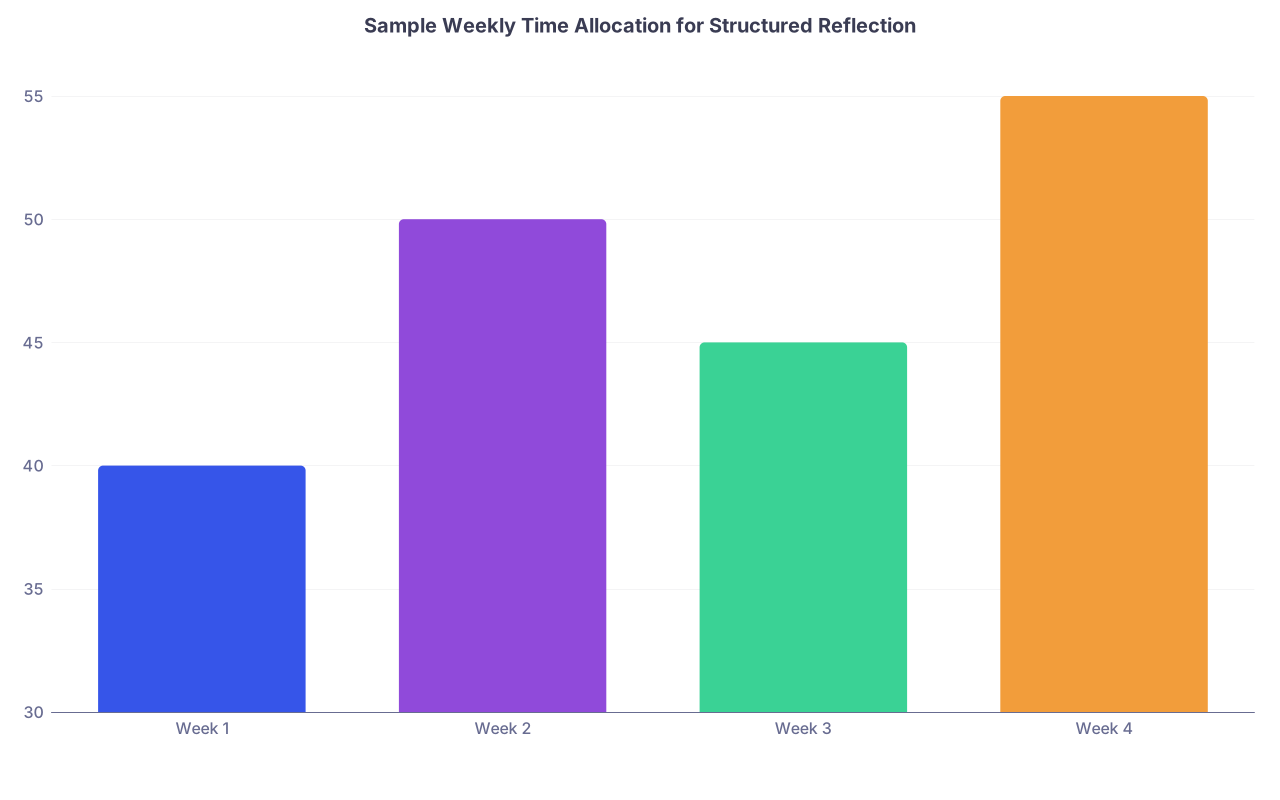
Here is what this looks like over a typical 4-week inpatient block:
| Category | Value |
|---|---|
| Week 1 | 40 |
| Week 2 | 50 |
| Week 3 | 45 |
| Week 4 | 55 |
Values are minutes per week. That is it. 40–55 minutes, total, over seven days. Roughly one Netflix episode worth of time.
You can afford that.
Common traps students fall into – and how to avoid them
I have seen the same mistakes repeatedly.
Trap 1: Turning reflection into a graded performance
You start writing like an OSCE station, trying to impress some hypothetical faculty reader. Suddenly you are quoting “autonomy” and “non-maleficence” and the whole thing is sterile.
Fix:
Remind yourself: “No one is grading this.” If you have to submit reflections to your school, keep a separate raw version for yourself. You can polish later for the portfolio. The one that actually helps you process? That is the private one.
Trap 2: Getting stuck in self-attack
“I am incompetent, I failed this patient, I should not be in medicine.” On and on. That is not reflection; that is mental self-harm.
Fix:
- When you notice global self-judgments, force yourself to narrow the scope.
Change: “I am terrible” → “In this case, one thing I wish I had done differently is…” - Then complete: “…and next time I will…” with a concrete behavior.
Trap 3: Over-intellectualizing
You hide behind theory. You talk about “healthcare disparities” and “structural violence” in the abstract, but never touch the fact that you were angry that the attending dismissed the patient’s concerns.
Fix:
In your template, add a sentence: “The ugliest thought I had but did not say was…” and write it. No one has to see it. But you need to be honest with yourself if you want to grow.
Trap 4: Never revisiting prior reflections
You do all this work, then never look back. That is like doing Anki once and never reviewing.
Fix:
Once per month, skim your last 4–6 reflections. Look for patterns:
- Same emotion showing up repeatedly (e.g., feeling invisible, feeling stupid).
- Same type of situation hitting you hard (end-of-life, conflict with nurses, being yelled at by attendings).
These patterns tell you where you need mentorship, scripts, or skills. They are also early warning signs for burnout.
How this actually supports exam performance and not just “wellness”
Let me be blunt: some students will ignore everything you just read because it does not look like UWorld.
They are wrong.
Unprocessed emotional load does three things that directly hit your grades:
Cognitive bandwidth drain
Rumination is a memory hog. If your brain is replaying that code at 02:00, your working memory the next day is trash. That hits your ability to learn on rounds and your stamina for question blocks.Avoidance of certain topics
If your hardest case was a child abuse scenario and you never processed it, you will unconsciously avoid studying child abuse, domestic violence, or psych trauma questions. I have watched this happen. Scores drop exactly in the domains that emotionally sting.Identity-level doubt → performance anxiety
“I am not cut out for this” migrates from clinical settings into exam rooms. You start to panic more easily with ambiguous questions because they feel like another test of whether you belong.
A structured method like this shortens the half-life of the emotional event. You still care. You are still moved. But you are not carrying the full, raw load for weeks.
That gives you more working memory, cleaner attention, and less background noise during exams.
I have seen students start this during their first real clinical exposures and watch their step scores, shelf scores, and OSCE performance genuinely benefit. Not because reflection is magic. Because reduced mental clutter is a competitive advantage.
A realistic example: compressing the method on a busy night
Let me show you what a 12-minute version looks like.
Scenario: You are an MS3 on medicine, you just had a patient yell, “You people do not care, you just want to discharge me and get a bed!” in front of the team. You felt humiliated. It is 22:30, you are exhausted. You decide this one needs at least a brief process.
Your note might look like:
Narrative (5–6 sentences)
“Ms. L, 54, with decompensated CHF, had improved with diuresis. Team felt she was medically ready for discharge tomorrow. When the attending mentioned this on rounds, she became very angry, raised her voice, and said we did not care and just wanted the bed. Attending responded neutrally and moved on. I stood at the back, felt my face get hot. Afterward, resident rolled eyes and said, ‘She is always like that, do not let it get to you.’”Emotions (5 emotions + triggers)
- Embarrassed – when she yelled in front of everyone.
- Angry – when she said we did not care.
- Confused – I did not understand why the attending did not explain more.
- Helpless – I had no idea what to say or do.
- Ashamed – for feeling angry at a sick patient.
Conflict (2–3 sentences)
“I want to be patient and understanding, but I was actually angry at her for accusing us of not caring. It also felt wrong that the team dismissed her reaction so quickly. This made me question whether I am becoming jaded or whether I am missing important communication skills.”Learning point (1 sentence)
“Anger from patients often reflects fear about being unsafe or abandoned, not just ‘difficult personality,’ and I need more language to respond to that.”Behavior change (1 sentence)
“Next time a patient reacts like this and I am not the main person speaking, I will at least say to them later, one-on-one, something like: ‘Earlier seemed really upsetting; can you tell me more about what worried you?’”
Then deliberate closure. Close notebook. Brush teeth. Sleep.
Is that perfect? No. Is it 1000% better than ruminating while scrolling your phone until 01:30? Absolutely.
When you need more than structured reflection
Let me be clear: this method is for routine difficult cases – death, conflict, value clashes, near-misses that did not result in patient harm, harsh feedback.
There are events that blow past this:
- Serious medical errors where someone is harmed and you were directly involved.
- Overt abuse, discrimination, or harassment from staff, attendings, or patients.
- Cases that trigger your own trauma history intensely (e.g., similar to your own family situation).
- Intrusive thoughts, nightmares, or panic that persist despite repeated reflection.
In those cases, structured reflection is adjacent support, not primary treatment. You also need:
- A trusted faculty mentor or advisor.
- Formal debriefing when available.
- Mental health support, ideally someone who understands healthcare work.
Red flag:
If you find yourself writing almost identical reflections every week (“I am a failure,” “I cannot handle this,” “Medicine was a mistake”), that is not normal “growth pain.” That is a sign you need more help, sooner rather than later.
Building a sustainable habit: what this looks like over a year
If you start using this as an MS1/MS2 with early clinical encounters, or early MS3 on clerkships, something interesting happens over 6–12 months:
- Your reflections get shorter and sharper. Less “I do not know why this bothered me” and more “This hit my identity as someone who values X.”
- You start to pre-emptively adjust in real time. In the middle of a code or a conflict, you catch yourself and think, “This is one of those moments. I know I will want to at least say X to the family.”
- You develop a library of phrases and behaviors that are “how I practice” – your own micro-scripts for hard moments.
By the end of clinical year, you can look back and see a concrete progression in how you show up:
- From peripheral, frozen, and quietly distressed
- To engaged, emotionally affected but not wrecked, with a sense of who you are becoming as a doctor
That identity stability is what carries you through residency, not grit slogans.
With a structured reflection habit in place, you are no longer just absorbing whatever medicine throws at you; you are actually digesting it. That is how you survive first year and early clinical life without burning out your capacity to care.
You now have a template for what to do after the next difficult case. The next step is learning what to say in the moment – the real-time communication scripts that make those encounters less damaging to you and more humane for your patients. That, though, is its own skill set. And a topic for another day.