
You are not the only one who thinks admissions made a mistake. You are just the only one assuming everyone else is confident.
Let me break this down specifically, because vague reassurance does nothing when you are staring at Anki at 1 a.m. thinking, “I am not cut out for this.”
1. What Imposter Syndrome Actually Looks Like in M1
Most talk about imposter syndrome is surface-level. “You feel like a fraud.” Sure. But in first‑year medicine, it shows up in very particular, painful ways.
Common thought patterns I hear from new med students:
- “Everyone else got in for the ‘right’ reasons. I slipped through.”
- “If I ask this question in small group, they’ll finally see I do not belong here.”
- “I only got that grade because the exam was easy / curved / lucky.”
- “Once we hit wards, my classmates will expose me.”
Notice something? The problem is almost never the actual performance. It is the interpretation.
CBT—Cognitive Behavioral Therapy—targets exactly that: the link between thoughts, emotions, and behaviors. You do not need a therapist to use CBT‑style tools. You need structure, repetition, and a bit of intellectual honesty.
Let me show you what that looks like in concrete med‑school scenarios.
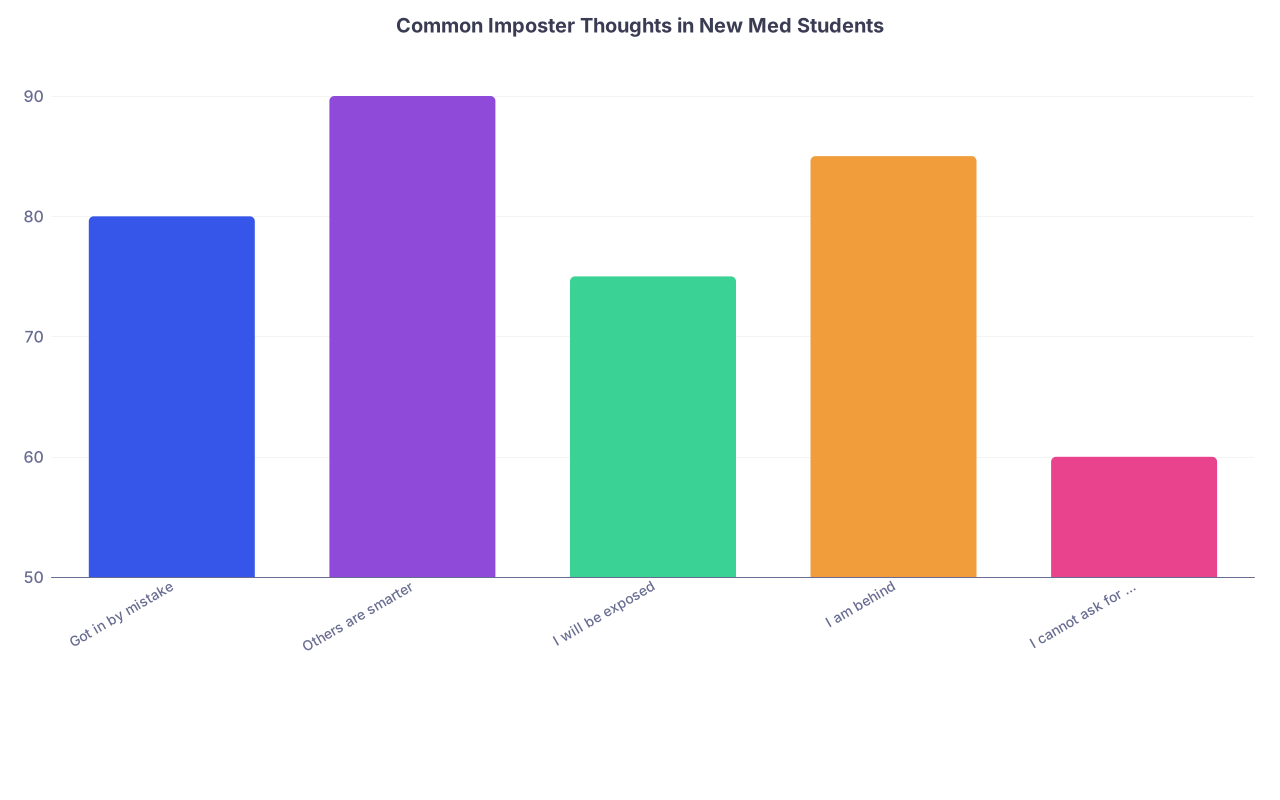
| Category | Value |
|---|---|
| Got in by mistake | 80 |
| Others are smarter | 90 |
| I will be exposed | 75 |
| I am behind | 85 |
| I cannot ask for help | 60 |
(Percentages here reflect what I roughly see when I actually ask a first‑year group; you are not special in your self‑doubt. In a good way.)
2. The Core CBT Framework (Without the Fluff)
Before the exercises, you need the skeleton. If you get this, everything else will make sense.
Basic CBT sequence:
- Situation
- Automatic thought
- Emotion + body sensation
- Behavior
- Consequence
- Alternative thought (after you slow down and think)
Very simple example from an M1:
- Situation: You miss 4/10 questions in a small group cold‑call.
- Automatic thought: “I am dumber than everyone else here.”
- Emotion: Shame, anxiety. Stomach tight, flushed face.
- Behavior: You stop answering questions. Switch camera off on Zoom. Study alone.
- Consequence: You participate less, learn less, feel even more behind. Imposter story strengthens.
CBT does not magically change grades. It changes the interpretation, which then changes what you actually do with the feedback.
You cannot wait to feel like you belong before behaving like you belong. The behavior has to come first.
3. Exercise 1: Thought Record Specifically for Exam Panic
You have seen generic “thought records” before. Most of them are uselessly abstract.
Here is a med‑school‑tuned version you can actually use after an exam, quiz, or anatomy lab where you froze.
Step 1: Set up a simple template
Make a note in your phone or a small notebook with 6 columns:
| Column # | Heading |
|---|---|
| 1 | Situation |
| 2 | Automatic Thought |
| 3 | Emotion (0–100) |
| 4 | Evidence For |
| 5 | Evidence Against |
| 6 | Alternative Thought |
Now let’s run a real scenario through it.
Step 2: Fill it out right after a trigger
Example:
Situation
“Got 72% on first anatomy written exam. Class average is 78%.”Automatic Thought
“This proves I am not smart enough for med school.”Emotion (0–100)
Shame 80/100, anxiety 70/100, disappointment 60/100.Evidence For
- I scored below average.
- I needed longer on dissection to identify structures.
- I guessed on several questions.
Evidence Against
- This is the first major exam with this format.
- I passed.
- I completed all lectures but rushed the last two days.
- Several classmates also scored in the low 70s and are not calling themselves frauds.
- My undergrad record shows I can improve from early exams (e.g., first biochem midterm C+, course grade A).
Alternative Thought
“I underperformed on this exam, but that does not mean I am not smart enough. It means my current anatomy study strategy is not working well enough yet. I have evidence I can improve with adjustment.”
Two key rules:
- Alternative thought must be accurate, not positive fluff. If it sounds like an Instagram quote, you wrote it wrong.
- You will not feel the new thought immediately. Feeling follows repetition, not one cute worksheet.
Target: Do this for 3–5 high‑stress academic situations in the first semester. After a while, you will start spotting the distorted thoughts in real time.
4. Exercise 2: Cognitive Distortion “Labeling Drill” for Rounds and Small Groups
Imposter syndrome thrives on cognitive distortions—systematic thinking errors. Medicine students are excellent at pattern recognition in pathology, terrible at pattern recognition in their own thought processes.
The common distortions I see in new med students:
- All‑or‑nothing thinking (“Either I crush this exam or I should not be here.”)
- Mental filter (“Everyone else understands except me.” based on one loud student who answers everything.)
- Discounting the positive (“I only passed because the exam was easy.”)
- Mind reading (“The attending thinks I am incompetent.”)
- Fortune telling (“If I ask this, they will think I am dumb.”)
The Labeling Drill
You train your brain to call these out, quickly, like naming an EKG pattern.
Step 1: Make a one‑page “distortion key”
Write on a notecard (or phone note):
- All‑or‑nothing
- Catastrophizing
- Mind reading
- Fortune telling
- Discounting the positive
- Overgeneralization
- Personalization
Step 2: After a triggering event, capture the raw thought
Example events:
- You freeze when cold‑called in problem‑based learning (PBL).
- You see a classmate say they “barely studied” and still scored 95.
- You get corrected on a simple physiology concept.
Write 1–2 sentences of the raw thought, not cleaned up:
- “I should already know this; they are going to realize I am not residency material.”
- “Everyone else is naturally smart; I am just brute forcing this.”
- “If I do not impress this attending now, my career is over.”
Step 3: Label the distortion
Force yourself to choose at least one label from your card.
“Everyone else is naturally smart; I am just brute forcing this.”
→ Mental filter + Discounting the positive.“If I do not impress this attending now, my career is over.”
→ Catastrophizing + Fortune telling.
Step 4: Short corrective follow‑up
You do not write a paragraph. You write one sentence:
- “This is catastrophizing. One interaction will not determine my entire career path.”
- “This is mind reading. I do not actually know what my attending thinks of me.”
Think of this like annotating your own thoughts. The goal is speed, not depth. 30–60 seconds, tops.
Do this 3–4 times a week for a month and you will be shocked how fast you start auto‑labeling distortions as they appear.

5. Exercise 3: “Evidence File” Against Your Inner Prosecutor
Imposter syndrome behaves like a hostile prosecutor in your own head. It keeps a meticulous file of every screw‑up and throws out every piece of exculpatory evidence.
You need your own evidence file. This is pure CBT.
Step 1: Create two running lists
Use a note app with pinned notes or a simple Google Doc. Two separate sections:
- “Competence Evidence”
- “Effort Evidence”
Competence Evidence examples:
- “Faculty comment: ‘Good clinical reasoning on that case.’”
- “Tutor said: ‘You explain this concept better than most M2s I work with.’”
- “Answered 8/10 UWorld renal questions correctly after review.”
Effort Evidence examples:
- “Completed 28/30 Anki cards all week.”
- “Showed up to every anatomy lab prepared.”
- “Went to office hours even though I felt stupid.”
You log small, concrete things. No general “I am a hard worker.” Evidence, not slogans.
Step 2: Make updating it a weekly ritual
Once a week (Sunday afternoon, for example), take five minutes and add:
- 2–3 competence items
- 2–3 effort items
If you genuinely cannot find anything, you are either lying to yourself or living in a cave. In that case, your “effort evidence” might simply be: “Asked a classmate for help for the first time.” That counts.
Step 3: Use it proactively before high‑stress events
Before an exam, anatomy practical, or first patient interaction, you quickly scan the file. Not to hype yourself up. To remind your prefrontal cortex that there is actual data contradicting the “I am a fraud” narrative.
You are training your brain to retrieve all relevant data, not only the worst moments.
6. Exercise 4: Behavioral Experiments Around Asking for Help
Thought work alone without behavior change is mental gymnastics. CBT forces you into “behavioral experiments”—small tests that prove or disprove your catastrophic predictions.
A very common M1 imposter belief:
“If I ask for help, people will realize I do not belong here.”
We are going to test that, scientifically.

| Step | Description |
|---|---|
| Step 1 | Prediction |
| Step 2 | Plan Experiment |
| Step 3 | Do Behavior |
| Step 4 | Record Outcome |
| Step 5 | Update Belief |
Step 1: Define the belief and numeric prediction
Belief: “If I email the professor a basic question, they will think I am not smart enough for this class.”
Prediction: “On a 0–100 scale, I am 80% sure their response will sound annoyed or dismissive.”
Step 2: Design the smallest possible experiment
Example experiment:
Send one concise email about a concept you genuinely do not understand, using professional wording.
You are not trying to impress. You are trying to ask a real question.
Step 3: Run it and log the outcome
When the response arrives, resist the urge to distort it. Write down:
- Was there evidence of annoyance? (Y/N, and quote specific words if yes.)
- Did they answer the question?
- Did anything bad actually happen?
You might get an occasional brusque response—faculty are human and imperfect. That does not prove the belief. You look at the pattern across experiments.
Run 3–5 experiments:
- Ask a classmate to explain a concept.
- Go to office hours once.
- Ask a resident on a shadowing day to clarify an acronym.
- Ask your learning specialist to review your study schedule.
Every time, log: prediction vs outcome.
Over time, your belief should shift from “If I ask for help, people will see I do not belong” to something more grounded like:
“Some people are brusque, most are fine, and asking for help is simply part of how competent people operate.”
That shift is CBT working.
7. Exercise 5: Self‑Compassion Script for Post‑Exam Spirals
This is the part high‑achieving med students roll their eyes at. Then end up in my office burned out in March.
Imposter syndrome plus perfectionism after exams is vicious. The language you use with yourself is often harsher than anything you would say to a struggling peer.
Self‑compassion in CBT is not “I am amazing no matter what.” It is: “I will talk to myself like a decent human while still holding standards.”
You are going to write a short script that you actually use. Not hypothetical.
Step 1: Write the “inner critic” script first
Right after an exam, your critic might say:
- “You messed that up again. Pathetic.”
- “Everyone else is moving ahead; you are stuck.”
- “You should not be here.”
Write the exact phrases on a page. Yes, it is unpleasant. Good.
Step 2: Rewrite it as if you were talking to a close classmate you respect
Same situation. Same performance. But you are speaking to them, not to yourself.
Example rewrite:
- “Yeah, this exam was rough. It makes sense you are disappointed.”
- “You are not the only one who struggled with that section. Let’s figure out why rather than just beating yourself up.”
- “You earned your spot here. One exam does not rewrite that.”
Clip it to a 4–6 line script you can read in under 30 seconds.
Step 3: Practice reading it out loud three times after the next stressful exam
Out loud. Not in your head.
Will it feel fake the first few times? Yes. Your critic has had 20+ years of practice. Your self‑compassion script is brand‑new. But repetition is how you encode a new default response.
You are not trying to feel better instantly. You are practicing a new mental habit in the same way you practice a physical exam maneuver.

8. Exercise 6: Values‑Anchored Scheduling (To Stop Chasing Everyone Else’s Metrics)
A subtle form of imposter syndrome in M1: trying to match the wrong people.
You start copying that one classmate who claims they do 1,000 Anki cards a day, 6 research projects, tutor undergrads, and run a marathon on weekends. You are not copying their physiology. You are copying their performance narrative.
CBT pairs well with clarifying values: What kind of physician do you actually want to become? Then you build your time around that, not around what looks impressive.
Step 1: Name 3–4 core professional values
Examples:
- Competence
- Reliability
- Curiosity
- Patient‑centeredness
- Teamwork
- Integrity
- Balance / Longevity
Pick 3–4 that actually resonate, not what you think admissions wants to hear.
Step 2: Translate each value into one weekly behavior
Concrete behaviors:
- Competence → “I will fully master at least one high‑yield topic each week, not just skim everything.”
- Reliability → “I will be on time and prepared for every small group and lab.”
- Curiosity → “I will spend 30 minutes per week reading beyond the exam syllabus on something that interests me clinically.”
- Balance → “I will protect one half‑day per week from all academic tasks.”
Step 3: Plug values behaviors into your weekly schedule before you add anything else
Open your calendar. Add:
- Reliability: block “Prep for PBL” 30–45 min the day before.
- Competence: block “Deep dive topic of the week” 1–2 hours.
- Curiosity: block “Clinic‑relevant reading” 30 min.
- Balance: block “Protected off‑time” 4 hours.
Only then fill in the usual lectures, Anki, etc.
You are no longer mindlessly comparing yourself to everyone’s Step prep spreadsheet. You are comparing your week to your own explicitly chosen values. That undercuts a huge chunk of imposter‑driven anxiety, which is almost always comparison‑based.
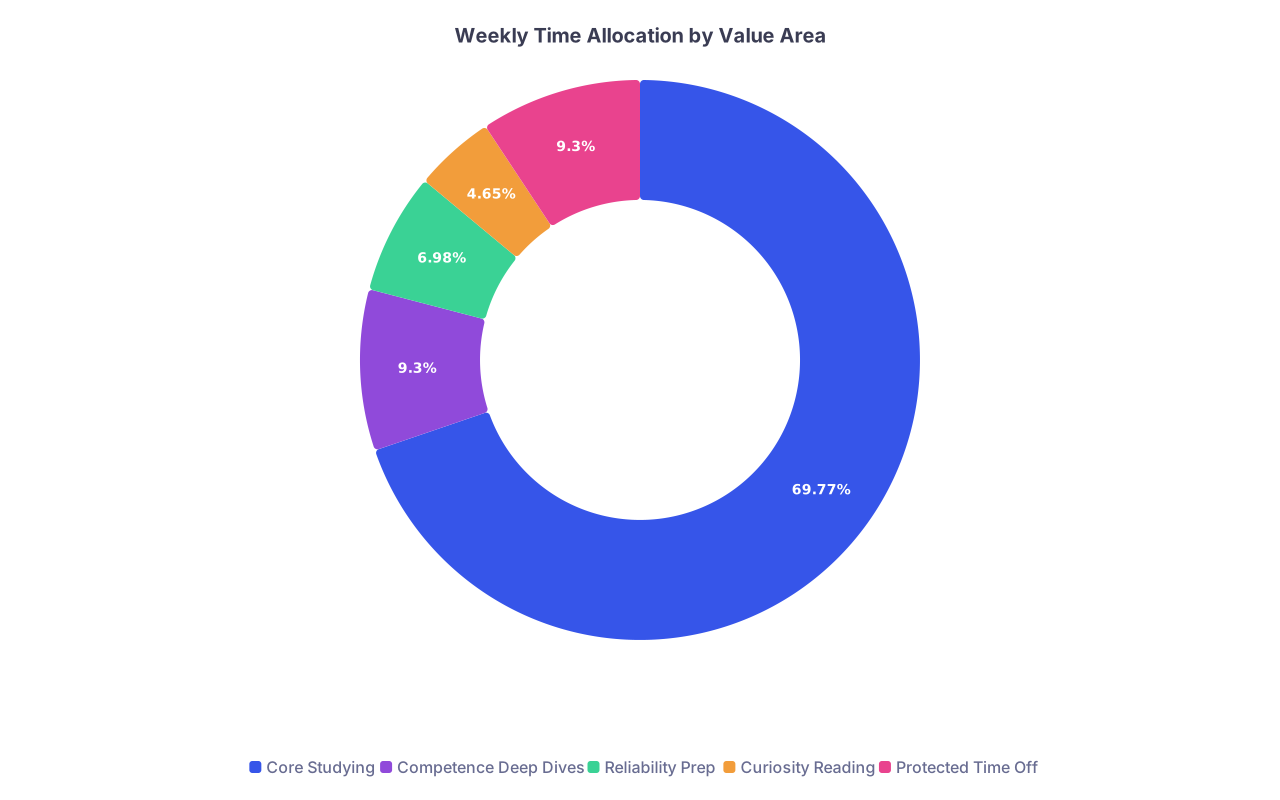
| Category | Value |
|---|---|
| Core Studying | 60 |
| Competence Deep Dives | 8 |
| Reliability Prep | 6 |
| Curiosity Reading | 4 |
| Protected Time Off | 8 |
(Numbers are hours per week; this is a reasonable target pattern, not a rigid prescription.)
9. Exercise 7: Clinical “Identity Reframe” for Early Patient Contact
The first time you walk into a patient room with a white coat, many M1s feel like they are cosplaying. “I am pretending to be a doctor.” That is a classic imposter reaction.
CBT intervention here is subtle but powerful: change the role label in your own head.
Step 1: Identify the unhelpful role thought
Common one:
“I am an imposter pretending to be a doctor.”
Or more quietly:
“I am just in the way; they would be better off with a ‘real’ medical person.”
Step 2: Write a realistic role statement
You are not a doctor. That is not the reframe. The reframe is:
- “I am a supervised learner here to practice basic skills and build comfort with patients.”
- “My job is to be present, curious, and respectful. Not to know everything.”
Write your version in one or two sentences.
Step 3: Ritualize it before patient encounters
Before you knock on a door or click “Join” on a telehealth encounter, mentally (or quietly) say your role statement once.
Sounds trivial. It is not. You are redirecting the “What if they find out I do not know anything?” loop into a concrete job description you can fulfill.
Over time, that builds a healthy clinical identity: “I am a learner, not a fraud.”

10. When to Stop DIY and Get Real Help
CBT‑style exercises are strong tools, but they are not magic and they are not sufficient for everyone.
You should not be white‑knuckling this alone if:
- You have persistent thoughts of harming yourself or wishing you would not wake up.
- Your sleep, appetite, or functioning are significantly impaired for more than 2 weeks.
- You are using alcohol, stimulants, or other substances to cope on a regular basis.
- You are failing or near‑failing multiple courses, and the dominant story in your head is “I am a failure as a human,” not “My strategies need help.”
That is the line where you stop playing heroic med student and you use the resources you theoretically believe in:
- Student mental health services
- A CBT‑trained therapist off‑campus (if confidentiality is a concern)
- Learning specialists / academic support staff
- Disability services if there is a suspected or known ADHD, learning disorder, or other condition
One of the quickest ways to dismantle imposter syndrome is to act like someone who deserves help. Because you do, and acting that way rewrites the internal script much faster than thinking about it differently in isolation.
FAQ (Exactly 5 Questions)
1. How do I know if what I feel is “normal” imposter syndrome versus something more serious like depression?
Imposter syndrome is usually situation‑linked and specific: it spikes around exams, cold‑calling, or comparison to classmates. Your mood in other areas of life is relatively intact. Depression is more global and persistent: low mood most days, loss of interest in things you previously enjoyed, sleep/appetite changes, low energy, feelings of worthlessness that extend beyond academics. If the negative feelings are constant, not just triggered, or you have any thoughts of self‑harm, you are past “normal” imposter territory and should talk to a clinician, not just do worksheets.
2. How often should I be doing these CBT‑style exercises for them to actually work?
Pick 2–3 exercises and do them consistently rather than trying everything sporadically. As a baseline: one thought record per significant academic setback, 3–4 distortion labels per week, updating the evidence file weekly, and 1–2 behavioral experiments per month. You are aiming for repetition over months, not a one‑week bootcamp. The brain changes with frequency and consistency, not intensity.
3. What if I intellectually “get” the CBT logic but I still feel like a fraud?
That is common, especially in high‑IQ, high‑achieving students. You can understand the distortions perfectly and still feel them. In CBT terms, your “emotional reasoning” circuits are overtrained. The fix is not more analysis. It is behavior. Run the behavioral experiments. Ask the questions. Go to office hours. Show up for clinical encounters. Then force yourself to write down what actually happened. The feeling usually lags behind the evidence; that lag can be weeks to months. Do not use “I still feel like a fraud” as proof that the exercises are not working; look at what you are doing differently.
4. Will working on imposter syndrome make me complacent or less driven?
No. That fear is one of the biggest myths I see. Imposter syndrome does not equal motivation; it equals fear‑driven overcompensation. Addressing it usually frees up cognitive bandwidth, improves focus, and actually allows you to work strategically instead of frantically. The students who learn to study from a place of competence and curiosity rather than terror are the ones still standing by Step 2 and residency.
5. Is it better to talk openly about imposter feelings with classmates or keep it to myself?
Selectively sharing is usually best. Telling one or two trusted classmates, a mentor, or a counselor can break the illusion that you are the only one struggling. Dumping your fears constantly into a group chat can backfire; it can normalize catastrophizing and comparison instead of grounded coping. Good rule: share with people who respond with specifics (“Yeah, I feel that, here is what helps me”) rather than platitudes or competitive humble‑brags.
Key points:
- Imposter syndrome in M1 is driven less by actual performance and more by distorted interpretations of that performance. CBT targets those directly.
- Thought records, distortion labeling, evidence files, behavioral experiments, and values‑based scheduling are concrete tools you can start this week, not abstract ideas.
- You do not need to feel like you belong in order to act like someone who belongs; the behavior usually has to come first.