
The way most first‑years “study harder” is exactly what keeps their stress high and their scores mediocre.
Let me be blunt: if you are in M1 and you are not systematically using active recall and spaced repetition, you are choosing unnecessary anxiety. You are choosing re-learning instead of reviewing. That is fixable.
I am going to walk you through, in practical detail, how to turn active recall and spaced repetition into a stress‑reduction system, not just a buzzword pair you see on Reddit.
Why Your Current Studying Is Making You Anxious
You are probably doing some version of this:
- Watching lectures at 1.5–2x speed
- Taking “detailed notes” in OneNote or Notion
- Highlighting PDFs because “it helps me focus”
- Re‑reading those notes before quizzes and block exams
- Feeling like you forgot 80% of last week by Monday morning
This creates a specific, familiar pattern:
- You feel okay at the end of a study session (“I understand this”).
- Two days later, it feels foreign again.
- By exam week, you are brute‑forcing 8–12 hour days, re‑learning old material under time pressure.
- Your heart rate spikes every time someone mentions “NBME style questions”.
That “I just saw this and I still feel like I do not know it” sensation is the core of your stress. It is not about the number of hours. It is about the instability of your memory. You cannot trust what you “know”, so every quiz feels like a pop quiz.
Active recall and spaced repetition solve exactly that problem. Not by magic. By mechanics.
What Active Recall Actually Is (And What It Is Not)
Active recall is not “doing questions sometimes.”
Active recall = trying to retrieve information from memory without the answer in front of you.
That means:
- Closed book, then check
- Question first, answer second
- Struggle, then feedback
Three very different levels of “active recall” you will see in M1:
Weak version (pseudo‑active)
Saying “yeah I know this” while glancing at highlighted notes.
Your brain is matching patterns, not retrieving. Feels good, scores badly.Decent version
Covering the answer and forcing yourself to say or write it before peeking.
Better. You at least confront what you cannot recall.Strong version (what you want)
You see a prompt (flashcard, concept check, board‑style question), you retrieve the answer from scratch, then you see the correct answer and compare. No answer cues, no multiple choice to guess from.
The stress‑reduction effect kicks in only when you are in category 3 most of the time. Because then you have calibrated confidence:
- “I have seen this 4 times, I get it right consistently, next review in 5 days.”
- That feels very different from: “I read this three times last week… I hope it sticks.”
How Spaced Repetition Lowers Stress (Mechanistically)
You already know the theory: spacing beats cramming. Fine. You need the implementation logic that actually matters in M1.
Spaced repetition, especially with tools like Anki, works by scheduling each piece of information just before you are likely to forget it. The core implications for your stress level:
You stop re‑learning
Instead of “Wait, what is 21‑hydroxylase again?” three times per block, you struggle hard once, then hit it again at increasing intervals. The second encounter is reinforcement, not reconstruction.You get daily, small doses of anxiety instead of huge spikes
A 2–3 hour daily review session of mixed cards feels manageable.
A 4‑day pre‑exam marathon of 12‑hour days feels like your life is on fire.You know where you stand at any moment
Mature card count up? New card count stable? Accuracy around 85–90%?
That is data. Not vibes. Very calming when done correctly.You separate “today’s learning” from “keeping everything alive”
Today might be all about renal physiology in lecture, but your spaced repetition deck will quietly pull in old microbiology, prior anatomy, and pharm from last week. Without you having to remember to “review micro later”.
Stress thrives on uncertainty. Spaced repetition shrinks that uncertainty down to a daily to‑do list.
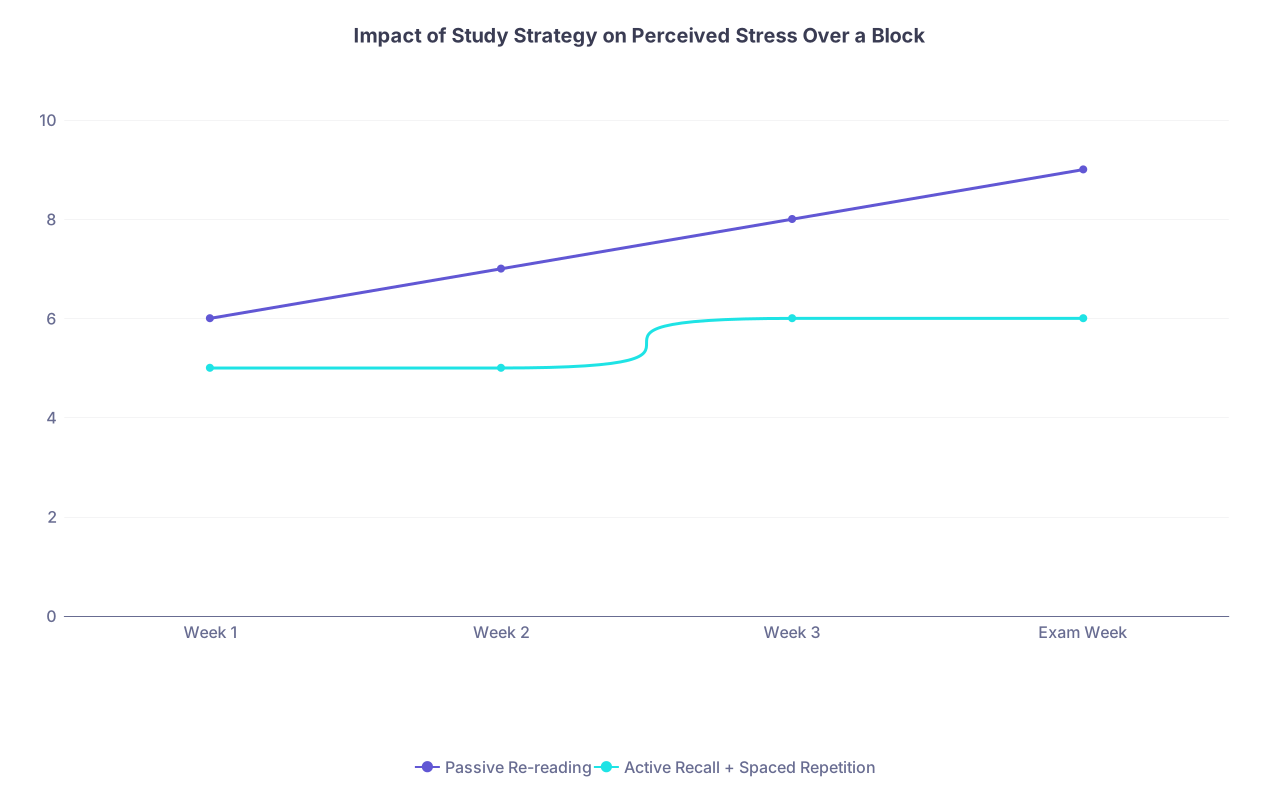
| Category | Passive Re-reading | Active Recall + Spaced Repetition |
|---|---|---|
| Week 1 | 6 | 5 |
| Week 2 | 7 | 5 |
| Week 3 | 8 | 6 |
| Exam Week | 9 | 6 |
Numbers are illustrative, but the pattern is real: passive strategies front‑load comfort and back‑load panic; active recall plus spaced repetition do the opposite.
The Core System: A Simple Daily Structure That Actually Works
Let me give you a structure you can use in any M1 curriculum (traditional, systems‑based, PBL, whatever). Adjust times, not the skeleton.
The 3‑Block Day
You are aiming for three recurring blocks on most non‑exam days:
Morning: Old Material (Spaced Repetition Block)
60–120 minutes, depending on card load and time of year.Midday/Afternoon: New Material Intake
Lectures, required sessions, assigned cases.Evening: Conversion of New Material into Recall Units
Flashcards, question banks, written summaries turned into questions.
Let me break that down more concretely.
1. Morning Review: Anki / Flashcards Only
Rule: No new cards before reviews. None.
You open Anki (or your SRS tool of choice). You do the due cards:
Target accuracy: roughly 80–90%.
Below 75% = your cards are bad or too detailed.
95–100% = you are lying to yourself or your intervals are too short.Target time:
Early M1: 45–60 minutes.
Peak systems heavy blocks: up to 90–120 minutes.
If you consistently need more than 2 hours: you are over‑making cards.
You finish your reviews, then and only then do you learn something new.
This one habit is anti‑anxiety gold. Because your brain starts the day with wins and familiarity, not with the feeling that you are behind.
2. New Material: Minimal Passive, Maximal “Processing”
You go to lecture (live or recorded). Here is the key: you are not trying to produce gorgeous notes. You are trying to figure out:
- What will I need to recall cold on test day?
- How does this integrate with what I already know?
Example: Renin‑angiotensin‑aldosterone system (RAAS). Instead of typing paragraphs, you mark:
- Important steps (trigger, renin, angiotensin I/II, aldosterone effects)
- Key associations (ACEi → bradykinin cough, efferent arteriole dilation)
- Clinical pivots (renal artery stenosis, CHF, diabetic nephropathy)
Then you move on. You will convert those into questions later. That conversion is where the memory gets real.
3. Evening: Active Recall Construction
This is where most students fail. They stop at “I watched lecture.” Then exam week hits and they realize their notes are a graveyard.
In the evening, you take your lightly marked slides/notes and do one of three things:
Make flashcards (preferably Anki)
Each card tests a single idea.
“What enzyme converts angiotensin I to angiotensin II?” is fine.
“Explain the entire RAAS pathway” is not one card. It is 10 bad cards.Do board‑style or module questions and convert misses to cards
Question banks, local quiz banks, or even the school’s own practice questions.
Every missed or guessed question → 1–3 cards targeting the reason you missed it.Short written recall, then cardify as needed
Close everything. On blank paper, write:
“RAAS: triggers, steps, pharmacology targets, clinical correlations.”
Fill it from memory. Compare to the source. The gaps become cards.
You do not need 4–5 hours of this every day. You do need consistent 60–120 minute blocks where new knowledge gets turned into future recall.
Building Cards Without Drowning Yourself
This is where students sabotage themselves. Over‑detailed cards = massive review load = burnout and stress.
Here is a concrete set of constraints I recommend for M1:
| Parameter | Recommended Target |
|---|---|
| New cards per day | 30–80 (block dependent) |
| Average card length | 1 fact / 1 concept per card |
| Deck creation time | 60–90 min on heavy days |
| Daily review cap | Usually ≤ 200–250 cards |
| Ideal card type mix | 60–70% cloze, 30–40% basic |
Some non‑negotiables if you actually want less stress:
One idea per card
“List the 5 causes of…” is usually 5 cards, not 1.Use cloze deletions for layered concepts
Example:
“ACE inhibitors ↓ production of {{c1::angiotensin II}}, leading to {{c2::efferent arteriole dilation}} and ↓ {{c3::GFR}}.”
You can test these one at a time.No verbatim paragraphs
If you are copying long sentences from slides, you are not learning medicine. You are learning copy‑paste.Tie to questions and pathology whenever possible
“What enzyme is deficient in classic CAH?” is better if you add “and what is the typical presentation in infants?” on a second card. Facts + clinical picture.Delete or suspend bad cards aggressively
If a card annoys you every time it appears, or it is always vague, fix it or kill it. Bad cards are a core anxiety source.
Integrating School Exams and Boards Without Going Insane
Your stress in M1 usually has two time‑horizons:
- Next week’s quiz / block exam
- Step/Level 1 looming 18–24 months away
You need a system that makes both the same process, not two separate, competing study schedules.
Here is what that looks like in reality:
Step 1: Use one main SRS system for everything
Do not maintain separate “school deck” and “boards deck” that never talk. That is how you end up reviewing the same glycolysis card in three different places.
Options that work:
- Use a solid premade deck (e.g., AnKing or a reputable school‑specific deck) and tag cards by block/system.
- Or build your own per‑block deck and then tag things by subject for later integration.
The critical thing is: one platform, multiple tags, not five platforms.
Step 2: Align your tags to your curriculum
Examples of useful tags:
block1_cardio,block2_resp, etc.lecture_micro_bugs,pathology,pharmmust_know_for_schoolvsnice_to_know_for_boards
Then you can quickly suspend low‑yield boards cards before a high‑stakes school exam and then unsuspend them later.
Step 3: Treat board‑style questions as sources of active recall
Do not wait until “dedicated” to do questions. That is a rookie mistake.
Even in early M1:
- Do a small number of board‑style or NBME‑like questions per week (even 5–10 a day is fine at first).
- Create cards for the concepts you missed.
- Tag them by discipline and block.
This is how you build a low‑level “boards background hum” from month one without sacrificing your current block.
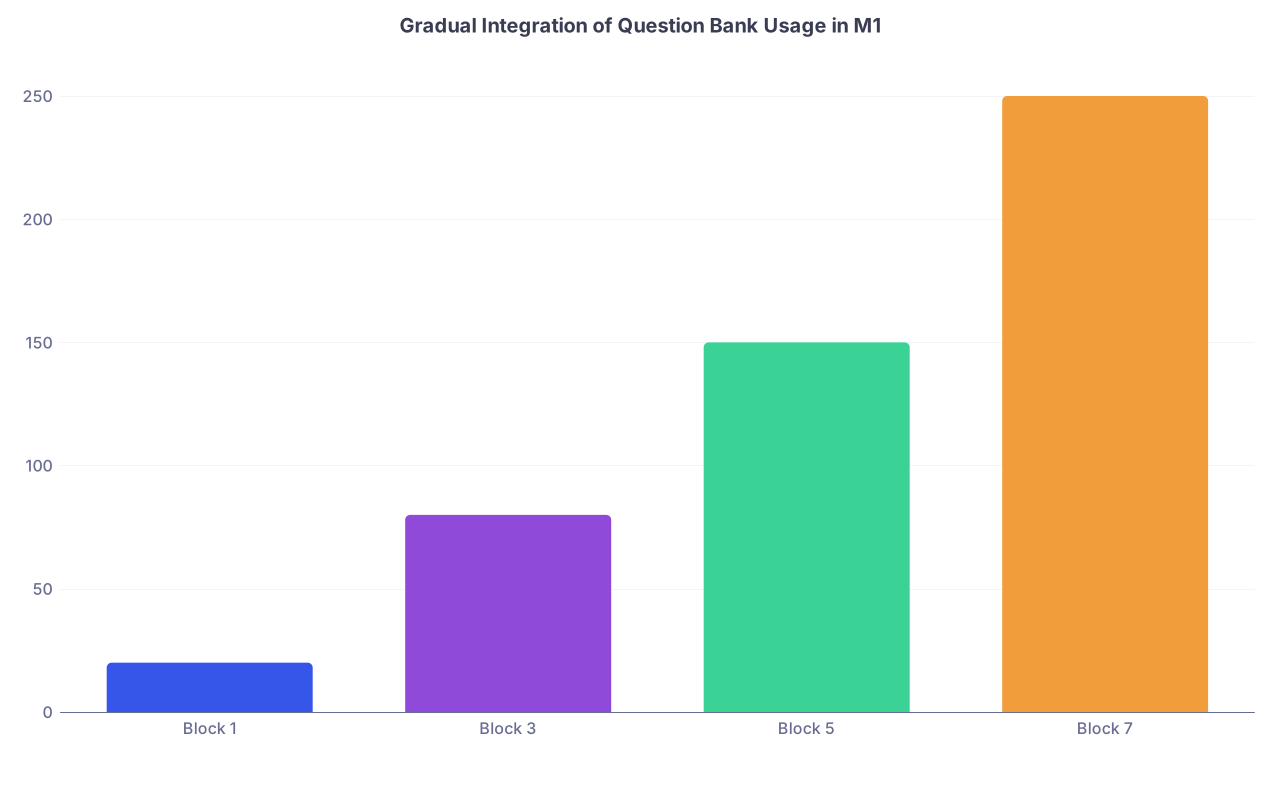
| Category | Value |
|---|---|
| Block 1 | 20 |
| Block 3 | 80 |
| Block 5 | 150 |
| Block 7 | 250 |
Those values are rough “questions per month” numbers. The point is trend: small and sustainable early, not “zero then 2000 in dedicated.”
Stress Traps: What Sabotages This System
You can absolutely take perfect tools like active recall and spaced repetition and still feel miserable. I have seen this repeatedly.
Here are the main ways M1s wreck themselves:
1. Turning Anki into a religion
If you are guilt‑tripping yourself because you missed one day and the review count doubled, you are doing this wrong.
Reality:
- Some days you will fall behind.
- Some weekends will be exam‑heavy and you will skip new cards.
- Some weeks your mental health will require shorter review sessions.
Use the tools. Do not let the tools use you.
If your review count is exploding (e.g., 400–600 due daily), you have three levers:
- Temporarily reduce new card creation to near zero.
- Suspend low‑yield or excessively detailed cards.
- Increase “easy” intervals so mastered cards bug you less frequently.
2. Paralysis by optimization
I have seen students spend entire afternoons debating which premade deck or which tags to use. Meanwhile, they have not tested themselves on a single fact.
Your first pass only needs to be “good enough.” You can always reroute later.
A bad, simple system that you use daily beats an intricate “perfect” one that lives in Notion and never gets executed.
3. Confusing discomfort with danger
Active recall often feels worse in the moment. You are confronting ignorance head‑on:
- “I thought I knew this pathway… wow I do not.”
- “Why do I keep messing up this cardio embryology question?”
That acute discomfort is what reduces your exam‑week chronic discomfort. But students misinterpret the feeling as “this method is not working for me” and run back to highlighting.
Measure outcomes, not feelings:
- Are you recalling more from last week than before?
- Are practice questions feeling more familiar?
- Are your pre‑exam days more review than re‑learning?
If yes, then the discomfort is exactly what you want.
4. Using too many overlapping tools
Flashcards + question bank + lectures + textual resources + 3rd party videos + 2 different note apps + 2 different flashcard platforms. I have watched people try this. It does not end well.
Pick:
- One main SRS platform (e.g., Anki).
- One main “question source” at any given time (NBME‑style, school question bank, etc.).
- One main content source per topic (textbook or resource, not five).
You can add texture later. Early M1? Keep it lean.
A Concrete 7‑Day Snapshot: What This Looks Like in Real Life
Let me spell this out as if you are in a random mid‑block week of M1.
Assumptions:
- Systems‑based curriculum, currently in cardiology.
- You are using Anki with a mix of premade + your own cards.
- You have a block exam in 3 weeks.
Daily (Mon–Fri):
Morning (1–1.5 hr):
- Open Anki.
- Do all due reviews (aim 85–90% correct).
- If review load is light (<45 min), add a small batch of new cards from yesterday’s lectures (20–40).
Midday (Variable):
- Attend/watch cardio lectures (e.g., cardiac cycle, heart failure, anti‑hypertensives).
- Light annotation of slides: highlight potential card material, mark unclear spots.
Evening (1–2 hr):
- Convert the day’s lectures into 30–60 new cards max.
- Do 5–10 board‑style cardio questions 3–4 days of the week.
- Make cards only for:
- Concepts missed.
- High‑yield associations you want to lock in early (e.g., JVP wave patterns, murmurs with maneuvers).
Weekend:
Saturday:
- Morning: Anki reviews.
- Late morning/afternoon: Larger chunk of board‑style or school‑style questions on cardio (e.g., 20–40 questions).
- Evening: Review explanations, make cards for missed/guessed items.
Sunday:
- Short review only (Anki plus maybe 10–20 questions).
- Longer break, catch up on life. Chronic stress drops when you actually take a real break once a week.
That schedule is not magical. Hundreds of permutations work. What matters:
- Every day you are confronting old material (spaced repetition).
- Every day you are converting new material into recall form (active recall).
- Questions are feeding your deck, not just draining your soul.
Mental Health, Sleep, and the “Stress Ceiling”
Let me say something that will offend a few grind‑culture types: if your active recall and spaced repetition system only works when you sacrifice sleep and basic mental health, then your system is trash.
Memory is brutally dependent on:
- Sleep consolidation
- Stress hormone levels
- Basic physical health (hydration, nutrition, movement)
You will not Anki your way out of 4‑hour nights and caffeine‑only diets. You may barely pass. You will feel awful.
A well‑run active recall + spacing system lowers the minimum number of hours you need to keep things afloat. It gives you room to protect sleep and basics.
Signs your system is working:
- You can take one evening off per week without sheer terror.
- Two days before exams, you are doing focused review, not catching up on entire units you never encoded.
- Your baseline anxiety between exams is low‑moderate, not permanent panic.
If that is not happening, the answer is not “do more Anki.” It is: fix the structure, shrink the load, and stop trying to do every single card and every single question source in existence.
FAQs
1. How many Anki cards per day is “normal” for an M1?
There is no universal number, but there is a sane range. For most M1s:
- New cards: 30–80 per day, depending on block intensity and whether you are using a premade deck or building your own.
- Total reviews (new + mature): usually 150–250 per day once things ramp up.
If you routinely see 300–400+ reviews daily, you are either over‑creating cards, using low‑quality cards, or refusing to suspend low‑yield material. That level is possible short‑term, but it is a recipe for burnout if maintained.
2. Should I use a premade deck or make my own?
If you are early M1 and overwhelmed, start with a well‑known premade deck that aligns with board resources, then layer your own school‑specific cards on top. Purely self‑made decks sound noble but usually collapse under the sheer volume of content.
Rule of thumb: premade for “core facts and buzzwords,” self‑made for “weird school‑specific details” and concepts you keep missing in questions.
3. What do I do if I fall a week behind on my Anki reviews?
Do not try to brute‑force everything. That is how people decide “Anki doesn’t work” and quit.
Better approach:
- Sort your deck by due date and tags.
- Suspend:
- Low‑yield or over‑detailed cards.
- Cards tied to past blocks that are not being tested soon.
- Tackle overdue reviews in chunks (e.g., 200–250 per day) for a few days.
- Limit new cards until the backlog is reasonable again.
Your goal is a sustainable rhythm, not maintaining some perfect review streak at all costs.
4. How do I balance school‑specific minutiae with high‑yield board content?
Use tagging and triage. Make two mental (and tag) categories:
- “High‑yield, will show up again”
- “Local trivia, I just need this for the upcoming exam”
You still make cards for local trivia if your school loves testing it, but you:
- Tag them as such.
- Consider suspending or burying them after the exam.
Do not let your long‑term spaced repetition load be dominated by facts that will never matter beyond your school’s picky preclinical tests.
5. What if active recall makes me feel dumb and I keep failing my own questions?
That “I feel dumb” phase usually means you are doing active recall correctly for the first time. You are confronting gaps that were always there; you just did not see them with passive methods.
Check three things:
- Are your cards well‑constructed (short, specific, one idea each)?
- Are you spacing them reasonably (not showing the same impossible card every day forever)?
- Are you actually reading explanations when you miss a question, or just hitting “Again” without learning?
If those are in order, keep going. Scores almost always lag behind for 2–3 weeks, then jump noticeably as the spaced repetition cycles kick in. This is where the stress actually starts to drop: once your performance catches up with the discomfort you have been tolerating.
Key takeaways:
- Active recall and spaced repetition are not buzzwords; they are mechanical fixes for the specific uncertainty that drives M1 anxiety.
- A simple, consistent daily structure—morning reviews, daytime intake, evening conversion—is far more powerful than an elaborate, rarely executed plan.
- You lower stress not by studying forever, but by building a system you can trust: one platform, sane card counts, ruthless deletion of bad cards, and early integration of questions.