Cognitive Load in M1: Specific Techniques to Keep Your Brain from Melting
Your brain is not failing you in M1. The system is overloading it.
Once you understand that, you stop blaming your “bad memory” and start fixing the actual problem: cognitive load. M1 is not about intelligence. It is about bandwidth. And most schools still teach like your working memory is infinite. It is not.
Let me break this down specifically, the way I wish someone had done for the first group of M1s I watched crash and burn halfway through Block 1.
The Three Types of Cognitive Load You Are Actually Feeling
Everyone throws around “burnout,” “overwhelmed,” “too much content.” Vague. Useless. You need to name the enemy.
Cognitive load theory splits what you are feeling into three buckets:
- Intrinsic load – how complex the material itself is
- Extraneous load – how stupidly the material is presented or organized
- Germane load – the useful effort that builds schemas and long-term knowledge
Your goal in M1 is not “study harder.” Your goal is:
- Reduce extraneous load to near zero
- Constrain intrinsic load to what your current schemas can handle
- Maximize germane load without frying your working memory
If this sounds abstract, let us anchor it in what you see daily.
How This Actually Looks in M1
- You have 60-slide lectures in biochem, 40-slide lectures in physiology, and 3 small groups the same day.
- You try to watch lectures at 1.5–2x, take notes, run Anki, do practice questions, and attend anatomy lab.
- By 4 pm, words stop meaning anything. You reread the same sentence five times. Nothing sticks.
That is not “you being weak.” That is your working memory completely saturated. You are trying to ingest raw information with no structure. It is like pouring water onto a plate.
We are going to turn that plate into a funnel.
Step 1: Stop Letting Your School Max Out Your Extraneous Load
Most M1s are destroyed not by the material itself, but by noise:
- Disorganized slides
- Unclear learning objectives
- Different attendings teaching the same topic in five different ways
- Massive PDFs with irrelevant detail
You cannot fix the curriculum. But you can ruthlessly strip away extraneous load on your end.
Technique 1: Define Your “Source of Truth” for Each Course
You should not be learning the same concept from five parallel resources. That is a great way to fry your working memory and feel constantly behind.
For each pre-clinical course, explicitly choose:
- 1 primary conceptual resource
- 1 primary question bank
- 1 flashcard system
For example, for Cardio block:
- Concept: Boards & Beyond + your school’s learning objectives only
- Questions: USMLE-Rx or UWorld (if your school starts you early)
- Flashcards: Pre-made Anki deck (e.g., AnKing) filtered to current topics
Everything else is optional. Not “I’ll try to get to it.” Optional.
| Block | Concept Resource | Qbank | Flashcards |
|---|---|---|---|
| Foundations | B&B + LO sheet | USMLE-Rx | AnKing |
| Cardio | B&B + LO sheet | UWorld (cardio-only) | AnKing |
| Pulm | B&B + LO sheet | USMLE-Rx | AnKing |
| Renal | B&B + LO sheet | UWorld (renal-only) | AnKing |
If you are “sampling” from four different resources for the same topic, you are not being thorough. You are multiplying extraneous load.
Technique 2: Rewrite Bloated Objectives into Questions
Learning objectives are usually trash as written:
- “Describe the biochemical pathways of glycolysis and gluconeogenesis including regulatory steps.”
That does not match how your brain works. Your brain wants questions.
You convert this into:
- “What are the regulatory enzymes of glycolysis and how are they regulated?”
- “What are the regulatory enzymes of gluconeogenesis and what activates/inhibits them?”
- “What is the energy cost difference between glycolysis and gluconeogenesis?”
Now you have 3 concrete hooks. Every slide either answers a question you care about or it gets ignored.
I used to watch students highlight 30 pages of notes, then wonder why nothing stuck. They were never asking anything of the content.
Step 2: Control Intrinsic Load with Chunking and “Pre-Wiring”
Intrinsic load = inherent complexity. You cannot make immunology “easy,” but you can stop trying to learn it in one shot.
Your tools here:
- Pre-wiring (previewing)
- Chunking
- Staging difficulty
Technique 3: 15-Minute Pre-Wire Before Any Dense Lecture
Pre-wiring is criminally underused. You never sit down to a lecture “cold” if you want to preserve cognitive bandwidth.
Before a heavy topic (e.g., cardiac action potentials), do this:
Spend 15 minutes the night before:
- Glance at the lecture titles + section headers only
- Read the learning objectives and convert them into 3–5 questions
- Watch 5–10 minutes of a high-yield video overview (B&B, Osmosis, etc.)
Your aim is not understanding. Your aim is familiarity with the map.
You want your brain to recognize terms as “I’ve seen this before,” not “brand new chaos.”
What this does: lowers intrinsic load. During the live or recorded lecture, you are not constructing everything from scratch. You are adding detail to an existing scaffold.

| Step | Description |
|---|---|
| Step 1 | Day -1 Evening |
| Step 2 | Review lecture titles & headers |
| Step 3 | Convert LOs to 3-5 questions |
| Step 4 | Watch 5-10 min overview video |
| Step 5 | Stop - do NOT deep dive |
| Step 6 | Day 0: Watch lecture with map in mind |
| Step 7 | Same-day: Build Anki or tag cards |
Most students skip this and then wonder why every lecture feels like drowning.
Technique 4: Chunk Concepts into 3–5 Node Schemas
Your working memory can actively handle about 4 ± 1 “chunks” at once. If your mental picture of the renin-angiotensin system is “all the steps,” you are doomed.
You need to chunk.
Example: Renin-Angiotensin-Aldosterone System (RAAS)
Instead of 15 disconnected facts, build a 4-node schema:
- Trigger: Low perfusion / low NaCl / sympathetic
- Renin release (kidney)
- Angiotensin II effects (systemic)
- Aldosterone effects (kidney)
Now every new detail you learn plugs into one of these four boxes:
- ACE inhibitors → block step from renin to Ang II (Node 3)
- HF meds that affect preload/afterload → Node 3
- Primary hyperaldosteronism labs → Node 4
Your recall improves because your brain is retrieving “RAAS schema” → then unpacking nodes, not searching random points.
Spend 5–10 minutes after any new topic explicitly writing your 3–5 node schema on paper.
Step 3: Convert Germane Load into a Daily, Repeatable System
Germane load is the good effort. The “brain-building” part. But it must be structured or it becomes random thrashing.
M1s who do well have a boringly repeatable cognitive workflow for every single day.
Let me give you one that is actually realistic.
Technique 5: The 3-Block Study Day (Protecting Your Brain’s Bandwidth)
Stop trying to study 10 hours straight. Your prefrontal cortex taps out after about 60–90 minutes of deep work. Past that, you are just creating the illusion of studying.
Use 3 focused blocks:
- Block 1 – Anki + Light Review (60–90 min)
- Block 2 – New Content (90–120 min)
- Block 3 – Integration / Questions (60–90 min)
With real breaks in between.
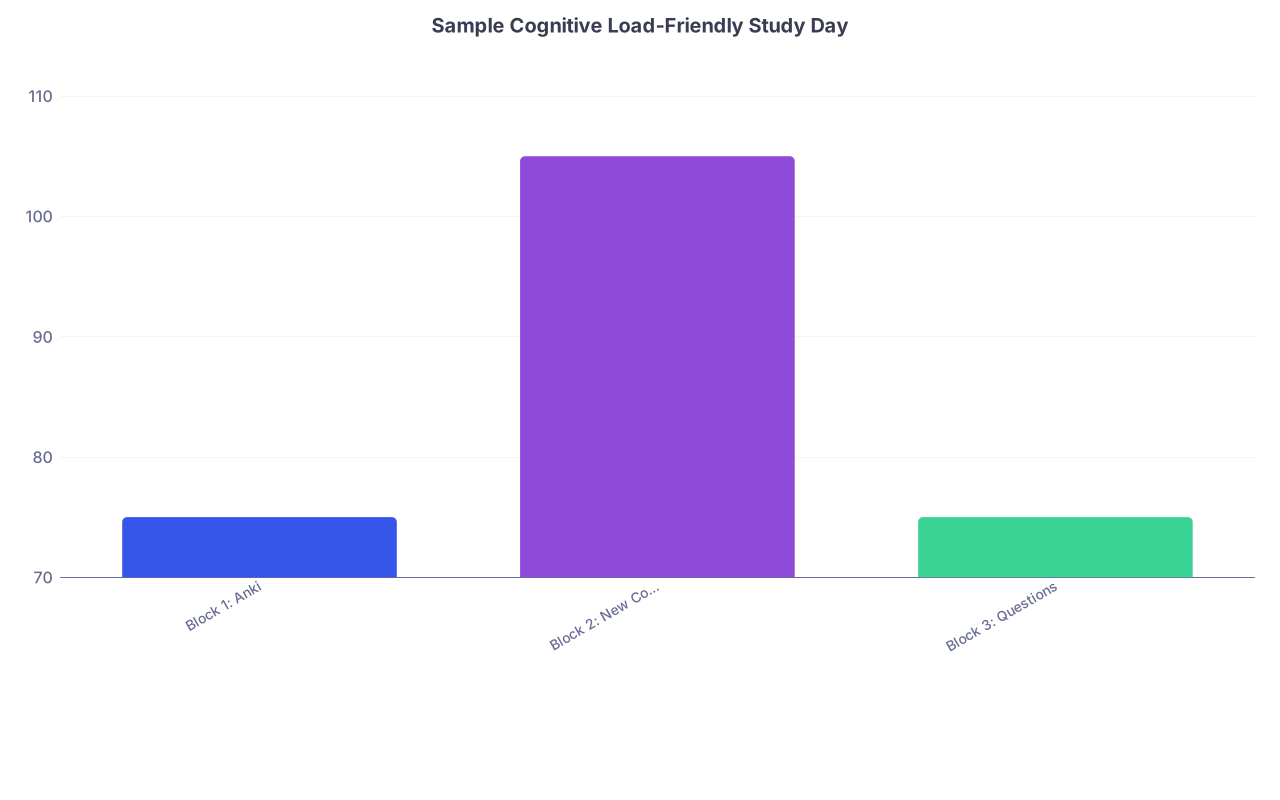
| Category | Value |
|---|---|
| Block 1: Anki | 75 |
| Block 2: New Content | 105 |
| Block 3: Questions | 75 |
Notice what is missing: random switching between 7 tasks. Every switch has a cognitive cost.
Block 1 – Anki as a Warm Start, Not a Whole Day
You open your day with your spaced repetition, but it should not eat the entire morning.
- Cap daily new cards. If you are doing 200+ new cards/day, you are setting up future cognitive bankruptcy.
- Ideal range for most M1s: 40–80 new cards/day, depending on deck and schedule.
- If your review queue is 500+ daily and growing, you are oversubscribing your future self.
The point: Anki is a tool to preserve cognitive load across weeks, not a masochistic badge of honor.
Block 2 – New Content with Active Construction
This is where most people hemorrhage cognitive load. They:
- Watch a 1-hour recorded lecture straight through
- Take verbatim notes
- Try to understand complex details as they first see them
Better:
- Watch in 10–15 minute segments.
- After each segment, close the video. On blank paper, write:
- 3–5 key points in your own words
- 1–2 “why” or “how” questions the content answers
You are forcing germane load (schema-building) instead of passively accumulating noise.
Technique 6: “Same-Day Compression” for Every Lecture
Same-day review is not about doing everything twice. It is about compressing. Reducing complexity while your memory is still warm.
Within 4–6 hours of a lecture:
Take a single blank page.
Write the topic in the center (e.g., “Asthma Pathophys”).
From memory, sketch 3–5 main branches:
- Triggers
- Inflammation + mediators
- Airway remodeling
- Clinical findings
- Treatment targets
Then briefly scan the slides to patch obvious gaps.
This compression step:
- Moves info from working memory into an organized schema
- Forces you to differentiate “core” vs “detail”
- Slightly painful, but that is germane load doing its job
You will find that topics you compress same-day need far fewer review cycles later.

Step 4: Managing Cognitive Load Across a Week, Not Just a Day
M1 burnout rarely comes from a single brutal day. It is cumulative overload with no system-level relief.
You need a weekly structure that respects cognitive load the way athletes respect recovery days.
Technique 7: The “Two-Scale” Planning Method (Energy + Complexity)
Most students plan by time: “I’ll study 8 hours Saturday.” That is meaningless. Cognitive load depends on:
- Your energy state that day
- The inherent complexity of tasks
Use a simple 2-scale system:
- Rate your energy each morning: 1 (wrecked) to 5 (sharp)
- Rate each task’s complexity: 1 (administrative) to 5 (deep conceptual work)
Now match wisely.
- Energy 4–5 → do your complexity 4–5 tasks (new cardio physiology, immuno pathways, tricky pathology)
- Energy 2–3 → do complexity 2–3 tasks (Anki reviews, simple anatomy labeling, watching low-yield lectures at 1.5x with minimal notes)
- Energy 1 → schedule recovery and non-cognitive tasks (laundry, groceries, scheduling appointments)
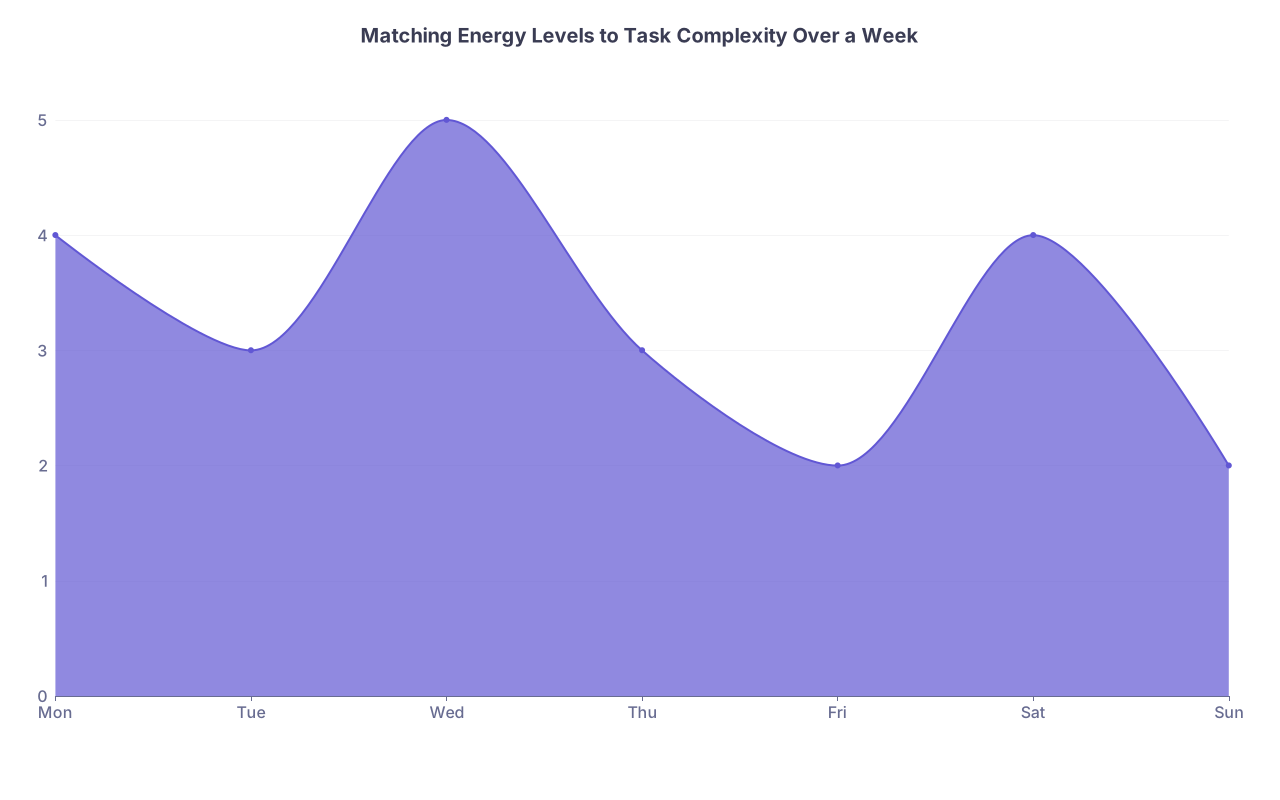
| Category | Value |
|---|---|
| Mon | 4 |
| Tue | 3 |
| Wed | 5 |
| Thu | 3 |
| Fri | 2 |
| Sat | 4 |
| Sun | 2 |
Low-energy days are not moral failures. They are bad days to do high-intrinsic-load tasks. Forcing it just produces garbage learning and more frustration.
Technique 8: Scheduled Forgetting – Why One Light Day per Week Protects You
You cannot run your brain at near-max load 7 days a week for 40 weeks and expect stability. M1s try. They crash by mid-year.
Build in one intentionally light cognitive day per week:
- Anki only (reduced load)
- Quick skim of upcoming week’s schedule
- Maybe one low-complexity topic (e.g., anatomy labeling or simple pharm charts)
The rest of the day: real life. Exercise, sleep, social connection, chores.
This is not indulgence. Your memory consolidation, especially for high-complexity topics, depends on sleep and lower-intensity periods. There is tough data on this. The brain literally offloads and reorganizes under lower load.
Step 5: Exam Weeks – Don’t Let Panic Override Cognitive Science
Exam weeks are where otherwise disciplined students suddenly break all their own rules and overload themselves into mush.
The common mistakes:
- Doubling or tripling new Anki cards
- Adding new resources (“maybe Sketchy will save me this week”)
- Binge-watching lectures
- Dropping sleep below 6 hours for multiple days
Let us fix that.
Technique 9: Three Phases of an Exam Week
Think in terms of phases:
- Consolidation phase (5–7 days out)
- Integration & practice phase (2–4 days out)
- Stabilization phase (last 24 hours)
1. Consolidation (5–7 Days Out)
Goal: Close primary knowledge gaps with your established resources.
What you do:
- Maintain normal Anki load (do NOT spike new cards)
- Prioritize topics clearly stated in learning objectives or emphasized in small groups
- Watch any must-see conceptual videos you missed
You are not late yet. No thrashing.
2. Integration & Practice (2–4 Days Out)
Goal: Move from “I’ve seen this” to “I can retrieve and use this under pressure.”
Shift time allocation heavily toward questions:
- School practice questions
- NBME-style stems
- Qbank sections matching your course content
Use a tight review loop:
- Do a timed or mixed block (10–20 questions).
- For each missed or guessed question, write the 1-sentence take-home.
- If it is truly testable and missing from your deck, add 1–2 high-yield cards, not 10.
Common trap: students turn question review into a second curriculum, adding 50 new cards per day from missed questions. You will never catch up.
3. Stabilization (Last 24 Hours)
Goal: Protect working memory, solidify schemas, reduce panic.
Here is what I recommend, and I rarely see students do this rationally:
- Limit new learning to near-zero
- Only light review of:
- Summary sheets / one-page schematics you made
- Highest-yield tables (e.g., murmurs, enzyme deficiencies, drug classes)
- Stop all heavy study 8–10 hours before your planned bedtime
Your performance on exam day is more sensitive to sleep and panic level than to the extra 3 hours of cramming microanatomy minutiae.

Step 6: Micro-Techniques to Reduce Moment-to-Moment Cognitive Friction
Not every fix is big-picture. A lot of cognitive load leaks out in small, stupid ways during the day.
Technique 10: Trim Interface Overhead
Your brain wastes power every time you hunt for things.
Concrete actions:
- Keep one central dashboard:
- A simple Notion page
- A paper planner
- A single Google Doc
It lists:
- Today’s 3 must-do tasks (max)
- Lectures to watch
- Question sets to complete
Everything else? Secondary. If your to-do list has 18 equal-priority items, you have made a cognitive mess.
Technique 11: Standardize Your Note Format
Some students switch note styles every block. That constantly forces your brain to relearn how to encode and retrieve information.
Pick one primary form:
- Typed outline with consistent headings
- Hand-drawn concept maps
- Cornell notes (questions on left, notes on right)
Then stick with it for an entire semester. You are building fluency with your own system, not just storing data.
Technique 12: Hard Boundaries for Device Distraction
Notification pings are not harmless. They reset your working memory context. That is expensive.
During deep work blocks:
- Phone out of reach, face down, in another part of the room if possible
- Tabs closed except:
- Video source
- Notes app
- Reference (e.g., UpToDate, if needed)
No Slack, no Discord, no group chat, no email. Your brain gets its threads cut every time you glance at them.
If this sounds strict, remember: your cognitive bandwidth is your only non-renewable resource during M1 hours. Guard it like a procedure room, not a coffee shop.
Step 7: Recognizing When Load Has Turned Toxic
There is a difference between “appropriately challenged” and “brain melting.” Most M1s normalize the latter until they hit a wall.
Here are red flags I pay attention to when I talk to students:
- You reread the same paragraph 4+ times and still cannot say what it means.
- You routinely forget what you studied earlier in the same day.
- You wake up and feel dread + mental “fog” before even starting.
- You sit in front of the screen for 2 hours and get <30 minutes of actual work done.
This usually means one of three problems:
- You are in chronic sleep debt.
- You are pushing too much intrinsic load without scaffolding.
- You are drowning in extraneous load (too many resources, chaotic systems).
You do not fix this with “more effort.” You fix it with subtraction and restructuring.
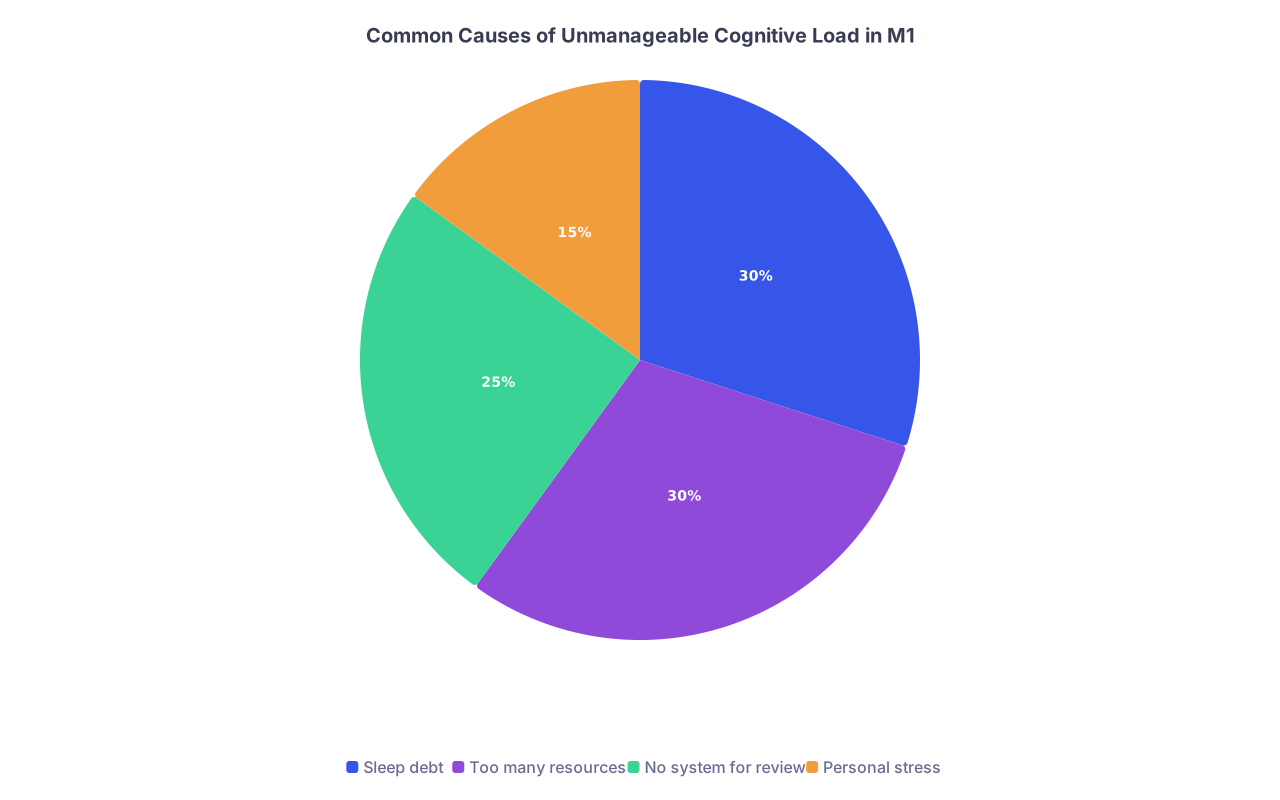
| Category | Value |
|---|---|
| Sleep debt | 30 |
| Too many resources | 30 |
| No system for review | 25 |
| Personal stress | 15 |
Putting It All Together: A Concrete Example Week in M1
Let me outline how this might actually look if you implemented even 60% of this for, say, a Cardio block.
Monday–Wednesday (New Content Heavy Days)
- Morning:
- 60–75 min Anki (cap new cards at ~60)
- Midday:
- 90–120 min Block 2: Two cardio lectures with 10–15 min segments and mini-summaries
- Late afternoon:
- 60–90 min Block 3: Same-day compression of the biggest lecture + 10–15 board-style questions
Thursday (Integration Tilted)
- Morning:
- Anki as usual
- Midday:
- Focus on RAAS, murmurs, or EKG basics as a “theme”
- Build 1–2 one-page schema sheets
- Late afternoon:
- 20–30 question set focused on the week’s topics
Friday (Light New Content, More Questions)
- Anki
- Finish any leftover lectures, but no more than 2
- 30–40 questions, plus tight review
Saturday (Moderate)
- Energy check: if 4–5, do a harder theme (e.g., heart failure pathophys)
- If 2–3, light questions + Anki + tidy notes
Sunday (Intentional Light Day)
- Reduced Anki
- 30–45 min skim of upcoming week’s schedule
- Maybe one low-focus review task
You come into Monday not fried, not “behind” in any lethal way, and with your schemas actually consolidating.

Final Thought: Your Job in M1 Is Not to Prove You Can Suffer
Let me be blunt. There is a toxic undercurrent in a lot of medical schools that glorifies misery. All-nighters, 500-card days on Anki, “I watched all of Pathoma in one weekend.”
That is not grit. That is poor cognitive strategy dressed up as dedication.
Your actual job in M1:
- Understand how your working memory and long-term memory really operate
- Ruthlessly strip away extraneous load
- Structure your days and weeks so that intrinsic load is matched to your bandwidth
- Invest effort into germane load – building schemas, compressing, retrieving
You are training to think clearly under complexity for the rest of your career. That starts now, not in residency.
With these foundations in place, you can start fine-tuning things for Step-style studying and clerkship survival. That is the next phase of the game—but that is a story for another day.