
The biggest mistake physicians make leaving full‑time clinic for remote work is treating it like a resignation, not a 12‑month project.
You are not just quitting a job. You are rewiring your income, identity, schedule, malpractice, and clinical skill set. That takes deliberate, timed steps. If you try to wing it in three months, you will end up underpaid on a patchwork of low‑quality telemed gigs, scrambling for benefits, and maybe crawling back to clinic.
Here is the one‑year transition timeline I use when I walk attendings through this shift. Month by month, then week by week as you get closer. Follow the order. The sequence matters.
Month 12–10: Reality Check and Planning Foundation
At this point you should not touch your job contract yet. You are in assessment mode.
Step 1: Financial and Lifestyle Audit (Month 12)
Sit down with a spreadsheet and be brutally honest.
- Pull the last 6–12 months of:
- Pay stubs
- Benefits breakdown
- Monthly spending (fixed vs variable)
- Define three numbers:
- Bare‑minimum monthly nut (mortgage/rent, loans, insurance, food, childcare)
- Comfortable target (what makes life feel “normal”)
- Savings buffer goal (how many months you want banked before leaving – I recommend 6 months of bare‑minimum expenses)
At this point you should:
- Confirm whether you can build a 6‑month buffer in the next 12 months.
- Decide if you will need:
- A spouse/partner’s income
- A part‑time clinical bridge
- A temporary spending cut
If the math does not work, good. Better to find out in Month 12 than Month 1.
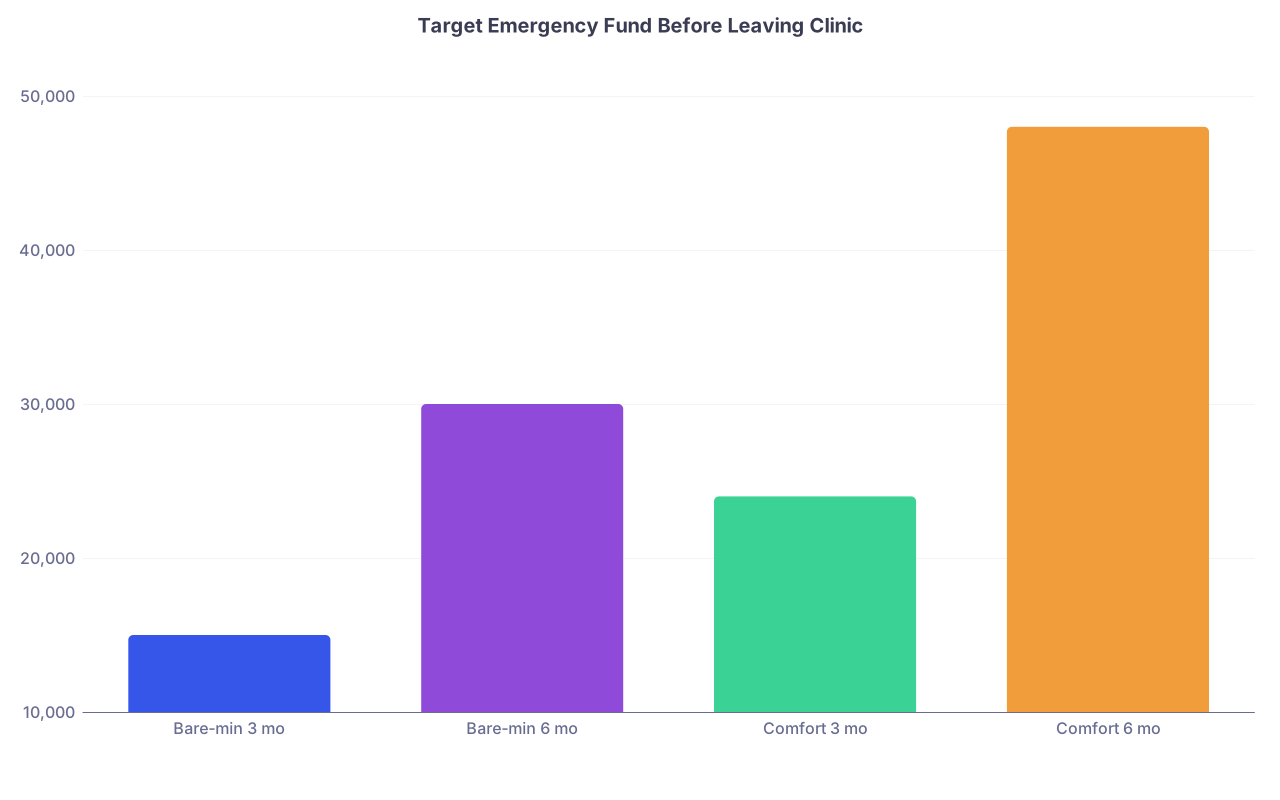
| Category | Value |
|---|---|
| Bare-min 3 mo | 15000 |
| Bare-min 6 mo | 30000 |
| Comfort 3 mo | 24000 |
| Comfort 6 mo | 48000 |
Step 2: Skills and Preference Mapping (Month 11)
Remote work is not one thing. Telemedicine is not just “video visits.” You need to match your skills and tolerance to the right buckets.
At this point you should:
- List what you actually enjoy:
- Rapid decision‑making vs long‑term continuity
- Adults vs kids
- Procedural vs cognitive
- Comfortable with high volume vs low volume and high complexity
- Map that to common remote roles:
- High‑throughput async urgent care (e.g., CirrusMD‑style chat, asynchronous e‑visits)
- Scheduled telemedicine primary care or specialties
- Chronic care management / RPM
- Utilization review / chart review
- Virtual second opinions
- Telepsychiatry, telederm, teleID, etc.
You should also decide your non‑negotiables:
- Minimum hourly or per‑encounter rate
- Maximum shift length
- Time‑zone constraints
- Whether you need benefits or can go 1099
Write those down. These become your filter later when recruiters start sending “great opportunities” that pay you like a mid‑level.
Month 10–8: Market Research and Early Positioning
At this point you should start acting like a candidate, not a dreamer.
Step 3: Market Scan and Shortlist (Month 10)
You need real data on what remote jobs and telemedicine contracts look like in your specialty.
At this point you should:
- Spend a weekend doing a focused scan:
- Telemedicine companies: MDLive, Teladoc, Amwell, Hims/Hers, Thirty Madison, Ro, K‑Health, etc.
- Remote utilization review / insurance roles: Optum, Aetna, Cigna, Anthem, Parexel, etc.
- Hospital/health system virtual care programs
- Record in a simple table:
- Type of role (video visits, async, chart review)
- W2 vs 1099
- Typical schedule expectation
- Stated or rumored pay range
| Role Type | Employment Type | Volume Expectation | Approx Pay Range/hr |
|---|---|---|---|
| Teleurgent Care | 1099 | High | $80–$140 |
| Virtual Primary Care | W2 | Moderate | $90–$130 |
| Utilization Review | W2 | Low | $70–$110 |
| Telepsych | 1099 | Moderate | $130–$200 |
| RPM/Chronic Care | Mix | Moderate | $80–$120 |
Notice something: very few of these are 1:1 replacements for a full‑time clinic salary plus benefits plus pension in one neat package. You are probably building a portfolio.
Step 4: CV, LinkedIn, and Online Positioning (Month 9)
Your academic CV is useless for most telemedicine and non‑clinical roles. Rewrite it.
At this point you should:
- Create a 2‑page, results‑focused CV:
- Quantify: “40 pts/day,” “RVU productivity 75th percentile,” “reduced wait times by…”
- Highlight tele‑adjacent skills: EHR optimization, patient messaging, care coordination, remote monitoring experience
- Fix your LinkedIn:
- Headline: “Board‑certified internist transitioning to virtual care and remote clinical leadership,” not “Attending Physician”
- About section: 3–4 sentences on what you are moving toward, not just what you did
- Join 2–3 relevant groups:
- Telemedicine physician groups
- Remote clinical roles communities
- Specialty‑specific virtual care groups
At this point you should be visible as “serious about remote work,” not “burned‑out doc ranting online.”
Month 8–6: Light Engagement and Trial Runs
Here you start testing the market without announcing anything to your current employer.
Step 5: Informational Interviews and Shadowing (Month 8)
Talking to people already doing this will save you months of mistakes.
At this point you should:
- Schedule 4–6 short calls over the month with:
- A teleurgent care physician
- Someone in a remote utilization review/medical director role
- A full‑time tele‑specialist (psych, derm, etc.)
- A hybrid clinician (part outpatient, part remote)
- Ask very specific questions:
- “What is a rough average hourly income for someone actually working full‑time?”
- “What does a bad day look like?”
- “What would you do differently if you were starting now?”
You are not asking for a job. You are building a mental model.
Step 6: First Low‑Risk Remote Work On‑Ramp (Month 7)
You want at least one side remote role up and running 6 months before fully leaving clinic.
At this point you should:
- Apply for:
- A flexible teleurgent care platform with:
- No minimum hours
- 1099, per‑consult pay
- Evening/weekend availability
- Or a low‑volume chart review / case review contract
- A flexible teleurgent care platform with:
- Plan 2–4 shifts per month to:
- Learn the workflows
- Get a feel for volume and cognitive load
- Check if you actually like remote care
If your current full‑time job contract bans moonlighting, you have a different problem. You either negotiate, wait, or accept you must delay your transition. Do not violate contracts casually; credentialing background checks are real.
Month 6–4: Concrete Job Search and Contract Strategy
Now we move into active transition mode.
Step 7: Formal Remote Job Search (Month 6)
At this point you should have:
- Clear income targets
- At least one small telemed or remote gig under your belt
- A sharper sense of what you want
Now you:
- Apply systematically:
- 5–10 targeted telemedicine roles (not “apply all” spam)
- 3–5 non‑clinical / remote clinical hybrid roles (e.g., part medical director, part virtual care)
- Track everything in a simple sheet:
- Date applied
- Contact person
- Stage
- Compensation discussed
You should aim to generate multiple offers / contracts so you are not forced to accept the first underpriced one.
Step 8: Review Contracts and Timeline Alignment (Month 5)
Most physicians underestimate how messy the timing can get. Credentialing, onboarding, notice periods—none of it lines up perfectly on its own.
At this point you should:
- Start receiving offers / contracts
- Map offers against your timeline and obligations:
- Credentialing time: 60–120 days for many telemed platforms
- Your current job’s notice requirement: often 60–90 days, plus any termination window
- Involve:
- A health care attorney (yes, actually pay one for at least 1–2 hours)
- A tax professional if you are moving into 1099‑heavy income
Key questions to resolve:
- When can your remote role realistically start generating revenue?
- When is the earliest safe date to resign from your current job?
- How many remote roles do you need concurrently to hit your minimum income?
At this point you should have a draft Gantt chart in your head of overlapping jobs.
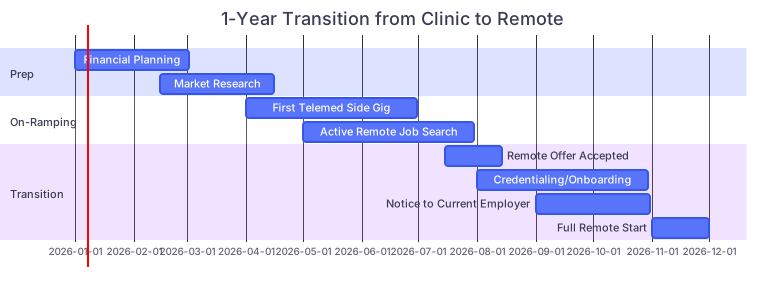
| Task | Details |
|---|---|
| Prep: Financial Planning | a1, 2026-01-01, 60d |
| Prep: Market Research | a2, 2026-02-15, 60d |
| On-Ramping: First Telemed Side Gig | b1, 2026-04-01, 90d |
| On-Ramping: Active Remote Job Search | b2, 2026-05-01, 90d |
| Transition: Remote Offer Accepted | c1, 2026-07-15, 30d |
| Transition: Credentialing/Onboarding | c2, 2026-08-01, 90d |
| Transition: Notice to Current Employer | c3, 2026-09-01, 60d |
| Transition: Full Remote Start | c4, 2026-11-01, 30d |
Month 4–3: Decision Point and Notice Preparation
This is where it becomes real.
Step 9: Finalize Remote Role Mix and Income Projection (Month 4)
You want your numbers as solid as they can be before you drop notice.
At this point you should:
- Have:
- At least one signed substantial remote contract
- One or two additional part‑time/PRN options for backup
- Build an income model:
- Conservative estimate: assume 75–80% of the “expected” volume or hours
- Include taxes, malpractice, health insurance premiums, retirement contributions (you will probably need to self‑fund)
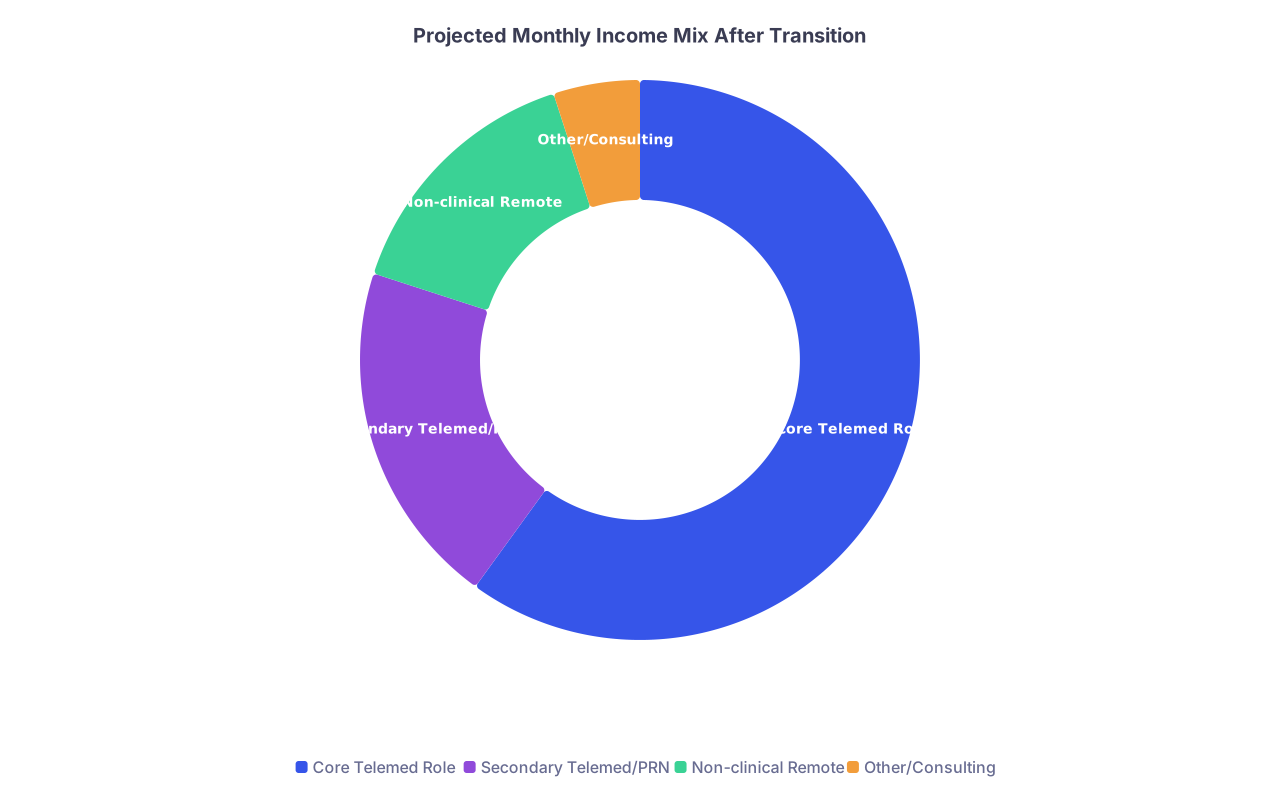
| Category | Value |
|---|---|
| Core Telemed Role | 60 |
| Secondary Telemed/PRN | 20 |
| Non-clinical Remote | 15 |
| Other/Consulting | 5 |
If the conservative model does not clear your bare‑minimum monthly expenses, you are not ready to resign. You either delay, take a part‑time clinic bridge, or add another remote role.
Step 10: Draft Your Exit Strategy and Notice (Month 3)
At this point you should:
- Pull your employment contract and read:
- Notice period
- Non‑compete / non‑solicit language
- Moonlighting or competing practice restrictions
- Plan your exit timing:
- Work backward from your remote start and credentialing completion
- Set a target resignation date that protects at least 1–2 months of overlap / cushion
You also:
- Draft your resignation letter:
- Simple, neutral, no venting
- Clear last day that respects the contract
- Decide:
- Whether you want to stay on in a per‑diem or very part‑time onsite role for 3–6 months as a safety net
- What you will tell colleagues and patients
Month 3–2: Formal Notice and Operational Setup
Now you execute.
Step 11: Give Notice (Start of Month 3)
At this point you should:
- Meet with your supervisor / leadership in person if possible
- Give formal written notice
- Keep the explanation high‑level: “Moving into remote/virtual care roles that better align with family/health/other professional goals.”
- Clarify:
- Final clinical day
- How leftover PTO is handled
- Malpractice tail coverage:
- Confirm if your employer covers it
- If claims‑made policy and not covered, get a tail quote immediately
You also ask about:
- COBRA / benefits end date
- Any retention or transition bonuses if you help onboard your replacement
Step 12: Build Your Remote Work Infrastructure (Month 2)
You are about to live or die on your home setup. Treat it like an OR, not a hobby.
At this point you should:
- Set up your workspace:
- Quiet, private room with a door
- Neutral, professional background
- Reliable high‑speed internet (and backup hotspot)
- Dual monitors, ergonomic chair, decent lighting
- Lock down security and compliance:
- HIPAA‑compliant environment
- No shared devices with kids on the same login
- Encrypted storage if you are keeping any PHI locally (many platforms keep everything in their own system)
You should also line up:
- Health insurance starting the month after your employment coverage ends:
- Marketplace plan
- Spouse’s plan
- Or a professional association plan if available
- Retirement account setup:
- Solo 401(k) or SEP‑IRA if you are going majority 1099

Final Month Before Transition: Week‑by‑Week
Here is where you tighten the screws.
4 Weeks Before Last Clinic Day
At this point you should:
- Confirm:
- Start dates and access dates for all remote roles
- That credentialing is complete or in final stages
- Create weekly practice blocks for:
- Logging into each platform
- Testing EHR workflows
- Practicing documentation templates and macros
You also:
- Start winding down long‑term patient panels:
- Transition notes
- Hand‑offs to colleagues
- Clear messaging in after‑visit summaries: “Your ongoing care will be with Dr. X after [date].”
3 Weeks Before
At this point you should:
- Meet with:
- Billing / coding staff to ensure all charts are up to date
- Clinic admin to finalize exit logistics (keys, badges, equipment return)
- For remote roles:
- Complete all required trainings and modules
- Do a mock telemedicine visit with a friend or family member to test camera, audio, and your on‑screen presence
You also finalize:
- Scripts for how you will describe your new work to:
- Patients (if asked)
- Colleagues
- Friends and family
2 Weeks Before
At this point you should:
- Double‑check:
- Malpractice coverage during the gap (if any) between jobs
- Health insurance effective dates
- Financially:
- Move a chunk of cash into a dedicated “transition buffer” account
- Turn off or reduce non‑essential recurring expenses for 2–3 months
For remote work:
- Lock in your first 4–6 weeks of telemed shifts on each platform, with:
- Some buffer days
- A mix of peak and off‑peak times to see where volume actually is
Final Week
At this point you should:
- Focus on clean closure:
- Finish charts same day
- Hand off remaining complex patients
- Leave your colleagues a concise transition summary (do not write a novel)
- Emotionally:
- Expect a mix of relief, grief, and panic
- None of that means the plan is wrong
For remote roles:
- Do one more full system check:
- Internet speed test
- VPN access
- Logins for each platform
- Test call if possible with tech support
First 4 Weeks Fully Remote: Stabilization Phase
Your job now is to stabilize, not to chase every shiny new contract.
Week 1–2: Volume and Workflow Calibration
At this point you should:
- Keep your remote schedule lighter than your long‑term target:
- Maybe 60–70% of planned volume
- Leave room to fix inevitable problems: tech glitches, learning curves, documentation time
- Track:
- Actual encounter rate or chart volume per hour
- Actual hourly income vs promised or estimated
- Cognitive fatigue at different times of day
You may realize:
- Evenings are far busier (and more draining) than you expected
- Some platforms flood you with low‑pay encounters
- Some non‑clinical tasks (utilization review) are slower but more sustainable
Week 3–4: Adjust and Lock In Version 1.0 Schedule
At this point you should:
- Prune:
- Drop lowest‑paying or highest‑annoyance shifts or platforms
- Say no to additional roles that do not fit your non‑negotiables
- Refine:
- Create templates / smart phrases for common visit types
- Standardize your pre‑visit checklist and post‑visit wrap‑up time
You also review:
- Does this schedule meet your bare‑minimum monthly target on a sustainable workload?
- Do you need to:
- Add a half‑day of per‑diem in‑person work?
- Add another remote role?
- Or simply increase hours slightly once workflows are smoother?

Months 2–6 After Transition: Optimization, Not Heroics
If you did the year correctly, this phase is fine‑tuning rather than survival.
At this point you should:
- Every month:
- Review actual income vs projection
- Tweak shift selection based on where the money and sanity are
- Every 2–3 months:
- Re‑evaluate benefits:
- Health insurance
- Disability coverage
- Retirement contributions
- Re‑evaluate benefits:
You might:
- Consolidate to 1–2 best platforms and drop the rest
- Add one small non‑clinical consulting or teaching role to diversify
- Decide to keep or drop any remaining in‑person per‑diem work

The Core Takeaways
- A safe, rational exit from full‑time clinic to remote work is a 12‑month project, not a 12‑week impulse.
- The sequence matters: financial buffer → small remote side gig → multiple offers → contract review → notice → infrastructure → stabilization.
- Your first remote schedule is a draft. Build redundancy, protect your downside, and expect to optimize for 3–6 months after you leave the clinic.