
Virtual Visits Don’t Mean Lower Quality: What Outcomes Data Really Shows
What if I told you your safest, most evidence-based visit for several common conditions might not be in your clinic at all—but on a screen?
You’ve been fed a pretty consistent story: telemedicine is fine for “simple” stuff, but “real medicine” happens in person. I hear it constantly in hospital hallways and physician lounges:
- “Virtual visits are glorified phone calls.”
- “You can’t do a quality exam on video.”
- “Telehealth just increases low-value care.”
Let’s cut through that. Because once you actually look at outcomes data, a lot of those claims fall apart—or at least get much more nuanced.
And if you’re post-residency or planning a telemedicine-heavy career, your income, malpractice risk, and job options all depend on whether that story is true.
The Myth: Virtual Care = Lower Quality Care
Let me state the myth bluntly: “Telemedicine visits are inherently lower quality than in-person visits and should only be used as a last resort.”
Here’s what physicians usually mean when they say that, based on what I’ve heard in practice meetings and QI committees:
- You’ll miss diagnoses because you “can’t examine” patients.
- Patients seen virtually will have more ED visits and hospitalizations.
- Antibiotic stewardship and chronic disease control will suffer.
- Virtual care is fine for convenience, terrible for outcomes.
Now compare that mythology to what the last decade of data actually shows.
What The Outcomes Data Really Shows
No, telemedicine is not a panacea. But the “lower quality” narrative? It’s lazy. And mostly wrong when you look specialty by specialty and condition by condition.
Let’s go through concrete outcomes—hospitalization, ED use, disease control, prescribing, and safety.
Hospitalizations and ED Use
A common claim: “Telehealth patients bounce back to the ER more.” The evidence says: not across the board.
Several large systems (Kaiser, Veteran’s Health Administration, integrated ACOs) have published on this. The pattern is remarkably consistent for primary care and several chronic disease programs:
- Carefully implemented telehealth either
- reduces downstream acute care use, or
- is at least non-inferior to in-person care.
Example patterns from published data and large integrated systems:
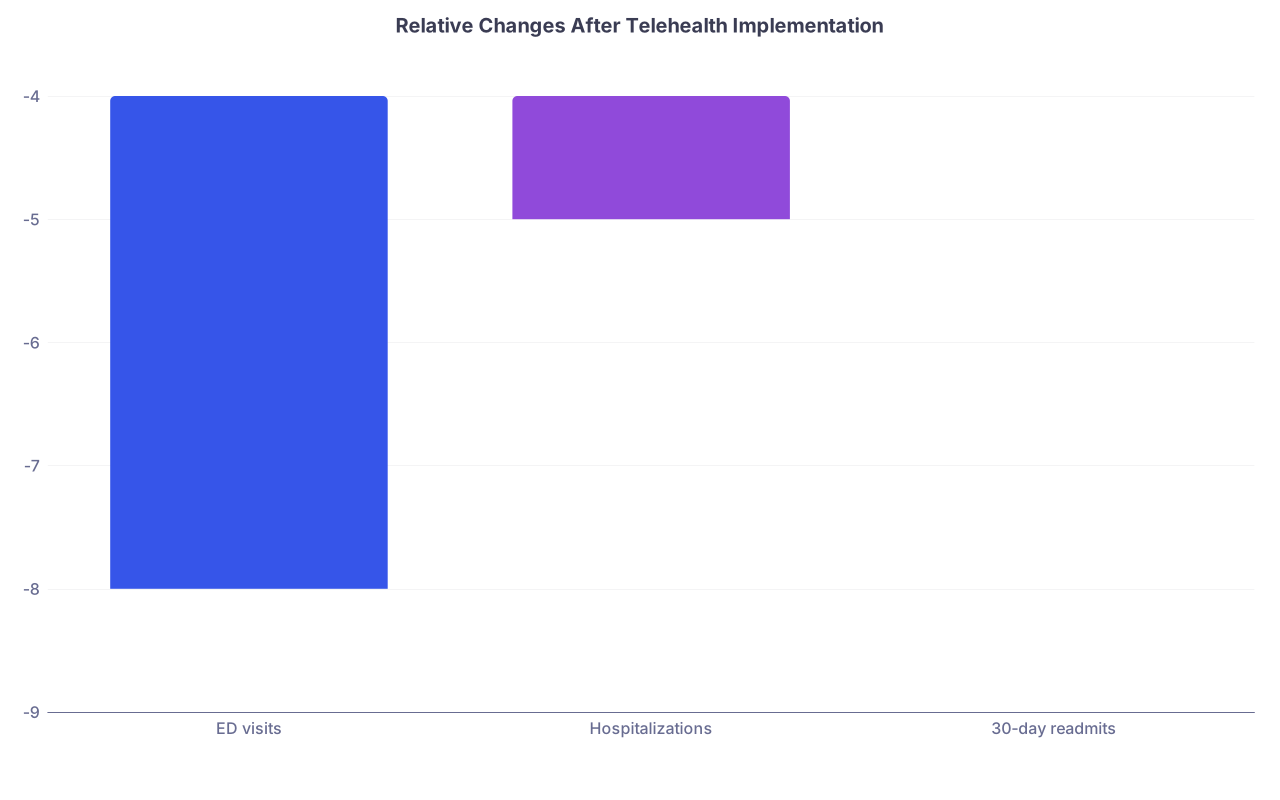
| Category | Value |
|---|---|
| ED visits | -8 |
| Hospitalizations | -5 |
| 30-day readmits | -4 |
Those percentages aren’t fantasy; they’re in the ballpark of what real programs have reported in heart failure, COPD management, and high-risk primary care panels when telehealth is integrated (not just bolted on).
Key nuance: quality depends heavily on how virtual care is embedded:
- Telehealth tied to the patient’s usual PCP or team? Outcomes usually hold or improve.
- Random, one-off virtual urgent care disconnected from longitudinal care? That’s where quality starts to wobble.
So the right claim is not “virtual visits are low quality.” It’s: fragmented telehealth is low quality. Completely different problem.
Chronic Disease Control: Hypertension, Diabetes, Heart Failure
If you’re considering a telemedicine-heavy job, this is where the story gets very interesting. Remote and hybrid models don’t just “match” in-person care—often they beat it.
Common findings:
- Telehealth + remote BP monitoring → better blood pressure control than usual care.
- Telehealth + home glucose monitoring + diabetes education → equal or better A1c reductions.
- Virtual heart failure clinics → fewer readmissions in well-run programs.
The mechanism isn’t magic video. It’s logistics:
- Patients don’t skip follow-ups because they can’t get off work.
- You see them more frequently in shorter bursts.
- Home data is often more accurate than one BP reading in a stressed clinic visit.
In other words, telehealth removes friction. Less friction → more touchpoints → better control.
If you’re a post-residency doctor choosing between “all clinic” vs “hybrid clinic + telehealth,” you’re not choosing between “real medicine” and “fake medicine.” You’re choosing how much you want to leverage more frequent, lower-friction contacts.
Mental Health Care: Telepsychiatry Is Not Second-Class
Psychiatry and therapy are where the “telehealth is lower quality” narrative completely implodes.
Randomized trials and large cohort data repeatedly show:
- Similar or better symptom improvement for depression and anxiety via telehealth vs in-person.
- High patient satisfaction and lower dropout rates.
- Better reach into rural and underserved populations, where the counterfactual is not “better in-person care”—it’s no care.
The main quality limitation in virtual mental health care is not “video vs in-person.” It’s continuity, care coordination, and whether the therapist/psychiatrist is working in a sweatshop model seeing 30 video visits a day with no team.
That’s not a telehealth problem. That’s a business-model problem.
The Physical Exam Objection (And What Actually Matters)
I’ve heard this line from some older attendings word-for-word: “You can’t practice real medicine without a hands-on exam.”
Let’s be blunt: this is nostalgia, not evidence.
Of course there are conditions where the absence of a physical exam makes virtual care inappropriate or dangerous:
- Acute abdominal pain, focal neuro deficits, chest pain with concerning features
- Worsening shortness of breath not explained by recent benign diagnosis
- Any unstable vital signs (if you have them)
But a gigantic fraction of outpatient medicine is history-driven. And in those cases, virtual visits can deliver equal or better quality because:
- You have the patient at home with their meds right in front of them.
- You see their environment (clutter, fall risks, food, inhaler technique).
- You bypass white-coat hypertension, transportation barriers, clinic delays.
Let’s separate ego from data: You’re not doing a detailed neuro exam on every tele-visit primary care patient in person either. You never were. You triage based on history, risk, and resources. The same logic applies on video.
Here’s how I think about it in practice: the quality bottleneck in outpatient care is almost never “I could not percuss their lungs.” It’s:
- Incomplete medication reconciliation
- Poor follow-up
- Patient not understanding the plan
- No time to explore barriers and context
Telehealth often helps those, not hurts them.
Prescribing Quality: Antibiotics and Overuse
There are real concerns about virtual urgent care mills churning out antibiotics and refills. And some of the research backs up the concern—especially for stand-alone, one-off telehealth platforms disconnected from primary care.
You see patterns like:
- Slightly higher antibiotic rates for URI/bronchitis in some tele-urgent-care settings.
- More imaging or follow-up in some tele-orthopedics settings when no prior relationship exists.
But again, context matters. Compare models side by side:
| Model Type | Antibiotic / Overuse Risk |
|---|---|
| Patient’s own PCP via video | Similar or lower |
| Integrated health system tele-UC | Similar or slightly higher |
| Stand-alone tele-urgent platforms | Higher |
| Direct-to-consumer Rx startups | Much higher |
Blaming “telemedicine” globally for overprescribing is like blaming “the stethoscope” for poor cardiology outcomes. The tool is neutral. The model of care is not.
If you’re considering a telemedicine job and care about quality, the question you should be asking is:
- “Will I be seeing an established panel and documenting in their main EHR?”
- “Is there antibiotic stewardship oversight?”
- “Are visits triaged appropriately between virtual and in-person?”
If you join an outfit that pays you per script and pushes 6-minute visits, do not be shocked when the quality is garbage. But do not blame the camera for that.
Safety, Misdiagnosis, and Malpractice Risk
Here’s another myth: “Telehealth is a malpractice minefield because you’ll miss stuff without laying hands on the patient.”
Let’s be honest: misdiagnosis risk exists in any limited-information environment. Telephone call. After-hours triage. Ten-minute walk-in.
What decreases risk?
- Clear triage rules about what is and is not appropriate for virtual care.
- Low threshold for converting to in-person or ED when your gut says “this could be bad.”
- Documenting shared decision-making and red-flag warnings.
Systems that do telehealth well have explicit protocols: chest pain → in-person/ED; high-acuity complaints → no video; certain neuro symptoms → direct evaluation. When that’s in place, there’s no good evidence showing some massive spike in telemedicine malpractice claims relative to brick-and-mortar outpatient care.
From a medicolegal standpoint, the bigger risk is practicing outside of a system that supports you—no triage, no integration, no clear follow-up pathways. Again, it’s structure, not screen.
Careers: What This Means For Post-Residency Job Choices
You’re not just asking, “Is telemedicine safe?” You’re asking, “Is building a telemedicine-heavy career smart or suicidal from a quality and reputation standpoint?”
Here’s the data-driven answer: telemedicine is a tool. It amplifies whatever care model it plugs into.
- Plug telehealth into a strong, team-based, data-driven practice → quality usually improves or holds.
- Plug telehealth into a high-volume cost-cutting machine → quality erodes, your professional satisfaction tanks, and your name is on the line.
When you evaluate telemedicine jobs, ignore the marketing fluff and ask these questions:
- Are visit lengths and panel sizes realistic, or are they asking you to do twice as much “because it’s just virtual”?
- Will you manage a defined patient panel or be a random doc in the queue?
- Is there clear triage between in-person vs virtual, or do they shove everything into video to avoid overhead?
- What outcomes do they actually track? (Readmissions, ED use, A1c, BP control, antibiotic rates.) If the answer is “we don’t really have that data,” that’s your sign.
If you care about practicing evidence-based medicine, there are plenty of telemedicine roles where you can do exactly that—and in some conditions, do it better than old-school clinic-only models.
Where Virtual Visits Really Do Fall Short
Let’s not swing to the other extreme and pretend video visits solve everything. They do not.
Telehealth is weaker when:
- You need procedures or point-of-care testing.
- The patient has poor tech literacy or no private space.
- The complaint is inherently exam-driven (e.g., subtle neuro, acute abdomen, certain MSK injuries without imaging access).
Quality craters when:
- Telemedicine is used to replace all in-person capacity instead of being part of a hybrid model.
- There’s no continuity—pure “visit mills” where no one owns the patient.
- Incentives are volume-at-all-costs rather than outcomes.
But those are failures of implementation, not proof that “virtual = inferior.”
The Real Takeaway
If you strip away the nostalgia and look at actual outcomes, the honest conclusion is:
- Telemedicine is at least non-inferior for a huge slice of outpatient care.
- It’s superior for some chronic conditions and for mental health when done in a structured way.
- Quality problems blamed on “telehealth” are usually problems of fragmentation, volume pressure, or bad business models.
For your post-residency career, that means you should stop asking, “Is telemedicine real medicine?” and start asking, “Is this telemedicine role structured to support real medicine?”
Big difference.


