You’re Here
It’s 11:45 pm.
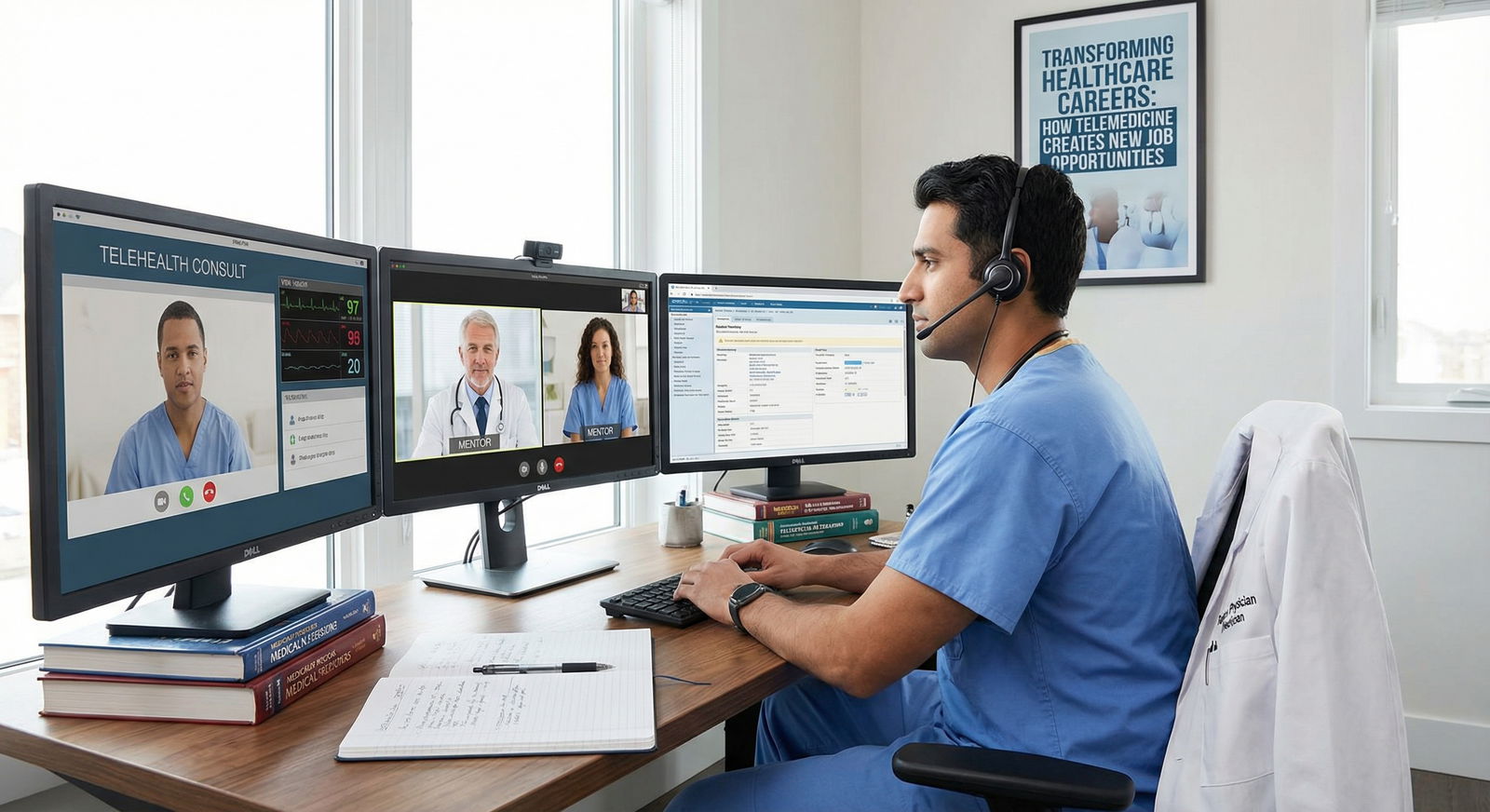
You just finished your last telemedicine shift of the week, still in scrubs but… at your kitchen table. Your friends from residency are texting in the group chat about grand rounds cases, residents they’re teaching, some new trial the division is running.
You’re staring at your dashboard: “Visits completed: 32.”
No academic title, no clinic, no fellows, no residents. Just you, a laptop, and a pile of standardized telemed notes.
And the thought hits:
“Am I quietly destroying my chances of ever being taken seriously in academic medicine?”
You start spinning out the scenarios:
– In five years, will a search committee look at your CV and see “telemedicine physician” and toss it?
– Are you going to be permanently branded as “the Zoom doc” instead of someone who does “real medicine”?
– If you decide you want a faculty job later, will they assume you just did telemed because you couldn’t hack it in an academic center?
Let’s walk through this like adults and not like spiraling-insomnia-brain. I’m going to be honest where it’s bad, and reassuring where it’s actually fine.
Because telemedicine can hurt you academically.
But only in very specific, preventable ways.
What Academic Committees Actually Care About (Not Your Zoom Percentage)
Here’s the blunt truth: academic hiring committees don’t care that you did telemedicine. They care what you did while you were doing telemedicine.
They’re basically looking at four buckets:
- Clinical credibility
- Scholarly output
- Teaching / mentorship
- Institutional / service contributions
Telemedicine can mess with your ability to build those. Not because it’s “lesser,” but because it’s very easy to drift through telemed jobs that are intentionally designed to be plug‑and‑play, zero‑academic, zero‑growth.
So the real risk isn’t “I did telemed.”
It’s “I did telemed in a way that left my CV flat for 3–5 years.”
Here’s how committees usually think when they see a telemedicine chunk on a CV:
| Telemed Profile Type | Likely Academic Reaction |
|---|---|
| Telemed + research + teaching | Neutral to positive |
| Telemed + QI projects / leadership | Neutral, maybe mildly positive |
| Pure telemed, no other growth | Concerned about trajectory |
| Long telemed gap + no references | Red flag |
| Short telemed period post‑residency | Often seen as fine / transitional |
So no, “telemedicine” alone doesn’t blacklist you. The emptiness around it might.
Where Telemedicine Can Make You Less Competitive (And How Bad It Actually Is)
Let’s just name the scary parts.
1. “You’re Not a Real Clinician Anymore”
Fear:
“In 4 years of telemed, I won’t have done procedures, admissions, inpatient management… Are they going to think I’m clinically soft?”
Reality:
Yes, if you only do high-volume, low-acuity tele-urgent care for years with no other clinical work, your perceived clinical heft can take a hit—especially for procedure-heavy or inpatient-heavy academic roles.
Programs will wonder:
- Can you handle complex in-person cases?
- Are your physical exam and bedside skills rusty?
- Are you basically a triage/referral machine now?
This matters more for: hospitalist, ICU, EM, surgical fields, subspecialties with procedures.
Less for: psych, derm, allergy, some outpatient-heavy IM subspecialties, primary care–focused roles.
How bad is it?
It’s not career-ending, but it will absolutely raise questions if you’re aiming for an academic job that requires substantial in-person clinical work.
Mitigation (so you don’t freak out):
If you’re worried about this, at minimum:
- Keep some in-person clinical work if humanly possible: 0.2–0.4 FTE clinic, per diem, locums, or PRN hospital shifts.
- Maintain procedures you actually care about: schedule them intentionally so you’re not the “I haven’t done a lumbar puncture in 5 years” candidate.
If your CV says: “Telemedicine 0.6 FTE + in-person academic or community practice 0.4 FTE,” no one will clutch their pearls.
2. “You Have Zero Academic Output During Your Telemed Years”
This is the big one. The thing that really hurts.
Fear:
“My CV is going to show: Residency → Telemedicine → nothing for 4 years. No papers. No teaching. No projects. Just… shifts.”
That’s the real risk. Not the telemed label. The stagnation.
Academic committees don’t like flatlines. They want to see trajectory.
They’ll ask:
- Did this person grow at all?
- Do they care about scholarship?
- Can they complete projects or just log in and see patients?
Here’s why telemedicine is dangerous here: it’s very, very easy to let it become a brain-off job. You log in, see 20–30 patients, log off. No residents. No colleagues down the hall. No grand rounds. No protected time to do anything academic unless you carve it out yourself.
That “I’ll start something later” becomes three years before you blink.
Real talk:
Three totally empty post‑residency years look bad if you want a real academic job at a moderately competitive institution. Not fatal, but you’ll be starting from behind.
The good news?
Telemedicine actually gives you flexibility in time and location. Which can be weaponized in your favor if you’re intentional.
3. “Telemedicine Means You Didn’t Get a ‘Real’ Job”
Fear:
“They’ll assume I did telemed because I couldn’t get hired in a clinic or academic center.”
This one’s more social than real.
Most adults on a search committee understand people choose telemed for reasons that make sense:
- Partner’s job/location
- Childcare and schedule flexibility
- Visa issues
- Need for remote work for health or family
- Burnout from residency / inpatient work
What does look bad is when telemed is paired with:
- Weak or no letters
- Spotty employment timeline with unexplained gaps
- Jumping between multiple telemed platforms every 6–12 months
- No clear narrative of what you were actually doing
If your story is: “I chose telemed to live near family and I used the flexibility to do X, Y, Z academically,” that’s fine.
If your story is: “I sort of bounced between a bunch of random platforms and didn’t really do anything else,” that’s harder to polish.
Ways Telemedicine Can Secretly Help An Academic Career (If You Don’t Sleepwalk Through It)
Here’s the part nobody tells you when you’re doomscrolling job boards at 2 am.
Telemedicine is exploding inside academic medicine. Institutions are still trying to figure it out. Which means there are gaps. Gaps = opportunities.
There are at least four academic flavors telemedicine can feed directly:
- Telemedicine as a research focus
- Telemedicine as a quality improvement / operations niche
- Telemedicine in education and curriculum
- Telemedicine in leadership / system design
If you lean into even one of those, your telemed years suddenly look a lot less like “I was hiding from real medicine” and more like “I built expertise in a rapidly growing domain.”
Think examples like:
- Publishing on no-show reduction with telehealth
- Designing or evaluating hybrid care models
- Studying outcomes of tele-psych vs in-person
- Building a tele-preop clinic and measuring post-op outcomes
- Creating telehealth OSCEs or resident curricula
Academic places love tidy niches. “Telehealth implementation,” “digital care models,” “virtual chronic disease management.” Those are very 2024+ friendly.
You just can’t assume that logging a lot of RVUs via webcam magically turns into academic credit. It doesn’t. You have to deliberately turn your telemed job into data / projects / curricula.
What Your Future CV Might Look Like (Telemed vs Non‑Telemed)
Here’s a hard side‑by‑side, because you’re probably picturing something worse in your head than what’s actually likely.
| Category | Pure Telemed, No Extras | Telemed-Integrated Academic Path |
|---|---|---|
| Clinical Work | 1.0 FTE tele-urgent care | 0.6 FTE telemed + 0.4 FTE clinic |
| Publications | 0 | 2–4 first/second-author telehealth papers |
| QI / Projects | 0 | 1–2 completed telehealth QI projects |
| Teaching | None | Resident tele-precepting or lectures |
| Roles | “Telemedicine physician” only | “Telemedicine medical director” or similar |
Scenario 1: You did 4 years of straight tele-urgent care, nothing else.
Scenario 2: You did 4 years telemed but deliberately layered in projects, some in‑person work, some teaching.
Scenario 1 is hard to spin into “assistant professor at mid‑tier academic center.”
Scenario 2 is very sellable.
So… Will Telemedicine Make You Less Competitive?
Here’s my honest, condensed version:
Telemedicine will make you less competitive for academic roles if:
- You do only low‑acuity, high‑volume tele-urgent care for many years
- You don’t maintain any in-person clinical experience (and you want a clinical academic role)
- You produce zero scholarship, QI, teaching, or leadership during that stretch
- You don’t have strong letters from anyone who can speak to your clinical or academic chops
Telemedicine will not significantly hurt you (and might actually help) if:
- You maintain some in-person clinical work, especially if it’s in or near an academic setting
- You attach academic things to your telemed work: research, QI, curriculum, leadership
- You can tell a coherent story: “I did telemed for X reason and used that flexibility to build expertise in Y”
- Your letters are strong and come from people who actually saw you think and work
In other words: the threat isn’t the medium.
It’s being professionally invisible for several years.
Concrete Moves If You’re Already Doing Telemedicine (Or About To)
Let’s get tactical, because vague reassurance doesn’t fix a dead CV.
1. Anchor Yourself to Some In‑Person World
Even 0.1–0.3 FTE in-person gives you:
- Real colleagues
- Teaching opportunities
- People to write letters
- Evidence you can still function IRL
Per diem hospitalist shifts. One day a week in a community clinic. Even a part-time faculty outpatient role at a local med school satellite. It doesn’t have to be perfect. It just has to exist.
2. Attach a Project to Your Job, Not Just Shifts
Take something you already see:
- High no‑show rates
- Poor follow-up completion
- Messy documentation
- Patient satisfaction issues
- Inappropriate ED referrals
Then turn it into:
- A small QI project
- A retrospective study
- A case series
- A process-improvement initiative
I’ve seen people turn “our tele-psych no-shows dropped from 40% to 18% with texting reminders” into a poster, then a paper, then a foot in the door for an academic position.
3. Stay in the Academic Orbit
You don’t have to be on faculty to stay plugged in.
You can:
- Attend local or virtual grand rounds
- Keep in touch with your residency mentors
- Volunteer to give a telehealth talk to residents or students
- Join a telehealth or digital medicine working group in a professional society
The worst‑case scenario is not telemedicine.
It’s doing telemedicine and becoming completely invisible to everyone who might one day hire you.
Quick Reality Check: What If You Already “Wasted” 2–3 Years?
You might be thinking, “Cool, but I’ve already done exactly what you’re warning against.”
You’ve done:
- Full-time telemed
- No papers
- No teaching
- No in-person
- No clear projects
Is it over? No. But you need to get intentional, now.
If I were you, I’d:
- Start 0.2–0.4 FTE in-person work as soon as you can secure it.
- Pick one telemed-related project you can realistically publish or present within 12–18 months.
- Reconnect with residency mentors and be honest: “I went heavy into telemed, but I want to build an academic path. Can you help guide/affiliate/collaborate?”
- Look for telemedicine leadership roles where you are—workflow committee, protocol design, triage algorithm review, whatever you can get your hands on and own.
Your story becomes: “I initially focused on telemedicine for flexibility, then realized I wanted an academic trajectory and started building one through X, Y, Z.” Committees like people who correct course and then actually do the work.
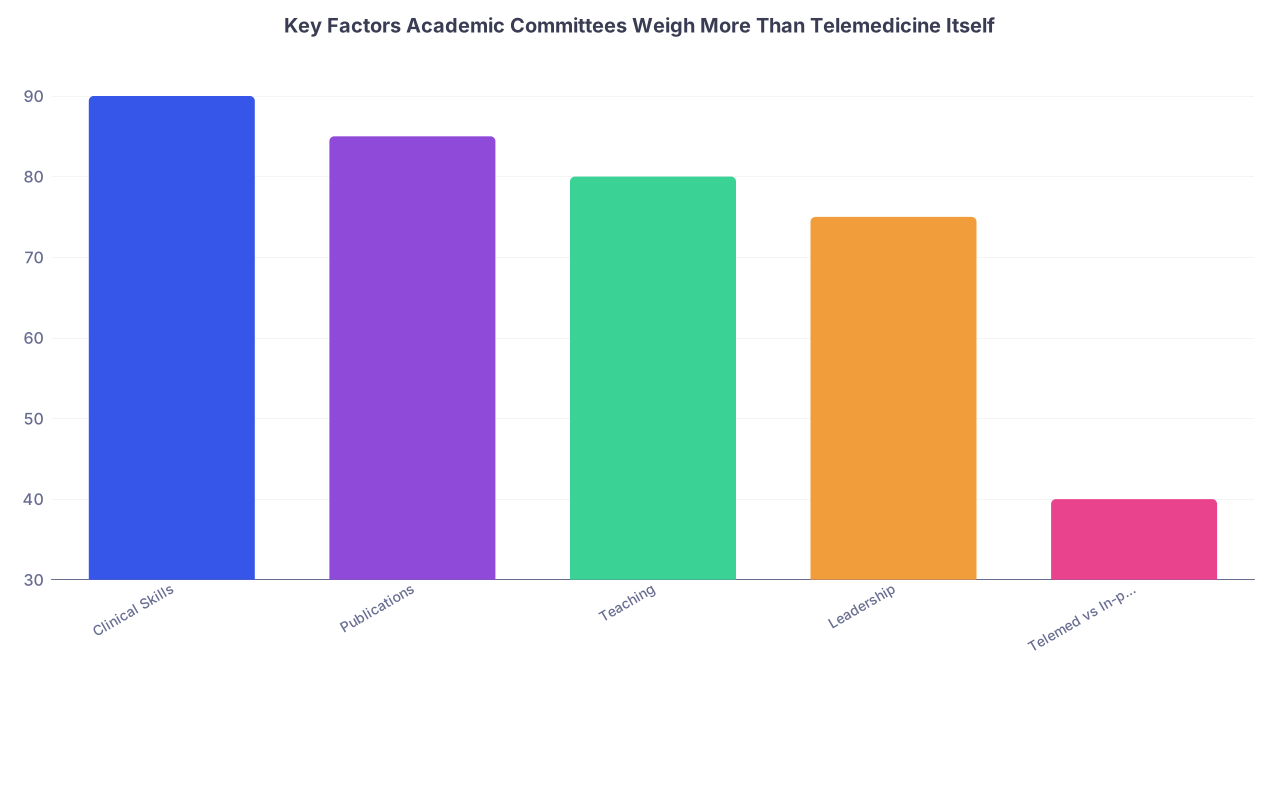
| Category | Value |
|---|---|
| Clinical Skills | 90 |
| Publications | 85 |
| Teaching | 80 |
| Leadership | 75 |
| Telemed vs In-person | 40 |

| Step | Description |
|---|---|
| Step 1 | Telemedicine Job |
| Step 2 | 0.2 to 0.4 FTE Clinic |
| Step 3 | Stay Pure Telemed |
| Step 4 | Start Telehealth Project |
| Step 5 | Present or Publish |
| Step 6 | Teaching or Curriculum Role |
| Step 7 | Apply for Academic Position |
| Step 8 | Add In Person Work |

FAQs (The Stuff You’re Probably Still Anxious About)
1. If I do 100% telemedicine for 2–3 years right after residency, am I permanently screwed for academia?
No, not permanently. But you’re making your own life harder. Two or three totally blank academic years mean you’ll have to play catch‑up: add in-person work, crank out at least a couple of projects, and get new letters. It’s recovery mode, not game over. People get hired into academic jobs all the time with non‑linear paths; they just have to show clear growth once they decide they want it.
2. Is telemedicine experience actually valued by academic centers, or are they just tolerating it?
At this point, telemedicine isn’t just tolerated; it’s baked into how many academic centers function. They run tele-ICUs, tele‑stroke services, virtual urgent care, subspecialty consults. Having meaningful telemed experience—especially if you’ve worked on protocols, quality, or education—can be a plus. What they don’t care about is “I took a lot of shifts and that’s it.” They value what you built, not just that you sat in front of a webcam.
3. Will programs think I chose telemed because I wasn’t good enough for a “real” job?
Some individual skeptics might think that privately. Most won’t say it, and more importantly, you can override that bias with your actual record. Strong letters, publications, and leadership beat assumptions. Your narrative matters too: “I chose telemed to stay near my family / manage health / keep flexible, and I used that flexibility to do X and Y” lands a lot better than “I drifted into telemed and stayed there without much else.”
4. Do I have to go back and do a fellowship or extra training to get “rescued” from telemedicine into academia?
Usually no. Fellowship can help if you want a subspecialty or research-heavy job, but it’s not a magical “fix my telemedicine years” button. What matters more is recent, demonstrable academic engagement: projects, papers, teaching, and some in-person clinical work. If you already wanted a fellowship for content reasons, sure. But don’t do it solely out of shame about telemed—that’s a bad, expensive way to fix a problem you can usually solve more directly.
5. If I stay in telemedicine long-term, is an academic title basically off the table?
Not necessarily. You could end up with adjunct, affiliate, or part-time academic titles, especially if you’re teaching residents or students remotely, helping run telehealth programs, or collaborating on research with an institution. A full, traditional academic clinician-educator role is harder if you never return to in-person care, but hybrid models are becoming more common. If an academic identity matters to you, you’ll have to actively create that connection; it won’t appear just because you’ve been in practice a long time.
Key points, so you can sleep:
- Telemedicine itself doesn’t kill an academic career; unproductive years wrapped in telemedicine can.
- Keep some in-person work and attach real projects, teaching, or leadership to your telemed role if you want academic options later.
- Even if you’ve already done the “pure telemed, zero growth” thing for a bit, you can course-correct—but you have to start treating your career like something you’re building, not just something that happens to you.