

The worst thing you can do after switching specialties is pretend your old Step 2 plan still works. It does not.
If you changed your target specialty after Step 1, during clerkships, or even right before ERAS, your Step 2 CK strategy needs surgery. Not a tweak. A rebuild.
I’ve watched students go from “I’m going into ortho” to “Actually… peds?” in June and then try to brute‑force Step 2 with generic question banks and vibes. They end up with decent scores but miss the chance to use Step 2 as a weapon for their new direction.
You’re in a specific situation with specific constraints:
- You already learned a ton, but in the wrong direction for your new specialty.
- Your rotations and letters may not match where you want to go.
- Step 2 is now your biggest lever to show programs you belong in this new lane.
Here’s how to refocus your prep like an adult, not a panicked M3.
Step 1: Get Brutally Clear on Your New Target
You cannot refocus if you’re still foggy on where you’re aiming.
Ask yourself three concrete questions and commit to answers for the next 3–4 months:
- What specialty am I now targeting?
- How competitive is it for my stats?
- What story do I need Step 2 CK to help tell?
Not some vague “maybe IM, maybe EM, maybe heme/onc later.” Pick a real lane.
| Situation | Minimum Goal | Competitive Goal |
|---|---|---|
| Switching into very competitive (Derm, Ortho, ENT, Plastics) | ≥ 245–250 | 255+ |
| Switching into moderately competitive (EM, Anes, OB, Rads) | ≥ 240–245 | 250+ |
| Switching into IM aiming subspecialty fellowships | ≥ 240 | 245–250+ |
| Switching into less competitive / community‑friendly fields | ≥ 230–235 | 240+ |
Are these perfect cutoffs? No. But they’re realistic anchor points.
Then connect that to your narrative. For example:
- “I’m switching from surgery to anesthesiology. Step 1 was 230. I need Step 2 ≥ 245 to show growth and that I’m serious.”
- “I thought I wanted psych, now I want IM with possible cards. Step 2 has to be my ‘I can handle complex medicine’ exam.”
Write that on a sticky note. Put it on your laptop:
“Step 2 CK ≥ 245 to show I belong in ___.”
You’re not just “taking an exam.” You’re building evidence for this new identity.
Step 2: Do a Ruthless Inventory of Where You Stand
You can’t plan a route if you refuse to admit where you’re actually starting from.
You need three things:
- Honest baseline performance
- Rotation‑by‑rotation strength/weakness profile
- Time reality check
A. Take a Baseline (Stop Stalling)
Within 3–5 days of “I should study,” do:
- One NBME Comprehensive Clinical Science Self‑Assessment (CCSSA)
or - A full‑length UWorld self‑assessment (UWSA 1)
Don’t “pre‑study” for two weeks. That’s procrastination disguised as preparation.
You’re not trying to impress anyone; you’re trying to find out if you’re at 215 or 245. Those are very different problems.
B. Map Your Rotation Strengths vs New Specialty
Your switch matters because your clinical brain is tuned to your old interest.
Make a quick grid on a sheet of paper with three columns:
- Strong
- Meh
- Weak/old specialty heavy
Then go rotation by rotation:
- Internal Med
- Surgery
- Peds
- OB/GYN
- Psych
- EM
- FM / sub‑Is
Example if you were surgery‑leaning then flipped to IM:
- Strong: Surgery, ICU, EM
- Meh: IM, Psych
- Weak: Peds, OB, outpatient FM
Now overlay your new specialty.
Switching into:
- IM → you can’t have “IM: Meh” and “Peds: Weak” and expect Step 2 to rescue you without a plan.
- Pediatrics → you can’t leave Peds/OB/ outpatient as “fix later.”
Your study plan should overweight the systems and rotations that matter most for your new field.
C. Time Reality Check
Students lie to themselves here constantly.
You need:
- Test date (fixed or flexible?)
- Days per week you can actually study
- Hours per study day you’ll realistically hit
Then do the math:
Study days × hours/day = total hours.
You’re switching specialties. You probably need at least 120–180 focused hours if your baseline score is >230, and 200–250+ hours if your baseline is <225 and your target field is competitive.
If your math comes out to 70–90 hours, you don’t need motivation. You need to move your exam or lower your expectations. Pretending it’ll magically work is how people end up with toxic Reddit posts about “my score ruined my dream specialty.”
Step 3: Rebuild Your Study Plan Around the New Specialty
Now the actual refocusing: less “What’s high yield?” and more “What’s high yield for me now?”
Priority 1: Master the Medicine Core
No matter what you switched to—EM, OB, psych—Step 2 is still a medicine‑heavy exam.
I don’t care if you’re going into radiology. If your IM, renal, and endocrine are trash, your score ceiling is low.
Non‑negotiables:
- Cardio: chest pain, heart failure, valvular disease, arrhythmias, ACS management
- Pulm: COPD/asthma, PE, pneumonia, ARDS, ventilator basics
- Renal: AKI, CKD, electrolyte acid‑base disturbances
- Endo: diabetes (all complications), thyroid, adrenal, calcium
- Infectious disease: sepsis, HIV, common bacterial/viral infections, antibiotics choice
If your new specialty is medicine‑adjacent (IM, EM, Anes, Neuro, Peds), double down here. This is your score engine.
Priority 2: Over‑index on Your New Specialty’s Adjacent Content
This is where refocusing actually shows up.
Switching into IM:
- Aggressive focus on: cardiology, pulm, renal, ID, rheum.
- OB/Peds/Psych still matter, but your tie‑breaker questions on the exam are likely to be adult complex medicine, not obscure OB.
Switching into Pediatrics:
- Weight your weeks toward growth & development, congenital heart disease basics, neonatal issues, vaccine schedules, pediatric ID, pediatric endocrine.
- OB is secondary but still important (pregnancy + fetus).
Switching into EM:
- Emphasize acute management: trauma, shock, airway, toxicology, fast decision trees.
- Surgical content you liked helps, but now shift to resuscitation, initial management, and disposition.
Switching into Psych:
- You still need a solid core in IM because Step 2 will not turn into a psych shelf just because you changed your mind.
- But make sure all psych: mood, psychosis, anxiety, substance, neurocognitive, and legal/ethical is automatic.
This doesn’t mean ignore other systems; it means when you allocate extra hours, they go where your new specialty lives.
Step 4: Use Question Banks Like a Specialist, Not a Generalist
Blindly doing “40 random questions a day” is lazy planning. You can do better.
A. Structure Your Question Blocks in Phases
Phase 1 (2–3 weeks):
- 40–80 questions/day, mixed but biased:
- 60–70% medicine + your new specialty’s adjacent domains
- 30–40% everything else
- Goal: plug glaring holes and re‑wake dormant knowledge.
Phase 2 (middle bulk of prep):
- 40–60 questions/day, truly mixed, exam‑style.
- Timed blocks, no pausing to read explanations mid‑block.
- Focus on test‑taking: “What are they actually asking? What’s the decision point?”
Phase 3 (final 2 weeks):
- Shorter but sharper: 40–80 Q/day depending on fatigue and NBMEs.
- Use missed‑questions‑only mode aggressively.
- Focus on pattern recognition and hammering weaknesses.
B. Tie Your Q‑Bank Use to Your Specialty Switch
Practical examples:
Surgery → IM switch:
- Stop spending extra time on every obscure surgical complication.
- When a question veers off into definitive operative management beyond basic indications, don’t obsess.
- Instead, obsess over:
- Pre‑op clearance
- Post‑op medical complications (MI, PE, pneumonia, delirium)
- ICU‑type medical management
Psych → EM switch:
- Keep psych knowledge, but prioritize:
- Overdose management
- Agitation + sedation choices
- Acute withdrawal
- Emergency differentials (is it medical, neuro, or psych?)
- Keep psych knowledge, but prioritize:
OB/GYN → Pediatrics switch:
- Instead of perfecting urogyne minimally tested details, invest time in:
- Neonatal resuscitation
- Early life infections
- Developmental milestones
- Congenital disorders
- Instead of perfecting urogyne minimally tested details, invest time in:
Step 5: Build a Targeted 4–6 Week Timeline
Here’s a realistic structure for someone with a moderate baseline (NBME around 225–235) trying to jump to 240–250 after a specialty switch.
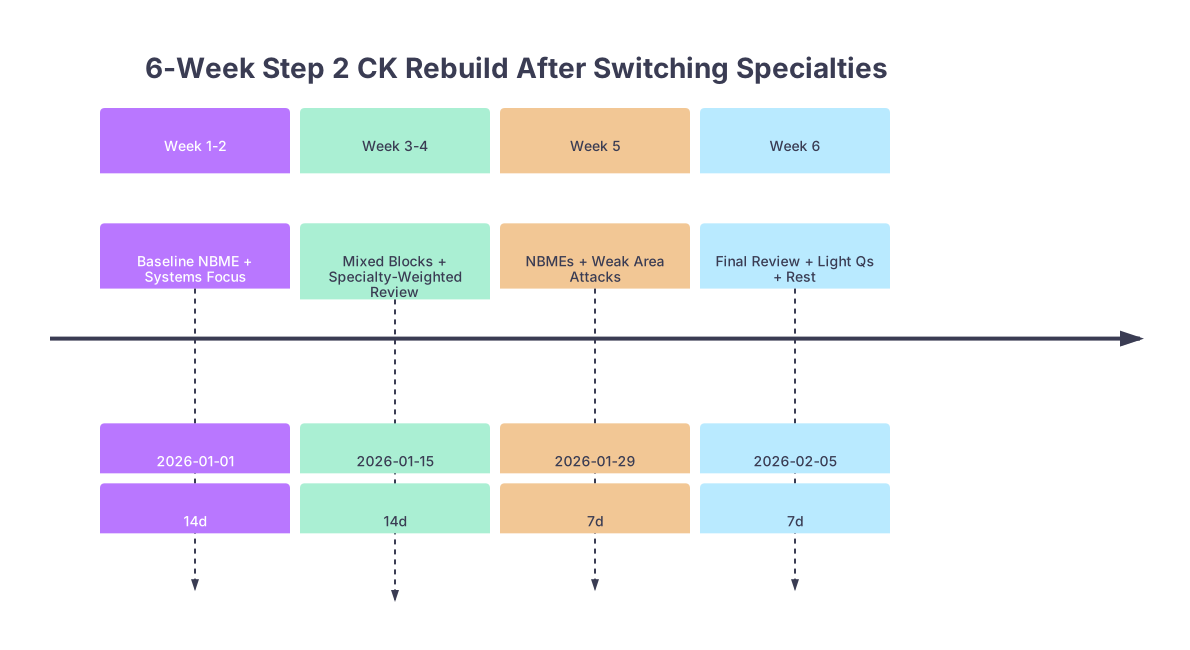
| Period | Event |
|---|---|
| Week 1-2 - Baseline NBME + Systems Focus | 2026-01-01 |
| Week 3-4 - Mixed Blocks + Specialty-Weighted Review | 2026-01-15 |
| Week 5 - NBMEs + Weak Area Attacks | 2026-01-29 |
| Week 6 - Final Review + Light Qs + Rest | 2026-02-05 |
Weeks 1–2: Foundation + Specialty Shift
- 40–60 Q/day, timed, tutor off, focus on explanations afterward.
- 60–70% blocks weighted toward medicine + your new target.
- Daily:
- 2 question blocks
- 2–3 hours reviewing and making lean notes (no rewriting textbooks)
- Content resource: pick 1 main text/video series (Online MedEd, Boards & Beyond, Step Up to Medicine, etc.) and aim for medicine + your specialty‑related sections.
Weeks 3–4: Mixed, Exam‑Realistic
- 40–80 Q/day, fully random blocks.
- Weekly:
- 1 NBME or UWSA on the weekend.
- After each assessment:
- Categorize misses into:
- True knowledge gap
- Misread question
- Overcomplicated thinking
- Target 1–2 problem categories per week.
- Categorize misses into:
Week 5: Precision Strikes
- 1–2 more NBMEs this week.
- Study days:
- 40–60 Q/day, focused on:
- Missed Q‑bank questions
- Low‑performance systems
- 1 hour/day: high‑yield tables/algorithms (antibiotics, chest pain workup, AKI, stroke, etc.)
- 40–60 Q/day, focused on:
Week 6: Taper & Confidence Building
- Last NBME or UWSA 5–7 days before exam.
- 20–40 Q/day max. No new resources.
- Flash through your:
- Personal “stupid list” (things you keep forgetting)
- Core algorithms your new specialty cares about
Step 6: Keep Your Old Specialty Knowledge On a Leash
You don’t need to burn what you learned for the old specialty. You just can’t let it hijack your prep.
Use it strategically:
Old surgery keener now going IM:
- Use your comfort with perioperative care and acute abdomen to crush those questions.
- But when you’re 20 minutes into reading about rare hernias in a Step 2 book, stop. That’s not where your points are.
Ex‑psych hopeful now going EM:
- Your psych background will make delirium vs psychosis, capacity, and substance questions easier.
- Don’t let that turn into a month long excursion through every DSM nuance.
Rule of thumb:
If something feels “fun” because it reminds you of your old path but is clearly niche for Step 2, you probably don’t need more of it.
Step 7: Use Step 2 To Fix the Story Your Application Tells
You’re not just chasing a three‑digit score; you’re repairing or reshaping your narrative.
Here’s where Step 2 helps you:
If Step 1 was mediocre:
- Step 2 is your “I grew up clinically” data point.
- Programs in your new specialty will look specifically for this.
If your rotations match your old specialty, not your new one:
- A strong Step 2 says: “Even though my schedule was surgery‑heavy, I actually have robust clinical medicine knowledge.”
If EM/IM/Anes PDs are side‑eyeing your late switch:
- High Step 2 + strong IM‑like content in your performance breakdown can calm that doubt.
You can and should mention this briefly in your personal statement or interviews:
- “After [experience], I realized my interests aligned more with [new specialty]. I focused my Step 2 preparation on developing strong [relevant] clinical reasoning, and my performance reflects that shift.”
Nothing dramatic. Just a clean, coherent story.
Step 8: Handle the Psychological Whiplash of Switching and Studying
The mental part is underrated here. You’re not just studying; you’re grieving a previous plan and trying to believe in a new one.
Common head trash I hear:
- “Did I just blow my chances by switching too late?”
- “Will programs think I’m flaky?”
- “If I screw up Step 2, that’s it.”
Here’s how to keep that from trashing your score:
Narrow your horizon
Don’t keep re‑litigating your life choices every 48 hours. Decide:
“I’ve committed to ___ for this application cycle. My only job for the next 6 weeks is to maximize Step 2.”Use metrics, not vibes
Track:- NBME scores over time
- Q‑bank percent correct (cumulative and last 200 questions)
- Performance broken down by system Improvement in those = you’re not doomed, you’re progressing.
Don’t try to prove your specialty switch to yourself with Step 2 content
You don’t need to turn your prep into “I must love every question related to my new field or I chose wrong.” It’s an exam, not therapy.
Step 9: Decide When to Postpone—And When Not To
Students in your shoes often ask: “Should I delay my exam to get a higher score for this new specialty?”
Here’s my line in the sand.
You should seriously consider postponing if:
- Your last 2 NBMEs are:
- < 230 and you need 240+ for a competitive switch, or
- Dropping rather than rising.
- You can realistically buy 3–4 more full study weeks.
- Delaying won’t wreck ERAS timelines (or you’re willing to apply a bit later but stronger).
You probably shouldn’t postpone if:
- You’re already in the competitive range for your new field and still obsessing over +5 points.
- Your NBME trend is upward, even if slowly.
- You’re burning out and another 4 weeks will add anxiety, not value.
If you’re not sure, look at your last three assessments:
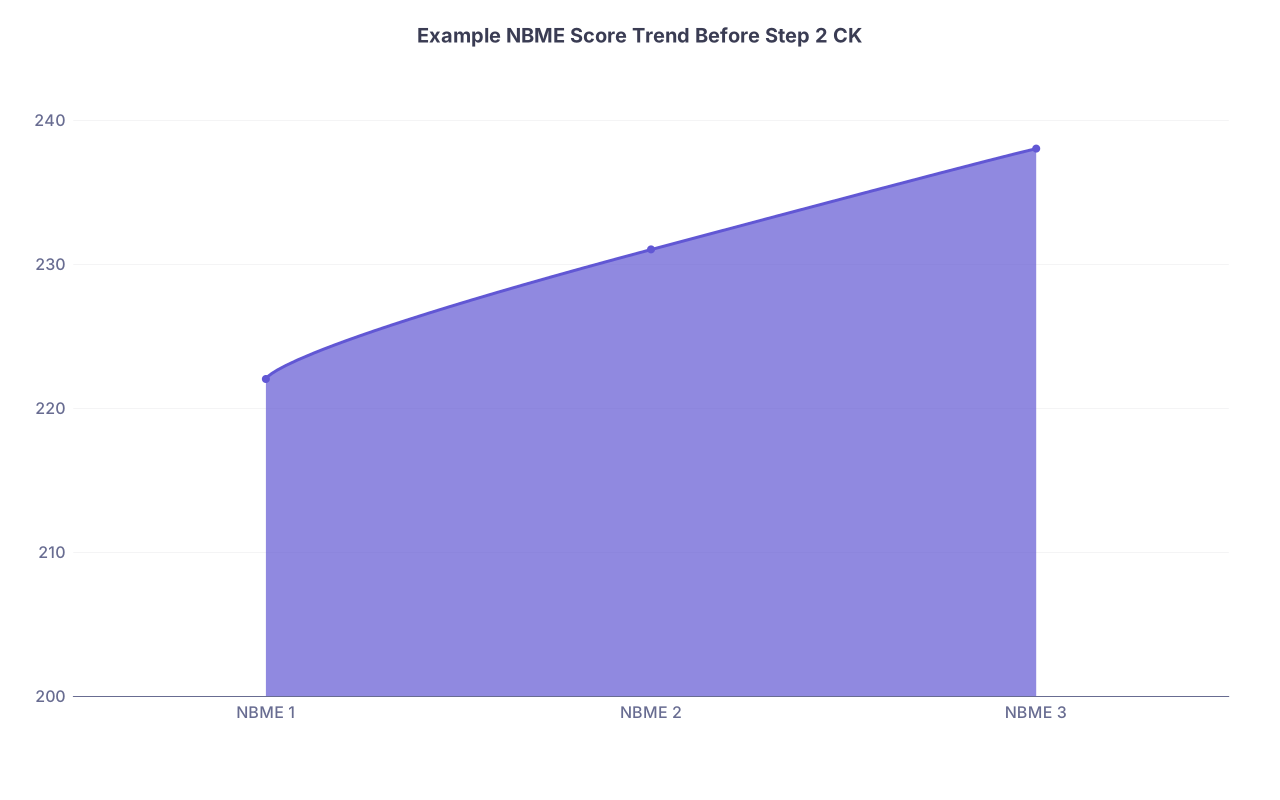
| Category | Value |
|---|---|
| NBME 1 | 222 |
| NBME 2 | 231 |
| NBME 3 | 238 |
That trend? I’d usually say: take it on schedule, tighten last‑minute weak areas, and move on.
Flat or declining? Different conversation.
Step 10: Concrete Daily Structure You Can Actually Follow
Here’s what a good, specialty‑refocused study day looks like when you’re not on rotations or you have light duties:
Morning:
- 40 Q mixed block, timed (no pausing)
- Immediate 60–90 minute review
- For each miss:
- Identify the moment you went wrong (“I ignored vitals,” “I forgot first‑line imaging,” etc.)
- For each miss:
Midday:
- 1–2 hours of content:
- One big system (cardio, pulm, renal)
- Heavily skewed toward your new specialty’s key areas
Afternoon:
- 40 Q block:
- Either random
- Or “focus block” on weakest area from last NBME
Evening (optional/light):
- 30–45 minutes:
- Rapid review of your “stupid list” and core algorithms
On heavy clinical days, strip that down:
- 1 block/day (20–40 Q)
- 45–60 min review
- 20–30 min of high‑yield flash or tables
You’re not going to have identical days. Real life and call shifts will wreck some plans. That’s fine. The point is consistency over 4–6 weeks, not perfection every 24 hours.
What To Do With This Today
Do not go organize your folders for three hours and pretend that’s progress.
Do this instead:
- Pick your new specialty and write a clear Step 2 target score next to it.
- Schedule a baseline NBME or UWSA within the next 3 days—book it like a real appointment.
- After that exam, sit down for 30 minutes and draft a 4–6 week plan with:
- Which systems and rotations you’ll overweight for your new specialty
- How many questions you’ll do per day
- Which specific days you’ll take your next two NBMEs
Open your calendar right now and block the date and time for that baseline test. If it is not on the calendar, it is not real.


