
Most people studying for Step 3 misunderstand how prevention is tested—and they bleed points on “easy” questions that are anything but easy.
Let me be blunt: Step 3 does not reward vague “PCP common sense.” It rewards guideline-level precision. Especially around screening and prevention.
I am going to walk you through exactly how Step 3 weaponizes health maintenance: which patterns show up over and over, where people get tricked, and how to answer these questions like someone who actually sees patients… but with exam-brain turned on.
1. The Big Picture: How Step 3 Uses Health Maintenance
Step 3 loves prevention because it hits multiple competencies at once:
- Can you apply age-, sex-, and risk-based screening guidelines?
- Do you know which preventive interventions actually change outcomes?
- Can you prioritize the next best step in a realistic outpatient vignette?
These questions typically:
- Look “easy” at first glance.
- Pack several conflicting cues into the stem (age, risk factors, insurance, comorbidities).
- Offer 2–3 answer choices that are defensible in real life, but only 1 that is guideline-correct.
You will see health maintenance in:
- Standalone multiple-choice questions (MCQs) on the CCS-like blocks.
- Long vignettes where one sentence about “has not seen a doctor in 15 years” is the entire point.
- CCS cases where you must order screening at the initial visit.
Step 3 is not asking: “What might be reasonable?” It is asking: “What is recommended by major guidelines (USPSTF, CDC, ACIP, ACOG, ADA, etc.)?”
If you think like a pragmatic intern instead of a detail-obsessed test-taker, you will get killed on these.
2. Age, Risk, and Timing: Core Screening Framework
Let me break down the scaffolding you should hold in your head. Without this, everything feels like trivia. With it, Step 3 stems become pattern-recognition.
Think in three steps:
Who is the patient?
- Age group
- Sex / pregnancy status
- Risk factors / past screening history
What category of prevention are we in?
- Primary: vaccines, counseling before disease appears
- Secondary: screening to catch asymptomatic disease
- Tertiary: preventing complications of established disease
What is actually due today?
- Not “what should they have done 10 years ago?”
- Not “what would be reasonable someday?”
- What is “next best step” right now?
Age-anchored screening that shows up constantly
Memorize the anchors first; then layer in exceptions.
| Topic | Typical Start (Avg Risk) | Typical Stop / Notes |
|---|---|---|
| Colon cancer | 45 years | To 75; individualized 76–85 |
| Breast cancer | 50 years (biennial) | To 74 (USPSTF); others start at 40 |
| Cervical cancer | 21 years | Stop 65 if adequate prior screens |
| AAA (men) | 65–75 years | One-time US in men who smoked ever |
| Lung cancer | 50–80 years | 20+ pack-years, quit <=15 yrs ago |
Step 3 will often hide the key variable in one casual phrase:
“He smoked half a pack a day for 40 years, quit 12 years ago.”
→ 20 pack-year threshold? Yes. Quit ≤15 years? Yes. Age 50–80? If yes, get annual low-dose CT.“She is 67, previously had normal colonoscopy at 55.”
→ Next colonoscopy at 65 (10-year interval). She is overdue now. Colonoscopy is the correct answer, not FIT test, not CT colonography.
The trap: they give you 3 things she “should” get (DXA, colonoscopy, pneumococcal vaccine) and you must pick one as “most appropriate next step.” The exam wants you to choose the intervention that has the strongest mortality benefit or that is most clearly overdue based on age/interval.
3. Cancer Screening Traps You Will See Repeatedly
Breast Cancer Screening
On Step 3, you need to know:
- Asymptomatic average-risk woman:
- USPSTF: Mammography q2y from 50–74.
- Many test writers still accept starting at 40 q1–2y as “not wrong” but will prefer 50 if they are being literal USPSTF.
- High-risk women (BRCA carriers, strong FH, prior chest radiation):
- Start earlier (often 25–30) with MRI + mammogram.
Common traps:
Ultrasound or MRI in average-risk asymptomatic woman
Wrong as routine screening. Ultrasound is for evaluation of a palpable mass in a younger woman; MRI for high-risk.Clinical breast exam as a preventive screening test
USPSTF does not recommend CBE as routine screening for average-risk women. If answer choices include mammography vs CBE, pick mammography.Genetic testing offered to the wrong person
- Strong family history pattern: multiple relatives with early breast/ovarian cancer, male breast cancer, bilateral disease, etc.
- You test the affected relative first if possible, not the unaffected 25-year-old with an aunt who had breast cancer at 63.
Cervical Cancer Screening
Key patterns:
- Start at age 21, regardless of sexual debut.
- Age 21–29: Cytology alone every 3 years.
- Age 30–65: Options (USPSTF):
- Cytology q3y, or
- hr-HPV testing alone q5y, or
- Co-testing (Pap + HPV) q5y.
High-yield Step 3 traps:
Doing Pap before 21
Even if she became sexually active at 14. The answer is “no screening yet.”Stopping Pap too early
You can stop at 65 only if:- Adequate prior negative screens (e.g., 3 consecutive negative Pap tests or 2 consecutive negative HPV-based tests in last 10 years, most recent within last 5 years), and
- No history of CIN2+ in last 20 years.
Continuing Pap after total hysterectomy for benign disease
If cervix removed and no history of CIN2+, you stop Pap. Many examinees reflexively pick “continue screening” and lose the point.HPV vaccine vs Pap
- HPV vaccination does not eliminate need for Pap.
- In a 22-year-old unvaccinated woman with no prior screening: both are indicated, but the “next step” usually is to start Pap (screening) and arrange vaccination at same visit. If you must pick one, Pap wins in a cancer-screening question; vaccine takes priority in a vaccination/prevention framing.
Colorectal Cancer Screening
Anchor concepts:
Average risk:
- Start at 45.
- Continue to 75.
- 76–85: individualize.
Intervals (common ones tested):
- Colonoscopy: q10 years.
- FIT: yearly.
- Sigmoidoscopy: q5y (sometimes with FIT q3y).
High-yield traps:
High-risk timeline confusion
For a first-degree relative with colon cancer <60:- Start screening at 40 or 10 years before the diagnosis age of the relative (whichever comes first).
- Use colonoscopy, more frequent (often q5y).
Offering FOBT to someone who is due for colonoscopy
Example: 62-year-old with colonoscopy at 52 now due again. Colonoscopy is correct. Do not “switch down” to a lesser test.Screening after 75
At 84, asymptomatic, previously well-screened, no family history: the correct answer is usually no further screening. The test sometimes tries to tempt you into “do colonoscopy because he is ‘healthy and independent.’” Guidelines do not support routine screening past 75 in well-screened individuals.
Lung Cancer Screening
You should be able to recite this in your sleep:
- Age 50–80.
- ≥20 pack-year history.
- Current smoker or quit within past 15 years.
- Modality: annual low-dose CT chest.
Traps:
- Using chest X-ray (wrong).
- Using CT with contrast (wrong for screening).
- Screening someone who quit >15 years ago (no).
- Extending screening beyond age 80.
4. Vaccination and Immunization: Adults, Pregnancy, and Special Populations
Step 3 does not just hit childhood vaccines. It loves edge cases: splenectomy, pregnancy, healthcare workers, and older adults.
Adult Core Vaccines
You should know these patterns cold:
- Influenza: annually for everyone ≥6 months.
- Tdap/Td:
- One-time Tdap in adulthood (if no prior Tdap), then Td or Tdap booster q10y.
- Pregnant patients: Tdap every pregnancy at 27–36 weeks, regardless of prior history.
- Pneumococcal:
- Adults ≥65: PCV20 alone, or PCV15 followed by PPSV23 (depending on schema you use; Step 3 is slowly updating but still often expects: give PCV13/15 first, then PPSV23 at least 1 year later).
- Earlier in certain high-risk conditions (asplenia, CSF leaks, cochlear implants, immunocompromised, etc.).
- Zoster:
- Recombinant zoster vaccine (RZV, Shingrix) for adults ≥50.
High-yield traps:
Giving live vaccines to pregnant or immunocompromised patients
- No MMR.
- No live attenuated influenza (intranasal).
- No varicella or zoster live vaccines (the old Zostavax).
Pregnancy and vaccines
- Give: Tdap (27–36 weeks), inactivated influenza, indicated COVID vaccine, hepatitis B if non-immune and at risk.
- Avoid: HPV, MMR, live varicella, live zoster, live nasal flu.
HPV vaccine timing
- Routine: start 11–12 years (as early as 9).
- Catch-up recommended through age 26.
- Ages 27–45: shared decision making; Step 3 usually expects “no vaccine” unless clearly high risk and very motivated.
- Do not start HPV vaccine in pregnancy; defer until postpartum.
Special Population: Asplenia (Sickle Cell, Splenectomy)
These patients are walking Step 3 bait if you do not know their vaccines:
- Encapsulated organisms: S. pneumoniae, N. meningitidis, H. influenzae type b.
Vaccines:
- Pneumococcal series (PCV + PPSV23).
- Meningococcal conjugate (MenACWY; and sometimes MenB).
- Hib (single dose if not previously vaccinated as adult).
You will often see a 24-year-old man post-splenectomy coming to establish care. The question: “Most appropriate next step?”
Correct answer: vaccinate against encapsulated organisms before discharge or as soon as possible; do not wait.
5. Cardiovascular and Metabolic Screening: ASCVD, Lipids, Diabetes
Here is where people think they know “medicine” but miss guideline details that Step 3 cares about.
Lipid Screening and Statins
Patterns you need:
Lipid screening:
- Men: at least once by 35, earlier if high risk.
- Women: start around 45 if high risk; exact ages vary by source, but Step 3 focuses more on statin indications than on raw screening age.
Statin therapy (ACC/AHA-ish logic):
- Clinical ASCVD → high-intensity statin (unless age very old or intolerant).
- LDL ≥190 → high-intensity statin.
- Age 40–75 with diabetes → at least moderate-intensity statin (consider high if additional risk).
- Age 40–75 with estimated 10-year ASCVD risk ≥7.5–10% → moderate to high-intensity statin.
Step 3 trap:
- Middle-aged smoker with borderline BP, LDL mildly elevated, and risk >7.5%. They will give you answer choices:
- Lifestyle modification only.
- Start statin therapy.
- Start aspirin.
- Order ABI.
The correct answer is often “start statin therapy” even if there is room for lifestyle discussions. Aspirin for primary prevention has a narrower indication now (higher risk, lower bleeding risk, age 40–59 with ≥10% risk, individualized; avoid above 60 typically).
Blood Pressure and Diabetes Screening
- Hypertension screening: USPSTF says screen adults ≥18. Step 3 expects you to know:
- Elevated BP on screening → confirm with home or ambulatory BP monitoring.
- Diabetes (type 2) screening:
- USPSTF: adults 35–70 with overweight/obesity; earlier for higher-risk populations (e.g., certain ethnicities, history of GDM).
Common exam setup:
- 46-year-old overweight woman, BP 138/86, fasting sugar unknown, no regular care.
- What is the most appropriate next step?
- Possible best answer: Screen for diabetes (fasting glucose, HbA1c) and/or repeat BP properly before labeling her hypertensive. Between those two, if question framed as “what additional test is indicated,” HbA1c is a frequent correct choice.
6. Behavioral and Psychosocial Screening: Where People Over- and Under-Treat
This category drives people crazy because real-life practice often lags behind guidelines, and Step 3 leans toward guideline purity.
High-yield behavioral screens:
- Depression:
- Screen adults, especially pregnant and postpartum women, those with chronic illnesses.
- Alcohol misuse:
- Screen adults; use validated tools (AUDIT-C, CAGE).
- Tobacco:
- Screen and provide counseling and pharmacotherapy.
- Intimate partner violence (IPV):
- Screen women of reproductive age.
Traps:
Doing invasive or expensive tests instead of screening
Example: A 28-year-old woman, no symptoms, mild worry due to family stress. The correct response is PHQ-2/PHQ-9 or some depression screen—not sending her for neuroimaging.Substance misuse question where the best answer is brief counseling and not an elaborate inpatient detox, when dependence is not demonstrated and withdrawal is not present.
IPV:
- The correct first step is private, safe, direct questioning and then referral to community resources, not automatically calling police unless there is immediate danger or child involvement.
- Never confront the partner in the exam answer set.
7. Pediatric Screening and Prevention: Don’t Overcomplicate It
Step 3 is less pediatric-heavy than Step 2, but you will see a few well-child visits. The traps tend to be:
- Using adult logic (e.g., lipid screening) in the wrong age group.
- Ordering unnecessary imaging or labs instead of following developmental screening schedules.
Core pediatric prevention points:
- Newborn screening: metabolic, endocrine, hemoglobinopathies, hearing, congenital heart disease (pulse oximetry).
- Developmental screening: standardized tools at specific ages (e.g., 9, 18, and 30 months for general development; autism-specific at 18 and 24 months).
- Obesity screening: BMI percentile and counseling; labs for comorbidities in certain age/weight combos.
- Lead screening in high-risk children (older housing, certain geographic areas).
Step 3 twist:
- They will put a 4-year-old in front of you whose growth has tracked along the 10th percentile consistently. Parents worried due to height. Exam wants you to reassure and schedule routine follow-up, not order bone age or GH levels. Prevention here is “prevent overtesting.”
8. Classic Prevention Question Patterns and How to Answer Them
Let me show you exactly how Step 3 frames these as traps.
Pattern 1: “She has not seen a doctor in 15 years”
Example:
A 56-year-old woman presents to establish care. She has not seen a physician in 20 years. She has no symptoms. BMI 29, BP 132/78, nonsmoker, no family history of cancer. LMP at age 52. Which of the following is the most appropriate next step in management?
Options might include:
- Colonoscopy.
- Mammogram.
- Pap smear.
- DXA scan.
- TSH level.
You must rapidly categorize:
- Age 56: Cancer screens due:
- Colonoscopy: definitely (start 45).
- Mammogram: yes.
- Pap: up to 65, yes.
- DXA: usually start at 65 for average-risk women.
- TSH: not universally recommended as routine screen.
Which has the greatest impact on mortality and is clearly overdue? Colonoscopy is usually the best single choice in this exact setup. If the question specifically says, “Which is the most appropriate cancer screening to do first?” colonoscopy still usually wins over mammography on exam logic.
Pattern 2: “Pregnant patient with vaccine confusion”
A 28-year-old primigravida at 32 weeks presents for routine prenatal care in October. She received Tdap 3 years ago, inactivated influenza 2 years ago, and completed HPV vaccination in adolescence. What is the most appropriate immunization strategy now?
Correct: Give both inactivated influenza vaccine (this season) and Tdap (27–36 weeks this pregnancy).
Traps:
- “No vaccine needed, she is up to date with Tdap” → Wrong. Tdap is given every pregnancy.
- “Give live attenuated influenza (nasal)” → Contraindicated in pregnancy.
Pattern 3: “What is the best next step in counseling?”
A 48-year-old man, 30 pack-year smoker, quit 5 years ago, presents for annual exam. BP 134/84, BMI 31, LDL 140, no diabetes. Which intervention will most reduce his risk of future cardiovascular events?
Options:
- Advise daily aspirin 81 mg.
- Start high-intensity statin therapy.
- Refer to structured diet program.
- Order CT coronary calcium score.
Correct: Start statin therapy. Smoking cessation he already did; statins have powerful primary prevention data. Aspirin for primary prevention is much more limited and is usually not first-line here.
9. CCS Angle: Ordering Preventive Care in Cases
Everyone focuses on acute management in CCS and then forgets that preventive stuff scores points.
When you have:
- New patient adult visit in CCS.
- Post-MI patient discharged to home.
- Diabetic patient seen for poorly controlled sugars.
You should think: “What preventive pieces should I order?”
Examples that score points:
- Post-MI: high-intensity statin, ACE inhibitor, beta-blocker, antiplatelet, pneumococcal and influenza vaccination, smoking cessation counseling, cardiac rehab.
- New 52-year-old woman in clinic: mammogram, colonoscopy, Pap (if due), lipids, BP, diabetes screen, flu vaccine, Tdap if not updated.
- Diabetic 45-year-old: statin, ACE/ARB if albuminuria or HTN, annual eye exam, foot exam, pneumococcal, flu, and hepatitis B vaccination if not immune.
On CCS, the mistake is to tunnel-vision on one problem and ignore age-appropriate screenings. The scoring engine absolutely tracks whether you remembered to protect the patient long-term.
10. High-Yield Comparison: Screening vs Diagnostic Testing
Here is a mental rule that prevents a lot of dumb misses:
“Screening” is for asymptomatic people.
“Diagnostic testing” is for people with symptoms or abnormal exam.
| Scenario | Correct Category | Example Test |
|---|---|---|
| 55-year-old, no symptoms, due for colon exam | Screening | Colonoscopy |
| 55-year-old with iron deficiency anemia | Diagnostic | Colonoscopy |
| 60-year-old smoker, no cough, eligible by criteria | Screening (lung) | Low-dose CT |
| 60-year-old with chronic cough and weight loss | Diagnostic | Full contrast chest CT, etc. |
Step 3 trap:
They describe an asymptomatic patient but load the stem with risk factors, then give you something silly like “Order CEA level” as a “screening” test. Ignore serum tumor markers as screening in colon, lung, pancreatic, ovarian cancer unless the question is explicitly about surveillance after treatment.
11. How to Study This Without Drowning in Guidelines
You do not need to memorize every USPSTF grade or every obscure condition. You need:
- The big 5 cancer screens (breast, cervix, colon, lung, prostate—though prostate is less heavily tested and often presented as a shared decision-making scenario).
- Adult vaccination patterns, especially pregnancy and high-risk.
- A mental timeline of what happens at 18, 21, 30, 40, 45, 50, 65, 75.
- Who gets statins, not just who gets lipids checked.
- How to respond to behavioral screen results (depression, alcohol, IPV).
I strongly recommend building one personal “prevention grid” on a single page that you actually rewrite from memory a few times during prep. You will feel dumb the first time. By the third time, it will feel natural, and those Step 3 questions will look embarrassingly straightforward.
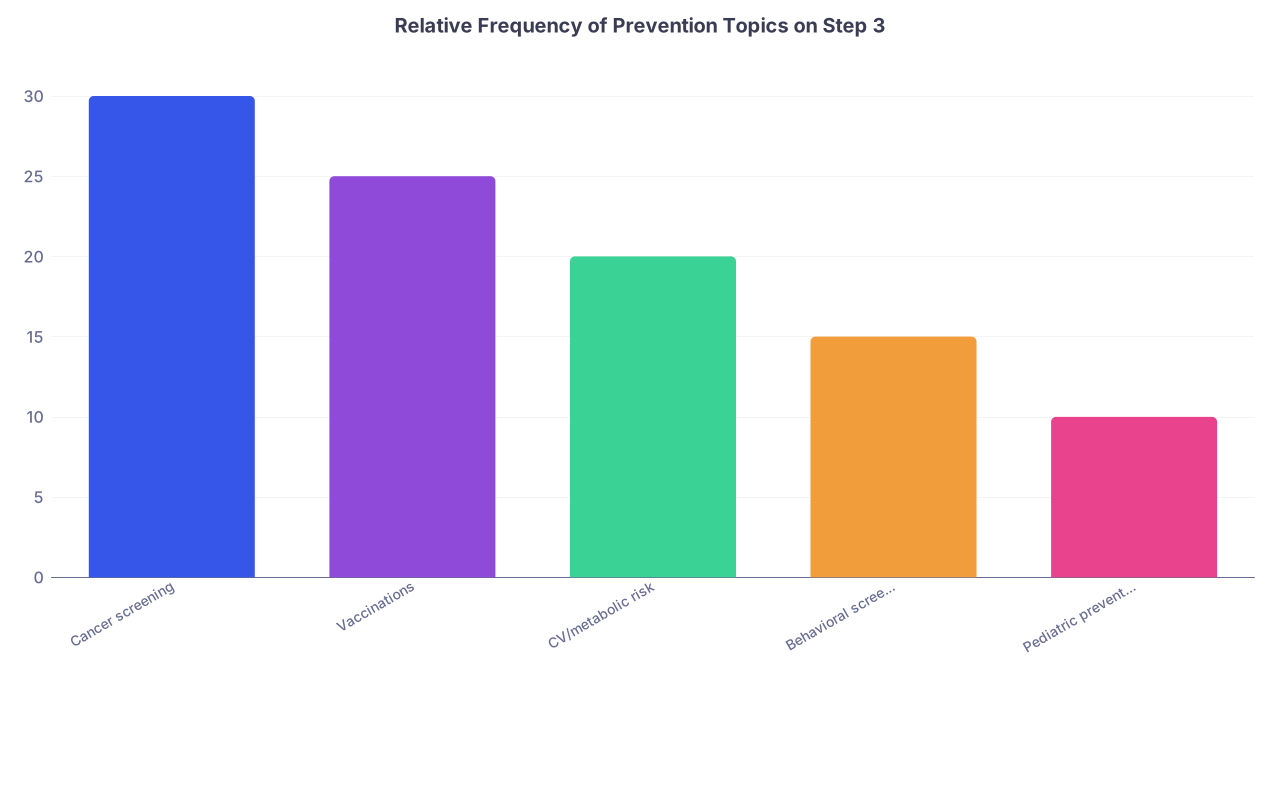
| Category | Value |
|---|---|
| Cancer screening | 30 |
| Vaccinations | 25 |
| CV/metabolic risk | 20 |
| Behavioral screening | 15 |
| Pediatric prevention | 10 |
FAQ (Exactly 4 Questions)
1. How closely do I need to follow USPSTF vs other societies (ACOG, ACC/AHA) for Step 3?
Step 3 leans heavily on USPSTF for general population screening and on big specialty societies (ACOG, ACC/AHA, ADA) when the question clearly lives in that domain. If there is a discrepancy, the test usually frames the answer in a way that is safe regardless of the guideline set. For example, starting mammography between 40–50 and continuing through about 70 is safe territory. You do not need to memorize every grade; you do need the age bands and intervals.
2. How often are guideline updates reflected on Step 3?
Slowly. The exam lags real-time practice. Brand-new changes (last 1–2 years) are less likely to appear than stable, long-standing recommendations. If a guideline has been changing a lot (like aspirin for primary prevention), Step 3 tends to test around broadly accepted principles: aspirin is no longer universal for primary prevention and must be individualized, while statins are central for ASCVD risk reduction.
3. Should I memorize every vaccine schedule detail for adults?
No. You should master: influenza, Tdap (including pregnancy timing), pneumococcal for ≥65 and for high-risk younger patients, HPV age windows, and zoster for ≥50. For special populations like asplenia, HIV, or post-transplant, know the concept (encapsulated bacteria coverage; avoid live vaccines in significant immunosuppression) rather than every brand and interval.
4. How do I practice prevention questions effectively for Step 3?
Do not just churn random question blocks. Set aside dedicated sessions to do only prevention / screening / health maintenance questions. After each item, ask yourself: “What age/risk rule or vaccine logic was being tested here?” Then add that to your one-page prevention grid. Repetition with explicit labeling of the underlying rule is far more effective than passively “seeing” questions and moving on.
Key takeaways:
- Step 3 prevention questions are guideline-driven, not “common sense” medicine. Know the age/risk anchors and apply them ruthlessly.
- Most traps hinge on a single phrase in the stem: age, pack-years, prior hysterectomy, pregnancy status, or time since last screen. Train yourself to hunt those details.
- A tight, handwritten prevention grid that you rebuild from memory is the single highest-yield way to stop donating points on “easy” health maintenance questions.