
It’s April of fourth year. Rank list is in. You’re half checked-out, half panicking about the future. Someone in your class group chat drops: “I’m scheduling Step 3 for June before residency starts. Get it out of the way.”
Your stomach drops.
You’re thinking:
“Wait, are we supposed to be doing that?”
“What if I’m the only intern who hasn’t taken Step 3?”
“But also… what if I take it and bomb and my new program thinks I’m an idiot before I even start?”
You open Prometric’s scheduling site, stare at the calendar, and just feel… trapped. If you schedule it now, you’re terrified you’re not ready. If you don’t, you’re terrified you’ll be the intern trying to cram for Step 3 between night float and cross-cover hell.
Let me say the quiet part out loud:
You are not the only one spiraling about this. I’ve watched people torture themselves over Step 3 timing way more than the exam itself.
Let’s untangle this.
What Step 3 Really Is (And Isn’t)
Step 1 used to feel like your whole career. Step 2 felt like your last big “prove yourself” shot. Step 3… feels like this weird final boss that no one talks about clearly.
Here’s what Step 3 actually is:
- A two-day exam (Day 1: Foundations, Day 2: Advanced Clinical Medicine + CCS cases)
- Pass/fail, but the score is real and goes on your transcript
- Required for full licensure
- Some programs require you to pass by a certain PGY year
- Most people take it PGY-1 or PGY-2
What it is not:
- It’s not the exam that determines your fellowship destiny the way Step 1/2 did for residency.
- It’s not something most PDs obsess over… unless you fail it. Then it matters a lot.
- It’s not something most med students need to take before starting residency.
And this is where the fear kicks in:
If it “doesn’t matter that much,” why does it feel so high stakes? Because now there’s something extra on the line: your new program’s first impression of you.
Fail Step 1? You can still claw your way back during med school.
Fail Step 3 right before residency? You’re walking in already on thin ice. That’s why your anxiety is screaming about timing.
The Two Big Fears: Failing vs. Waiting
There are really only two scenarios your brain keeps spinning:
- “I take Step 3 before residency and fail. I walk in as ‘the intern who already failed Step 3.’”
- “I wait, start residency, and then I have to study after 12-hour days and I fail anyway because I’m exhausted.”
Both sound awful. Let’s not sugarcoat it.
So the real question becomes:
Which risk is actually bigger for you?
To answer that, you need to be brutally honest in a few areas: your test-taking history, your energy level, your specialty, and your program’s expectations.
Who Should Seriously Consider Taking Step 3 Before Residency?
Let me be direct: taking Step 3 before residency is not the default smart move. It’s a selective strategy that makes sense for a narrow slice of people.
Here’s who might realistically benefit.
Group 1: Strong Test-Takers Who Are Still “In Shape”
If this sounds like you:
- You passed Step 1 and Step 2 comfortably (not barely)
- You didn’t have multiple attempts
- You’re not completely burned out, and you can tolerate one more sprint
- You’re okay sacrificing some of 4th-year chill time for intense study
Then pre-residency Step 3 can be smart, because:
- You still remember a lot of core medicine and test style
- You can give Step 3 your full brain without intern-level fatigue
- You remove one giant stressor from your intern year
But “strong test-taker” doesn’t mean “I passed Step 2 on the third try and barely remember any CCS.” That’s a very different story.
Group 2: People Whose Program Explicitly Wants It Early
Some programs will say: “We want you to pass Step 3 by the end of PGY-1. Earlier is better.” Or they offer Step 3 money/paid days off only in PGY-1.
In that case, taking it late M4 or right before residency can be reasonable if:
- You can get in at least 4-6 weeks of focused prep
- You’re not already drowning in relocation, sub-I burnout, and personal life chaos
- You’ve recently reviewed core medicine for Step 2
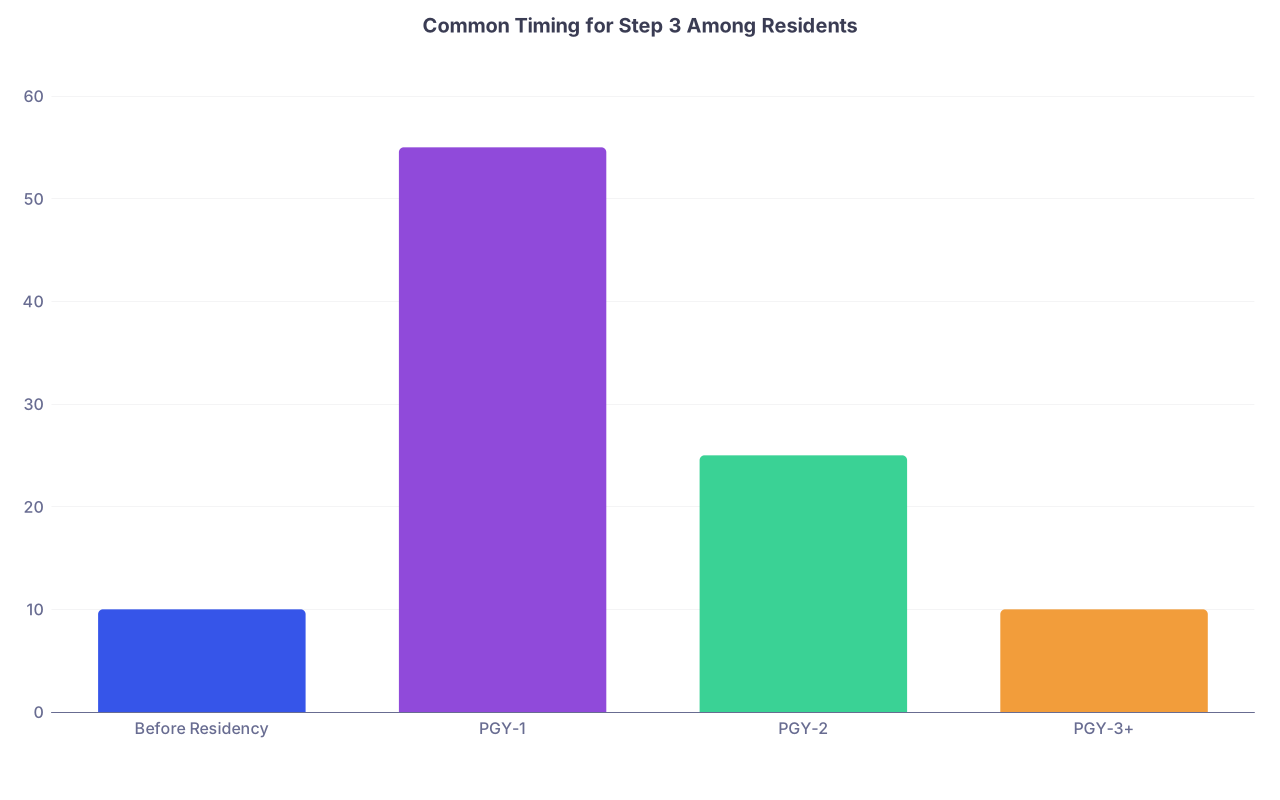
| Category | Value |
|---|---|
| Before Residency | 10 |
| PGY-1 | 55 |
| PGY-2 | 25 |
| PGY-3+ | 10 |
Most people don’t take it before residency. You are not behind if you don’t.
When Taking Step 3 Before Residency Is Flat-Out Risky
Here’s where I’m going to be blunt, because sugarcoating this is how people end up with avoidable failures.
You’re playing with fire if:
- You barely passed Step 2 or needed multiple attempts
- You haven’t seen serious clinical content in a while (long research year, non-clinical gap)
- You’re emotionally fried, running on fumes, and just telling yourself “I’ll suck it up one more time”
- You don’t have at least 4 honest weeks to prep (or longer if you struggled on earlier exams)
- You think you’ll “wing it” because “it’s just Step 3, people say it’s easier”
The worst-case scenario is not “I had to study during residency.”
The worst-case scenario is:
You rush, take it underprepared, fail, and start residency with:
- A PD who now has to “keep an eye” on you
- Extra pressure to retake and pass while working full-time
- A permanent exam failure on your record that programs and state boards will always see
I’ve seen people do this because they wanted to “get it over with” and then spend PGY-1 under a microscope. It’s not worth it.
How Much Score/Performance History Really Matters
Let’s be clinically cold for a second and match your test history to realistic risk.
| Step History Pattern | Pre-Residency Step 3 Risk |
|---|---|
| Step 1 + Step 2 both > 240, first attempt | Low–Moderate |
| Step 1 pass, Step 2 ~230s, first attempt | Moderate |
| Step 1 borderline, Step 2 improved ≥ 235 | Moderate–High |
| Any Step exam failed once | High |
| Any Step exam failed more than once | Very High |
This isn’t exact science, but you get the idea. The more turbulence you had with Step 1/2, the more cautious you should be with “I’ll just knock out Step 3 before residency.”
Because PDs don’t freak out over a 215 vs 230 on Step 3. They do freak out about a fail.
Specialty & Program Reality: Does It Even Help You?
Your next anxiety spiral: “Will this help my fellowship chances?”
For most people: no, not meaningfully.
- Competitive fellowships (cards, GI, heme/onc) care way more about your residency performance, letters, research, and Step 2 than Step 3 timing.
- Some PDs vaguely like seeing a solid Step 3 score, but hardly anyone is out here saying, “Oh, you took it before residency? Wow, superstar.”
It might matter a bit more if:
- You’re going into IM, Peds, FM, EM, and your program talks a lot about early Step 3 completion
- You’re an IMG and want to show you’ve “checked all the boxes” early
- Your future state license timeline will be tight and passing Step 3 early gives you breathing room
But again: timing is not the flex. Passing without drama is.
What Studying Before vs During Residency Actually Looks Like
Your brain is probably doing that catastrophizing thing:
“If I don’t take it now, I’ll never pass it later because internship will eat me alive and I’ll forget how to read and then I’ll be fired and homeless.”
Let’s compare reality.
Scenario A: Study Before Residency
You:
- Block off 4–6 weeks in late M4 or pre-July
- Use a Qbank (UWorld, AMBOSS), CCS cases, maybe a review book
- Study 4–6 hours a day, because you can
- Walk into residency with Step 3 done and one less mental load
Risk: if you’re emotionally done with standardized tests, that “4–6 weeks” turns into “sporadic questions and vibes,” and then you take it underprepared.
Scenario B: Study During Residency
You:
- Carve out a dedicated month or lighter rotation (ambulatory, elective, consults)
- Do Qbank questions 1–2 hours a day for several weeks
- Schedule Step 3 when your call schedule is reasonable
- Are clinically sharper, which actually helps a lot
Risk: If you procrastinate until your program says “You must pass by X date” and you cram between nights. That’s when people get into trouble.
The difference isn’t “before vs after.” It’s structured study vs panic study.

| Step | Description |
|---|---|
| Step 1 | Think about Step 3 |
| Step 2 | Plan for PGY-1/2 |
| Step 3 | Pre-residency Step 3 is reasonable |
| Step 4 | Step 1 & 2 solid? |
| Step 5 | 4-6 wk to study now? |
| Step 6 | Burned out? |
Red Flags That You’re Pushing It for the Wrong Reasons
If any of this sounds like you, hit the brakes:
- “Everyone on Reddit says they’re doing it now.”
- “My classmate matched at [Big Name Program] and they’re taking it, so I probably should.”
- “I’m scared I’ll be the only one who hasn’t taken it.”
- “I just want to be done, even if my prep isn’t great.”
Those are emotion-driven, not outcome-driven decisions.
The only good reasons to take Step 3 before residency are:
- You have the bandwidth to prep properly.
- Your test history suggests you’re likely to pass if you put in the work.
- Your program/visa/state timeline gains something meaningful from you getting it done early.
Everything else is just anxiety in costume.
How to Decide in a Structured Way (Not Pure Panic Mode)
Let’s take this out of the vague stress-cloud and into something you can actually act on.
Step 1: Reality Check Your Test Readiness
Ask yourself:
- When did you take Step 2?
- If it’s been 1+ year and you haven’t done much clinical medicine since, your “pre-residency advantage” is smaller.
- How many questions could you realistically do per day for weeks, not just two days of heroic effort?
If your honest answer is: “I’m not sure I could sustain serious prep right now,” that’s a sign you’re forcing it.
Step 2: Ask Your Program (Yes, Actually Email Them)
One email can lower your anxiety more than 10 hours of scrolling forums.
Something like:
“I’m considering whether to take Step 3 before starting residency. Are there any program expectations or recommendations about timing?”
Best and most common reply:
“We generally expect residents to take it sometime during PGY-1 or PGY-2. No need to do it before starting.”
Now you have data, not just dread.
Step 3: Put It On a Calendar Either Way
If you’re not taking it before residency, don’t just say “I’ll do it later.” That’s how later turns into panic.
Take 10 minutes and:
- Look at your first-year rotation schedule (or at least the rough template)
- Pick a lighter rotation or elective block
- Pencil in: “Tentative Step 3 window: [Month X]”
Your brain calms down when it sees a plan, even if it’s not immediate.
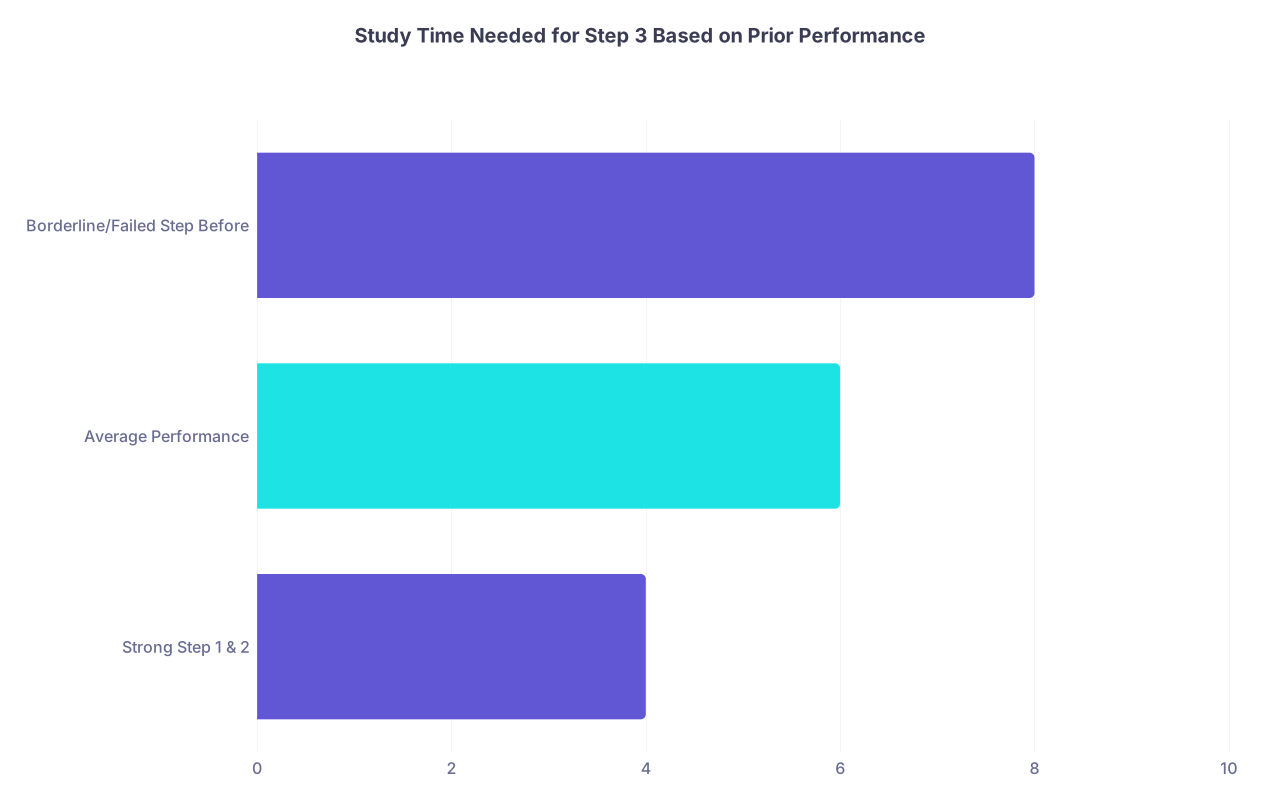
| Category | Value |
|---|---|
| Strong Step 1 & 2 | 4 |
| Average Performance | 6 |
| Borderline/Failed Step Before | 8 |
(Values roughly = weeks of focused study, not gospel, but you get the point.)
What If You’re Still Terrified Either Way?
You’re allowed to be scared of both options. It’s not irrational.
You’re scared of:
- Taking it now and failing.
- Taking it later and failing.
- Being judged by a number.
- Being “the weak link” in residency.
Here’s the uncomfortable truth: whether you take it now or later, the only consistently bad outcome is walking into it underprepared.
So instead of obsessing over “now vs later,” ask:
“Which timing gives me the best shot at being genuinely prepared?”
Whichever answer that is for you — even if it’s “in the middle of PGY-1” — that’s the smart choice. Not the bravest, not the trendiest. The smartest.

Very Blunt Summary
- No, you are not behind if you don’t take Step 3 before residency. Most people don’t.
- Yes, taking it before residency can be smart for a small group: strong test-takers, not burned out, with real time to prep.
- For anyone with shaky Step history or serious burnout, forcing Step 3 early is risky as hell.
- Programs care way more that you pass than when (except for a handful with strict deadlines).
- The worst outcome isn’t taking it later. It’s failing it because you rushed.

FAQ (Exactly 5 Questions)
1. Will programs think I’m less prepared if I don’t take Step 3 before starting?
No. For most specialties and programs, they expect you to take it during PGY-1 or PGY-2. If they wanted you to do it earlier, they would’ve told you in offer letters, onboarding materials, or emails. You won’t show up on July 1st and get side-eyed for not having Step 3 done.
2. Is Step 3 really easier than Step 2, or is that a myth?
It’s “easier” in the sense that the pass rate is higher and the focus is more on practical clinical reasoning than obscure facts. But it’s still a 2-day exam, and people absolutely fail it — especially if they assume it’s low-stakes and don’t study seriously. Treating it as “easy” is exactly how you turn a passable exam into a problem.
3. How much time do I realistically need to study if I take it before residency?
If you did well on Step 2 and it was recent: around 4 weeks of consistent, focused study is usually enough. If you were average or it’s been a while: 6–8 weeks is safer. Not 3 days between vacations. Real prep. Qbank, CCS cases, and some structured review of weak areas.
4. I had a prior Step failure. Should I even think about taking Step 3 before residency?
Honestly? Probably not. With a prior failure, your absolute top priority is avoiding another one. You want the best support, the most structure, and a stronger clinical foundation — which you’ll usually have during residency. Talk to your program early; many are very proactive about giving extra support and helping you pick a good timing.
5. If I decide to wait, what’s one thing I can do now to not totally lose Step knowledge?
Pick a good Step 3 Qbank and buy it now, then just do 10–15 questions a day for a few weeks before you start residency. Not to “finish it,” but to keep your brain from going completely offline. That way, when you do go into full Step 3 mode later, you’re not starting from absolute zero.

Today, don’t schedule the exam. That’s too big a leap for a brain already in panic mode.
Instead, do this one thing:
Open a blank page and write three columns:
“Now (pre-residency) / Early PGY-1 / Later PGY-1/PGY-2.”
Under each, jot down real pros and cons for you — your test history, your burnout level, your program’s expectations. Then send a three-sentence email to your incoming program asking about their Step 3 timing preferences.
Once you have their answer and your own list in front of you, the “risky vs smart” decision is going to look a lot less mysterious and a lot more obvious.