
The obsession with Step 3 and COMLEX Level 3 is mostly misplaced. Program directors care—but not in the way most applicants think.
Let me tell you what actually happens behind closed doors when attendings and PDs talk about these exams, especially for med students planning ahead and early residents panicking about timing and scores.
Step 3 and Level 3 are not like Step 1 and Step 2 / Level 1 and 2. They’re cleanup exams. Safety checks. Occasionally tiebreakers or red flags. Almost never golden tickets.
If you understand what matters and what doesn’t, you’ll stop wasting energy on the wrong things and focus on what PDs really judge you by.
The Real Role of Step 3 / Level 3 in a PD’s Head
Every year, I hear the same naïve question from MS4s and new interns:
“If I crush Step 3, will it make up for my Step 1/2 scores?”
No. That fairy tale lives on Reddit, not in selection meetings.
Here’s the mindset most PDs actually have, whether they say it out loud or not:
Step 1 / Level 1 and Step 2 CK / Level 2 CE are the primary academic filters.
Step 3 / Level 3 is a competency checkpoint:
- Can this resident safely progress?
- Will they be eligible for independent call, promotion, or graduation?
- Will they meet board-certification requirements on time?
A great Step 3 / Level 3 score is nice. A pass is usually enough. A fail is a problem.
When we’re ranking applicants (for fellowship or late-match positions) or deciding on promotions, Step 3/Level 3 is usually in one of four boxes:
- Passed on first attempt, normal timing → green. Move on.
- Delayed a bit but passed → yellow, we glance at the story.
- Failed once then passed → orange. We talk about it in the room.
- Multiple failures or still not taken when they should have → red. Serious discussion.
Notice what’s missing: “Got a 250+ Step 3 so we moved them up twenty spots.” That just does not happen in most rooms.
What PDs Actually Look At With Step 3 / Level 3
Let’s break it down the way PDs and CCC (Clinical Competency Committee) members actually talk about it.
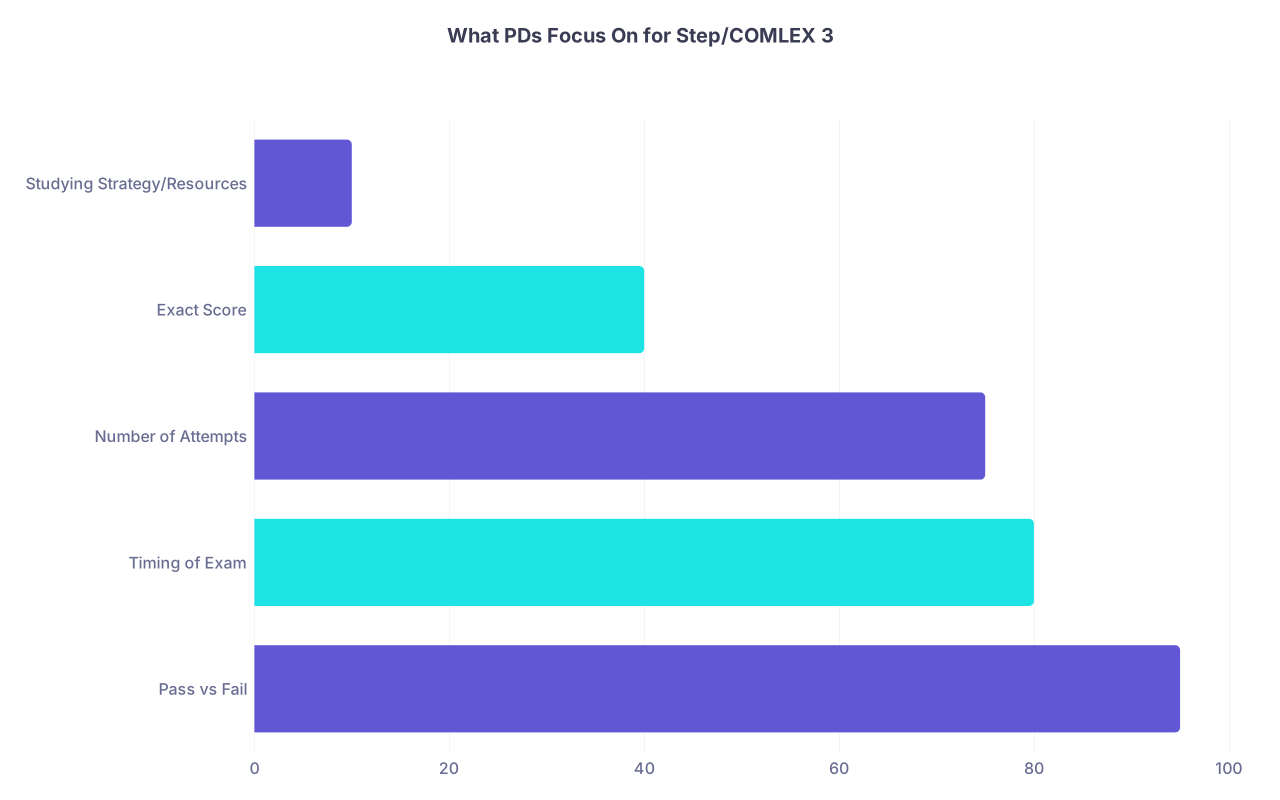
| Category | Value |
|---|---|
| Pass vs Fail | 95 |
| Timing of Exam | 80 |
| Number of Attempts | 75 |
| Exact Score | 40 |
| Studying Strategy/Resources | 10 |
The conversation is not about how “impressive” your score is. It’s about whether anything concerns them.
1. Pass vs fail (this is huge)
Every PD I know thinks this way:
“If they passed Step 3 / Level 3 on the first go, I’m done worrying.”
We’re not recalculating Z-scores. We’re not comparing your 220 to someone else’s 240. This isn’t Step 1.
We’re asking:
- Did they clear the bar?
- Did they show basic clinical reasoning and management competence?
For Level 3, especially in DO-heavy programs, I’ve heard exactly this in more than one meeting:
“Level 3 is done? Passed? Good. I don’t need the number. Just mark them green.”
You’ll never see that in an NRMP data table, but it’s exactly the attitude.
2. Timing matters more than you think
This is one of the big behind-the-scenes truths: PDs care a lot about when you take it.
They’re balancing this:
- Hospital credentialing requirements
- Board eligibility timelines
- Program accreditation metrics
- Call schedules and supervision requirements
If you’re a categorical resident:
- Taking Step 3 / Level 3 by mid-PGY2 is what most IM/FM/peds/psych/surgery PDs prefer.
- Some programs push for end of PGY1 (especially internal medicine and prelim years feeding into advanced programs).
- If you’re still putting it off in late PGY2 or early PGY3 with no good reason, PDs start asking, “What’s going on here?”
For advanced specialties (neuro, rad, anesthesia) there’s often a quiet expectation:
- “They should have this done before they finish PGY2.”
Not always written in a handbook. But absolutely discussed in leadership meetings.
I’ve sat in a room where the PD said about a PGY3 applicant for chief:
“I like them a lot, but they dragged Step 3 out to the last minute. That worries me about how they’ll handle other deadlines.”
Fair or not, your timing signals something about organization, follow-through, and whether you’re a future problem for the program’s metrics.
3. Number of attempts
This is where PDs start reading your file more closely.
- First-time pass → reassurance.
- One failure → explanation required.
- More than one failure → serious red flag.
Is a single failure the end of the world? No. I’ve seen residents with a Step 3/Level 3 fail still get fellowships at excellent programs. But they had to own it and show a clear upward trajectory.
The honest PD discussion sounds like:
“They failed once, then passed with a decent cushion. Do we think that’s a true reflection of their capability, or was it a bad life circumstance?”
If you have a fail, PDs want the story. Short, credible, and paired with later success.
What Absolutely Does Not Matter As Much As You Think
Now the part most students and junior residents completely misunderstand.
Myth 1: “A high Step 3 score will rescue bad Step 1/2 scores”
No. It might soften the blow a bit. But it does not erase your earlier performance.
If you’ve got a 205 Step 1 and 215 Step 2 CK, then score 245+ on Step 3, here’s what actually goes through people’s heads:
- “Okay, they can improve with time and clinical experience.”
- “Good, they’re not declining.”
- “Maybe their test-taking finally caught up.”
That’s good news. But they’re not suddenly equivalent to the applicant who had 240s across the board.
For fellowship PDs, Step 3 is more of a trend check than a game-changer. They ask, “Does this follow the story, or contradict it?”
Myth 2: “PDs obsess over your exact Step 3 / Level 3 score”
Some do. Most don’t.
I’ve watched 3-hour ranking meetings in IM and EM where Step 3 was literally mentioned only to say:
“He passed Step 3, all good.”
“She still needs Level 3 before graduation; keep an eye on that.”
In more academic or ultra-competitive subspecialties (cards, GI, derm, rad onc), the people at the very top of the pile usually already have strong Step 1/2/3. Step 3 doesn’t separate them—research, letters, and reputation do.
Myth 3: “Taking it super early impresses programs”
It impresses some. It worries others.
An MS4 who takes Step 3 or Level 3 before internship? That makes a few PDs quietly nervous:
- “Why were they so eager to crank through this? Were they trying to game something?”
- “Did their school encourage that, or did the student push it?”
- “Is this another person who prioritizes tests over actual clinical learning?”
More importantly, your clinical experience in MS3–MS4 is usually not deep enough for Step 3/Level 3 to feel natural. The exam is written assuming early residency-level exposure. That matters.
So if you’re still in med school asking “Should I just knock this out now?”—for most people, the answer is no.
Step 3 vs Level 3: The DO/MD Reality
Here’s another unspoken truth: most MD PDs barely understand COMLEX Level 3 scoring. Many don’t pretend to.
What they actually do:
- Confirm you took and passed Level 3.
- If they’re score-focused, they’ll look more heavily at your USMLE equivalents if you have them.
- Some ACGME programs will quietly nudge DO residents to take Step 3 if they want certain fellowships, especially historically MD-dominated specialties.
For DOs in ACGME residencies, this is how the conversation really sounds:
“He’s a DO, strong Level 1/2, all passed. Did he ever take Step 2 or 3?”
“No Step exams, but Level scores solid.”
“Okay, that’s fine. He’s clinically strong. I don’t care about the number on Level 3; he passed.”
If you’re DO and planning on a competitive fellowship at a big-name academic center, Step 3 can still carry more “currency” because it’s a language they all understand. But for your home residency PD, Level 3 pass is usually what matters.
Strategic Timing: When PDs Actually Want You To Take It
Here’s the part you never see spelled out.
I’ll generalize based on what I’ve seen across IM, surgery, EM, peds, psych, FM, and some subspecialties.
| Training Type | Typical PD Preference | Seen As Concerning |
|---|---|---|
| IM / FM | PGY1–early PGY2 | After mid-PGY2 |
| Surgery | PGY2 | PGY3+ without plan |
| EM | PGY1–early PGY2 | Late PGY2 |
| Psych/Peds | PGY2 | End of PGY3 |
This isn’t universal, but it’s not far off from how a lot of PDs discuss it in private.
The unspoken rules:
- Take it after you’ve had enough clinical exposure to not be blindsided by management questions.
- Do it before you’re deep into senior responsibilities, in-service exams, and specialty boards.
- Do not leave it to the final year unless your program explicitly structures it that way.
How PDs View Studying and Preparation
Most of you overcomplicate this.
PDs do not care which qbank you used. Or whether you did 2,000 questions or 4,000. They care about outcomes and professionalism.
What actually impresses PDs:
- You scheduled the exam at a sane time relative to your rotations.
- You communicated with your chiefs/PD if scheduling or life events became an issue.
- You took it once and passed, without drama or excuses.
I’ve heard more PDs complain about residents who meltdown around the exam than about their scores:
“She disappeared into a cave for Step 3 and let all her ward work slack. That’s more concerning than the score.”
This is the harsh truth: they’re not just judging your test performance. They’re judging how you behave around career milestones.
When Step 3 / Level 3 Does Move the Needle
There are a few situations where Step 3/Level 3 really matters more.
1. You’re applying for fellowship with a weaker earlier record
If you had:
- Mediocre Step 1 / Level 1
- Slight bump on Step 2 / Level 2
- Strong clinical evaluations
- Solid research or leadership
- And then a good Step 3 / Level 3 (clear pass, maybe even higher than expected)
Then in fellowship meetings, I’ve heard:
“They’re not a numbers rockstar, but they’ve clearly matured. Step 3 looks good, and they’re clinically very strong.”
It won’t turn you into a “top of the stack” candidate in GI or cards, but it can move you from “maybe” to “safe yes” in many mid-tier or community-based fellowships.
2. You previously failed another board exam
This is where Step 3 / Level 3 becomes a redemption story.
If you failed Step 1 or Step 2 / Level 1 or 2, then later:
- Consistently passed in-service exams
- Passed Step 3 or Level 3 on first time, with no drama
PDs and fellowship directors often say:
“Whatever happened before, they figured it out. I’m not worried about their ability to pass specialty boards.”
That’s huge. Because one of the PD’s biggest anxieties is board pass rates—they’re literally tracked and reported. They don’t want graduates who will fail ABIM/ABFM/ABP/etc.
3. You’re IMG or non-traditional and they’re checking for stability
For IMGs, Step 3 can be used as a reality check:
- Are they still performing at the same or higher level than their earlier scores?
- Are they clinically integrated into the U.S. system?
A solid Step 3 is one more reassuring data point. Again, not a magic key, but it can fight some bias.
How Much Should You Actually Care?
If you’re still in medical school, here’s what you need to understand:
Your energy should be going into:
- Step 1 / Level 1
- Step 2 CK / Level 2 CE
- Strong clinical rotations
- Letters
- Fit with your desired specialty
Step 3 / Level 3 falls into the “required, not defining” bucket. You should plan for it, budget time, and avoid self-sabotage. But you should not obsess about the exact score.
Think of it this way:
- Step 1/2: Who gets invited to the party.
- Step 3: Do you get to stay until the end without causing problems.
One determines entry. The other determines whether you’re a maintenance risk.
Practical Advice: What To Actually Do
Let me be blunt and cut through the fluff.
- Plan the exam timing early in internship. Talk to seniors who already took it and ask which rotations are lighter and best for studying.
- Treat it as a serious but finite task. Two to six weeks of focused prep, depending on your baseline.
- Use one main qbank and actually finish it. You don’t need three different resources; you need repetition and comfort with the style.
- Protect your clinical reputation while studying. Never be that intern who lets sign-outs crumble because “I’m studying for Step 3.”
- If you fail, be proactive. Tell your PD before they hear from someone else. Show them your plan. Then execute.
PDs are surprisingly forgiving of human problems—if you’re honest early and you follow through.
What they hate: surprises, excuses, and repeated patterns of “almost ready” that never quite materialize.
Visualizing Your Exam Timing in Training
Here’s the rough picture that most PDs have in their heads, even if they never draw it on a board.
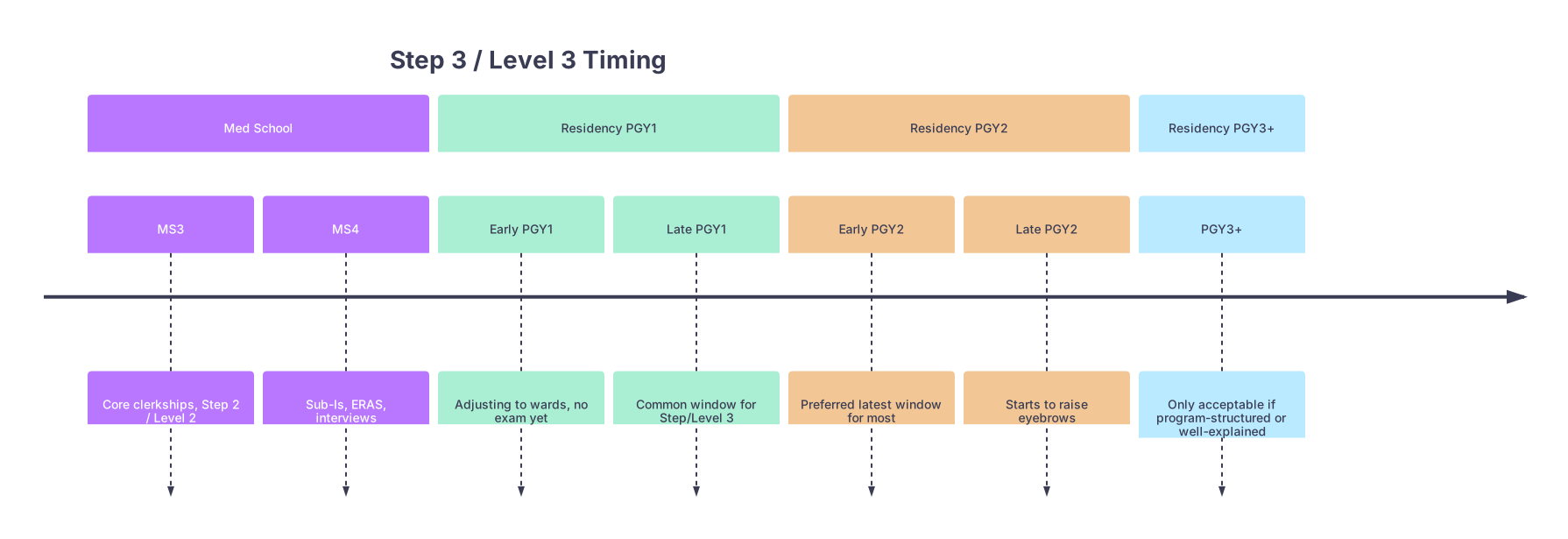
| Period | Event |
|---|---|
| Med School - MS3 | Core clerkships, Step 2 / Level 2 |
| Med School - MS4 | Sub-Is, ERAS, interviews |
| Residency PGY1 - Early PGY1 | Adjusting to wards, no exam yet |
| Residency PGY1 - Late PGY1 | Common window for Step/Level 3 |
| Residency PGY2 - Early PGY2 | Preferred latest window for most |
| Residency PGY2 - Late PGY2 | Starts to raise eyebrows |
| Residency PGY3+ - PGY3+ | Only acceptable if program-structured or well-explained |
If you stay inside that sweet spot—late PGY1 to early PGY2—most PDs will never think twice about your timing.
A Quick Reality Check on Stress
One more behind-the-scenes detail: attendings and PDs can tell when Step 3 / Level 3 is consuming you.
When you’re:
- Turning every downtime moment into frantic question blocks
- Snapping at nurses and co-residents because you’re drained
- Asking for special treatment constantly “because I’m studying”
They notice. And unlike Step 1, where people sort of expect you to go dark, Step 3 is not important enough to justify becoming a mess.
The residents who impress PDs handle it like this:
- Quietly block off a test date
- Study during a reasonably light block
- Maybe take 1–3 days off before the exam if allowed
- Take it, pass, move on
Minimal drama. Professional behavior. That’s what gets remembered.