
It’s 7:59 a.m. Your Zoom link is open, mic and camera are on. One faculty member joins. Then another. Then a chief resident. Suddenly there are four faces staring at you from a Brady Bunch grid, and you feel your brain just… disconnect. Your heart’s racing, you can see your own face in the corner looking weirdly frozen, and you’re thinking:
“Say something. Say anything. Why can’t I think? Oh my God I’m blowing this.”
Yeah. That.
Let’s talk about that exact nightmare: multiple interviewers on screen, all watching, and you freezing.
Because honestly, this is the thing almost nobody admits out loud, but a lot of us fear. Not “I’ll say something dumb.” Not “I’ll get a slightly awkward question.” The real fear is: I’ll blank. I’ll go silent. I’ll embarrass myself so badly I tank my whole match.
I’m going to walk through what actually happens in those moments, how programs see it (versus how your anxiety tells the story), and what to do in the exact 10 seconds when your mind goes white.
First: How Bad Is “Freezing” Really?
Let me be blunt: freezing for a few seconds is not what destroys people’s interviews.
What destroys interviews is:
- Never recovering and staying scattered
- Panicking and rambling nonsense for 3 minutes
- Getting so rattled that you seem rude, disinterested, or hostile
A pause? A moment of “let me think about that”? Even a visible wobble you steady yourself out of? That’s normal human behavior. I’ve seen attending surgeons completely lose their train of thought in front of 40 people and just say, “Sorry, long call night, give me a second,” and then keep going. Nobody cares.
Your brain says:
“If I freeze, that proves I’m incompetent and socially broken.”
Reality:
“If I freeze and then handle it like a semi-functional adult, I may actually look thoughtful and self-aware.”
Let’s separate out three kinds of “freezing” so you know what you’re up against.
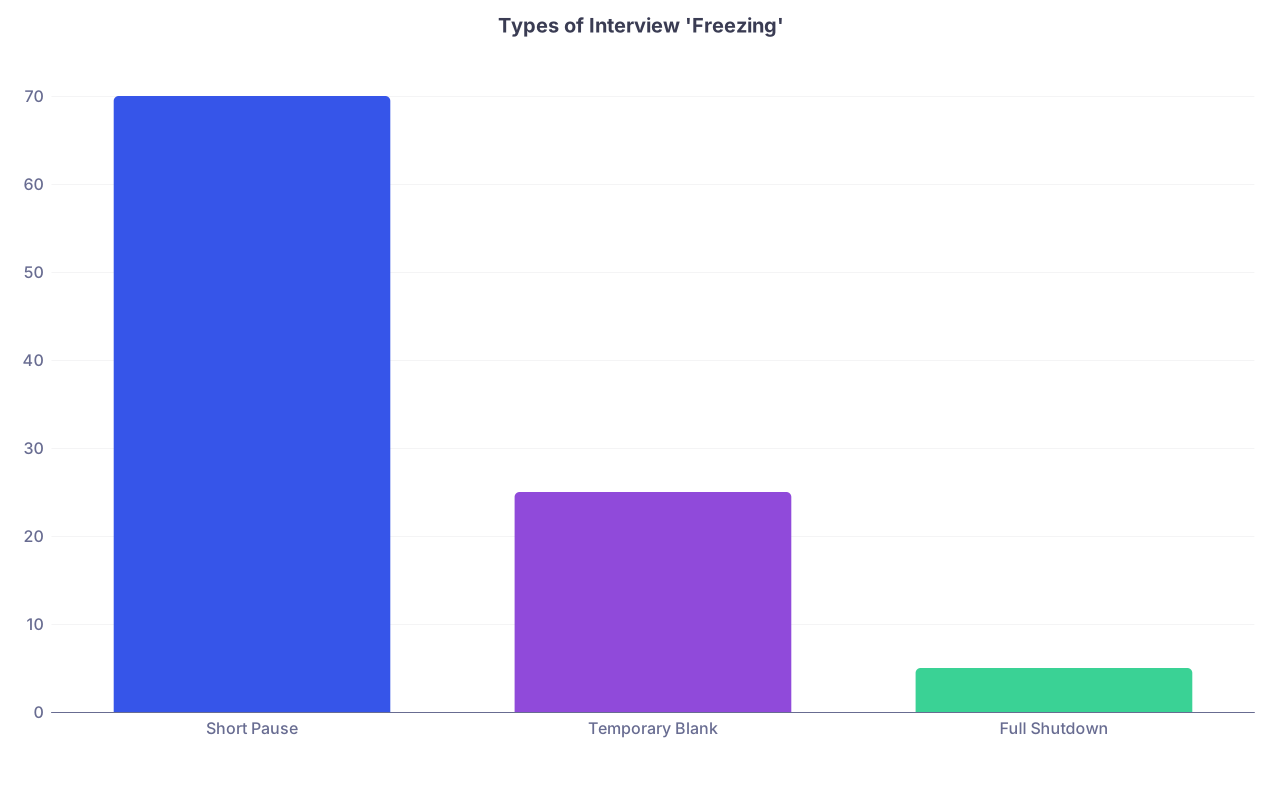
| Category | Value |
|---|---|
| Short Pause | 70 |
| Temporary Blank | 25 |
| Full Shutdown | 5 |
Here’s how I’d define them:
- Short pause: 2–5 seconds. You look up, think, then answer. Honestly, this often looks good.
- Temporary blank: 5–20 seconds of obvious “uhh… sorry one sec” with some visible anxiety.
- Full shutdown: You basically stop functioning, lose the question, can’t get yourself back.
You’re probably terrified of that last one. Fair. But most people live in the first two categories. Your anxiety just tells you it was a “full shutdown” because it felt like a year.
Why Multiple Interviewers Feel So Brutal on Screen
If there were just one interviewer, you’d be a bit nervous, sure, but you can track one face, one reaction. Multiple faces on screen is a different kind of psychological hell.
Here’s what your brain is secretly dealing with:
- You’re seeing yourself and judging your own face in real time
- Four or five other faces are watching you, but their expressions look flat because webcams suck
- There’s a 0.5 second delay, so your brain is constantly doing “Are they bored? Are they mad?” calculations
- You’re hyper-aware you’re being “evaluated” by a panel, not just one person
So instead of focusing on the actual question, you start thinking:
- Does that attending look annoyed?
- Is that resident rolling their eyes?
- Why am I staring at my own face?
- Why is nobody smiling?
And while you’re doing that, the clock is ticking, and then suddenly: you’re frozen.
You’re not broken. You’re overloaded.
What To Do In The Exact 10 Seconds When You Freeze
Let’s script out the moment you’re dreading, because this is where your brain needs a pre-planned move, not vague “just relax” nonsense.
Step 1: Name it (internally), don’t fight it
The worst move is to silently scream at yourself:
“Don’t freeze. Don’t freeze. Oh no I’m freezing. SAY SOMETHING.”
That just digs the hole. Instead, literally think:
“Okay. I’m blanking for a second. That’s fine. I have a script for this.”
You’re shifting from panic to execution mode.
Step 2: Buy 3–5 seconds on purpose
Say something like:
- “That’s a great question, let me think about that for a moment.”
- “I want to give you a thoughtful answer—give me a second to collect my thoughts.”
Then actually pause. Take a breath. Look slightly up or away from your own image. You just converted “awkward silence” into “deliberate thinking.”
If your brain is still mush, go one layer simpler:
- “Sorry, I just lost my train of thought for a moment—let me back up.”
Nobody sane dings you for that. This is what humans do.
Step 3: Anchor to something simple and concrete
Your brain in panic wants to “create the perfect answer.” That’s too big. Instead, aim for: “Say one true, simple sentence.”
For example, if they asked, “Tell us about a time you had a conflict with a team member,” and you blank:
First sentence:
“One example that comes to mind is from my third-year internal medicine rotation.”
That’s it. Doesn’t need to be genius. You just need to START. Once you’re moving, it’s 100x easier to keep going.
Then you can follow a simple structure (STAR, if you like that: Situation, Task, Action, Result). But don’t overthink structure mid-freeze. Just keep talking in chronological order. Humans are decent at stories once we start.
How To Practice So Your Brain Doesn’t Short-Circuit On Screen
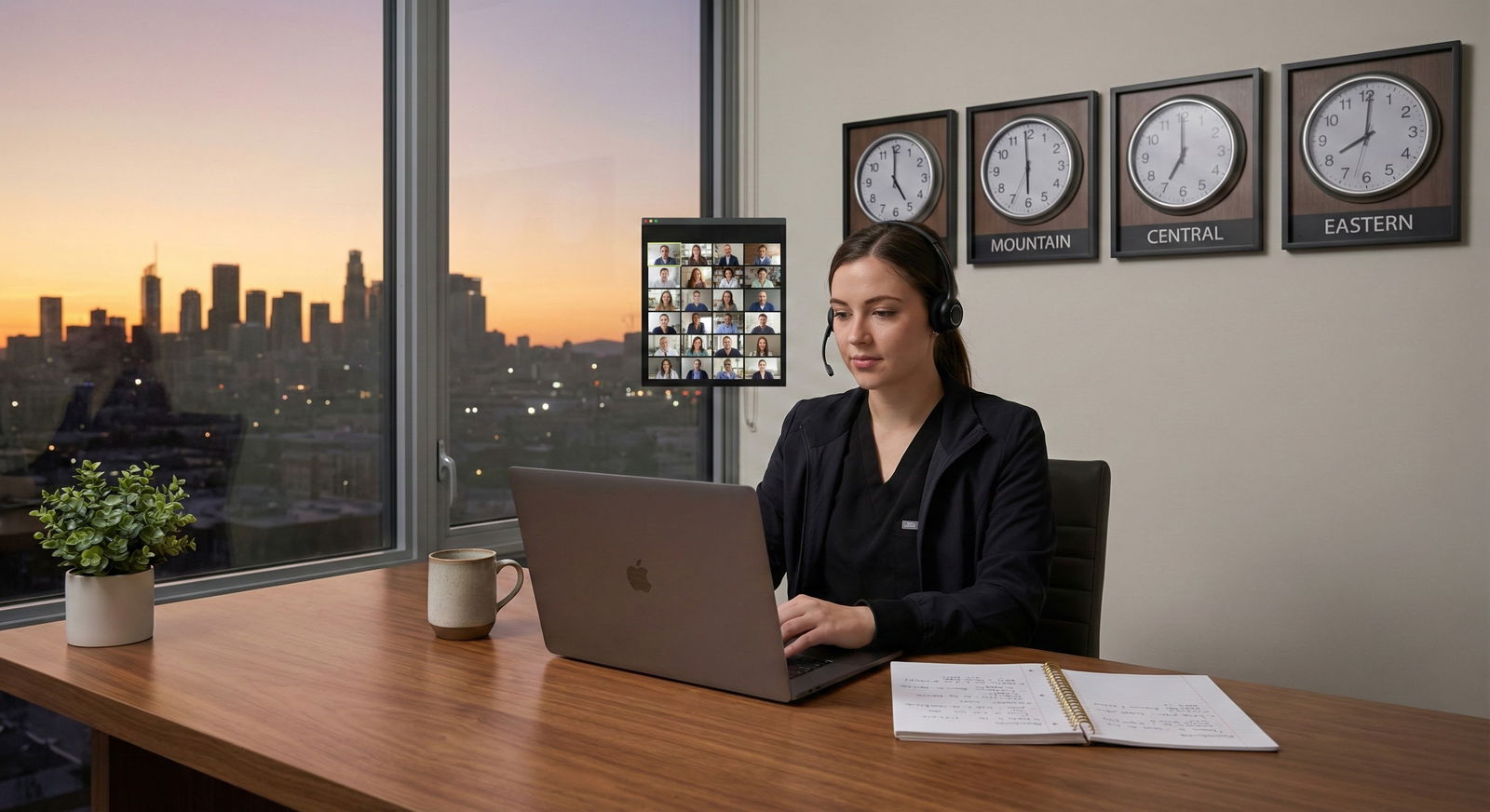
You can’t eliminate all anxiety, but you can absolutely train your system not to collapse when four people stare at you through a webcam.
1. Simulate the panel, not just the question
Most people just do “mock interviews” with one friend or one faculty. That’s only half the problem. The other half is “panel of blank faces.”
Do this instead:
- Get 3–4 classmates on Zoom (they can mute themselves most of the time)
- Ask one person to read questions, others just sit there and watch
- Ask them deliberately to keep “neutral” faces, like real faculty
You’re not just practicing content. You’re immunizing your nervous system to the sight of That Grid of Judgment.
2. Practice freezing on purpose
This sounds stupid, but it works.
Have a friend ask you a question, and then:
- Wait 5–10 seconds on purpose before answering
- Practice your “buy time” line: “Let me think about that for a moment.”
- Then answer, slowly
You’re training your brain that pauses are allowed. That silence does not equal death. If your nervous system learns that, it won’t freak out as hard in the real thing.
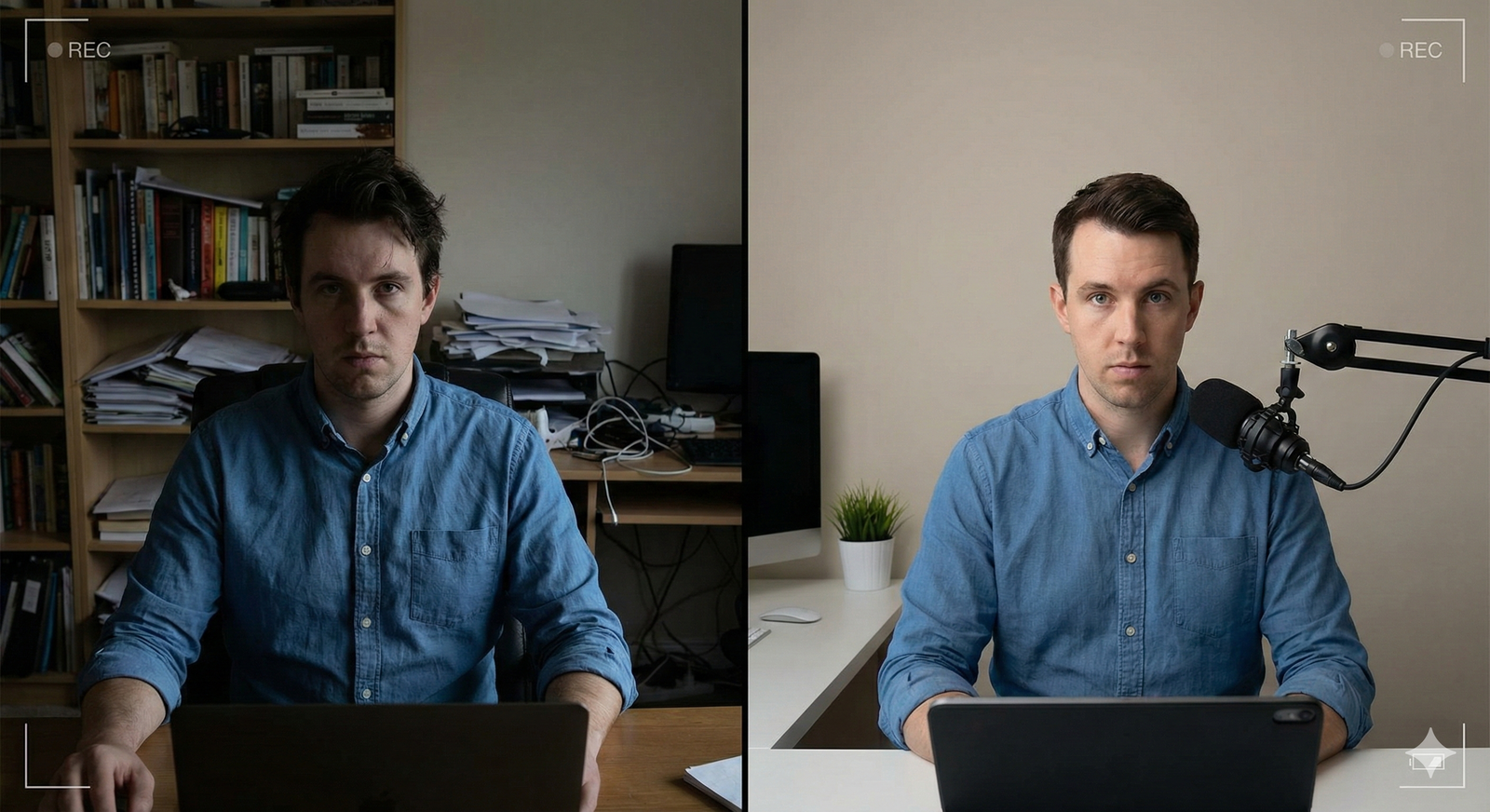
3. Kill the evil mirror (your own face)
Seeing your own anxious micro-expressions is gasoline on the fire. Turn your self-view off.
Almost every platform has “hide self-view” now. If not, drag your own window partially off screen or cover that part of the monitor with a sticky note. I’m serious. People perform way better when they’re not busy thinking, “Why does my mouth look weird when I talk?”
What Interviewers Actually Think When You Freeze
Your catastrophe-brain script:
“They’ll think I’m stupid, unprepared, and not cut out for this specialty.”
Reality: most interviewers are:
- Half-tired
- Half-distracted
- Half-trying not to be awkward themselves
They’re not tracking your every micro-second.
| Situation | Your Interpretation | Their Likely Interpretation |
|---|---|---|
| 3–5 seconds of silence | “I’m choking” | “They’re thinking carefully” |
| You say “Sorry, I lost my train of thought” | “I look unprepared” | “Long season, they’re human” |
| You restart your sentence mid-answer | “I’m incoherent” | “They’re just rephrasing” |
| You look nervous for first few minutes | “They hate me already” | “Yep, normal applicant anxiety” |
| One interviewer looks bored | “They hate me, I’m bombing” | “They have email/notes/OR later” |
I’ve sat in rooms where someone clearly stumbled early, then pulled it together, and what people said later was usually:
- “They seemed a bit nervous at first, but they warmed up.”
- “Content was good once they settled.”
Almost no one goes: “Remember that 6-second pause in question three? Immediate no.”
Full shutdowns do sometimes stick in people’s memories, but again: that’s when it never recovers. If you bounce back, people mostly remember that you were thoughtful and maybe a little anxious. Not catastrophic.
What If I Completely Shut Down Anyway?
Let’s say worst-case happens. You get a question, your brain collapses, and you really cannot get words out for like 20 seconds.
Here’s the emergency move:
Name the moment out loud.
“I’m sorry—my mind just went totally blank for a second. Let me try that again.”Ask them to repeat or reframe the question (if needed).
“Would you mind repeating the last part of that question?”Give a simpler, shorter answer than you planned.
Don’t go for perfect. Go for coherent and honest.
You can even lean slightly into vulnerability without turning it into a therapy session:
- “I’m a little nervous because this program is really high on my list, but what I’d say is…”
If you then give a solid answer, you’ve actually turned a disaster into: “They were nervous, but really care about being here and recovered well.”
Repeated shutdowns in the same interview? That’s trickier. But usually that’s a sign of:
- Dehydration / hypoglycemia
- Not sleeping
- Doing 3–4 interviews in a row and being psychically drained
So yes, the boring self-care stuff matters the week of interviews. Not because “wellness,” but because your brain literally won’t function on fumes.
, Lack of Practice, Baseline Anxiety](https://cdn.residencyadvisor.com/images/articles_svg/chart-factors-contributing-to-interview-meltdowns-2463.svg "Factors Contributing to Interview Meltdowns")
| Category | Value |
|---|---|
| Sleep Deprivation | 30 |
| Over-Scheduling | 20 |
| [Tech Stress](https://residencyadvisor.com/resources/video-interviews-residency/when-to-upgrade-your-tech-for-residency-interviews-on-a-tight-clock) | 15 |
| Lack of Practice | 15 |
| Baseline Anxiety | 20 |
Fixing The “Panel Is Judging Me” Story In Your Head
There’s a mental trick I like for multi-interviewer screens: assign each face a role that serves you.
Instead of: “Four judges evaluating me,” think:
- Attending: “The person who wants to know how I think.”
- Resident: “The person deciding if I’m tolerable on nights.”
- PD/APD: “The person checking if I’ll represent the program well.”
Now your job becomes:
- Show the attending you can think
- Show the resident you’re not a jerk
- Show the PD you can talk to patients like a human
That’s it. Not “don’t mess up.” Just: “Give each of them something reassuring.”
You can even glance mostly at the one who feels safest. If one interviewer is nodding a little more, look at them more. That’ll stabilize you.
Concrete Prep Plan For The Next 2 Weeks
If interviews are coming up and you’re already spiraling about freezing, do this:
Week 1:
- 1–2 mock panel calls with friends / classmates
- Practice “buying time” lines until they feel natural
- Turn off self-view in every casual Zoom/Teams meeting to get used to it
Week 2:
- One high-pressure mock: dress up, real start time, full panel, no breaks
- Ask them to give you at least 2 curveball questions
- After, ask specifically: “Did I seem like I froze at any point?”
You’ll be surprised how much less they noticed than you did.

| Step | Description |
|---|---|
| Step 1 | Today: Identify fear |
| Step 2 | Week 1: Panel mocks |
| Step 3 | Practice buy-time phrases |
| Step 4 | Turn off self-view in calls |
| Step 5 | Week 2: Full mock interview |
| Step 6 | Targeted feedback on freezing |
| Step 7 | Real interview day |
FAQ: “What If I Freeze Up When Multiple Interviewers Stare at Me on Screen?”
1. If I freeze once in an interview, is my chance at that program basically dead?
No. One freeze that you recover from is background noise. Everyone’s seen applicants get flustered and then find their footing. Programs don’t expect robotic TED Talk performances; they expect slightly anxious humans. What hurts you more is staying rattled for the next 30 minutes. The goal isn’t to never freeze; it’s to recover fast and move on.
2. Should I tell them I’m nervous or will that make me look weak?
A tiny, controlled acknowledgment is fine and sometimes helps:
“I’m a little nervous because I’m excited about this program, but…”
Don’t turn it into a monologue about your anxiety. One sentence max, then straight into your answer. That reads as self-aware and honest, not weak.
3. What if I completely blank on a basic question like ‘Tell me about yourself’?
It happens more than you think because your brain overthinks the “easy” ones. If you blank:
“Sure—so I’m originally from [city], did med school at [school], and I’m really drawn to [specialty] because…”
Start with simple facts: where you’re from, where you trained, why this specialty. Once you start, your brain usually unlocks. Don’t try to deliver the “perfect” rehearsed script if it’s not loading—just be clear and straightforward.
4. Is it okay to ask them to repeat or clarify a question if I froze?
Yes, absolutely. You won’t look dumb. You’ll look like you care about answering what they actually asked. Say:
“Sorry, I lost the thread for a second—could you repeat the last part of that question?”
Then give yourself 3 seconds, breathe, and start with one concrete sentence. That looks a lot better than fumbling through a half-relevant answer.
5. How do I stop obsessing about one bad moment after the interview?
You won’t fully stop—that’s just how our brains work—but you can contain it. After the interview, write down:
- The question
- What you said
- What you’d say next time if asked again
Then that’s it. You’ve converted it into a learning rep instead of an endless shame loop. Remind yourself: programs look at the whole file, the whole interview, not one shaky moment. Then move on to prepping for the next one, because that’s where you actually have control.
If you remember nothing else:
- A pause is not a failure. Use it on purpose and call it “thinking,” not “choking.”
- You don’t need perfect answers; you need coherent, honest, recoverable ones.
- One bad moment doesn’t define your whole interview—but how you bounce back from it absolutely can help you.