
The biggest mistake dual-physician couples make is pretending they can each plan backup specialties in isolation. You cannot. Your backup plans either mesh, or one of you gets stranded.
If you and your partner are going through the Match together—especially as a couples match—you’re not just picking “backup specialties.” You’re designing a system of complementary options that protects both of you from worst-case scenarios: no match, geographic separation, being locked into a miserable specialty just because it was the only overlapping option.
Let me walk you through how to build this like adults instead of like two separate applicants who happen to be dating.
Step 1: Get Uncomfortably Clear on Reality First
You cannot design smart backup specialties until you both stare at your actual risk.
Forget vibes. Pull up your real data.
| Factor | Partner A | Partner B |
|---|---|---|
| US/IMG status | ||
| Step 1 (P/F or score) | ||
| Step 2 CK | ||
| Class rank/AOA | ||
| Research output | ||
| Red flags (LOA, remediation, etc.) |
Now, answer these blunt questions together:
- Who is more competitive on paper?
- Is either of you targeting a high-risk specialty? (Derm, plastics, ortho, neurosurg, ENT, urology, ophtho, etc.)
- Are either of you IMGs or DOs targeting historically snobby fields?
- Any red flags: Step failure, remediation, big career change, gap years?
If one of you is swinging for a competitive specialty and the other is reasonably competitive for a wide range of fields, that affects the design. The more competitive partner often has more flexibility to “move” their backup to support the couple strategy.
Be honest: if both of you are borderline for your chosen fields and you’re insisting on a specific city? You’re not planning a backup; you’re planning a fantasy.
Step 2: Decide Your Primary Fields—Like You Mean It
You can’t build complementary backups until your primary targets are locked.
This means:
- You’ve done rotations/sub-Is in those fields
- You’ve got at least one letter from that specialty
- You’ve already started (or finished) a focused personal statement for that field
If you’re still “torn between three things,” you’re not ready to engineer a rational backup structure. One of the worst patterns I’ve seen: couples where both people are “open to like 4–5 specialties.” That’s not flexibility; that’s indecision disguised as strategy. It leads to scattered applications, weak narratives, and poor letters.
So: each of you picks a primary specialty and commits. Then we design around that.
Step 3: Understand How Competitive Your Combo Really Is
Certain primary specialty pairings are naturally safer than others. Others are landmines.
| Pairing | Risk Profile | Notes |
|---|---|---|
| IM + Peds | Low-Medium | Lots of programs, wide geography |
| FM + Any Primary Care | Low | Very flexible, good for couples |
| IM + EM | Medium | EM volatility, but still workable |
| Ortho + Derm | Extreme | Needs aggressive backup design |
| Gen Surg + OB/GYN | High | Both moderately competitive |
| Anesthesia + IM | Medium | Reasonable overlap cities |
If you’re in a high or extreme risk pair—two moderately or very competitive fields—you must take backups seriously from the start of the application season, not in January when interviews are thin.
Step 4: Map Out Your Geography vs Specialty Flexibility
Couples get burned when they try to maximize everything:
- Top specialty choice
- Top-tier program prestige
- Specific city/region
- No backup specialties
You do not get all four. You’re picking maybe two.
Together, decide:
- Which matters more: Same city or best possible specialty fit?
- Are you truly willing to live somewhere rural or mid-sized if it means matching together?
- Are there hard no-go regions for either of you? (Family obligations, visas, safety concerns)
Then, be explicit:
- Tier 1 regions: “We’d actually be happy here”
- Tier 2: “We can do 3–7 years here without hating life”
- Tier 3: “Only if it’s this or being in different states”
This will guide where backups make sense. For example: FM or IM backups are far more powerful if you’re open to midwestern or southern programs that are hungry for couples.
Step 5: Learn Which Specialties Play Nicely Together
Some fields naturally create complementary backup opportunities. Others do not.
For dual-physician partners, good complementary backup structures usually follow one of three templates:
Template A: One stable, one swing
- Partner A: Competitive specialty (e.g., Derm, Ortho, ENT)
- Partner B: Broad specialty with many spots (FM, IM, Peds, Psych)
Here, the couple strategy often is:
- Partner B stays in their primary, focuses on geographic breadth.
- Partner A has a clear backup that’s compatible with B’s field and geographic pattern.
Example:
- A: Ortho primary, backup General Surgery or IM (depending on how late the pivot is)
- B: FM primary, no backup specialty needed, just wide geographic range
Template B: Two mid-competitive specialties + one shared backup family
- Partner A: Anesthesia primary, open to IM as backup
- Partner B: OB/GYN primary, open to IM or FM as backup
Here, both of you quietly build a parallel track in something like IM or FM just enough that if October–November data look bad, you both can pivot into that family.
Template C: Both in the same broad field, different tiers
- Both: IM-based paths (IM, Neuro, EM in some cycles)
- One targets academic or competitive programs, the other is less picky
This is less about “backup specialties” and more about:
- One person being the anchor (widely marketable)
- The other person swinging higher but still in a reasonably safe field
Step 6: Build Actual Backup Specialties, Not Fantasy Ones
“Backup specialty” does not mean “I’ll just apply to IM in January if ortho doesn’t invite me.” That’s not a backup; that’s a Hail Mary with no letters, no narrative, and no credibility.
If you’re serious about backups, here’s what that actually looks like:
- You schedule at least a short rotation or elective in the backup field.
- You obtain at least one letter from that specialty by late summer or early fall.
- You draft a backup personal statement. Even if it’s rough.
- You quietly identify 15–30 realistic programs in that backup field where:
- Your stats are in range
- Programs are in regions that overlap reasonably well with your partner’s plan
This has to be done early—July to September—not when ERAS is already in motion and interviews are half sent.
Step 7: Synchronize Backup Specialties So You Don’t Break the Couple
You can’t plan backups like two solo free agents. You’re designing an ecosystem.
Here’s the key question: If one of you needs to pivot to your backup, what happens to the other?
Let’s work through some specific scenarios.
Scenario 1: One ultra-competitive, one broad
- Partner A: Derm primary, IM backup
- Partner B: IM primary
How to design this:
- Both of you apply IM from day 1, but:
- A emphasizes derm on all derm applications, IM appears as “I enjoy medicine broadly and want strong internship training.”
- B applies IM only.
- Couple match lists:
- Rank Derm+IM combos highly in cities you both like.
- Also rank IM+IM in those same cities and “second-tier” cities.
- If A’s derm interview season looks bleak (e.g., 0–1 interviews by mid-November), you fully pivot to IM without scrambling for letters or a sudden new story.
Your backup specialties are now perfectly complementary. Worst case, you’re an IM + IM couple in the same or neighboring programs. That’s a solid life.
Scenario 2: Two moderately competitive fields
- Partner A: Anesthesia primary, IM backup
- Partner B: OB/GYN primary, FM backup
Here’s a rational structure:
- A:
- Early anesthesia rotations and letters.
- One medicine sub-I and at least one IM letter.
- B:
- Sub-I in OB/GYN, strong letters.
- FM elective and one FM letter.
- Match strategy:
- Apply primary specialties heavily but also:
- A sends a quiet IM application to a limited but realistic list.
- B does the same for FM.
- Rank lists include:
- Anes + OB/GYN combos first where possible.
- Then Anes + FM or IM + OB/GYN combos.
- Then IM + FM as the “floor” scenario.
- Apply primary specialties heavily but also:
You’ve created multiple safety nets instead of a single brittle plan.
Step 8: Use Data as the Trigger, Not Panic
You shouldn’t pivot specialties based on a bad day or a rumor. You pivot based on numbers.
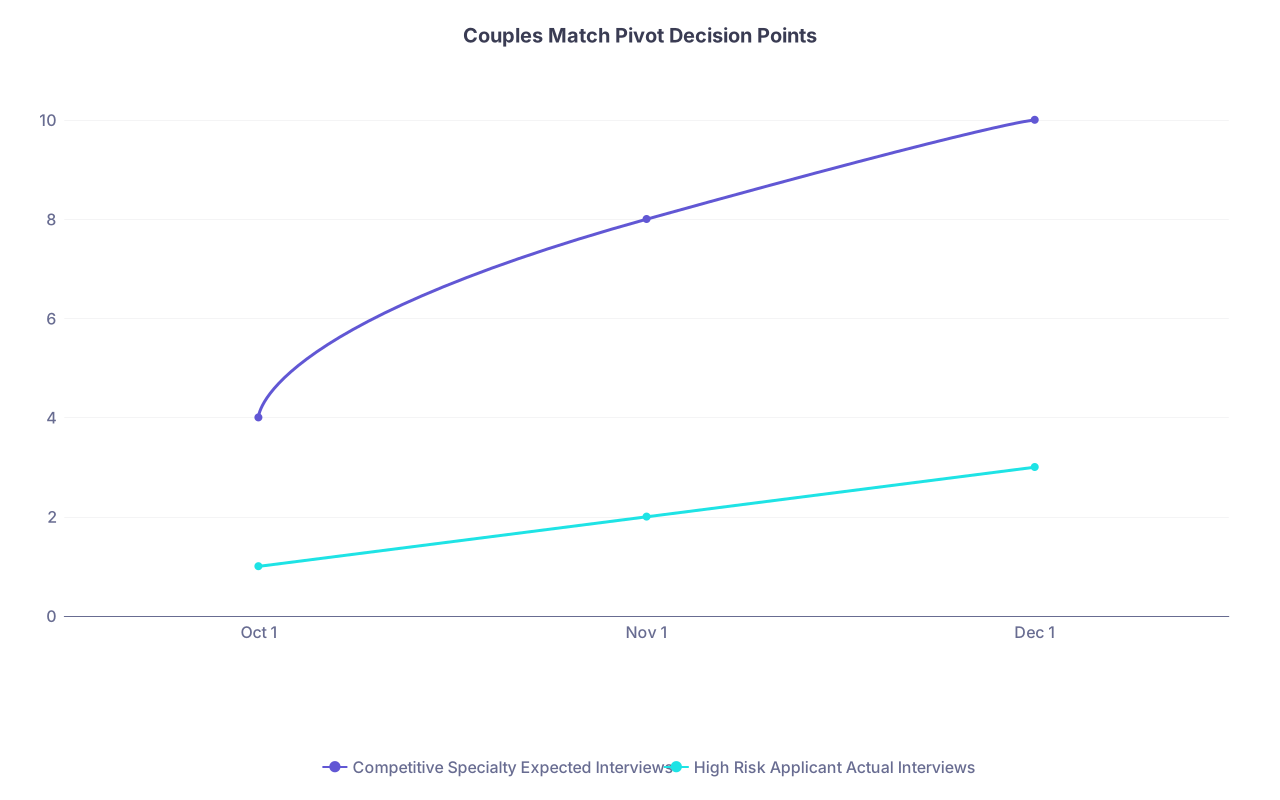
| Category | Competitive Specialty Expected Interviews | High Risk Applicant Actual Interviews |
|---|---|---|
| Oct 1 | 4 | 1 |
| Nov 1 | 8 | 2 |
| Dec 1 | 10 | 3 |
If by late October/early November:
- You’re in a competitive field
- Your interview count is significantly below what similar applicants are reporting (talk to upperclassmen, mentors, PDs—not Reddit alone)
- Your home and away programs are silent or lukewarm
…that’s when your pre-built backup track becomes very real. You can send that second wave of applications to your backup specialty, using the letters and PS you already banked.
For dual-physician partners, you decide in advance:
- “If X happens for one of us by Y date, we both pull the backup lever in this way.”
For example:
- “If A (ortho) has fewer than 3 ortho interviews by Nov 5, A leans fully into IM backup; B will expand their IM list by 20 programs in overlapping regions to maximize couples options.”
Write that down. Literally. On a shared Google Doc.
Step 9: Don’t Accidentally Torch Your Future
Bad backup design can lock one of you into a field you barely tolerate, in a place you actively dislike, with very little path back to what you actually wanted.
Guardrails:
- Neither of you picks a backup you’d hate practicing for 30 years. Mild disappointment is fine; dread is not.
- Know which fields allow subspecialty escape hatches:
- IM → cards, GI, heme/onc, etc.
- Peds → NICU, PICU, subspecialties.
- FM → sports, OB-heavy practice, addiction, etc.
- Be cautious about:
- EM right now, depending on year and market saturation.
- Fields with unstable job markets as your “safety net.”
If one of you is clearly compromising more for the couple plan (for example, giving up a dream field to make geography work), talk explicitly about how the other person will “pay that back” in future decisions: fellowship choice, job location, schedule flexibility.
This is a relationship issue, not just a career one.
Step 10: Communicate With Honesty, Not Performance
I’ve watched couples implode over the Match because they treated it like a performance review of the relationship. “If you really loved me, you’d…”.
Do this instead:
- Schedule specific “Match planning” conversations—don’t let every dinner turn into strategy war rooms.
- In those meetings:
- Each person names their real priorities in order: specialty, geography, prestige, lifestyle.
- Each person names one non-negotiable and one “I really care, but I can bend.”
- Then you design backup specialties and couples lists to respect both sets of priorities as much as the system allows.
You’re not trying to win. You’re trying to avoid mutually-assured destruction.
A Concrete Example: How to Build a Complementary Backup Plan
Let’s build one out so you can see it in action.
Couple:
- Partner A: US MD, Step 2 250, AOA. Wants Dermatology.
- Partner B: US MD, Step 2 238, solid but not stellar. Likes IM and Peds, prefers IM.
Goals:
- Same city if possible
- A would be miserable in FM, open to IM
- B is pretty flexible specialty-wise, but wants at least some inpatient medicine
Rational design:
Partner A:
- Primary: Dermatology
- Backup: IM
- Actions:
- Do derm away, derm letters x3.
- Also do an IM sub-I, get at least 1 strong IM letter.
- Draft:
- Derm PS focused on academic derm.
- IM PS framed as: “I love complex medical patients; whether in derm or IM, I want broad internal medicine grounding.”
- Submit:
- Derm applications broadly (including mid-tier and community-affiliated).
- IM applications to 30–40 programs in cities overlapping with B’s IM targets, but keep derm as main narrative in early season.
Partner B:
- Primary: IM
- No separate backup needed; IM is solid.
Couples strategy:
- Rank list:
- Top: Derm+IM combos in cities/regions they like.
- Next: IM+IM combos at same or affiliated hospitals.
- Floor: IM+IM in mid-tier cities that are “fine but not ideal.”
If derm interviews tank for A, they already have full IM materials ready and can send a second wave to more IM programs, especially in B’s geographic target zones. Backup specialties now aligned. Nobody is left on an island.
Visual: How Decisions Link Together

| Step | Description |
|---|---|
| Step 1 | Define primary specialty each |
| Step 2 | Assess competitiveness and risk |
| Step 3 | Focus on geography and program tiers |
| Step 4 | Select realistic backup options |
| Step 5 | Secure rotations and letters in backups |
| Step 6 | Prepare backup personal statements |
| Step 7 | Apply broadly with couples match |
| Step 8 | Stay primary course |
| Step 9 | Activate backup application wave |
| Step 10 | Rebuild couples rank list with backups |
| Step 11 | High risk for either? |
| Step 12 | Interview counts low by Nov? |
FAQs
1. Do we both need backup specialties, or is it enough if just one of us has one?
No, it’s not enough “if one of us is safe.” Ideally both of you have some backup thinking, even if only one has a formal secondary specialty. At minimum, the “safer” partner should have geographic flexibility built in and a clear willingness to prioritize locations where the riskier partner’s backup specialty has programs.
2. Will programs judge me for applying in two specialties while couples matching?
Some will notice; most will not care as long as your materials for each specialty are coherent and professional. What gets you judged is sloppiness: one-size-fits-all personal statements, letters that obviously aren’t for that field, applications sent in January with no story. If your backup track looks intentional and sincere, you’re fine.
3. Can we couples match across different specialties and still be competitive?
Yes. Happens all the time: IM + Peds, IM + Anesthesia, FM + Psych, etc. The key is geographic and program list coordination. The more common and less competitive the fields, the easier it is. Two hyper-competitive fields in the same year, same couple? Then your backup design becomes critical.
4. When is it too late to add a backup specialty?
If it’s December and you have zero letters, no rotations, and no personal statement for that backup field, you’re not adding a real backup; you’re just flailing. Realistically, the backup plan needs to be conceptually designed by July–August, with at least one rotation and letter completed by early fall. Pivot decisions should usually happen by early–mid November.
5. How do we handle it if one of us clearly has to compromise more?
You say it out loud and treat it like a joint decision, not silent martyrdom. Acknowledge explicitly who’s bending more (specialty, geography, program tier), and write down how you’ll re-balance later—maybe in fellowship choice, job search flexibility, or location after training. Couples who talk through that trade honestly tend to survive the Match. The ones who pretend it’s all equal usually don’t.
Key takeaways:
- Backup specialties for dual-physician couples must be coordinated, not individual.
- Real backups require early rotations, letters, and a coherent story—panic applications don’t work.
- Decide your triggers (dates, interview counts) in advance, then execute the plan like professionals, not like two people guessing their way through crisis.